Missed transmission days and fragmented cardiac data quickly turn into denied 99454 claims and lost revenue. A heart failure patient whose scale transmits only 15 days will not qualify, and CIED and RPM data scattered across portals often invite audits. Billing CPT 99454 for fewer than 16 days of device usage in a 30-day period, submitting multiple claims for different devices for the same patient, or using non-FDA-approved devices or manually uploaded data triggers denials.
Clean 99454 billing creates a reliable revenue stream that equals 1 to 2 hours of billable time per patient each month. Cardiology practices that standardize compliant RPM workflows see faster cash flow and fewer administrative bottlenecks.
Confirm these prerequisites before you start billing CPT 99454.
CPT 99454 in 2026 requires 16 to 30 days of data transmissions in a 30-day period with $48.79 reimbursement. The rolling 30-day cycle means billing periods follow device start dates rather than calendar months.
Run this checklist before you enroll a patient in RPM and submit 99454.
Cardiology example: A heart failure patient with I50.9 uses a Bluetooth-enabled scale and also receives CIED monitoring. Each device type needs its own documentation trail, even though you submit a single 99454 claim.
Automatic data upload from the device forms the foundation of compliant 99454 billing. CMS requires automatic transmission from FDA-approved devices, and manual entries do not count as data and lead to denials. Track transmission days closely, because 15 days of data in a 30-day cycle results in a rejected claim.
Rhythm360 advantage: AI-driven tracking maintains more than 99.9% transmission reliability and consolidates OEM, CIED, and RPM data streams into a single dashboard.
Build detailed EHR documentation that clearly supports every billed 99454 period.
Vague or incomplete notes often trigger payer audits and denials. Insufficient documentation and failure to meet transmission day requirements are common denial reasons.
Rhythm360 solution: Bi-directional EHR integration auto-generates compliant documentation and reduces manual entry errors.
Use the GT modifier for telehealth-related RPM services when required by the payer. Primary cardiology RPM diagnosis codes often include I50.x for heart failure and I10 for hypertension. CPT 99445 covers 2 to 15 days at about $47 reimbursement and is billable once every 30 days per patient.
Code | Days | 2026 Medicare Rate | Notes |
99454 | 16+ | ~$48-52 | Once per 30 days |
99445 | 2-15 | ~$48-52 | New 2026 code |
Bill CPT 99454 once per 30-day cycle per patient and follow incident-to guidelines when they apply. Medicare and most commercial payers use similar RPM structures, although prior authorization rules and local coverage policies can differ.
Rhythm360 case study: Cardiology clinics using Rhythm360 report higher claim approval rates and up to 300% revenue growth through automated compliance tracking and consistent 99454 workflows.
Review remittance data regularly, identify denial patterns, and submit appeals with strong clinical documentation when needed. Tracking denial patterns reveals systemic issues and helps align RPM billing cycles to reduce complexity.
Pro tip: Rhythm360’s dashboard flags potential billing issues before submission, which prevents denials and shortens revenue cycles.
Schedule a Rhythm360 demo to automate 99454 compliance and remove manual billing work.
Rhythm360’s cloud platform tracks 16-day compliance automatically, generates EHR-ready documentation, and merges CIED, OEM, and RPM data into one view. The AI engine maintains more than 99.9% transmission reliability and cuts administrative workload by up to 80%.
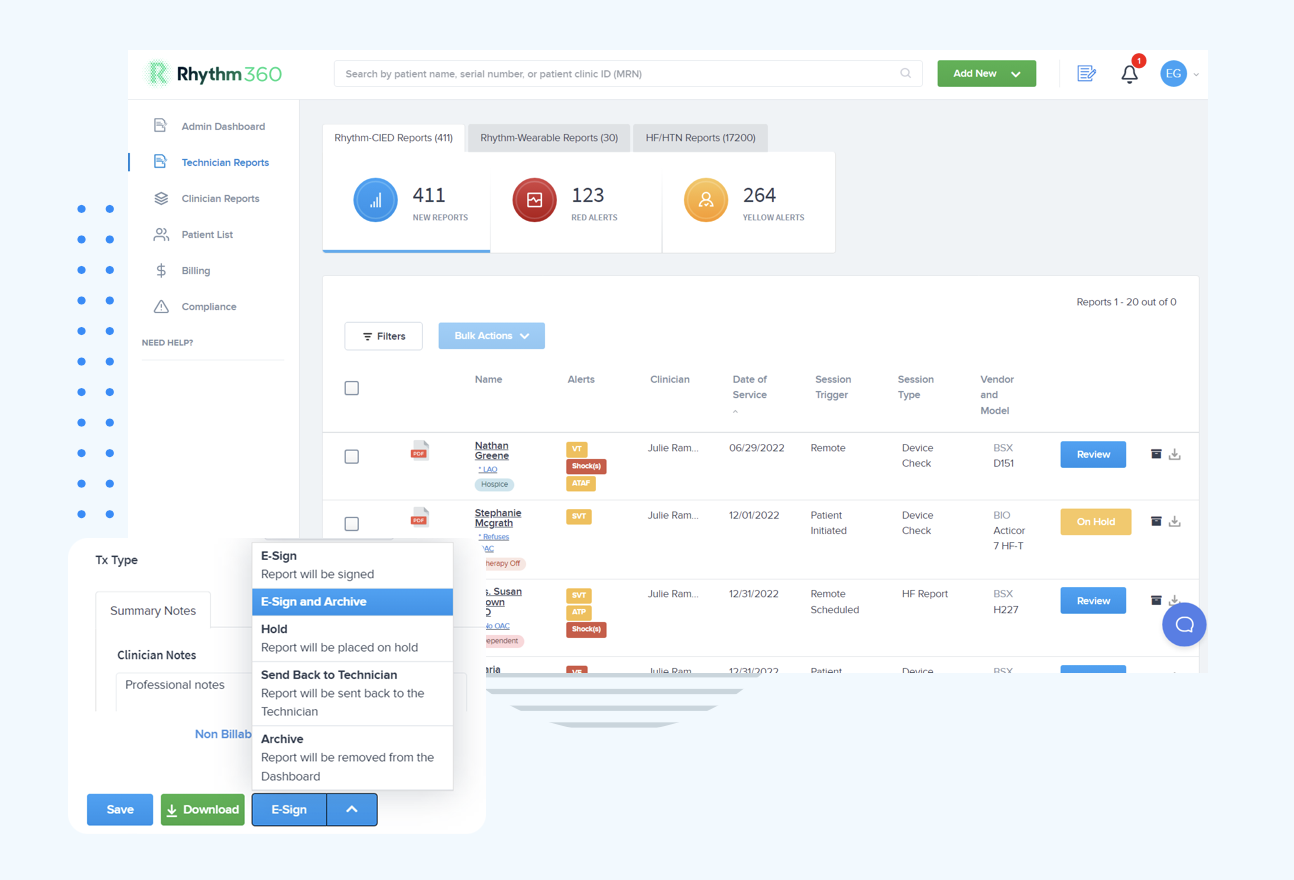
Key features that support accurate 99454 billing include:
Schedule a demo today to remove 99454 billing friction and increase RPM revenue by up to 300%.
Use this quick reference table to avoid frequent 99454 errors that cause denials.
Pitfall | Fix | Example |
Less than 16 days | Bill 99445 or extend monitoring | HF scale with 15 days results in denial |
Manual data entry | Use automatic transmission only | Manual CIED alert entry does not qualify |
Duplicate billing | Submit one claim per 30 days | Multiple devices allowed, single 99454 claim |
Poor documentation | Capture detailed EHR evidence | Rhythm360 auto-generates compliant notes |
Missing consent | Store signed authorization | Obtain forms before starting RPM |
Rhythm360 prevention: Pre-bill compliance checks highlight missing days, consent, or documentation before you send claims, which supports consistently high approval rates.
CPT 99445 allows billing for 2 to 15 days of readings at about $47 reimbursement, while CPT 99454 covers 16 or more days. Providers must choose either CPT 99445 or 99454 based on transmission days and cannot bill both for the same patient in the same month.
CCM and RPM can be billed together in the same month when services are distinct and documented separately without counting the same minute twice. Cardiology example: Bill 99454 for device supply and monitoring plus CCM 99490 for heart failure patients with CIED monitoring, while documenting separate time for each service.
CMS 2026 Physician Fee Schedule Final Rule confirms RPM code restructuring and reimbursement levels.
Strong 99454 programs deliver predictable revenue and measurable operational gains.
Rhythm360’s dashboard tracks billable events, transmission compliance, and revenue opportunities in real time. Advanced cardiology groups use these insights to expand CIED monitoring and RPM for comprehensive cardiac care management.
The 16-day rule requires patients to transmit physiological data automatically for at least 16 days within a 30-day billing period to qualify for CPT 99454. When patients transmit data on fewer than 16 days, use the new CPT 99445 code for 2 to 15 days of data transmission.
CPT 99445 is the primary new RPM code for 2026 and covers device supply with 2 to 15 days of data transmission at about $47 to $52 reimbursement. CPT 99454 remains in place for 16 or more days of transmission. These two codes cannot be billed together for the same patient in the same 30-day period.
Yes, CCM and RPM codes can be billed in the same month when they represent separate time and activities. For example, you can bill 20 minutes of distinct RPM management with 99457 plus 22 minutes of distinct CCM work with 99490 for the same patient, as long as you do not count any minute twice.
CPT 99454 reimbursement ranges from about $47 to $52 nationally under Medicare, with modest regional variation. The rate increases slightly in 2026 because of conversion factor changes and aligns with the payment level for the new CPT 99445 code.
Bill CPT 99454 once per 30-day period per patient using only automatic transmission data from FDA-approved devices. Include the GT modifier for telehealth when required, use appropriate diagnosis codes such as I50.x for heart failure, and maintain comprehensive EHR documentation of device setup, transmission review, and clinical interventions.
Consistent CPT 99454 billing depends on strict adherence to the 16-day transmission rule, use of FDA-cleared devices, and clear documentation. Follow the six-step workflow and avoid pitfalls such as manual data entry, duplicate claims, and missing consent.
Rhythm360 automates compliance tracking, produces audit-ready documentation, and unifies cardiac device data for smooth 99454 billing. Practices that adopt the platform report higher claim approval rates and up to 300% revenue growth from scalable RPM programs.
Schedule a demo to transform your cardiology RPM revenue and remove 99454 billing headaches permanently.