Implantable cardiovascular physiologic monitors, most notably the CardioMEMS pulmonary artery pressure sensor, generate continuous hemodynamic data that must be reviewed, analyzed, and reported within a 30-day billing period. CPT 93297 is the mechanism cardiology practices use to capture reimbursement for that clinical work. Each 30-day period functions as a discrete billing window, and a missed window becomes permanently lost revenue.
The financial stakes are material. CIED remote-monitoring codes 93294–93299 received RVU increases in 2026, which makes accurate capture more valuable than in prior years. Practices managing even a modest CardioMEMS population that routinely miss billing cycles or submit claims with incorrect modifiers can forfeit tens of thousands of dollars annually. Fragmented OEM portal workflows remain the primary operational driver of those losses.
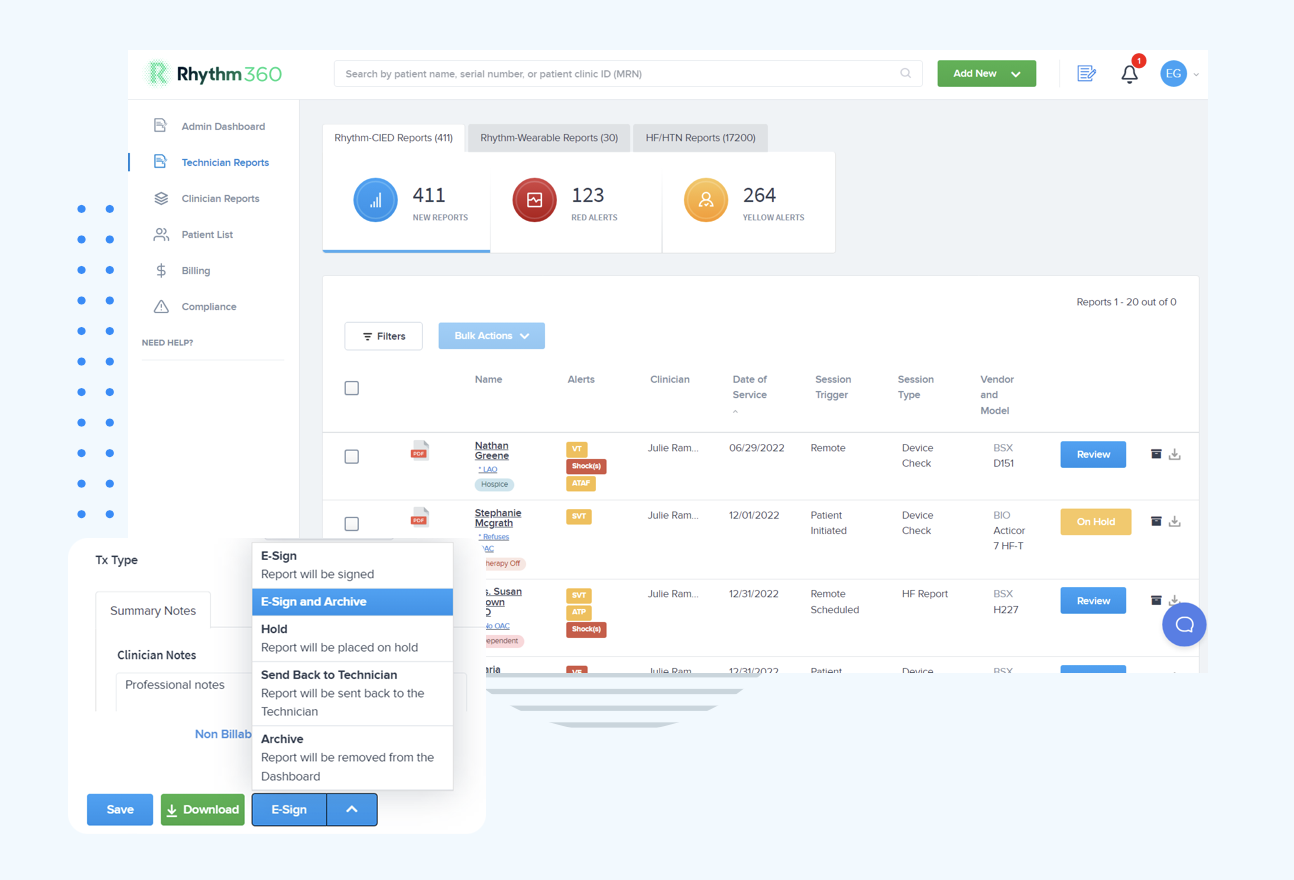
Rhythm360 consolidates data from all device manufacturers into a single, vendor-neutral platform that automates documentation, tracks 30-day billing windows, and generates audit-ready reports, which helps practices capture up to 300% more revenue from remote monitoring codes.
See how Rhythm360 closes your revenue gap in a live demo of the platform.
CPT 93297 describes remote interrogation device evaluation, up to 30 days, of an implantable cardiovascular physiologic monitor system. It includes analysis of one or more recorded physiologic cardiovascular data elements from all internal and external sensors, along with analysis, review, and report by a physician or other qualified health care professional.
The code applies specifically to implantable cardiovascular physiologic monitors, which measure hemodynamic parameters such as pulmonary artery pressure rather than cardiac rhythm. The CardioMEMS HF System is the most widely implanted device in this category. Common clinical scenarios include:
CPT 93297 is distinct from rhythm-monitoring codes and from subcutaneous cardiac rhythm monitor codes. The device type, physiologic monitor versus rhythm monitor, determines which code applies.
CPT 93297 is billable once per 30-day period per patient. The code is tied to implantable cardiovascular physiologic monitors and a defined 30-day interrogation window.
A calendar example clarifies the rule. If a patient’s 30-day window opens on June 1, the earliest the next billable period begins is July 1. A report signed on June 28 closes the June window, and the July window still opens July 1 regardless of when the June report was finalized. Billing two claims within the same 30-day window for the same patient will result in denial.
Common pitfalls that cause frequency-related denials include:
CPT 93297 has a professional and technical component split. Modifier 26 is appended when billing only the professional component, which covers the physician’s or qualified health care professional’s analysis, interpretation, and written report. Modifier TC is appended when billing only the technical component, which covers data acquisition equipment, transmission infrastructure, and technical support.
Premera Blue Cross policy CP.PP.151.v2.9 (last approval 05/12/26) states that modifiers 26 and TC are recognized only when the CMS National Physician Fee Schedule assigns the procedure code a PC/TC indicator of 1 or 6. Claims that append these modifiers to codes without an eligible indicator will be denied.
| Modifier | Component Billed | Medicare National Average | Work RVUs |
|---|---|---|---|
| None (global) | Professional + Technical | Varies by locality and setting | 0.51 |
| 26 | Professional only | Varies by locality and setting | 0.51 |
| TC | Technical only | Varies by locality and setting | 0.00 |
Payer variation is significant. Premera’s policy notes that PC/TC indicators are updated quarterly and must be referenced using the quarter corresponding to the date of service. Verify each payer’s current indicator before submitting split-component claims.
The distinction between 93297 and 93298 turns on device type. UnitedHealthcare’s 2026 policy 2026T0489JJ defines CPT 93298 as: Interrogation device evaluation(s), (remote) up to 30 days; subcutaneous cardiac rhythm monitor system, including analysis of recorded heart rhythm data, analysis, review(s) and report(s) by a physician or other qualified health care professional.
| Attribute | CPT 93297 | CPT 93298 |
|---|---|---|
| Device type | Implantable cardiovascular physiologic monitor | Subcutaneous cardiac rhythm monitor |
| Data analyzed | Physiologic cardiovascular data elements (for example, pressure, fluid) | Recorded heart rhythm data |
| Example device | CardioMEMS HF System | Implantable loop recorder (for example, Medtronic Reveal LINQ) |
| Billing period | Up to 30 days | Up to 30 days |
Submitting 93298 for a CardioMEMS patient, or 93297 for a loop recorder patient, constitutes an incorrect code assignment and will generate a denial or, in audit scenarios, a recoupment demand.
| Code / Modifier | Component | Medicare National Average | Total Office RVUs |
|---|---|---|---|
| 93297 (global) | Professional + Technical | Varies by locality and setting | Varies |
| 93297-26 | Professional only | Varies by locality and setting | Varies |
| 93297-TC | Technical only | Varies by locality and setting | Varies |
As noted earlier, the 2026 RVU increases make this billing category more financially significant than in prior years. Practices should verify rates against the CMS Physician Fee Schedule for their geographic locality, because national averages vary by Medicare Administrative Contractor region.
UnitedHealthcare’s 2026 policy 2026T0489JJ states that medical records documentation may be required to assess whether a member meets clinical criteria for coverage of services billed under CPT 93297. Required documentation elements for a compliant 93297 claim include:
Common denial scenarios include submitting a claim before the physician report is signed, failing to document the specific physiologic data elements reviewed, using 93297 for a device that is a subcutaneous rhythm monitor (correct code: 93298), and appending modifier 26 or TC without confirming the payer’s PC/TC indicator for the date of service.
Denial prevention for CPT 93297 is primarily an operational problem because most denials stem from workflow breakdowns rather than clinical judgment errors. Missed tracking deadlines, unsigned reports, and incorrect modifier application create preventable gaps in otherwise appropriate care. The following checklist addresses the most common failure points that create these operational gaps:
| Checklist Item | Risk if Missed |
|---|---|
| Confirm device type matches 93297 (physiologic monitor, not rhythm monitor) | Wrong-code denial; potential audit flag |
| Track 30-day window open and close dates per patient in a centralized system | Missed billing period; permanent revenue loss |
| Verify payer PC/TC indicator before appending modifier 26 or TC | Modifier-related denial per Premera policy CP.PP.151.v2.9 |
| Confirm physician or QHP signature on report before claim submission | Unsigned-report denial; duplicate-claim risk on resubmission |
| Document all sensor data elements reviewed in the report narrative | Medical necessity denial on audit |
| Cross-reference payer policy for coverage criteria before billing | Non-covered-service denial |
A cardiology practice managing numerous CardioMEMS patients that misses billing cycles can forfeit substantial Medicare reimbursement annually, even before accounting for commercial payer rates, which are typically higher.
See how automated tracking eliminates denial triggers across your entire patient population.
The core operational problem for practices billing 93297 is data fragmentation. When CardioMEMS data lives in one portal and CIED data from other manufacturers lives in separate portals, staff must manually track billing windows, retrieve reports, and reconcile documentation across systems. This manual process introduces errors and missed deadlines at scale.
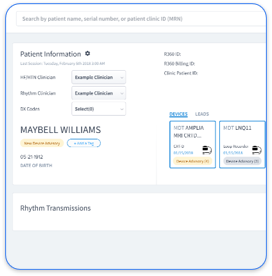
Rhythm360 addresses this directly by eliminating the need to log into multiple portals. The platform ingests and normalizes data from all major device manufacturers, including Boston Scientific, Medtronic, Abbott, and Biotronik, into a single, vendor-neutral dashboard so staff see all patients in one view. For 93297 specifically, this consolidation enables automated capture of physiologic monitor transmissions and generation of compliant reports with the required data elements.
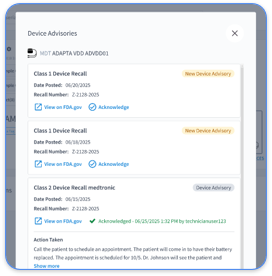
Because the platform tracks each patient’s 30-day billing window in that same unified view, it can flag periods approaching closure without a signed report. This alerting prevents the silent revenue loss that occurs when a deadline is buried in a separate OEM portal.
The platform’s AI-powered data reliability infrastructure achieves greater than 99.9% transmissibility through redundant data feeds and computer vision-based PDF parsing, which ensures that a failed OEM server transmission does not silently create a gap in the billing record. Bi-directional EHR integration with Epic, Cerner, Athenahealth, and others sends the signed report directly into the patient record without manual transcription.
Practices implementing Rhythm360 have achieved these revenue gains by eliminating missed billing windows, reducing claim denials, and adding new RPM service lines for heart failure and hypertension management.
CPT 93297 does not require a modifier when a single entity performs both the professional and technical components of the service. Modifier 26 is appended only when billing the professional component separately, typically when a physician interprets data acquired by a separate technical entity. Modifier TC is appended only when billing the technical component separately. Appending either modifier incorrectly, or to a code whose payer does not recognize a PC/TC split for that code, will result in a denial. Always verify the payer’s current PC/TC indicator for the date of service before submitting a split-component claim.
Billing both codes in the same 30-day period is appropriate only when the patient has two distinct implanted devices, one implantable cardiovascular physiologic monitor and one subcutaneous cardiac rhythm monitor, and both were remotely interrogated during that period. Billing both codes for a single device, or for a device that falls under only one category, constitutes incorrect coding. Documentation must clearly identify each device by type and confirm that separate data analysis and reports were completed for each.
The billing opportunity for that period is permanently forfeited. Medicare and commercial payers do not allow retroactive billing for a closed 30-day window. This scenario represents the most common and most costly revenue leak in CardioMEMS monitoring programs. Practices without automated window-tracking systems frequently discover missed periods only during retrospective billing audits, at which point the revenue cannot be recovered. Implementing a platform that proactively flags approaching window closures is the most effective mitigation strategy.
Rhythm360 automates the generation of reports that include the required elements for a compliant 93297 claim, including device type confirmation, the 30-day monitoring period dates, documentation of physiologic data elements received from all sensors, and a structured report ready for physician or qualified health care professional signature. The platform tracks each patient’s billing window in real time and alerts staff before a period closes without a completed, signed report. All documentation is stored with a full audit trail, which supports both internal compliance reviews and external payer audits.
CPT 93297 is a high-value, recurring revenue code for cardiology practices managing implantable cardiovascular physiologic monitors. With the recent RVU increases making this code more valuable, accurate billing is now more financially significant than in prior years. The rules governing frequency, modifier use, device-type specificity, and documentation are well-defined, yet fragmented workflows make consistent compliance difficult at scale.
Practices that standardize on a vendor-neutral platform with automated window tracking, compliant report generation, and integrated billing documentation eliminate the primary operational drivers of 93297 denials and missed revenue. Rhythm360 is built specifically for this environment, consolidating all cardiac device data into a single auditable system that supports both clinical care and billing compliance.
Learn how to protect your 93297 revenue and streamline remote physiologic monitoring compliance in 2026 and beyond.