Last updated: September 23, 2026
Talk With Rhythm360 About Automating RPM Day Counts
CPT 99454 under the CY2026 Physician Fee Schedule follows a clear set of rules.
These requirements appear consistently in CMS MLN901705, the CY2026 Physician Fee Schedule final rule published in the Federal Register on November 5, 2025, and Noridian's 2026 RPM/E&M update. For a deeper review of Medicare eligibility and coverage rules, see the Rhythm360 articles on CPT 99454 Billing Guidelines for Remote Patient Monitoring and CPT 99454 Medicare Billing Rules for Remote Monitoring.
Most CPT 99454 denials trace back to miscounted qualifying days. Apply these rules consistently.
This example uses a connected blood pressure cuff to show how two extra transmission days change the billable code. The monitoring period opens September 1, 2026, and closes September 30, 2026. The 30-day window runs from the date monitoring begins, not the calendar month boundary. The table below tracks two patients through the same period to show how a two-day difference in transmissions changes the billable code.
| Day | Patient A (Transmitted?) | Patient B (Transmitted?) |
|---|---|---|
| 1 | Yes | Yes |
| 2 | Yes | Yes |
| 3 | No | No |
| 4 | Yes | Yes |
| 5 | Yes | Yes |
| 6 | Yes | No |
| 7 | No | No |
| 8 | Yes | Yes |
| 9 | Yes | Yes |
| 10 | Yes | Yes |
| 11 | No | No |
| 12 | Yes | Yes |
| 13 | Yes | Yes |
| 14 | Yes | No |
| 15 | No | No |
| 16 | Yes | No |
| 17 | Yes | No |
| 18 | No | No |
| 19 | Yes | No |
| 20 | No | No |
| 21–30 | No further transmissions | No further transmissions |
Patient A: 16 qualifying days → bill CPT 99454.
Patient B: 14 qualifying days → bill CPT 99445.
The days do not need to be consecutive. The requirement is 16 or more days of transmitted readings within a 30-day period, counted by qualifying calendar day rather than by a consecutive run.
That two-patient example reflects a broader rule: the final qualifying day count always drives the code choice. The day-count bands below cover every possible outcome.
Once the period closes and the qualifying days are counted, the count itself determines which device-supply code applies. The table below maps each day-count band to its code and billability.
| Days of Monitoring in the 30-Day Period | Device-Supply Code | Billable |
|---|---|---|
| 0–1 days | None | No device-supply code billable |
| 2–15 days | CPT 99445 | Yes, 2026 short-duration code |
| 16–30 days | CPT 99454 | Yes, standard device-supply code |
CPT 99454 and CPT 99445 cannot both be billed for the same patient in the same 30-day period, and only one device-supply code is billable per patient per period. CPT 99445 carries the same billing frequency limit as CPT 99454: once per 30-day period, selected on the actual day count in that period.
See How Rhythm360 Selects The Right Code Automatically
The 2026 update restructures the threshold while keeping CPT 99454 in place. CPT 99454 still applies at 16 to 30 days, while the new short-duration code CPT 99445 applies at 2 to 15 days. The practice decides which code to bill at the end of the period based on the actual count. A patient with 18 days one month and 12 the next requires switching codes between cycles.
CMS finalized equal reimbursement for CPT 99454 and CPT 99445 because the practice expense of supplying the device is unchanged regardless of how many days data is transmitted. The code choice is therefore driven by compliance rather than by payment differences.
This section explains how multiple devices feed one day count and one claim. A patient using both a connected blood pressure cuff and a connected scale in the same 30-day period illustrates how aggregation and the once-per-period rule interact. Qualifying days from multiple devices are combined to reach the 16-day threshold, while the practice still submits a single device-supply claim for that period.
Suppose the cuff transmits on days 1–10 and the scale on days 8–20. The overlap on days 8–10 counts once per calendar day, which yields 20 unique qualifying days rather than 23. Issuing a second device does not open a second billable period.
The 16-day minimum applies to device-supply code 99454 and does not apply to RPM management codes 99457 and 99458. A thin data month can still carry management time when the interactive contact and time requirements are met.
A representative billing scenario for a new RPM patient shows how the codes stack.
This checklist reflects requirements confirmed by the First Coast Service Options MAC audit checklist (September 2, 2026) and RCM Staff's 2026 RPM billing guide.
Meeting that documentation standard manually creates a heavy workload for most practices. Rhythm360 was built to close that gap.
Rhythm360 is a cloud-based RPM platform that is vendor-neutral and HIPAA-compliant. It consolidates data from all major CIED manufacturers — Medtronic, Boston Scientific, Abbott, and Biotronik — into a single dashboard.
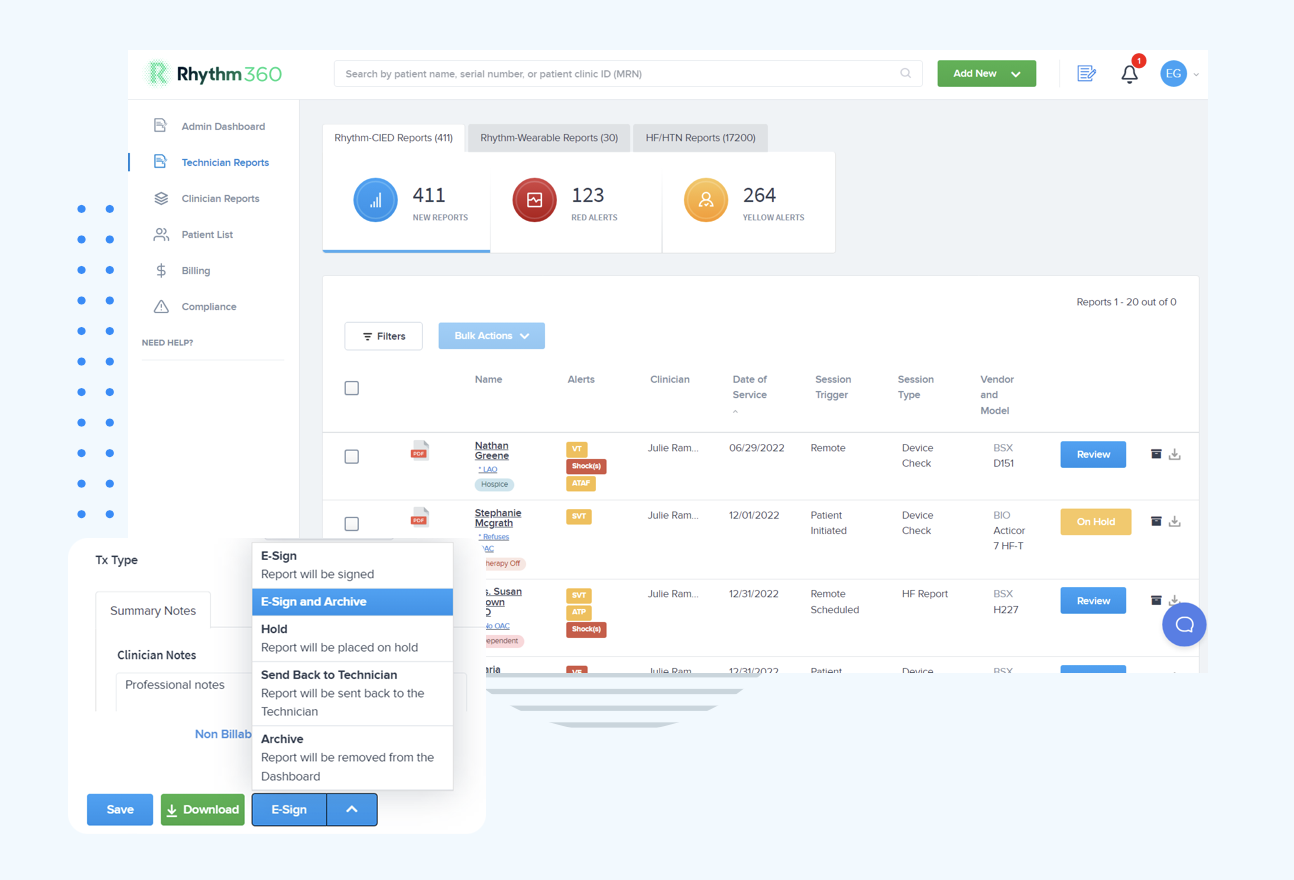
The platform automates data ingestion and report generation and tracks device-specific CPT pairings to prevent device-type mismatch denials and unbilled technical components. Rhythm360 supports the full 2026 RPM code set, including CPT 99453, CPT 99454, CPT 99457, and the 2026 short-duration code CPT 99445. Its automated CPT capture and documentation help practices recover previously lost revenue, with outcomes including up to an 80% reduction in critical alert response times and up to a 300% increase in revenue capture. Other platforms operating in this category include Murj, Implicity, Rhythm Management Group, and Octagos.
Explore Rhythm360 For Automated RPM Billing Support
The 16 qualifying days can occur anywhere within the 30-day period. The count follows qualifying calendar days rather than a consecutive run. A patient who transmits on days 1–8 and then again on days 20–27 of a monitoring period has 16 qualifying days and meets the CPT 99454 threshold.
Qualifying days from multiple devices combine into a single day count, and the practice still submits only one device-supply claim per patient per 30-day period. If a blood pressure cuff transmits on days 1–10 and a connected scale transmits on days 6–20, the unique qualifying calendar days are counted once each, so overlapping days are not double-counted. A single CPT 99454 claim is submitted when the combined unique day count reaches 16 or more.
Bill CPT 99445, the 2026 short-duration device-supply code for 2–15 days. CPT 99454 does not apply in that situation. The two codes are mutually exclusive, and billing 99454 for a period with fewer than 16 qualifying days is one of the most common RPM denial triggers. CPT 99445 reimburses at the same national average rate as CPT 99454, so the code switch does not reduce revenue for that period.
CPT 99445 is billable once per patient per 30-day period, selected on the actual day count in that period, and is mutually exclusive with CPT 99454. The code choice is made at the end of each period based on the final transmission count, regardless of what was billed previously. A patient may require CPT 99454 one month and CPT 99445 the next if their adherence varies.
CPT 99445 and CPT 99470 were added effective January 1, 2026, under the CY2026 Physician Fee Schedule final rule. Existing RPM codes 99453, 99454, 99457, and 99458 remain active and valid; the CY2026 final rule made no changes to them. No RPM device-supply or management codes were deleted in 2026.
The 16-day rule applies only to device-supply code CPT 99454. It does not apply to treatment-management codes CPT 99457 and CPT 99458. Management codes turn on documented minutes and the interactive communication requirement. A month with fewer than 16 qualifying transmission days can still support a CPT 99457 or 99458 claim if the management time and live interaction requirements are independently met and documented.
Rhythm360 produces compliant, audit-ready day counts automatically, so the correct device-supply code is identified at period close without manual reconciliation.
The 16-day rule did not disappear in 2026. It split into two codes: CPT 99454 for 16 or more qualifying days and CPT 99445 for 2–15 qualifying days. The code choice rests on the actual day count in each period and applies independently every cycle, regardless of what was billed the month before. Miscounting qualifying days by including failed syncs, manual entries, or setup-only days remains the leading cause of device-supply claim denials.
Rhythm360 automates the day-count process, applies the correct CPT code at period close, and generates the transmission logs and documentation needed to withstand a MAC medical review. Practices using Rhythm360 bill the right code every period instead of writing off short months or defending miscoded claims.
Get A Rhythm360 Walkthrough And Automate Your RPM Day Counts