CPT 99454 represents the monthly billing code for remote physiologic monitoring device supply and data transmission services. The 2026 Medicare reimbursement rate is approximately $47, which creates a meaningful recurring revenue stream for cardiology practices managing chronic conditions.
Key requirements for CPT 99454 billing include:
CPT 99454 supports cardiology programs that monitor heart failure patients who need daily weight checks, hypertensive patients who require regular blood pressure tracking, and patients with cardiac devices who benefit from continuous physiologic oversight. To qualify for this reimbursement, practices must select FDA-cleared devices that meet the automatic transmission requirement.
FDA-cleared devices eligible for CPT 99454 billing must provide automatic data transmission without manual patient input. The following devices meet these criteria and support specific cardiac applications.
Device | FDA Clearance | Cardiac Use Case | Transmission Method |
Omron Evolv | K181452 | HTN Management | Bluetooth to smartphone |
Withings Body Cardio | K162977 | HF Weight Monitoring | WiFi/Cellular |
Masimo MightySat | K183181 | HF Respiratory Status | Bluetooth |
CardioMEMS HF System | P100045 | HF Pressure Monitoring | RF Transmission |
iHealth Track | K143387 | HTN Monitoring | Bluetooth/WiFi |
QardioArm | K151635 | HTN Management | Bluetooth |
BodyTrace Scale | K172894 | HF Weight Tracking | Cellular |
ResMed Oximetry | K183456 | Sleep Apnea/HF | Bluetooth/Cloud |
These devices support cardiac care by automating data collection for heart failure fluid management, hypertension control, and respiratory monitoring in cardiac patients. The automatic transmission requirement helps practices stay compliant with CPT 99454 billing guidelines and reduces manual work for clinical staff.
Successful CPT 99454 billing depends on precise documentation and timing. Practices must meet the 16-day minimum data collection requirement within each 30-day billing cycle and maintain clear transmission logs for potential audits.
Essential billing requirements follow the same sequence as patient enrollment and monitoring. Documented physician orders establish medical necessity for RPM services. Patient consent for remote monitoring comes next and confirms that patients understand and accept the program.
After consent, staff must document device setup and patient education to show that patients can use the equipment correctly. During the billing period, transmission logs must confirm at least 16 days of successful data collection. Clinical review and interpretation of the collected data then complete the cycle by demonstrating that clinicians used the information to guide care.
Common billing combinations for cardiology practices include:
Eligible cardiac conditions for CPT 99454 billing include heart failure, hypertension, cardiac arrhythmias, and post-surgical cardiac monitoring. When combined with the care management codes mentioned above, these reimbursement rates create substantial revenue opportunities for compliant cardiology RPM programs.
Cardiology practices benefit from RPM workflows that combine multiple device types into a single, clear view of each patient. Heart failure patients gain the most from daily weight monitoring paired with blood pressure tracking, while hypertensive patients rely on consistent blood pressure data with activity context.
Heart failure monitoring workflows typically include:
Hypertension management workflows focus on:
Modern RPM platforms support implantable device data integration for cardiac remote monitoring, including continuous ECG or EKG, arrhythmia detection, and heart failure symptom tracking, with multi-vendor device compatibility and EHR integrations. Many practices still face data fragmentation across original equipment manufacturer portals from Medtronic, Abbott, Boston Scientific, and Biotronik.
Rhythm360 solves this fragmentation by providing a vendor-neutral platform that normalizes data from all major device manufacturers and connects CPT 99454-eligible RPM devices into one unified clinical workflow.
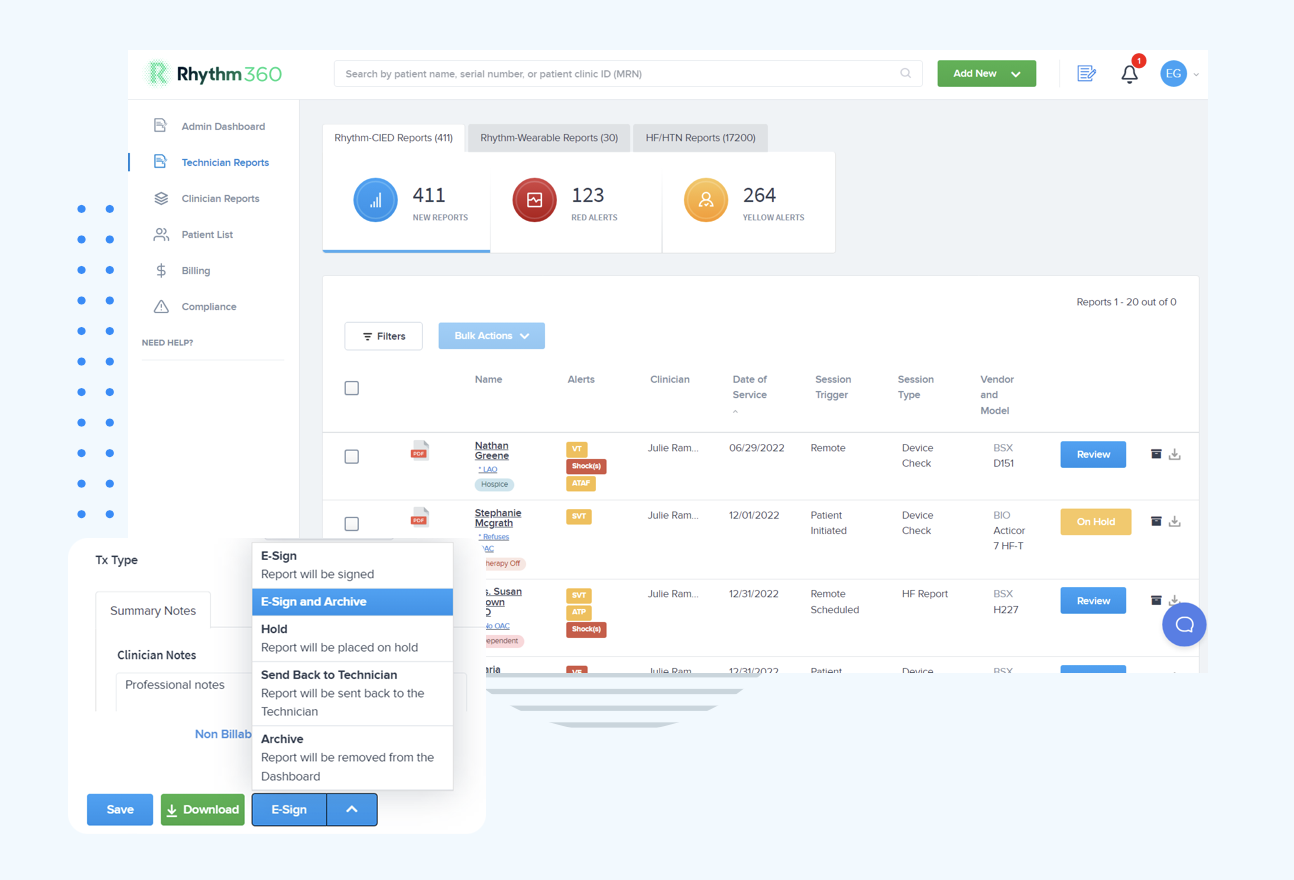
Rhythm360 gives cardiology practices a vendor-neutral platform that supports CPT 99454 revenue while maintaining strong clinical standards. The platform ingests data from implantable cardiac devices and FDA-cleared RPM devices to create a single monitoring ecosystem for each patient.
Key revenue-focused features include:
Practices using Rhythm360 have reported revenue increases of up to 300% through stronger billing capture, fewer claim denials, and expanded RPM service lines. The ability to unify CIED monitoring with RPM services creates new revenue streams and supports better patient outcomes.
Schedule a demo to see how Rhythm360 can strengthen your practice’s CPT 99454 compliance and revenue performance.
Cardiology practices need to avoid frequent CPT 99454 billing errors that trigger claim denials and audit exposure. Non-FDA cleared devices, manual data entry workflows, and weak transmission documentation represent the most common compliance failures.
Key pitfalls to avoid include:
Policy updates for 2026 highlight stricter expectations around automatic transmission and documentation. Practices must confirm that their devices meet current FDA clearance standards and maintain detailed transmission logs to protect against audits.
CPT 99454 requires FDA-cleared devices with automatic transmission capabilities. Cardiology programs often rely on connected blood pressure monitors such as the Omron Evolv for hypertension, smart scales like the Withings Body Cardio for heart failure weight monitoring, pulse oximeters such as the Masimo MightySat for respiratory assessment, and specialized cardiac sensors like the CardioMEMS system for heart failure pressure monitoring. All devices must send data automatically without manual patient input.
CPT 99454 requires at least 16 days of data collection within a 30-day billing period. Patients must use their monitoring devices and successfully transmit physiologic data on 16 or more separate days during the billed month. The data collection must be automatic, and transmission logs must clearly document compliance for audit readiness.
The 2026 Medicare reimbursement rate for CPT 99454 is approximately $47 per month per patient. This payment covers device supply and data transmission services. Practices can add revenue through care management codes CPT 99457, at about $52, and CPT 99458, at about $41, when they meet the related clinical oversight and patient interaction requirements.
No, CPT 99453 and CPT 99454 cannot be billed together in the same calendar month for the same patient. CPT 99453 covers device setup and patient education, while CPT 99454 covers ongoing device supply and data transmission. These codes remain mutually exclusive within one billing period, although CPT 99453 can be billed in one month and CPT 99454 in later months.
Heart failure patients benefit most from connected weight scales that automatically track daily weight changes, which often signal fluid retention. Blood pressure monitors support both heart failure and hypertension patients by tracking medication effectiveness and revealing concerning trends. Pulse oximeters help monitor respiratory status in heart failure patients. The most effective devices integrate smoothly with existing cardiac workflows and CIED monitoring systems, including those supported by Rhythm360’s vendor-neutral platform.
Yes, CPT 99454 and CPT 99457 can be billed together in the same month when the practice delivers the required services. CPT 99454 covers device supply and data transmission, and CPT 99457 covers care management that requires at least 20 minutes of clinical staff time for data review, patient communication, and care coordination. This combination works especially well for cardiology practices that manage complex patients with multiple chronic conditions and ongoing clinical needs.
CPT 99454-eligible devices and clear billing rules give cardiology practices a reliable framework for growing RPM revenue while supporting comprehensive patient care. Integrating FDA-cleared RPM devices with existing cardiac monitoring workflows creates measurable gains in outcomes and financial performance. Rhythm360’s vendor-neutral platform supports compliance and helps practices capture the full clinical and financial value of remote patient monitoring. Schedule a demo today to update your approach to cardiac RPM and CPT 99454 billing.