

Remote monitoring CPT codes interact in specific ways that either protect your revenue or trigger denials. The 2026 payment structure rewards accurate bundling and strict adherence to timing rules while punishing even small mistakes.
The table below highlights how reimbursement and billing frequency differ by code and, more importantly, which combinations payers accept versus which pairings cause automatic denials.
CPT Code | 2026 Reimbursement | Billing Frequency | Bundling Rules |
99453 | ~$22 | Once per 30 days | Can bundle with 99454 |
99454 | ~$47 | Monthly (16+ days data) | Standalone or with 99453 |
99457 | ~$52 | Monthly | Cannot bundle with 99454 |
The most damaging mistakes involve short data collection periods, missing written physician orders, incorrect bundling with evaluation and management codes, and weak consent documentation. CMS requires specific monitoring thresholds for acute and chronic conditions, and 2026 rules demand tighter consent logs and transmission records to withstand OIG review.
Compliant CPT 99454 billing starts with clear physician orders and documented patient consent. Many cardiology practices rely on verbal orders for CIED remote monitoring, yet CMS expects written documentation that spells out medical necessity, monitoring parameters, and the duration of remote physiologic monitoring.
The Fix: Create a standard workflow that requires written physician orders before device setup. Capture explicit patient consent for data transmission, including agreement on monitoring frequency and how the clinical team will respond to alerts. Embed consent forms directly in your EHR with timestamp verification so every step appears in the chart. See how Rhythm360 automates physician orders and consent capture so every patient meets documentation requirements before billing starts.
The 16-day threshold mentioned earlier remains the single most common reason for CPT 99454 denials. Many practices bill monthly without confirming actual transmission days, especially when juggling multiple OEM portals where connectivity problems and patient non-compliance create silent gaps.
The Fix: Start with automated data tracking that monitors transmission frequency in real time. These systems should trigger alerts when patients approach the 16-day mark with too few transmissions, which gives your team time to intervene before the billing window closes. Because patient behavior often drives these gaps, build education protocols that explain why daily transmission matters for both clinical safety and continued coverage. Finish the process by training staff to confirm data sufficiency before submitting claims and by keeping detailed logs that show exact transmission dates for audit protection.
Submitting CPT 99454 more than once in a 30-day period invites payer scrutiny and potential fraud investigations. Some teams bill for every device transmission or submit duplicates across different monitoring parameters, which payers treat as overbilling.
The Fix: Put billing calendar controls in place that block duplicate CPT 99454 submissions within a 30-day window. Feed those controls into patient-specific tracking views that show the last billing date and the next eligible period so staff can see eligibility at a glance. Because automation still needs human oversight, train billing staff on monthly limits and add approval workflows that require supervisor review before claim submission. Document the exact 30-day span covered by each CPT 99454 claim to create a clear audit trail.
Bundling confusion causes lost revenue when teams miss valid combinations or submit claims that payers reject. The roles of 99453 for device setup, 99454 for data collection, and 99457 for clinical review follow specific CMS rules that your billing team must understand.
The Fix: Write clear bundling rules that explain when 99453 and 99454 can appear on the same claim and when 99457 must stand alone. Build simple decision trees that guide staff to the right code mix based on the actual services delivered. Add claim review checkpoints that catch bundling mistakes before submission. Avoid any attempt to bundle 99454 with 99457 in the same billing period.
Commercial payers often apply their own modifier rules, prior authorization steps, and coverage limits that differ from Medicare. Practices that apply a single Medicare-style approach across all payers experience frequent denials and slow payments.
The Fix: Maintain payer-specific billing guides that list modifier rules, prior authorization workflows, and coverage limits for each major insurer. Train billing staff on these differences and add verification steps that confirm coverage before you start services. Build relationships with payer representatives so your team can clarify unclear rules and challenge inappropriate denials.
OIG auditors now focus heavily on timestamps and complete audit trails that prove services occurred as billed. Practices that rely on manual notes or partial electronic records face serious risk when transmission logs do not match billing dates.
The Fix: Capture timestamps automatically for every patient interaction, device transmission, and clinical review. Maintain full audit trails that show service dates, staff involvement, and related clinical decisions. Add backup systems that preserve data during upgrades or outages. Review internal records regularly to confirm that documentation remains complete and accurate.
Commercial insurers apply different coverage rules, prior authorization requirements, and reimbursement rates that add complexity beyond Medicare. Many practices only discover these limits after services occur, which leads to write-offs and frustrated patients.
The Fix: Build thorough verification protocols that confirm coverage, prior authorization needs, and patient financial responsibility before you start monitoring. Design payer-specific workflows that address unique billing rules and appeal paths. Communicate clearly with patients about coverage limits and possible out-of-pocket costs so expectations stay aligned.
Rhythm360’s vendor-neutral AI platform replaces manual remote monitoring workflows that drain staff time and revenue. The system ingests data from all major OEM portals, including Medtronic, Abbott, Boston Scientific, and Biotronik, and reaches greater than 99.9% transmissibility through redundant data feeds and computer vision.
The platform then creates compliant CPT 99454 documentation automatically, tracks the 16-day requirement, and produces audit-ready billing reports. Bi-directional EHR integration with Epic, Cerner, and other major systems streamlines daily work, while mobile tools support alert responses that are up to 80% faster. Practices using Rhythm360 achieve the 300% revenue uplift mentioned earlier through stronger billing capture and lower administrative overhead.
Core automation features include real-time transmission monitoring, automated consent documentation, billing calendar controls, and complete audit trail generation. The platform blocks common billing errors and protects legitimate revenue by aligning code selection and timing with payer-specific rules.
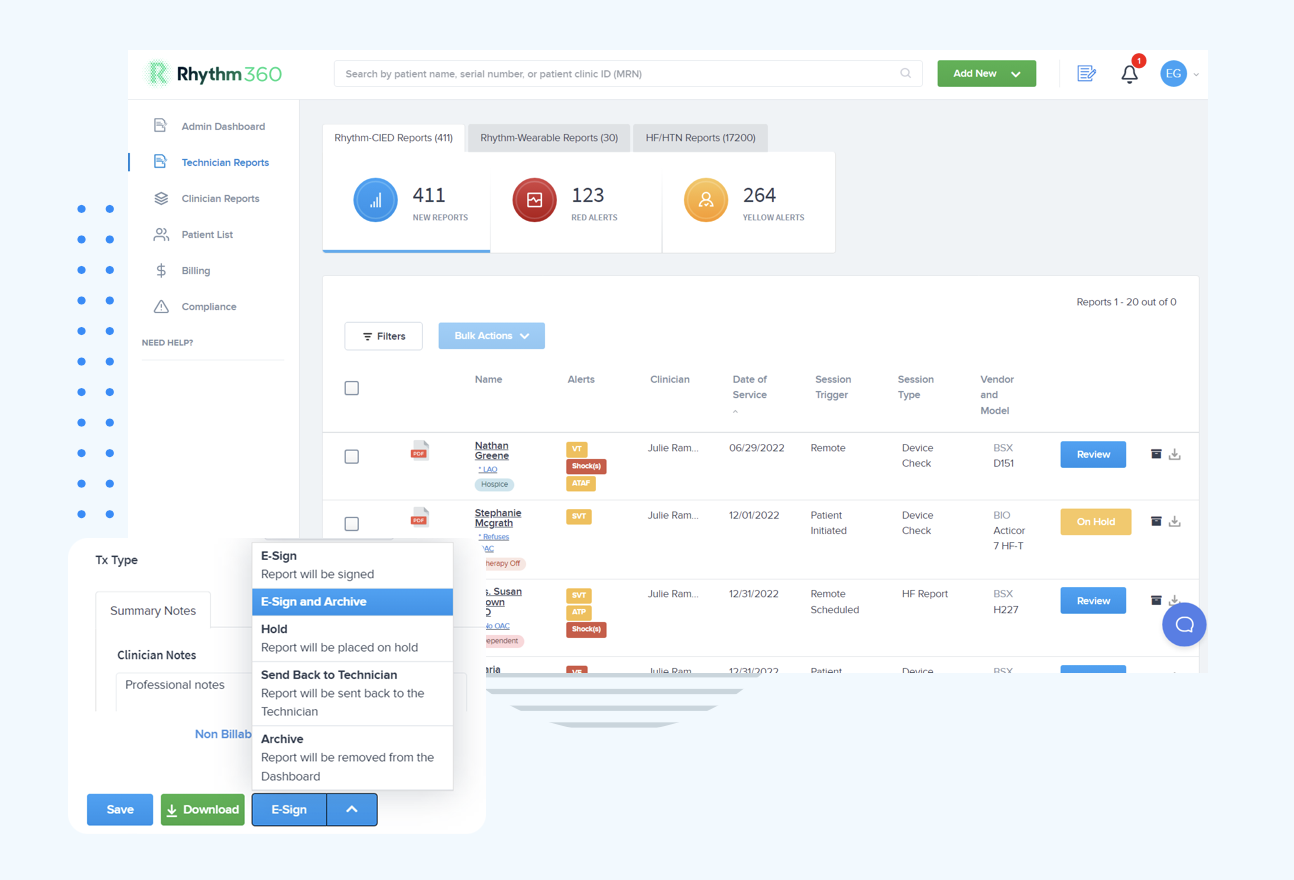
Explore a Rhythm360 demo focused on your 99454 workflow and turn remote monitoring from a billing burden into a predictable, compliant revenue stream.
The gap between manual remote monitoring billing and Rhythm360 automation shows clearly in real practice metrics.
Performance Metric | Manual Process | Rhythm360 Platform |
Weekly Administrative Hours | 20+ hours | 2 hours |
Claim Denial Rate | 30% | <1% |
Revenue Performance | Baseline | 300% increase (as noted above) |
Practice administrators report major gains in efficiency and financial performance. One cardiology practice manager shared, “Rhythm360 reduced our alert response time by 80% while helping us ace our recent OIG audit. The automated documentation saved us during compliance review, and our billing denial rate dropped to practically zero.”
The seven CPT 99454 billing problems described here separate profitable remote monitoring programs from those headed toward compliance trouble. As 2026 OIG audits increase their focus on remote patient monitoring claims, practices need strong systems that close documentation gaps, prevent billing errors, and streamline daily operations.
Rhythm360 delivers the automation and compliance framework that turns remote monitoring billing into a reliable revenue source instead of a constant risk. Avoid waiting for an audit to reveal weaknesses in your current process.
See how Rhythm360 can resolve your CPT 99454 billing issues while expanding your remote monitoring revenue potential.
CPT 99454 requires at least 16 days of data collection within a 30-day period and follows a monthly billing limit. The code covers device setup, patient education, and data transmission for remote physiologic monitoring. Compliant documentation includes written physician orders, patient consent, and detailed transmission logs. The service must monitor defined physiologic parameters for acute or chronic conditions, with average Medicare reimbursement of about $47 in 2026.
Medicare covers CPT 99454 remote patient monitoring when the service is medically necessary and properly documented. The 2026 reimbursement rate is about $47 for qualifying claims. Coverage depends on meeting the 16-day data threshold, securing written physician orders and patient consent, and monitoring approved acute or chronic conditions. Medicare pays at non-facility physician fee schedule rates through 2026, and claims must go to the correct Medicare Administrative Contractor with complete documentation.
CPT 99454 can be billed only once per patient during a 30-day period, no matter how many transmissions occur. Practices cannot bill multiple times in the same month even when monitoring several parameters or receiving daily data. The monthly limit applies per patient rather than per device or condition. Attempts to bill more often than monthly invite payer scrutiny and potential fraud investigations.
CPT 99453 for device setup and 99454 for data collection and transmission can be billed together when both services occur in the same billing period. In contrast, 99454 cannot be bundled with 99457, which covers clinical review and interpretation, in the same month. The 99453 and 99454 combination fits the start of remote monitoring, with 99453 covering setup and education and 99454 covering ongoing data collection and transmission.
Compliant CPT 99454 billing requires written physician orders that define medical necessity and monitoring parameters, documented patient consent for data transmission, and logs that prove at least 16 days of data within the 30-day billing period. Complete audit trails with timestamps for all interactions also matter. Additional elements include EHR notes on clinical decision-making, records of patient education, and confirmation of device functionality. Rhythm360 automates this full documentation workflow, keeping every claim audit-ready.





