Last updated: September 19, 2026
See How Rhythm360 Automates 99454 Compliance
The AMA descriptor for CPT 99454 reads: device supply with daily recordings or programmed alert transmissions, digitally stored and/or transmitted, each 30 days. The code pays for the device and the data stream it produces, not for clinician time.
In the CY 2021 Medicare Physician Fee Schedule final rule, CMS clarified that physiologic data must be electronically and automatically collected and transmitted. Connected Bluetooth, Wi-Fi, and cellular devices satisfy this standard. Patient-typed readings, values reported by phone, and written logs fall outside the requirement.
This distinction drives a large share of CPT 99454 denials. Audit-ready documentation focuses on concrete artifacts:
The FCSO Medicare RPM documentation checklist (published September 2, 2026) requires documentation that the device is both FDA and HIPAA compliant and explicitly states that manually uploaded data does not qualify toward the 16-day threshold.
Explore Audit-Ready RPM Documentation
A qualifying day is a calendar day on which the device records at least one reading and automatically transmits it to the data platform. A single reading on a given day counts as a transmission day when it is automatically transmitted and digitally stored.
The following categories do not count toward the threshold, per CMS billing guidance:
The CY 2026 Physician Fee Schedule Final Rule introduced CPT 99445 to cover 2–15 days of data transmission within a 30-day period. CPT 99454 requires 16 or more days. The two codes are mutually exclusive and cannot both be billed for the same period.
The 30-day period starts when data transmission begins, not on the device shipment date or the calendar month. For example, a period opening January 10 closes February 8. Teams must monitor the day count during the period, because a day that failed to sync cannot be recovered after the fact.
Multiple devices can contribute to the 16-day threshold for a single CPT 99454 unit when every device is FDA-defined and every reading is automatically transmitted and digitally stored. A blood pressure reading on Monday and a weight reading on Tuesday count as two qualifying days, per CMS measurement-day guidance.
The code is billed once per 30 days per patient regardless of the number of devices. Issuing a second device does not open a second billable period. Submitting multiple CPT 99454 claims for different devices appears on CMS denial lists, as confirmed by CMS policy on once-per-period device supply billing.
Only one practitioner or practice can bill CPT 99454 for a given patient in a 30-day period, even when devices were supplied by different practitioners. Per CMS RPM billing rules, practices sharing a patient must agree in advance on who owns the claim. This rule covers all of the patient’s devices for that monitoring episode, which makes multi-device patients the highest-risk cohort for duplicate billing.
CPT 99454 covers device supply and data transmission. CPT 99457 covers the first 20 minutes of clinical staff time spent on remote monitoring treatment management, including at least one live, two-way interactive communication with the patient or caregiver. They are distinct services and can be billed in the same 30-day period when each service’s own requirements are independently met, per the CY 2026 PFS Final Rule.
The table below summarizes how CPT 99454 pairs with related RPM codes within a 30-day window.
| Code | What It Covers | Billing Frequency | Can It Pair With 99454? |
|---|---|---|---|
| 99453 | Initial device setup and patient education | Once per episode of care | Yes, billed at enrollment, while 99454 is held until the 16-day threshold is met |
| 99454 | Device supply with automatic data transmission, 16–30 days per 30-day period | Once per 30-day period | N/A, this is the anchor code |
| 99457 | First 20 minutes of RPM treatment management, including live interactive communication | Once per calendar month | Yes, device supply and management time are distinct services |
| 99458 | Each additional 20 minutes of RPM treatment management (add-on to 99457) | Per additional 20-minute increment, per calendar month | Yes, when 99457 threshold is met and additional time is documented |
CPT 99453 is billed once per episode of care for setup and patient education. CPT 99454 is held back until 16 days of data are collected, even when both appear in the first monitoring period.
CPT 99457 and 99458 are time-based codes. The 16-day data minimum does not apply to them. They can be billed in a month with thin device data as long as time thresholds and the interactive communication requirement are met. Time counted toward 99457 cannot also be counted toward CCM or another time-based service.
RPM and RTM codes cannot both be billed for the same patient in the same month, per CMS MLN901705.
Medicare covers CPT 99454 when all requirements are met, including established-patient status and documented consent. RPM is billed as a care-management service rather than a telehealth service, so it is not subject to Medicare’s geographic or originating-site restrictions, per CMS RPM coverage policy.
The patient must be established to the practice. Per CMS RPM billing rules, the ordering clinician must already have treated the patient for the condition being monitored. An established patient relationship generally means at least one prior visit, often a face-to-face encounter within the prior year.
Consent must be obtained and documented before billing begins. Verbal consent is acceptable if the date, the person who obtained it, and a summary of what was disclosed are recorded, per CMS consent documentation requirements. Re-consent is not required for each new 30-day period when the original consent covers ongoing monitoring.
The following checklist can be run against a live patient panel before submitting a claim and copied directly into a policy document or audit response:
Before submitting, run a five-question check on the items above: qualifying day count, consent date versus monitoring start date, order specificity, period dates, and duplicate billing. This step catches nearly every preventable denial, per CMS RPM claim assembly guidance.
Rhythm360 is a vendor-neutral, HIPAA-compliant platform that supports CPT code billing, including remote monitoring codes such as 99454. It ingests and normalizes data from major cardiac device manufacturers including Medtronic, Boston Scientific, Abbott, Biotronik, and others into a single source of truth. Multi-device patients then aggregate cleanly toward the 16-day threshold without staff logging into separate OEM portals.
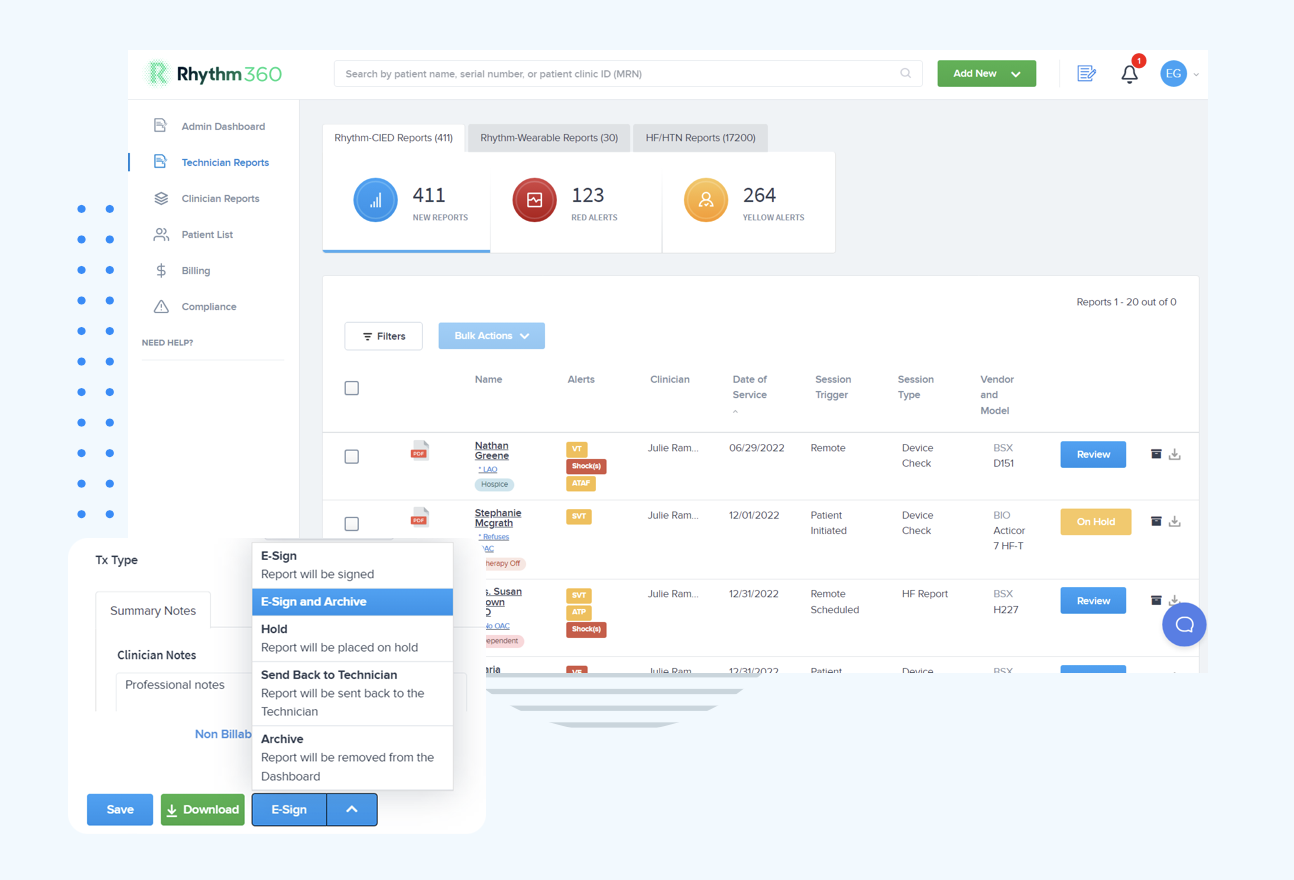
Rhythm360’s core capabilities for CPT 99454 compliance include:
Other platforms in the cardiac remote monitoring space include Murj, Implicity, Rhythm Management Group, and Octagos. Rhythm360 focuses on automated documentation that produces audit-ready transmission logs and automates CPT code capture so every 99454 claim is defensible before submission. Practices using Rhythm360 have achieved up to an 80% reduction in critical alert response times and up to a 300% increase in revenue capture.
Get A Pre-Billing Compliance Walkthrough
Evaluating readiness to bill CPT 99454 at scale requires assessing five operational areas:
Rhythm360 streamlines implementation, with onboarding that typically takes a few days to a few weeks, including EHR integration. The platform’s real-time dashboard gives administrators a live view of patient compliance, critical alerts, and captured versus potential revenue based on CPT code requirements. Teams can intervene mid-period before a patient falls below the 16-day threshold.
The following errors occur in operationally mature practices and represent audit risk and revenue leakage rather than beginner mistakes:
Rhythm360 helps prevent these errors through automated threshold tracking, real-time transmission monitoring, and documentation that is audit-ready at the point of claim submission.
CPT 99454 requires an FDA-defined device, automatic transmission and digital storage of physiologic data, 16 or more qualifying transmission days within a 30-day period, once-per-30-days billing to a single practitioner, established-patient status, and documented consent obtained before billing begins. Manual data entry fails the digitally stored standard and does not count toward the 16-day threshold under any circumstance.
A qualifying day is a calendar day on which the device records at least one reading and automatically transmits it to the data platform. Multiple readings on the same day count as one day. Days with no transmission do not count even if the device was powered on. A failed sync cannot be recovered after the period closes, which makes real-time monitoring of the day count operationally essential.
CMS clarified in the CY 2021 Physician Fee Schedule final rule that physiologic data must be electronically and automatically collected and transmitted. Patient-reported readings, phone-transmitted values, readings typed into an app by the patient, and staff transcription do not qualify and do not count toward the 16-day threshold. The FCSO Medicare RPM documentation checklist explicitly states that manually uploaded data is disqualifying.
CPT 99454 and CPT 99457 can be billed together when each service independently meets its own requirements. CPT 99454 covers device supply and data transmission and is earned by the device meeting the 16-day threshold. CPT 99457 covers the first 20 minutes of clinical staff time for remote monitoring treatment management, including at least one live, two-way interactive communication with the patient or caregiver. The 16-day data minimum does not apply to CPT 99457. Time counted toward 99457 cannot also be counted toward CCM or any other time-based service in the same month.
Medicare covers CPT 99454 under Part B when all requirements are met: an FDA-defined device with automatic transmission, 16 or more qualifying days of data within a 30-day period, established-patient status, and documented consent. RPM is billed as a care-management service rather than a telehealth service, so it is not subject to Medicare’s geographic or originating-site restrictions. Standard Part B cost-sharing applies, and the patient is typically responsible for 20% coinsurance after any applicable deductible.
CPT 99454 is a device supply and data transmission code earned by the device meeting the 16-day automatic transmission threshold within a 30-day period. CPT 99457 is a time-based treatment management code earned by documented clinical staff time of at least 20 minutes per calendar month and at least one live, two-way interactive communication with the patient or caregiver. The two codes measure different services on different clocks. Code 99454 runs on a rolling 30-day period from the monitoring start date, while 99457 runs on a calendar month.
Days from multiple FDA-defined devices with automatic transmission can aggregate toward the 16-day threshold. A blood pressure reading on Monday and a weight reading on Tuesday count as two qualifying days. Only one CPT 99454 unit may be billed per patient per 30-day period regardless of how many devices are in use. Submitting multiple 99454 claims for different devices is a listed denial reason, and the one-practitioner rule means only one practice can own the claim for that period.
CPT 99454 requirements for digitally stored patient data services function as a documentation standard rather than a simple billing formality. Practices that absorb denials and recoupment exposure often count manual entries as transmission days, measure the 30-day window against the calendar month, or submit duplicate claims for multi-device patients. Each of these errors is preventable when documentation infrastructure is in place before the claim is submitted.
Rhythm360 is a vendor-neutral, HIPAA-compliant platform that consolidates data from major cardiac device manufacturers, produces auditable transmission logs, and automates CPT code capture so practices meet CPT 99454 requirements while reducing denial risk and capturing previously lost revenue. These capabilities drive the efficiency gains described earlier and support sustainable RPM growth.
Talk To A Rhythm360 Compliance Specialist