

Last updated: September 22, 2026
Talk to Rhythm360 About CPT 99454 Compliance
CPT 99454 is the remote monitoring device-supply code covering the monthly supply of an FDA-cleared remote monitoring device and the automatic daily recording and transmission of patient-generated physiologic data. First Coast Service Options (FCSO), a Medicare Administrative Contractor, specifies that CPT 99454 documentation must show device supply for 30 days, 16 days of physiological data transmission, automatic data transmission, and only one provider billing per 30-day period.
CPT 99454 is billed once per patient per 30-day period and requires an established patient relationship, meaning the patient must have had at least one prior visit with the billing provider or practice before RPM services begin. CPT 99454 is a non-face-to-face service, so no direct patient encounter is needed to bill it; the established patient requirement still applies.
CPT 99454 is distinct from two related codes:
A compliant CPT 99454 record captures seven specific elements in a way an auditor can follow quickly.
The core checklist includes:
The 16-day automatic transmission rule is the operative threshold for CPT 99454. FCSO's RPM medical review checklist, published September 2, 2026, specifies that CPT 99454 documentation must show 16 days of physiological data transmission within the 30-day period.
The "at least 2 days" language that appears on the CMS Remote Patient Monitoring page refers to the minimum number of days of data transmission required to bill the shorter-duration device-supply code. That language does not change the 16-day threshold for CPT 99454. CPT 99445 is the RPM device-supply code for 2 to 15 days of transmitted data within a 30-day period, while CPT 99454 remains the code for 16 or more days of transmitted data.
The 16-day minimum data requirement for CPT 99454 remains in force in 2026; CMS added code 99445 for shorter 2–15 day spans rather than removing the 16-day threshold. The two thresholds refer to two different codes, and conflating them creates confusion that often produces denials.
The checklist above assumes every qualifying day came from a device, not a patient. That distinction is where many claims fail. Manual data entry does not qualify for CPT 99454, and the device must support automatic data transmission to the provider. Missing the 16-day threshold is the single most common reason for CPT 99454 claim denials.
A qualifying example is a connected blood pressure cuff that automatically transmits each reading to the monitoring platform at the time of measurement, with no patient action required beyond taking the reading.
A non-qualifying example is a patient who manually types a blood pressure reading into a patient portal or records it on a paper log. That reading does not count toward the 16-day threshold regardless of clinical accuracy.
CPT 99454 and CPT 99457 can be billed in the same period when their respective requirements are independently met. CPT 99454 is untimed and is triggered by the 16-day automatic transmission threshold within a 30-day period. CPT 99457 is time-based and requires at least 20 minutes of cumulative RPM treatment management time in a calendar month, including at least one real-time interactive communication with the patient or caregiver.
CPT 99454 (device supply, 16–30 days) and CPT 99457 (treatment management, first 20 minutes) is described as the classic full-month RPM pairing. A common denial scenario occurs when practices bill one code without the supporting documentation for the other, or when they bill 99457 without a documented real-time interactive communication. A common denial or downcoding cause is failure to note the date, modality, and participant of the live contact.
The denial scenario is straightforward: a claim that includes both 99445 and 99454 for the same patient in the same 30-day period will be rejected. The RPM device-supply code selection is period-specific. The final data-day count for that specific 30-day cycle determines whether 99445 (2 to 15 days) or 99454 (16 to 30 days) is correct, so practices should wait until the end of the billing period to determine which code applies. Submitting the claim before the period closes and the final day count is confirmed often triggers this denial.
If the 16-day threshold is not met within the 30-day period, CPT 99454 cannot be billed for that period. The period does not qualify, and submitting a 99454 claim anyway is the most common audit finding for this code.
The operational fallback depends on the day count:
When a patient falls short of 16 days, document the reason for the shortfall in the medical record, such as device connectivity issues, patient non-compliance, or a hospitalization. Address the root cause before the next billing period so the pattern does not repeat.
Documenting the shortfall matters because it separates a clinical gap from a billing error. Continuing to supply the device and monitor the patient's engagement is appropriate, and the shortfall itself represents a clinical issue. The compliance failure occurs when a practice bills 99454 even though the threshold was not met.
Even when the transmission-day count is correct, claims can still fail if the record mixes RPM and telehealth documentation. The two are separate: RPM documentation requirements are distinct from telehealth visit documentation requirements, and the record should reflect that separation.
Telehealth visit documentation, by contrast, is encounter-centric. For Medicare telehealth billing, place of service matters; POS 10 is used when the patient is in their home and POS 02 when the patient is elsewhere, and claims may require modifier 95 for synchronous audio-video telehealth and modifier 93 for audio-only services. Because telehealth E/M services are billed with standard office or outpatient E/M codes rather than RPM supply or monitoring codes, RPM documentation cannot substitute for telehealth visit documentation.
Each service category requires its own record, and neither can substitute for the other. Billing drift, where RPM and telehealth documentation elements are mixed in a single record, is a recognized audit risk.
Meeting these documentation standards manually is where many practices struggle, which is why Rhythm360 builds the audit trail into the workflow.
Rhythm360 is a vendor-neutral, HIPAA-compliant, cloud-based remote patient monitoring platform that consolidates data from all major device manufacturers into a single source of truth. The platform automates data ingestion and report generation, producing auditable documentation aligned with CPT code requirements, including the transmission logs, device identification records, and billing period documentation that auditors expect for CPT 99454.
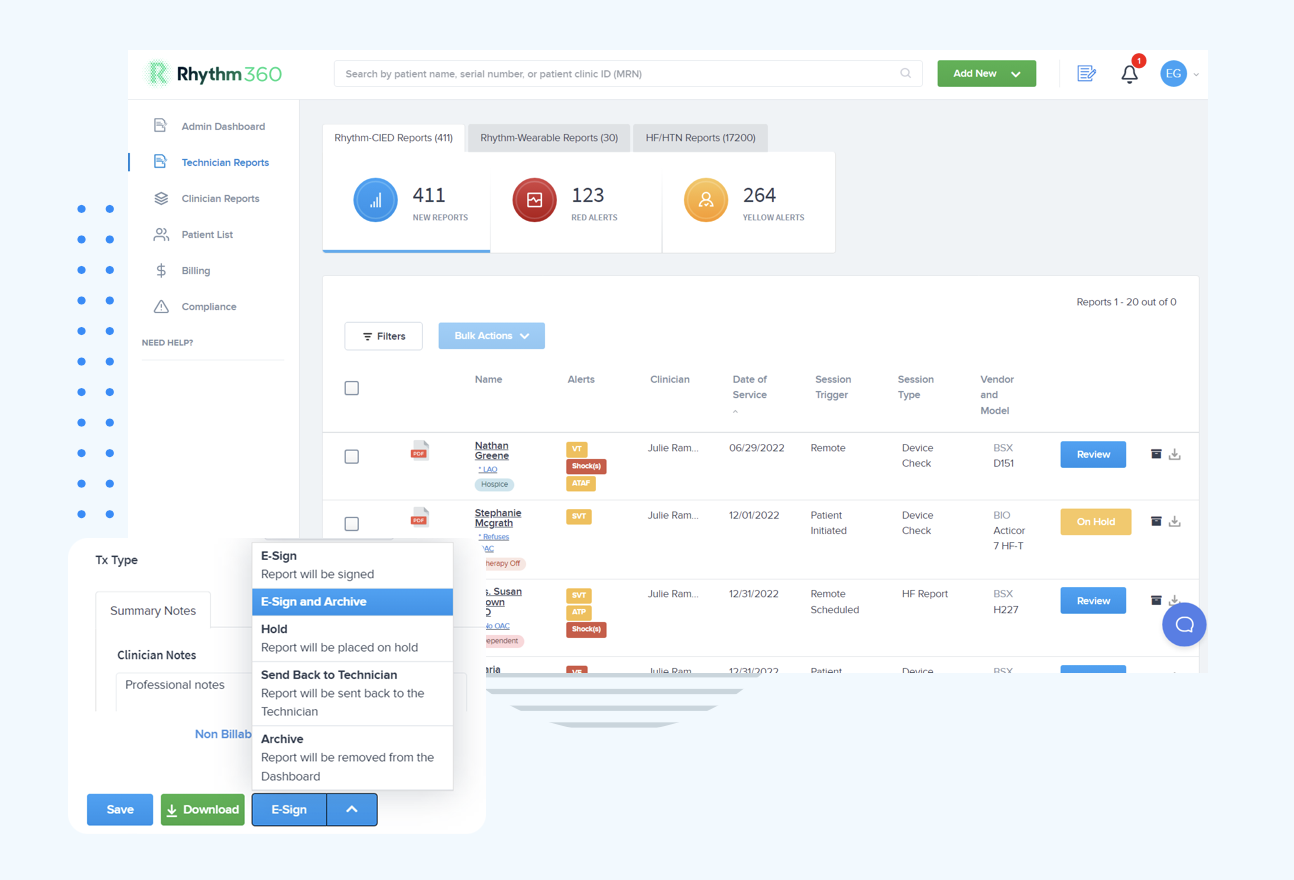
Rhythm360 automatically tracks device-specific CPT pairings and billing cycles. Pacemakers and ICDs follow 90-day cycles: 93294 and 93295 cover the professional components, and 93296 covers the technical component. Physiologic monitors and loop recorders follow 30-day cycles: 93297 applies to implantable cardiovascular physiologic monitors and 93298 to subcutaneous cardiac rhythm monitors and implantable loop recorders. Each is billable once per 30 days and can be split into professional (-26) and technical (-TC) components.
Rhythm360's automated CPT code capture and documentation helps practices recover previously lost revenue, with outcomes including up to an 80% reduction in critical alert response times and up to a 300% increase in revenue capture and profitability. Other platforms in the remote monitoring space include Murj, Implicity, Rhythm Management Group, and Octagos. Rhythm360 focuses on delivering a unified, vendor-neutral platform with the documentation infrastructure practices need to defend every claim.
See How Rhythm360 Builds Your CPT 99454 Audit Trail
The questions below recap the points practices ask about most often when preparing CPT 99454 claims.
A compliant RPM record for CPT 99454 requires seven elements: signed patient consent for remote monitoring (including cost-sharing acknowledgment), device make, model, and serial number, a transmission log showing at least 16 distinct calendar dates of automatic data transmission within the 30-day billing period, an ICD-10 diagnosis code establishing medical necessity, the supervising provider NPI, the defined 30-day billing period start and end dates, and evidence that transmission was automatic rather than patient-reported. The FCSO RPM medical review checklist, published September 2, 2026, confirms these elements and adds that the device must be both FDA-compliant and HIPAA-compliant, and that documentation must be complete, legible, signed, and dated by the physician or clinician.
CMS requires that CPT 99454 be billed once per patient per 30-day period, that the patient have an established relationship with the billing provider, and that the device automatically transmit physiologic data on at least 16 distinct calendar days within that period. Only one practitioner may bill RPM for a given patient per 30-day period. The CY 2026 Medicare Physician Fee Schedule Final Rule (CMS-1832-F), effective January 1, 2026, added CPT 99445 for patients with 2–15 days of transmission and CPT 99470 for 10–19 minutes of treatment management time, expanding the billable RPM framework without removing the 16-day threshold for 99454. The device must meet the FDA's definition of a medical device; consumer wearables and fitness trackers do not qualify.
CPT 99454 follows the 16-day rule described above. The "at least 2 days" language that appears in some CMS guidance refers to the minimum threshold for CPT 99445, the shorter-duration device-supply code introduced January 1, 2026 under CMS-1832-F. The FCSO RPM medical review checklist explicitly states that CPT 99454 documentation must show 16 days of physiological data transmission. The two thresholds apply to two different codes: 99445 covers 2–15 days and 99454 covers 16–30 days, and they remain mutually exclusive for the same patient in the same 30-day period.
Yes. CPT 99454 and CPT 99457 can be billed in the same period when their respective requirements are independently met. CPT 99454 is triggered by the 16-day automatic transmission threshold within a rolling 30-day period. CPT 99457 is triggered by at least 20 minutes of cumulative RPM treatment management time within a calendar month, including at least one documented real-time interactive communication with the patient or caregiver. Because the device-supply period (rolling 30 days) and the management period (calendar month) do not always align, practices must maintain two separate billing calendars. The combination of 99454 and 99457 is the standard full-month RPM billing pairing when both thresholds are met and documented.
The 16-day automatic transmission rule for CPT 99454 remains in force, and the "at least 2 days" language in circulation refers to CPT 99445, which follows a different threshold. A compliant CPT 99454 claim depends on a specific, auditable record: consent, device identification, transmission logs, ICD-10 medical necessity, provider NPI, evidence of automatic transmission, and the defined 30-day billing period. Under Medicare's medical record maintenance and access requirements (42 CFR 424.516(f)), documentation supporting a claim such as CPT 99454 must be provided to CMS or its contractors within 2 business days of a request, and recommended best practices include maintaining evidence of data transmission on at least 16 days within the billing period.
Rhythm360 automates the capture of that record. The platform consolidates device data from all major manufacturers into a single, auditable source of truth, generates the transmission logs and billing documentation CPT 99454 requires, and tracks billing cycles so practices can defend every claim. The same practices that automated their documentation also saw the alert-response and revenue-capture gains described above.
Talk To Our Team About Your RPM Documentation Workflow





