

Last updated: August 24, 2026
Every CPT 99454 claim relies on two core records: a physician order and documented patient consent. Both must exist before the first billing cycle opens.
The physician order must:
Patient consent must be documented before billing begins and must confirm the patient's acknowledgment of:
Pro Tip — Rhythm360 Automated Consent Capture: Rhythm360 captures and timestamps patient consent at enrollment inside the platform. This creates an immediately retrievable, audit-ready record and removes the manual filing step.
The 2026 CMS Physician Fee Schedule introduced CPT 99445 as a companion device-supply code. This change creates a two-tier structure that replaces the prior all-or-nothing billing cliff.
Both codes reimburse at approximately $47 per month under the 2026 Medicare national non-facility rate (CPT 99454: $47.43; CPT 99445: about $47).
The two codes are mutually exclusive within the same 30-day cycle. A transmission day counts when a device automatically sends physiologic data on a distinct calendar day. Multiple readings on the same day count as one qualifying day.
Connectivity logs must record:
Pro Tip — Rhythm360 Time-Stamped Audit Trails: Rhythm360 maintains a running, real-time log of qualifying transmission days across all connected OEM devices. The platform automatically distinguishes 99445-eligible periods from 99454-eligible periods so billers apply the correct code every time.
An audit-ready CPT 99454 record requires a four-part documentation checklist, according to RVUDoc.
Pro Tip — One-Click Report Generation: Rhythm360 auto-populates these elements into a structured monthly report. The platform pulls device serial numbers, transmission counts, and related diagnosis information directly from integrated OEM and EHR data without manual entry. If your team spends hours each month rebuilding these records, a demo will show how to remove that workload.
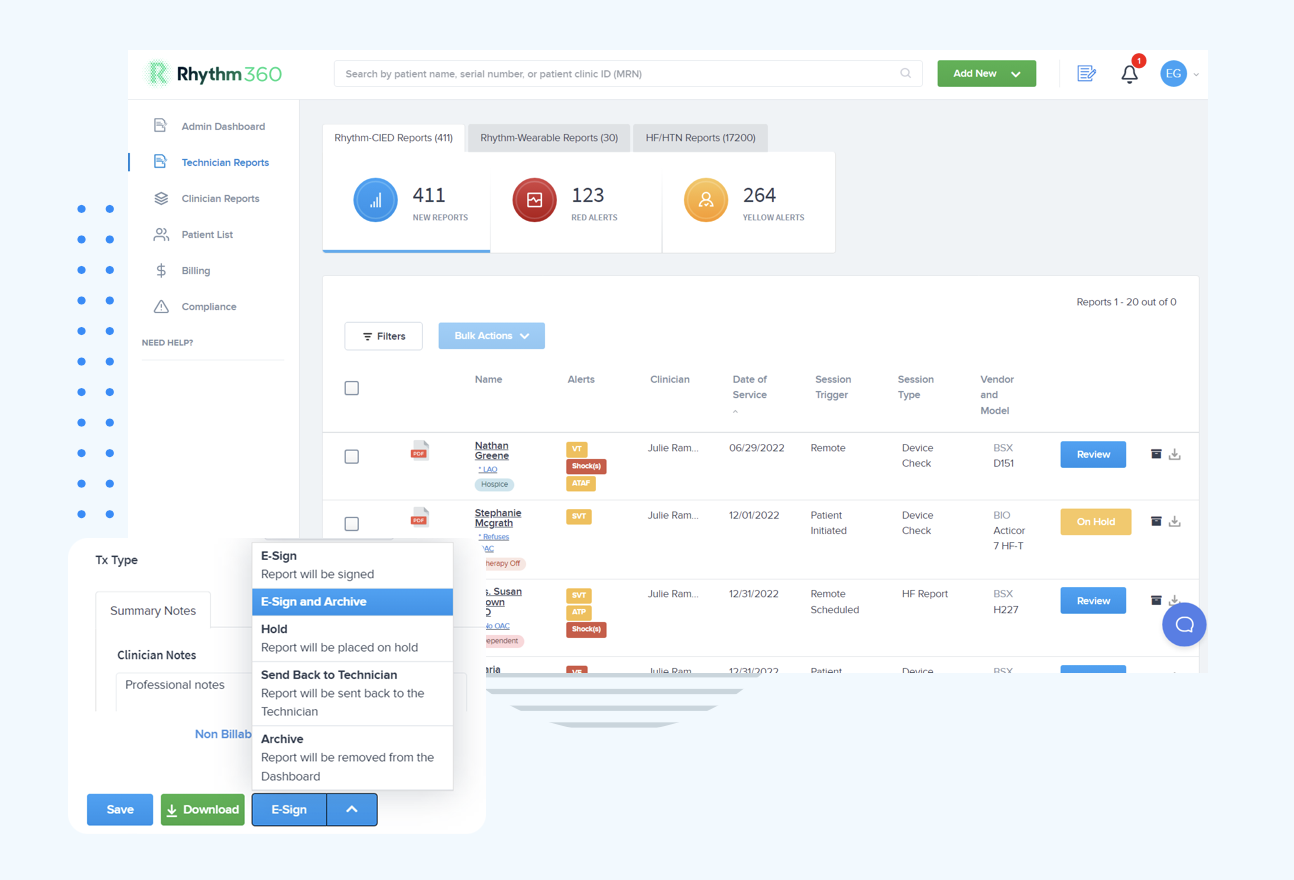
CPT 99454 and CPT 99457 cover different services and require separate documentation sets. Mixing them in a single record often triggers audit recoupment.
RPM management time billed under 99457 and 99458 must remain clearly separate from any concurrent Chronic Care Management, Transitional Care Management, or Behavioral Health Integration time for the same patient in the same period. CMS has flagged micro-fragmentation, which means artificially breaking management time into short increments, as a specific audit concern, per Circle Healthcare.
Pro Tip — Automated Time-Stamping: Rhythm360 generates time-stamped clinical activity logs that are stored separately from transmission logs. This structure keeps the 99454 and 99457 documentation sets clearly distinct during an audit review.
The HHS Office of Inspector General's Fall 2025 Semiannual Report to Congress identified RPM as vulnerable to improper billing and called for increased oversight. The most frequent denial triggers for CPT 99454 include the following issues.
Pro Tip — Rhythm360 Redundant Data Feeds: Rhythm360 uses redundant data feed architecture that maintains greater than 99.9% transmissibility. If an OEM server goes offline, the platform's fail-safe ingestion layer preserves the transmission record. This design prevents a gap day from appearing in the log and protects the 16-day threshold.
The following examples show how to structure EHR documentation that captures all four mandatory elements in a single clinical note. Each sample clearly states the threshold-met date and makes it easy to see whether the encounter supports CPT 99454 or CPT 99445.
Sample Note 1 — Heart Failure Patient on CardioMEMS (Abbott)
Patient enrolled in RPM for chronic systolic heart failure (I50.32) on [enrollment date]. CardioMEMS HF System (Abbott), serial [XXXXXXX], FDA-cleared for pulmonary artery pressure monitoring, supplied and activated on [enrollment date]. Patient consent obtained [enrollment date], including acknowledgment of cost-sharing obligations. Device transmitted pulmonary artery pressure readings automatically on [N] of 30 days in the current billing period. Threshold met for CPT [99454/99445] on [threshold-met date]. Average mean PA pressure: [X] mmHg. Readings reviewed by [Clinician Name, Credential] on [review dates]. Clinical action: [describe action or "no urgent changes; continue current diuretic regimen"]. Plan: continue remote monitoring; follow-up in [X] weeks.
Sample Note 2 — CIED Patient with Abbott ICD
Patient enrolled in RPM for history of ventricular tachycardia with implanted ICD (Z95.810, I47.2) on [enrollment date]. Abbott Ellipse ICD, serial [XXXXXXX], FDA-cleared CIED, remote monitoring activated via Abbott Merlin.net on [enrollment date]. Patient consent obtained [enrollment date], including acknowledgment of cost-sharing obligations and the right to revoke. Device transmitted remote check data automatically on [N] of 30 days in the current billing period. Threshold met for CPT [99454/99445] on [threshold-met date]. No sustained VT episodes detected. Battery status: [X] years remaining. Lead impedances within normal limits. Reviewed by [Clinician Name, Credential] on [review dates]. Clinical action: [describe action or "no device reprogramming required"]. Plan: continue scheduled remote monitoring per device follow-up protocol.
Workflow: Device Transmission to Billing
The Rhythm360 data pipeline follows a sequential, auditable path that connects device transmission to claim-ready output.
- Device transmission — An FDA-cleared CIED or RPM device automatically transmits physiologic data via cellular, Wi-Fi, or Bluetooth to the OEM server.
- Rhythm360 ingestion — The platform ingests data from all connected OEM portals (Medtronic, Boston Scientific, Abbott, Biotronik, and others) via API, HL7, XML, and AI-powered PDF parsing with computer vision. Rhythm360 then normalizes these formats into a single structured record.
- Audit trail generation — Rhythm360 timestamps each transmission event, increments the qualifying-day counter, and flags the correct device-supply code, 99445 or 99454, based on the running day count.
- EHR billing module push — Bi-directional HL7 integration pushes the completed documentation set, including transmission log, device identifiers, ICD-10 codes, and provider NPI, directly into Epic, Cerner, Athenahealth, eClinicalWorks, or other connected EHR systems.
- Claim-ready output — The billing team receives a pre-populated, audit-ready record that requires no manual reconstruction at month end.
Measure Success and Prepare for 2027
Practices that implement a structured CPT 99454 compliance program should track a small set of metrics every month.
- CPT 99454 and 99445 denial rate, with a target below 5 percent
- Average qualifying transmission days per patient per period
- Staff hours spent on RPM documentation reconciliation
- Time from billing period close to claim submission
Practices that already achieve consistent 99454 compliance can expand revenue by layering CPT 99458. This approach means billing additional 20-minute management increments beyond the first 99457 period while using the same time-log discipline already in place.
The OIG has recommended that CMS consider device-specific HCPCS codes or modifiers for RPM services, per BDO's RPM oversight analysis. Practices that document device type and FDA clearance details at a granular level now will adapt more easily if 2027 rulemaking introduces device-specific reporting requirements.
Frequently Asked Questions
What data transmission is required for CPT 99454 in 2026?
CPT 99454 requires a patient to transmit physiologic data automatically from an FDA-cleared device on at least 16 distinct calendar days within a 30-day billing period. Multiple transmissions on the same calendar day count as one qualifying day. The 2026 CMS Physician Fee Schedule introduced CPT 99445 for patients who transmit on 2 to 15 days in the same period, which removes the prior all-or-nothing billing structure. The two codes are mutually exclusive, so only one device-supply code may be billed per patient per 30-day cycle. Manual patient data entry, locally stored device data, and consumer wearables without FDA clearance do not count toward the threshold. Rhythm360 maintains a real-time, running count of qualifying transmission days across all connected devices and automatically identifies which code applies at the close of each billing period.
How does CPT 99454 documentation differ from CPT 99457 documentation?
CPT 99454 documentation centers on the automated device transmission log. The log must show the date, reading type, and data-receipt confirmation for each qualifying day, along with the device's FDA clearance reference, serial number, and the date the transmission threshold was met. CPT 99457 documentation centers on clinical management time. It must document at least 20 minutes of staff time per calendar month along with at least one live interactive communication with the patient or caregiver. Asynchronous data review alone does not satisfy the 99457 requirement. The two documentation sets must be stored and presented separately during an audit. Rhythm360 maintains distinct record structures for transmission logs and clinical time entries, which makes the separation immediately clear to reviewers.
Which device types qualify for RPM billing under CPT 99454?
A device qualifies for CPT 99454 billing when it meets two criteria. It must have FDA clearance for the intended clinical measurement, and it must be able to automatically transmit physiologic data electronically to the provider's monitoring system without requiring the patient to manually enter readings. Qualifying device categories include connected blood pressure monitors, digital weight scales, pulse oximeters with automated transmission, continuous glucose monitors that stream data, spirometers, cardiac implantable electronic devices such as pacemakers, ICDs, CRT devices, and implantable loop recorders, and specialized sensors such as the CardioMEMS pulmonary artery monitor. Consumer wearables, fitness trackers, smartwatches, and any device that stores data locally without automated transmission do not qualify. Rhythm360 is vendor-neutral and ingests data from all major CIED manufacturers as well as connected RPM devices, then consolidates qualifying transmission records into a single audit-ready log.
Conclusion
Audit-ready CPT 99454 documentation in 2026 requires complete core documentation elements, precise use of the 99454 versus 99445 split-code rules, FDA-cleared devices with automated transmission, and clearly separated documentation sets for device supply and treatment management codes. Practices that manage this process manually across multiple OEM portals face persistent denial risk, staff burnout, and revenue leakage. Rhythm360 automates every step of this workflow, from consent capture and transmission logging to EHR integration and code selection, so cardiology and electrophysiology teams can focus on patient care instead of documentation reconstruction.
Schedule a demo of Rhythm360 today and see how your practice can reduce CPT 99454 denials and capture every billable RPM period.Read Next





