

Last updated: July 14, 2026
CPT 99454 covers the recurring monthly supply of an FDA-cleared remote monitoring device and the automatic daily recording and transmission of patient data over a 30-day period. The code is reported once per patient per rolling 30-day cycle, not per calendar month, for as long as the patient stays enrolled and meets the transmission threshold. Every requirement below traces back to this one rule, and missing any piece of it is the fastest way to trigger a denial.
In 2026, CPT 99454 has no national RVU on the Medicare Physician Fee Schedule. Pricing is carrier-determined rather than calculated from RVUs.
A patient must transmit physiologic data on at least 16 days within each rolling 30-day billing period for CPT 99454 to be billable. The table below shows which code applies based on transmission count, since getting this number wrong is the single biggest source of denied claims.
| Transmission Days in 30-Day Period | Applicable Code | 2026 Medicare Rate | Notes |
|---|---|---|---|
| 16–30 days | 99454 | $52.11 | Standard device supply code, billed once per 30-day period |
| 2–15 days | 99445 (new 2026) | $47.43 | Mutually exclusive with 99454, cannot bill both in same period |
| Fewer than 2 days | Neither code billable | $0 | No device supply code applies |
Each calendar day with at least one automatically transmitted reading counts as one day. Multiple readings from different devices on the same day still count as one day. Days with no transmission never count, regardless of device power status.
Meeting the 16-day threshold gets you halfway there. CMS requires seven more elements on file before you submit a claim, and missing any one of them can turn a valid claim into a denial.
CPT 99453 is billed once per patient for initial device setup and education, separate from CPT 99454's recurring 30-day cycle. Under the 2026 CMS Physician Fee Schedule, this one-time setup code ties to the episode of care, not the calendar month.
If a patient receives a second device in the same month, bill its setup the following month instead. Device codes like 99454 and 99445 run on a 30-day cycle, while time codes like 99457, 99458, and 99470 follow the calendar month. Align device codes to calendar months to simplify billing.
Only one CPT 99454 claim is billable per patient per 30-day period, even when a patient uses multiple qualifying devices. For cardiology patients using both a CIED and a blood pressure monitor, the 16-day threshold is met when at least 16 unique calendar days have transmissions from any combination of devices, for example BP readings on 10 days and cardiac device data on 12 days.
CPT 99454 and CPT 99445 are mutually exclusive. Only one device supply code may be billed per patient per 30-day period, based on actual transmission days.
Patient consent must be documented in the medical record before any RPM billing begins. This is the second most common denial trigger after the transmission count, so the consent record needs to include these five elements:
Missing consent documentation before device deployment renders subsequent services unbillable under CMS requirements. Store audit-ready consent language in the patient's EHR record, not a separate system.
Consent covers the paperwork side. The device itself has to meet CMS standards too, and this table shows which categories qualify for cardiology and chronic disease monitoring.
| Device Category | Qualifying Examples | Transmission Method | Qualifies for 99454? |
|---|---|---|---|
| Cardiac Implantable Electronic Devices (CIEDs) | Pacemakers, ICDs, CRT devices, implantable loop recorders | Automatic wireless transmission | Yes |
| FDA-cleared physiologic monitors | Blood pressure monitors, glucometers, pulse oximeters, digital weight scales | Automatic electronic transmission | Yes |
| Respiratory monitors | Respiratory flow rate monitors | Automatic electronic transmission | Yes |
| Consumer wearables | Apple Watch, Fitbit, general fitness trackers | Manual or app-based sync | No |
Every requirement above needs to show up in one place when an auditor asks for proof. This checklist covers each documentation element a defensible CPT 99454 claim needs:
Rhythm360 generates automated transmission logs that capture each of these elements in real time, cutting out the manual assembly of audit packages. The billing dashboard flags patients who haven't yet reached the 16-day threshold mid-period, so staff can reach out before the billing window closes.
See how Rhythm360 turns your audit package into a one-click export.
CPT 99454 cannot be billed unless the patient transmitted device readings on at least 16 of the 30 days in the billing period. This is the most commonly violated compliance requirement and the leading cause of denials. Here are the six patterns that show up most in cardiology settings, and how to fix each one.
A clean 99454 claim is only part of the revenue picture. Compliant billing also means understanding how the companion time codes stack on top of it. CPT 99454 is billed monthly alongside 99457 or 99458 for the same patient: 99454 covers device supply and data transmission, while 99457/99458 cover clinical treatment management time.
CPT 99458 is an add-on code to 99457 and cannot be billed without first billing 99457 in the same month. Once management time reaches 20 minutes, bill 99457 for the first 20 minutes, then 99458 for each additional 20-minute increment. There's no cap on how many times 99458 can be billed per month once that 20-minute threshold under 99457 is met. By contrast, CPT 99470 and CPT 99457 are mutually exclusive in the same month: bill 99470 for 10 to 19 minutes of management, or 99457 once time reaches 20 minutes or more.
The table below shows how these combinations play out across a patient's first month versus later months.
| Billing Period | CPT Codes Billed | Approximate Revenue (National Average) | Notes |
|---|---|---|---|
| Month 1 | 99453 + 99454 + 99457 | ~$74 device-side + ~$52 management = ~$126 | 99453 billed once, 16-day threshold must be met for 99454 |
| Month 1 (extended time) | 99453 + 99454 + 99457 + 99458 | ~$74 device-side + ~$93 management = ~$167 | 99458 added when management time exceeds 40 minutes |
| Subsequent months | 99454 + 99457 | ~$99 per month | 99453 not rebilled unless a new device episode begins |
| Subsequent months (extended time) | 99454 + 99457 + 99458 | ~$140 per month | 99458 requires 99457 billed first in same month |
A claim can meet every rule above and still get denied if the patient's diagnosis falls outside a payer's coverage policy. That's the piece most practices miss. Medicare fee-for-service reimburses CPT 99454 at $47.43 nationally in 2026, with no indication-specific restrictions mentioned.
UnitedHealthcare announced plans to limit RPM coverage, including CPT 99454, to heart failure and hypertensive disorders of pregnancy starting January 1, 2026 across Commercial, Individual Exchange, and Medicare Advantage plans, then delayed that implementation. This matters most for cardiology practices with mixed RPM populations spanning multiple diagnoses.
Cigna's RPM policy covers COPD, diabetes mellitus, and heart failure when medical necessity criteria are met, but excludes isolated hypertension. Anthem/BCBS takes a different approach: rather than restricting coverage to specific diagnoses, its policy weighs documented clinical rationale and the likelihood that monitoring prevents deterioration.
Commercial payers can deny or recoup 99454 claims when the indication falls outside their medical policy, even if every CPT requirement including the 16-day rule is met. Verify payer-specific policies before enrolling patients, and document indication alignment in the physician order.
Fragmented OEM portals, from Medtronic, Boston Scientific, Abbott, Biotronik, and others, force staff to log into separate, non-interoperable systems to retrieve transmission data. When 16-day tracking depends on manual reconciliation across those portals, billing errors are inevitable.
Rhythm360 is a vendor-neutral, HIPAA-compliant RPM platform that ingests and normalizes data from all major device manufacturers into a single dashboard. Using API, HL7, XML, and PDF parsing via computer vision, the platform achieves greater than 99.9% transmissibility through redundant data feeds and AI-powered extrapolation. For CPT 99454 specifically, it automates transmission log generation, tracks unique transmission days in real time, flags patients approaching the 16-day threshold, and produces audit-ready packages that include ICD-10 linkage, consent records, and provider NPI data.
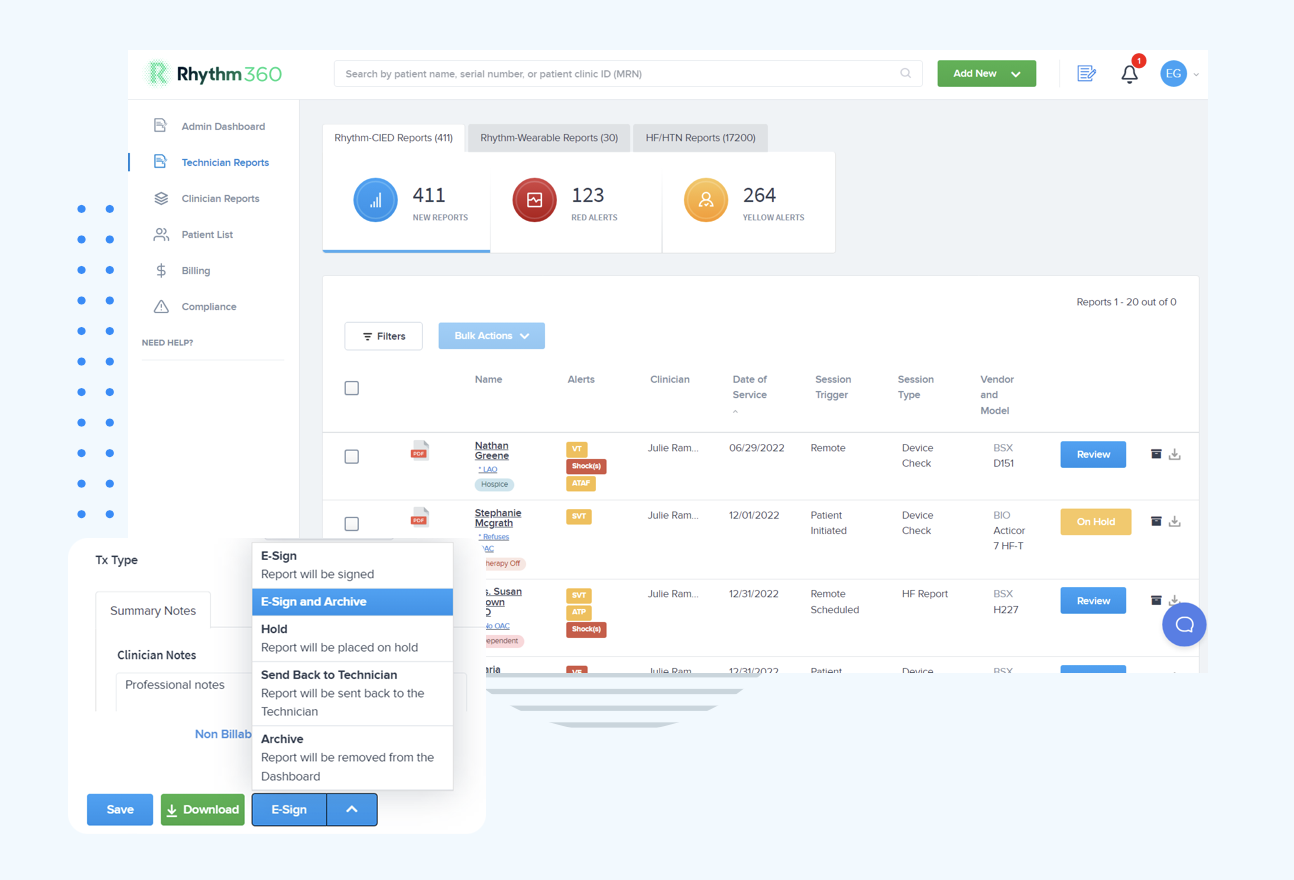
The platform's AI alert triage system filters non-actionable notifications and prioritizes clinically significant events, cutting critical response times by up to 80%. Bi-directional EHR integration with Epic, Cerner, Athenahealth, eClinicalWorks, and others removes manual transcription. Practices using Rhythm360 have seen up to 300% improvement in revenue generation through better CPT code capture and staff efficiency.
Talk to our team about closing your practice's top denial triggers.
At least 16 transmission days per rolling 30-day period. SeeRead Next





