CPT 99454 requires at least 16 unique days of automatic data transmission from FDA-cleared devices within any rolling 30-day period for cardiology RPM billing.
Billing occurs once per 30-day rolling cycle, not per calendar month, which supports flexible revenue capture for hypertension and heart failure monitoring.
CPT 99445 serves as a 2026 fallback for 2-15 data days, remains mutually exclusive with 99454, and supports post-discharge and intermittent monitoring.
Common denials stem from insufficient data days, missing audit trails, and non-compliant devices, so automated tracking and structured compliance checklists are essential.
Rhythm360 automates data aggregation, billing documentation, and compliance for CPT 99454, significantly boosting practice revenue; explore a Rhythm360 demo to strengthen your cardiology RPM program.
The 2026 Medicare Physician Fee Schedule defines clear CPT 99454 billing requirements that cardiology practices must follow to avoid claim denials. CPT 99454 requires at least 16 days of device data based on a rolling 30-day cycle, not a calendar month, which changes how practices track billing periods and monitor eligibility.
The following table breaks down the four core requirements and shows how they apply specifically to cardiology RPM programs.
Requirement | 2026 Specification | Cardiology Application | Reimbursement |
|---|---|---|---|
Minimum Data Days | 16+ unique days | Daily BP, weight, HR monitoring | ~$52.11 average |
Billing Period | Rolling 30-day cycle | Any consecutive 30 days | Once per period |
Device Requirements | FDA-cleared, auto-transmit | Connected BP cuffs, scales | No manual entry |
Data Types | Physiologic parameters | BP, weight, oxygen, pulse | Automatic collection only |
The rolling 30-day calculation means that if a hypertensive patient begins RPM on January 15 and transmits blood pressure data for 16 days by February 13, CPT 99454 becomes billable. The next billing opportunity occurs after March 15, which maintains the 30-day interval.
RPM device codes use a 30-day cycle while RPM time codes use a monthly calendar cycle, so practices must coordinate both timelines carefully to avoid billing errors.
Cardiology practices must capture at least 16 unique days of data in any 30-day period. This minimum defines CPT 99454 billing eligibility for RPM programs. Physiologic data must come from FDA-cleared medical devices that automatically and digitally transmit, which excludes any manually entered patient data.
The table below illustrates how different data day counts determine which CPT code to bill across common cardiology monitoring scenarios.
Scenario | Data Days | Billing Status | Cardiology Example |
|---|---|---|---|
Compliant HTN Monitoring | 18 days | Bill CPT 99454 | Daily BP readings via connected cuff |
Insufficient HF Monitoring | 12 days | Bill CPT 99445 | Weight scale connectivity issues |
CIED + RPM Combined | 20 days | Bill CPT 99454 | Device transmissions + BP monitoring |
Non-compliant Program | 1 day | No billing | Patient non-adherence |
For heart failure patients using connected weight scales, each day the device automatically transmits weight data counts toward this minimum. Missing transmissions from connectivity issues or patient non-compliance reduce billable opportunities and threaten program revenue. Reliable device management and proactive patient outreach protect both reimbursement and clinical outcomes.
Practices can bill CPT 99454 once per rolling 30-day period per patient. The billing clock starts when the patient first meets the data-day minimum, not at the start of a calendar month. This structure requires precise tracking so teams capture every eligible period while staying compliant.
Cardiology RPM billing workflow for CPT 99454:
Day 1: Patient enrollment and device setup (potential CPT 99453)
Days 1-30: Monitor daily data transmissions
Day 16: Minimum threshold met, CPT 99454 becomes billable
Day 30: Submit CPT 99454 claim for the first billing period
Day 31: Begin tracking for the next 30-day period
Day 61: Next CPT 99454 billing opportunity, if the data requirement is met
A traditional office visit does not prevent billing CPT 99454 in the same 30-day period, but in-office vital measurements do not count toward RPM device data requirements.
Practices can therefore maintain regular in-person care while capturing RPM revenue streams at the same time. Understanding how these billing rules apply to specific patient populations helps teams identify strong RPM candidates and design sustainable programs.
Cardiology practices apply CPT 99454 across several high-impact clinical scenarios, each with specific device setups and data workflows. A recent AJMC study of 1,594 Medicare patients with stage-2 hypertension found that a one-year RPM program using FDA-cleared connected blood pressure cuffs lowered mean systolic blood pressure from 152 mmHg to 132 mmHg, which demonstrates both clinical value and billing compliance.
Hypertension Management: Connected blood pressure cuffs automatically transmit daily readings, and each transmission day contributes toward the data requirement. Patients with newly diagnosed hypertension or recent medication changes benefit from intensive monitoring that supports both blood pressure control and CPT 99454 billing.
Heart Failure Monitoring: FDA-approved wireless weight scales track daily weight fluctuations and support early detection of fluid retention. RPM programs for Medicare patients with congestive heart failure may include FDA-approved wireless weight scales alongside hypertension monitoring devices to create comprehensive monitoring that still aligns with CPT 99454 rules.
CIED Integration: Patients with cardiac implantable electronic devices can join additional RPM programs for hypertension or heart failure management. Transmissions from pacemakers or ICDs complement, but do not replace, the requirement for separate FDA-cleared RPM devices that satisfy CPT 99454 data expectations.
Multi-device scenarios require careful consent management and clear data coordination. Practices must ensure each device type maps to the correct billing codes without creating documentation conflicts or compliance risk. See how Rhythm360’s automated data aggregation simplifies complex, multi-device RPM programs.
CPT 99445 in 2026 gives practices a billing path when patients do not reach the data minimum for CPT 99454. CPT code 99445 can be billed for RPM device supply if a patient transmits physiological data for at least 2 days within a 30-day period, serving as a fallback when the 16-day threshold for CPT 99454 is not met.
Code | Data Days Required | Reimbursement | Cardiology Use Case |
|---|---|---|---|
CPT 99454 | 16-30 days | ~$52.11 | Established HTN/HF monitoring |
CPT 99445 | 2-15 days | ~$52.11 | Post-discharge, medication adjustments |
Examples of cardiology applications for CPT 99445 include post-discharge monitoring, newly diagnosed hypertension management, and CHF patients adjusting to diuretics during periods of 2–15 days of data. This flexibility allows practices to capture revenue from patients with intermittent monitoring needs or adherence challenges.
CPT codes 99445 and 99454 are mutually exclusive and cannot both be billed for the same patient within the same 30-day period. Teams must select the correct code based on actual transmission days, so accurate tracking directly supports revenue integrity.
Recognizing frequent denial patterns helps cardiology practices design preventive workflows and improve claim acceptance rates. Failure to capture an audit trail of automated data transmissions and clinical interactions in HIPAA-compliant care coordination software leads to denials of CPT 99454 claims.
Denial Reason | Prevention Strategy | Documentation Requirement |
|---|---|---|
Insufficient data days | Automated tracking systems | Daily transmission logs |
Missing audit trail | HIPAA-compliant software | Complete interaction records |
Incorrect billing period | Rolling 30-day calculations | Precise date tracking |
Non-FDA devices | Approved device verification | Device certification records |
Essential compliance checklist for CPT 99454 claims, organized from data collection through final submission:
Data Requirements:
Verify at least 16 unique transmission days within the rolling 30-day period.
Confirm FDA-cleared device status and automatic transmission capability.
Clinical Documentation:
Document medical necessity with appropriate ICD-10 codes.
Maintain a complete audit trail of patient interactions.
Billing Validation:
Ensure no duplicate billing with CPT 99445 in the same period.
Validate provider NPI and place of service codes.
Rhythm360 serves as a vendor-neutral platform for cardiology RPM that centralizes data from all major device manufacturers, supports intelligent alerting, and automates billing documentation. The AI-powered platform maintains more than 99.9% data transmissibility and creates comprehensive audit trails that align with CPT 99454 billing requirements.
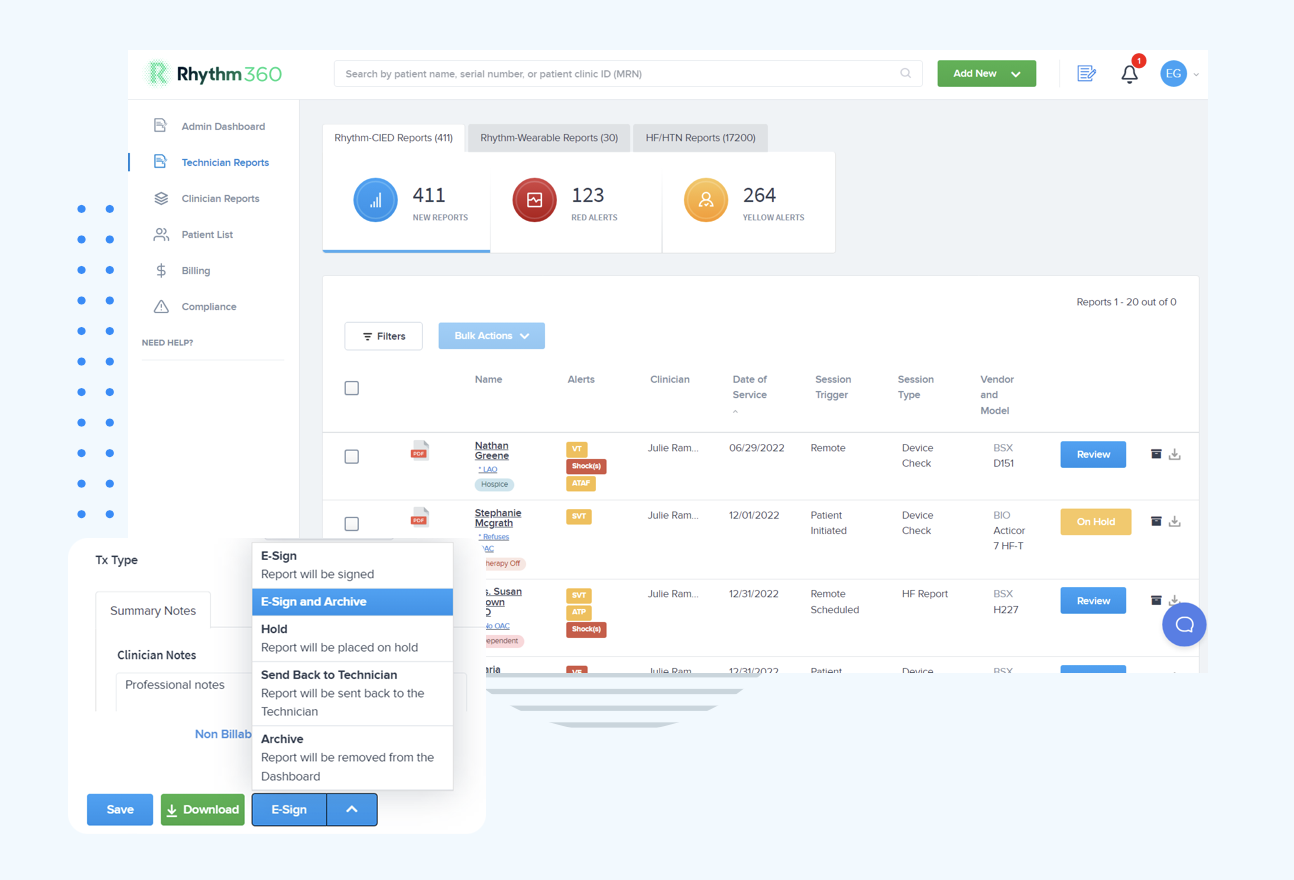
The platform’s bi-directional EHR integration removes manual data entry and automatically generates compliant documentation for hypertension, heart failure, and CIED monitoring programs. Practices using Rhythm360 report significant revenue increases through stronger billing capture and reduced administrative overhead.
Key features for cardiology RPM billing success:
Real-time data aggregation from Medtronic, Abbott, Boston Scientific, and Biotronik devices
Complete audit trail generation for Medicare compliance
Automated report generation and billing documentation
Mobile access for on-call clinicians and remote monitoring
One cardiology practice increased RPM revenue by 285% within six months of implementing Rhythm360 and reduced claim denials by 92% through automated compliance tracking.
Discover how Rhythm360 can transform your cardiology RPM billing performance.
A day for CPT 99454 billing counts when an FDA-cleared medical device automatically transmits physiologic data on a unique calendar day. Each transmission day within the rolling 30-day period contributes to the minimum data requirement. Manual patient data entry does not qualify, and multiple transmissions on the same day count as only one day toward the requirement.
Practices can bill CPT 99454 alongside CIED monitoring codes such as 93298 and 93299 when the RPM data comes from separate FDA-cleared devices like blood pressure monitors or weight scales. CIED transmissions themselves do not count toward CPT 99454 data requirements, but patients with implanted devices can still participate in additional RPM programs for hypertension or heart failure management.
CPT 99445 can be reported once per 30-day rolling period when a patient transmits physiologic data for 2-15 days. It cannot be billed in the same 30-day period as CPT 99454, because these codes are mutually exclusive. After billing CPT 99445, the next billing opportunity begins with a new 30-day period, during which either CPT 99445 or CPT 99454 may apply based on actual data transmission days.
Rhythm360 provides real-time data transmission monitoring, automated billing documentation, and comprehensive audit trails that support CPT 99454 compliance. The platform generates compliance reports and offers a centralized dashboard to track patient adherence and billable activities based on CPT code requirements. Dashboard alerts notify staff of critical patient data and key compliance metrics.
The 30-day rule for Medicare RPM states that CPT 99454 and CPT 99445 billing follow rolling 30-day periods rather than calendar months. Billing eligibility begins when patients meet the minimum data thresholds and continues for exactly 30 days, regardless of month boundaries. Each new billing period starts 30 days after the previous period began, which supports consistent revenue capture while maintaining Medicare compliance.
Rhythm360’s automated tracking helps practices capture every billing opportunity while maintaining precise alignment with Medicare’s 30-day rolling period requirements. Optimize your cardiology RPM billing performance with a Rhythm360 demo.
Mastering 2026 CPT 99454 billing rules requires precise tracking, clear documentation, and reliable technology infrastructure. The rolling 30-day structure and associated data requirements create both opportunity and complexity for cardiology practices that want to grow RPM revenue while staying compliant with Medicare. Transform your practice’s RPM billing capabilities with Rhythm360’s automated compliance management.