Last updated: July 14, 2026
The 2026 Medicare Physician Fee Schedule added two RPM codes, CPT 99445 and CPT 99470. Both reshape how cardiology practices stack device-supply and management-time codes this year.
Four rules govern 99454 billing under the new structure. A patient must transmit physiologic data on at least 16 unique calendar days within each rolling 30-day period. Missing this threshold causes most 99454 denials.
CPT 99454 and the new CPT 99445 are mutually exclusive. Only one device-supply code can be billed per patient per 30-day period. 99454 pairs with 99457 for 20 or more minutes of management time, and with 99458 for each additional 20 minutes. The new 99470 covers the first 10 to 19 minutes but cannot be billed alongside 99457.
CIED interrogation typically bills under cardiac-specific codes 93294–93298 rather than the general RPM set, though payer contracts govern specific stacking allowances. The next section breaks down exactly how the 16-day rule works in practice, since it drives the majority of denials.
See how Rhythm360 automates this framework for your practice.
A "day" counts only when an FDA-cleared device records a reading and transmits it automatically to the monitoring system. Multiple readings from different devices on the same calendar day count as one data day.
Practices that consistently hit the 16-day threshold follow a connected sequence. First, confirm the patient uses an FDA-cleared device with automated cellular, Bluetooth, or Wi-Fi transmission. Manual data entry does not qualify. Next, enable daily automated reminders through push notifications, texts, or calls to prompt device use.
From there, staff monitor transmission dashboards weekly and flag patients missing two or more consecutive days. That early flag is what makes proactive intervention possible: troubleshooting connectivity, replacing batteries, or shipping a new device before the billing period closes. Once the period ends, confirm the transmission log shows 16 or more unique calendar days with at least one received reading, and verify the combined day count across all devices, such as a weight scale and blood-pressure cuff, reaches that 16-day mark. The threshold applies to combined transmissions across all devices.
Heart-failure patients transmitting daily weights via a connected scale illustrate this rule well. So do CardioMEMS pulmonary artery pressure monitors that stream hemodynamic data automatically. Common failure scenarios include hospitalization, battery depletion, and patient travel without the device.
CPT 99454 follows rolling 30-day cycles rather than calendar months and bills once per patient per period. A patient enrolled on March 10 has a billing period closing April 8, not March 31.
Meeting these frequency rules only matters if the underlying documentation holds up. The next section covers exactly what payers require on file.
CMS and commercial payers require specific documentation before and during each billing period. Missing any single element below can trigger a denial, so use this table to confirm your practice has each piece on file.
| Documentation Element | Requirement | Notes |
|---|---|---|
| Patient consent | Written, obtained before first billing cycle | Must include cost-sharing acknowledgment |
| Physician order & medical necessity | Documented before enrollment | Must state condition (e.g., CHF, HTN) and rationale for RPM |
| Device confirmation | FDA-cleared device with automatic transmission | Consumer wearables like Apple Watch or Fitbit do not qualify |
| Automated transmission log | Date, reading type, and receipt confirmation per qualifying day; 16+ days confirmed | Data must be timestamped at the device level |
| ICD-10 diagnosis codes | Tied to qualifying condition (e.g., I50.x for HF, I10 for HTN) | Required on every claim |
| Device setup & patient education | Logged at enrollment | Billed separately under CPT 99453 (one-time, ~$22) |
| Sole-billing confirmation | No other practitioner billing RPM for same patient in same period | Audit-ready documentation required |
CIED remote monitoring typically bills under interrogation codes 93294–93298 rather than 99453–99454. Pacemakers, ICDs, and CRT devices still qualify as FDA-cleared devices eligible for 99454 when they support automatic daily transmission, so the two code sets can interact in ways practices often miss.
Start by verifying with each payer whether 99454 can be stacked with 93294–93298 for the same patient in the same period. If it can, document the distinct clinical purpose of each modality, rhythm interrogation versus physiologic parameter tracking, since that distinction supports separate billing. Keep in mind that 99454 cannot be billed with RTM codes; RPM and RTM cannot both be billed for the same patient in the same month. Finally, 99454 pairs with 99457/99458 for management time only when that time and those activities are documented independently, with no overlap.
Rhythm360's vendor-neutral platform ingests data from major CIED manufacturers, including Medtronic, Boston Scientific, Abbott, and Biotronik, alongside RPM device streams. This gives billing teams one audit trail that supports compliant code selection across both code sets, without staff reconciling multiple OEM portals.
CMS finalized two new RPM codes effective January 1, 2026, in the CY 2026 Physician Fee Schedule Final Rule.
| CPT Code | Description | 2026 National Average Rate | Key Restriction |
|---|---|---|---|
| 99453 | Initial device setup & patient education (one-time) | ~$22 | Billed once per patient |
| 99445 (new 2026) | Device supply, 2–15 transmission days per 30-day period | approximately $47 | Mutually exclusive with 99454 |
| 99454 | Device supply, 16–30 transmission days per 30-day period | $52.11 | Mutually exclusive with 99445 |
| 99470 (new 2026) | RPM treatment management, 10–19 minutes per 30-day period | ~$26 | Mutually exclusive with 99457 |
| 99457 | RPM treatment management, first 20+ minutes per 30-day period | ~$52 | Requires live interactive communication |
| 99458 | Add-on: each additional 20 minutes of management time | ~$41 | Reported with 99457; may be billed more than once |
Aetna's March 2026 policy limits RPM coverage to heart failure, hypertension, and diabetes, and excludes the new codes 99445 and 99470. Anthem Medicare Advantage plans fully cover both new short-cycle codes. Practices must verify coverage by payer before billing either new code. That coverage gap is exactly the kind of detail that triggers audits when missed, which is why documentation discipline matters as much as code selection.
CMS, OIG, DOJ, and Medicaid Program Integrity units apply heightened scrutiny to RPM claims, including 99454, for medical necessity, proper coding, and accurate billing. Most denials trace back to a short list of recurring problems.
A pre-submission audit checklist for each 30-day period should confirm the following points, in order, before a claim goes out.
Practices can turn this checklist into a downloadable audit template, paired with a transmission-log template capturing patient name, MRN, device type, FDA clearance number, billing period dates, and a day-by-day transmission receipt log. Retain both templates in the patient record for each billing period, since they become the first documents an auditor requests.
Rhythm360 unifies CIED data management and RPM compliance in a single, vendor-neutral environment. It was built to handle the exact checklist and threshold-tracking work described above without manual reconciliation.
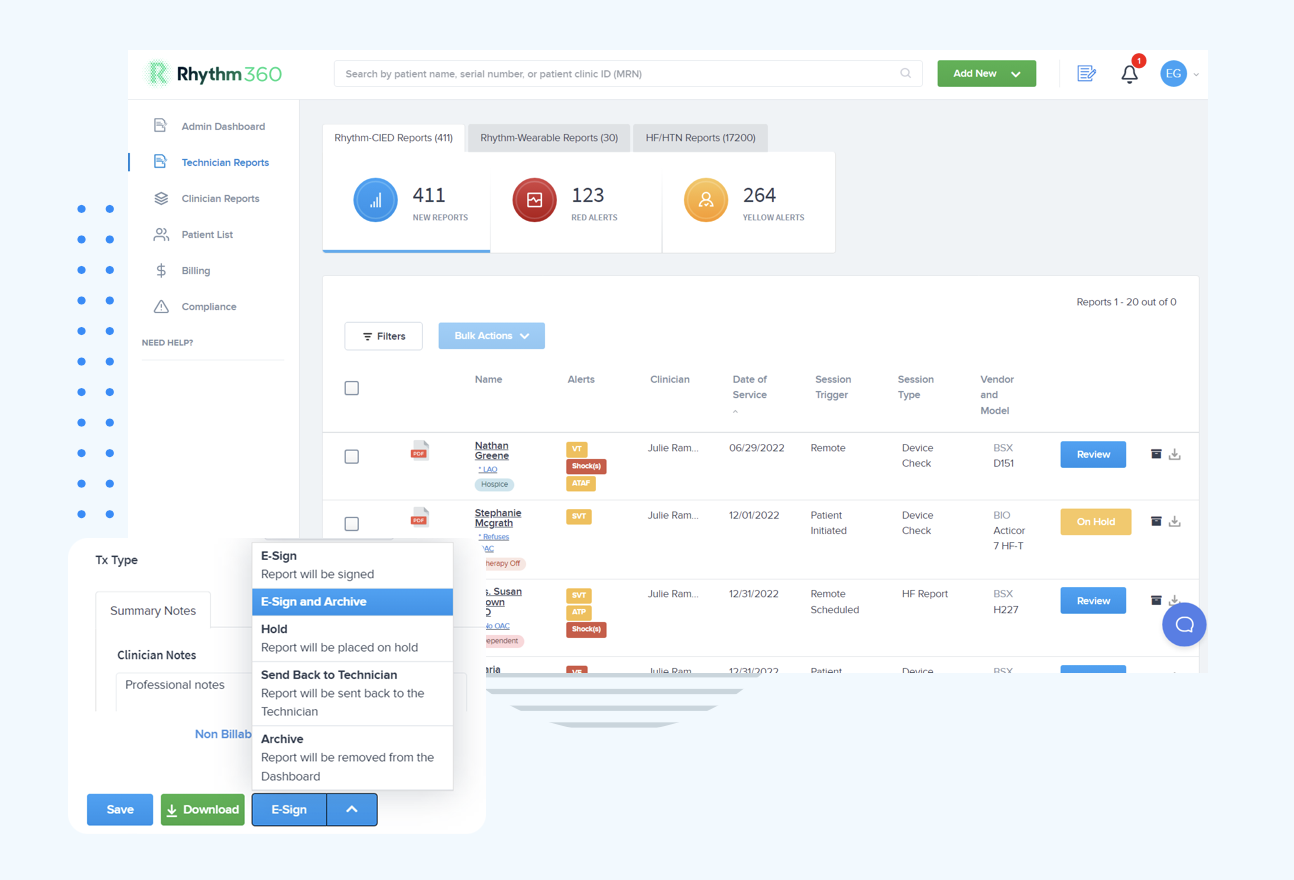
Rhythm360's capabilities relevant to 99454 compliance include:
Practices implementing Rhythm360 have achieved up to a 300% increase in RPM revenue through better CPT code capture and staff efficiency, alongside an 80% reduction in critical alert response times.
Watch the 16-day tracking dashboard in action and see the documentation workflow firsthand.
The 2026 RPM code landscape gives cardiology practices more billing flexibility than any prior year. 99454 anchors high-compliance patients, while 99445 and 99470 open shorter monitoring windows. A practice monitoring 200 RPM patients at the standard tier (99454 + 99457) generates approximately $19,800 per month from RPM alone.
Capturing that revenue consistently requires automated threshold tracking, audit-ready documentation, and a platform that handles CIED and RPM data without forcing staff through multiple OEM portals. Rhythm360 provides that infrastructure: 16-day rule automation, CIED data unification, CPT documentation generation, and EHR integration, so practices can focus on patient care instead of billing risk.
Talk to our team about your practice's RPM revenue capture and see how Rhythm360 keeps you audit-ready.
Yes. CPT 99445 covers 2 to 15 days of valid transmission within a 30-day period at approximately $47. The practice bills 99445 instead of 99454 for that period, since the two codes are mutually exclusive. If the patient transmits on fewer than 2 days, no device-supply code may be billed for that period. Practices should verify that their payer covers 99445, since some commercial plans, including Aetna as of early 2026, have not adopted the new short-cycle codes.
The two code sets serve distinct purposes. Codes 93294–93298 cover device-specific interrogation and programming review, while 99454 covers supply and daily transmission of an FDA-cleared monitoring device. Whether both may be billed together depends on the payer contract and the clinical documentation supporting each service. Practices should consult their Medicare Administrative Contractor and review commercial payer policies before stacking these codes. Rhythm360 maintains separate, auditable documentation streams for CIED interrogation and RPM monitoring, supporting the distinct medical necessity documentation each code set requires.
Before the first billing cycle, the practice needs written patient consent with cost-sharing acknowledgment, a physician order documenting medical necessity tied to a qualifying condition, confirmation that the device is FDA-cleared with automatic transmission, and a completed device setup record billed separately under CPT 99453. The ICD-10 diagnosis code tied to the monitoring condition must appear on every subsequent claim. Rhythm360 automates generation and storage of these enrollment documents, building an audit trail from day one.
As noted above, Rhythm360's dashboard tracks each patient's transmission count in real time throughout the billing period. When a patient misses two or more consecutive days, the platform triggers outreach through SMS, voice, or push notification. Clinical staff get a prioritized worklist of at-risk patients with days remaining, enabling intervention such as device troubleshooting before the period closes. Because the platform counts unique calendar days across every connected device, it prevents the undercounting that happens when staff manually reconcile multiple OEM portals.
Yes, provided the documented time and activities for each service do not overlap. Time logged toward RPM management codes (99457, 99458, or 99470) must stay distinct from time logged toward CCM. Practices must also confirm that only one practitioner bills any RPM code per patient per 30-day period, and that RPM and RTM codes are not billed concurrently. Rhythm360's time-logging tools capture service-specific entries separately, supporting compliant stacking across care-management programs.