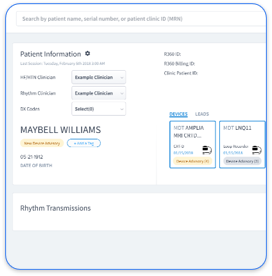
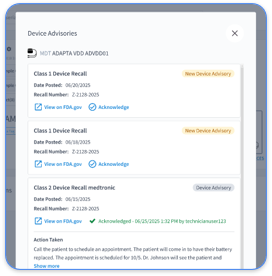
Rhythm360 is a vendor-neutral, HIPAA-compliant platform that consolidates data from all major CIED manufacturers into a single AI-powered dashboard. It ingests API, HL7, XML, and unstructured PDF data through computer vision and AI-powered normalization, which delivers greater than 99.9% transmissibility and removes the data gaps that trigger denials for 93298, 99454, and the full CIED remote monitoring code family (93294–93299).
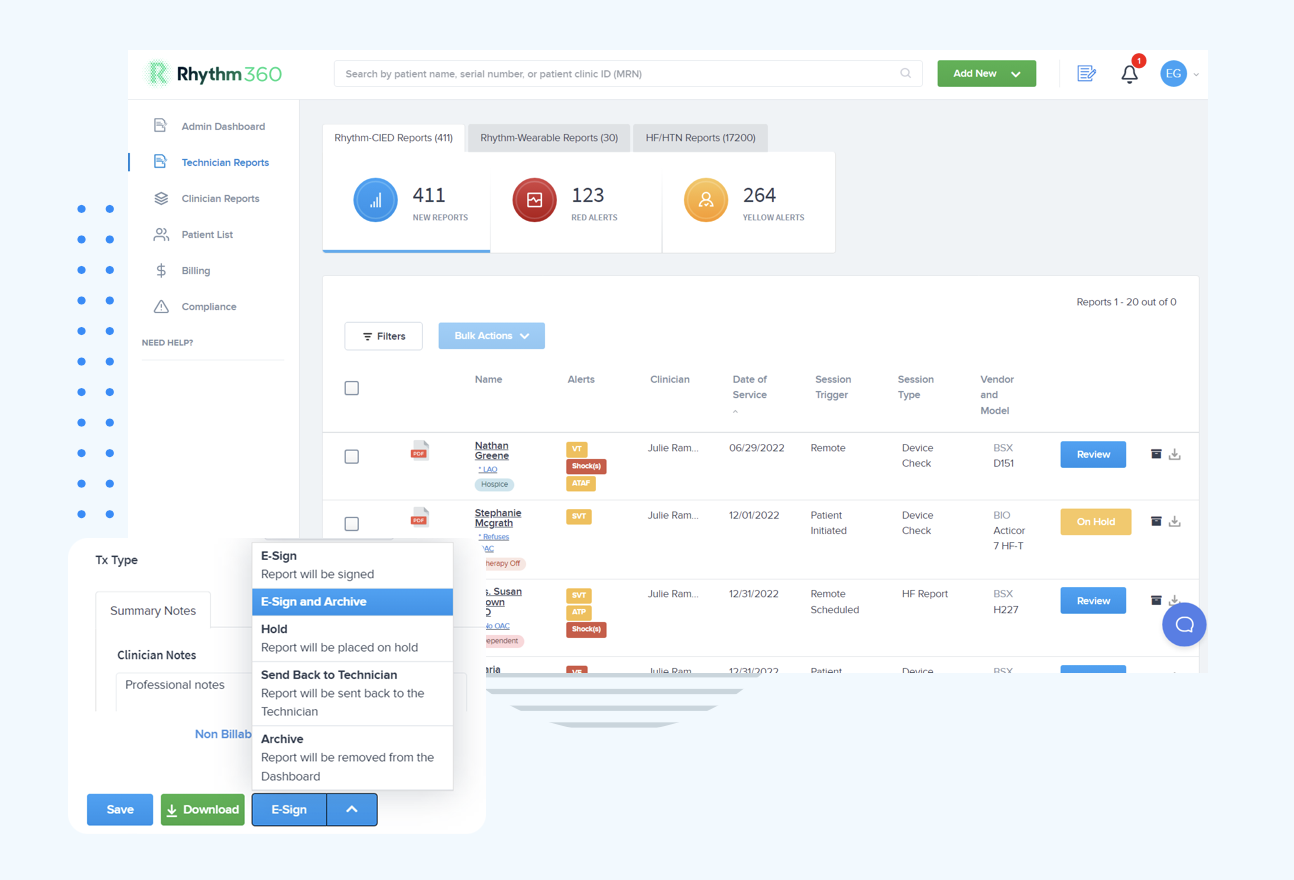
Bi-directional EHR integration with Epic, Cerner, Athenahealth, and eClinicalWorks sends compliant documentation directly into the billing workflow without manual transcription. Automated CPT capture tracks transmission days, flags threshold eligibility, and generates the complete documentation stack that CMS and commercial payers require for clean claim submission.
These capabilities prevent the most frequent rejection scenarios that cardiology teams see every month. The following denial codes account for a large share of remote monitoring claim failures and show where automation delivers the fastest impact.
| Denial Code | Common Cardiology Trigger | Quick Fix | Rhythm360 Automation Benefit |
|---|---|---|---|
| CO-16 (Claim lacks information) | Missing transmission logs, absent FDA device proof, or no documented patient consent for 99454 or 93298 | Attach complete transmission records, FDA device confirmation, and signed consent before submission | Auto-generates compliance documentation including consent logs, device records, and transmission reports at the point of billing |
| CO-4 (Modifier required) | Missing or incorrect modifiers (26, TC, 59, 51) on multi-code CIED encounters | Audit modifier logic against payer-specific LCD rules before submission | Built-in claim scrubbing flags modifier mismatches against payer rules prior to submission |
| CO-50 (Not medically necessary) | ICD-10 diagnosis codes that do not demonstrate medical necessity for the RPM service billed | Ensure ICD-10 codes align with the monitored condition and document clinical rationale in the record | Structured EHR integration surfaces diagnosis-to-CPT alignment gaps before claim submission |
| CO-97 (Bundling/frequency) | Billing 93297 and 93295 together, or exceeding frequency limits such as billing 93880 twice per year | Implement a payer policy matrix tracking frequency limits and mutually exclusive code pairs | Automated code-pair validation prevents mutually exclusive and frequency-exceeded submissions |
| CO-B7 / Eligibility Mismatch | Front-office data entry errors or stale eligibility data causing NPI or coverage failures | Run real-time eligibility verification at scheduling and again at claim submission | Real-time eligibility checks integrated into the billing workflow catch coverage issues before submission |
See how automated claim scrubbing catches these errors before submission with a guided walkthrough of Rhythm360’s pre-submission validation.
1. Transmission-Day Threshold Failures (99454 / 99445)
Billing 99454 when a patient transmitted fewer than 16 days of data is one of the most common denial triggers in RPM billing. The 2026 CPT update introduced 99445 for 2–15 transmission days. Rhythm360 tracks daily transmission counts per patient and automatically routes billing to the correct code, which removes threshold errors from your workflow.
2. Mutually Exclusive Code Pairs
CPT codes 99445 and 99454 are mutually exclusive, as are 99470 and 99457 when billed in the same period. Billing mutually exclusive codes together is a documented top denial cause for 2026 RPM claims. Rhythm360’s automated code-pair validation blocks these combinations before submission and prompts staff to correct them.
3. Incomplete RPM Code Stack
Failure to bill the full RPM code stack — 99453 setup, 99454 or 99445 device supply, and 99457/99458 management — together in the same month leaves 30–40% of available RPM revenue uncaptured. Rhythm360’s billing dashboard flags incomplete code stacks for eligible patients each calendar month so staff can close those gaps before month-end.
4. CO-16: Missing or Insufficient Documentation
Lack of detailed records, activity logs, and complete documentation for enrollment, device orders, readings, time spent, alerts, and ordering provider makes denial appeals harder and CO-16 rejections more likely. Rhythm360 auto-generates structured documentation at every billable event and creates a complete audit trail without manual entry.
5. Missing Patient Consent Records
Patient consent is required for RPM services. Lack of documented patient consent is a confirmed top denial cause for RPM claims. Rhythm360 stores consent records within the patient record and surfaces missing consent flags before billing starts.
6. Non-FDA-Cleared Device Documentation
RPM devices require proper documentation to support billing. Missing FDA device proof increases denial risk for 99454 and CIED remote monitoring codes 93294–93299. Rhythm360 maintains device-level records confirming FDA clearance status for every monitored patient and links those records to each claim.
7. Modifier Errors on Multi-Code CIED Encounters
Incorrect or incomplete CPT and ICD coding, particularly when multiple codes, modifiers such as 26, TC, 59, and 51, and device-related procedures are involved in a single encounter, is a primary driver of cardiology claim denials. Rhythm360’s pre-submission scrubbing validates modifier logic against payer-specific rules before the claim leaves the practice.
8. Eligibility and NPI Mismatches
Correct NPI usage for RPM claims reduces rejections under Medicare rules. Rhythm360’s billing logic enforces single-NPI compliance per patient per period automatically and pairs that control with integrated eligibility checks.
9. Missing Interactive Communication Documentation (99457 / 99470)
CMS requires at least one live, interactive communication with the patient or caregiver per calendar month to bill any RPM treatment management code. Rhythm360’s integrated Twilio-powered communication hub logs all patient interactions with timestamps and creates the evidence required for clean 99457 and 99470 claims.
10. Payer-Specific Rule Violations and Timely Filing
Commercial payers frequently impose their own timelines, coverage policies, prior authorization requirements, and claim edits for RPM services, making payer-specific tracking essential. Timely filing issues and shifting Medicare reimbursement policies cause claims that previously passed to suddenly fail. Rhythm360 maintains a payer-rule framework that updates compliance logic as LCD and payer policies change.
Legacy workflows require device technicians to log into separate OEM portals, manually transcribe transmission data into the EHR, and then hand off incomplete documentation to billing staff who must reconstruct the compliance record from scratch. Manual data entry from multiple device manufacturer portals fails the automatic transmission requirement for CPT 99454 and similar remote monitoring codes, which triggers denials in cardiology CIED billing.
Rhythm360 replaces that chain of manual steps with a single automated workflow. Data ingestion from all OEM sources runs continuously, and the platform tracks transmission-day counts in real time. It flags CPT eligibility automatically and uses bi-directional EHR integration to push structured documentation directly into the billing record. Automated claim scrubbing catches modifier errors, ICD-10/CPT mismatches, and payer-specific rule violations before submission, which mirrors the AI-driven approach that payers now use to deny claims. Claim denial rates can drop significantly after RPM platform implementation in monitored cohorts, and that improvement compounds across the full patient population.
Vendor neutrality: The platform must ingest data from all major OEMs such as Medtronic, Boston Scientific, Abbott, and Biotronik without requiring separate portal logins or manual data entry. This unified data foundation supports accurate tracking and billing.
Transmission-day tracking: The system should provide automated, real-time counting of qualifying transmission days per patient per 30-day period, with automatic routing to 99445 or 99454 based on actual data. These tracked events then feed directly into your compliance record.
Complete compliance documentation: Every billable event such as consent, device order, transmission log, clinical communication, and time-stamped notes must be captured automatically and stored in a structured, retrievable format ready for payer audit.
Bi-directional EHR integration: The platform should integrate with your existing EHR, including Epic, Cerner, Athenahealth, and eClinicalWorks, and push structured data in both directions, not just export PDFs.
Pre-submission claim scrubbing: Built-in logic needs to validate CPT code pairs, modifier requirements, NPI rules, and payer-specific LCDs before the claim is submitted so staff can correct issues in real time.
Payer policy tracking: A maintained framework must update compliance rules as Medicare and commercial payers release new coverage determinations and reimbursement policy changes throughout the year.
Onboarding speed: Implementation, including EHR integration, should complete in days to weeks rather than months to limit revenue disruption during transition.
Revenue recovery metrics: The platform should provide a real-time dashboard showing captured versus potential CPT revenue, denial rates by code, and trend data that quantify ROI.
How do I handle a rejected remote monitoring claim for CPT 99454?
Start by identifying the denial code on the Explanation of Benefits or remittance advice. For CO-16 denials, the most common fix is attaching complete transmission logs confirming at least 16 days of automatic data upload, documented patient consent, and FDA device confirmation. If the patient transmitted fewer than 16 days, rebill using CPT 99445 for 2–15 days rather than appealing a threshold violation. Verify that only one NPI was used for the patient in that 30-day period and that the full RPM code stack, including setup, device supply, and management, was submitted together. Appeals must include all supporting documentation and must be filed within the payer’s timely filing window, which varies by payer but typically ranges from 60 to 180 days from the denial date.
What does CO-16 mean in cardiology billing?
CO-16 is a claim adjustment reason code that indicates the claim lacks the information needed for adjudication. In cardiology remote monitoring, CO-16 most commonly appears when transmission logs are missing, patient consent is not documented in the medical record, FDA device clearance is not confirmed, or the ordering provider’s credentials are not on file. It remains one of the most preventable denial codes in RPM billing because every required data element can be captured automatically at the point of service with the right platform infrastructure.
What is the difference between CPT 99454 and CPT 99445 in 2026?
CPT 99454 applies when a patient transmits physiologic data on 16 or more days within a 30-day billing period. CPT 99445, introduced January 1, 2026, applies when transmission occurs on 2–15 days in that same window. The two codes are mutually exclusive and cannot be billed together in the same month for the same patient. Practices must track actual transmission days per patient per period and route billing to the correct code accordingly. Billing 99454 when a patient transmitted fewer than 16 days creates a direct denial trigger and can also flag the practice for audit.
How long do I have to appeal a denied cardiology remote monitoring claim?
Appeal timelines vary by payer. For Medicare, the first level of appeal, called a redetermination, must be filed within 120 days of receiving the initial denial. Commercial payer timelines typically range from 60 to 180 days from the denial date, and some payers impose shorter windows for specific denial types. Missing the appeal deadline forfeits the revenue entirely, which is why proactive denial prevention through automated claim scrubbing and documentation usually proves more cost-effective than relying on the appeals process. Maintaining a payer policy matrix that tracks appeal deadlines by payer and denial code type is a recommended operational control.
Can RPM codes be billed at the same time as CIED remote monitoring codes like 93298?
RPM codes (99453, 99454, 99445, 99457, 99458, 99470) and CIED remote monitoring codes (93294–93299) serve different clinical purposes and follow different billing rules. CIED codes cover interrogation and monitoring of implantable cardiac devices and are billed based on device type and interrogation frequency. RPM codes cover physiologic data monitoring such as blood pressure, weight, or heart rate from external devices. A patient with a CIED who is also enrolled in an RPM program for heart failure management may qualify for both code families, but each set of codes must independently meet its own documentation, threshold, and medical necessity requirements. Billing both without meeting the separate requirements for each creates denial risk, and practices should confirm payer-specific policies because some commercial payers impose additional restrictions on concurrent billing.
The root cause of most cardiology remote monitoring claim rejections is not coder error, but fragmented infrastructure. When transmission data lives across four OEM portals, when consent records sit in paper files, and when transmission-day counts are tracked on spreadsheets, denials for 93298, 99454, and the full CIED code family become almost inevitable. The 86% of claim denials that are potentially avoidable remain unresolved because manual workflows cannot match the documentation precision that payers now expect.
Rhythm360 addresses the problem at its source. A single vendor-neutral platform normalizes data from every OEM, automates CPT capture and threshold tracking, scrubs claims against payer-specific rules, and delivers structured documentation ready for payer review before a claim reaches the payer. Practices that implement Rhythm360 have achieved an 80% reduction in critical alert response times and up to a 300% increase in revenue generation through improved CPT code capture and the removal of preventable denials.
Calculate your potential revenue recovery and denial reduction with a Rhythm360 consultation and see how a unified platform can close the revenue gaps that fragmented OEM portals create in your cardiology practice.