

Schedule a Demo with Rhythm360
Remote patient monitoring billing compliance depends on accurate code selection, disciplined documentation, and reliable operational workflows. Cardiology and electrophysiology practices face higher stakes than many specialties because RPM codes and cardiac implantable electronic device (CIED) interrogation codes run in parallel on the same patient panel, each with its own frequency rules, device-type requirements, and supervision standards.
Billing teams need a shared vocabulary. RPM (remote physiologic monitoring) captures automatically transmitted physiologic data such as blood pressure, weight, and pulse oximetry. RTM (remote therapeutic monitoring) captures non-physiologic, often self-reported, therapeutic adherence data. CCM (chronic care management) covers care coordination for patients with two or more chronic conditions. CIED (cardiac implantable electronic device) includes pacemakers, ICDs, implantable cardiovascular physiologic monitors, and subcutaneous cardiac rhythm monitors. An initiating visit is the face-to-face or telehealth encounter required before monitoring services begin. General supervision means the billing practitioner directs the service without being physically present.
Two developments make 2026 a pivotal compliance year. First, the CMS CY 2026 Physician Fee Schedule Final Rule added CPT 99445 and 99470 effective January 1, 2026, which now pay for partial-month work that previously went uncompensated. Second, Medicare paid approximately $536 million for RPM in 2024, up 31% year over year, a growth curve that has drawn sustained OIG scrutiny and the first False Claims Act settlements in the RPM space. The CY 2027 Physician Fee Schedule Proposed Rule, released July 14, 2026, signals tighter controls ahead, including an initiating visit requirement and a contracted clinical staff limitation. Practices that cannot produce a defensible audit file for every 30-day and 90-day cycle are accumulating recoupment exposure now.
See How Rhythm360 Automates CPT Capture
Given the compliance stakes outlined above, practices need a concrete audit file for every RPM claim. The following nine-item checklist represents the documentation a practice must be able to produce on request for any RPM claim. A missing element on any item creates grounds for denial or post-payment recoupment.
The table below covers the six RPM codes active in 2026. Code definitions remain concise, and the documentation and denial columns highlight the operational compliance requirements that determine whether a claim survives review.
| CPT Code | Time / Data Threshold | Who Can Bill / Perform | Documentation Required and Most Common Denial Reason |
|---|---|---|---|
| 99453 | One-time per episode of care; setup and patient education | QHP or clinical staff under general supervision | Documentation: device type, setup date, patient education. Denial: billed more than once per episode or no setup documentation. Source |
| 99454 | 16 or more days of transmitted data in a 30-day period | QHP | Documentation: device transmission log showing 16 or more unique days. Denial: fewer than 16 days of data, in which case bill 99445 instead. Source |
| 99445 | 2–15 days of transmitted data in a 30-day period (new for 2026) | QHP | Documentation: day range and device type. Denial: billed with 99454 for the same period, because the codes are mutually exclusive. Source |
| 99457 | First 20 minutes of treatment management per calendar month | Physician, QHP, or clinical staff under general supervision | Documentation: time log, data review, and at least one real-time interactive communication. Denial: no documented interactive communication. Source |
| 99458 | Each additional 20 minutes beyond 99457 | Same as 99457 | Documentation: separate time log for the additional increment. Denial: billed without 99457 in the same month. Source |
| 99470 | First 10–19 minutes of treatment management per calendar month (new for 2026) | Same as 99457 | Documentation: time log and at least one interactive communication. Denial: billed with 99457 in the same month, because the codes are mutually exclusive. Source |
While the table covers the six RPM codes active in 2026, two of them, 99445 and 99470, are new this year and warrant a closer look.
The CMS CY 2026 Physician Fee Schedule Final Rule created new codes for both RPM and RTM for episodes involving less than 16 days of data transmission per 30-day period and less than 20 minutes of interactive communication per month. For RPM, those codes are CPT 99445 and CPT 99470, both effective January 1, 2026.
CPT 99445 covers the supply of an FDA-cleared connected physiologic monitoring device and the daily recording and transmission of patient data for 2 to 15 days within a 30-day period. CPT 99470 covers the first 10 to 19 minutes of RPM treatment management services in a calendar month and requires at least one interactive communication with the patient or caregiver.
The operational impact for billing teams is direct. A patient with 12 reading days and 15 management minutes, previously worth $0 under the 2025 framework, can now generate 99445 plus 99470. CPT 99445 cannot be billed with 99454 for the same period, and CPT 99470 cannot be billed with 99457 for the same month. These pairs are mutually exclusive, so practices must select the code that matches the patient’s actual engagement level.
On the RTM side, new codes 98984, 98985, and 98979 address RTM episodes below the 16-day and 20-minute thresholds. RTM and RPM cannot be billed together for the same patient in the same month.
Medicare pays separately for RPM when the code-specific requirements are met. CMS’s Medicare Learning Network booklet MLN901705 (December 2025) states that only one practitioner may bill remote monitoring for a patient in a 30-day period.
Only physicians and non-physician practitioners eligible to provide evaluation and management services can bill RPM services, per the CMS Telehealth Services MLN Fact Sheet (December 2025). This group includes nurse practitioners and physician assistants, though state scope-of-practice rules may further restrict billing in some jurisdictions.
CMS clarified in the 2026 Final Physician Fee Schedule that RPM, RTM, and Digital Mental Health Treatment services are inherently non-face-to-face, do not meet the definition of a Medicare telehealth service under section 1834(m) of the Act, and are therefore not subject to section 1834(m) telehealth restrictions. Coverage extends to both acute and chronic conditions when remote physiologic monitoring is medically necessary.
CMS’s MLN901705 (December 2025) requires practices to prevent duplicate billing across providers, locations, and NPIs within the same 30-day window and to confirm before the first month of either time-based family whether another practitioner is already billing it for that patient. The one-practitioner-per-30-day rule functions as a hard stop.
RPM and RTM cannot be billed together for the same patient in the same month, per the CY 2024 Physician Fee Schedule Final Rule. RPM monitors physiologic data transmitted automatically by an FDA-cleared device. RTM monitors non-physiologic therapeutic data that may be self-reported. Billing both for the same patient in the same period creates a concurrent-billing error that payers catch on review. To avoid this, the biller must confirm several items before submitting any claim.
Before submitting any claim, the biller must confirm three things. First, verify single-biller status: no other practitioner has billed RPM or RTM for this patient in the same 30-day window. Second, ensure RPM and RTM are not both active for the same patient in the same month. Third, check that the device and data type match the code family being billed. Missing any one of these creates a concurrent-billing error.
CMS allows the same practitioner to bill CCM (99490) and RPM (99457) for the same patient in the same month because they compensate different work, and no minute of staff time may count toward both. Supporting both requires at least 40 total minutes in two separately logged buckets.
The chart note must show separate time entries for RPM activities such as data review, device-related patient communication, and care plan updates tied to the monitored parameter. It must also show separate entries for CCM activities such as broader care coordination, medication management, and care plan oversight for all chronic conditions. Vague or combined time entries create audit exposure, and CCM and RPM time cannot be merged into a single entry.
Pre-submission check for concurrent RPM and CCM billing:
Cardiology and EP practices manage two billing cadences simultaneously, the 90-day cycle for pacemakers and ICDs and the 30-day cycle for physiologic monitors and loop recorders. Applying the wrong cycle or the wrong code to the wrong device is the most common source of CIED remote monitoring denials.
For pacemakers and ICDs, the relevant codes are CPT 93294 (pacemaker professional component), CPT 93295 (ICD professional component), and CPT 93296 (shared technical component for both pacemakers and ICDs). These codes run on a 90-day reporting interval. Billing pacemaker or ICD interrogation codes on a monthly cycle rather than the required 90-day cycle creates a frequency denial pattern and audit exposure on previously submitted claims.
For implantable cardiovascular physiologic monitors and subcutaneous cardiac rhythm monitors, the relevant codes are CPT 93297 and CPT 93298. These are device-specific codes, not a professional and technical pair. Each is billable once per 30 days and can be split into professional (-26) and technical (-TC) components.
Device-type mismatch is the most common denial reason in this code family. For example, billing 93297 for a loop recorder or 93298 for a physiologic monitor triggers a denial on review. CPT 93296 is the technical component code for remote pacemaker and implantable defibrillator monitoring over a 90-day period and is not the technical partner to 93297.
The 93297 and 93298 versus 99454 distinction creates a key compliance fault line for cardiology practices that manage CIED patients alongside RPM. CPT 99454 is the generic RPM device-supply code for physiologic data such as blood pressure, weight, and pulse oximetry, and it does not function as a cardiac device interrogation code. CIED monitoring and RPM can be operationally related but are billed under different code sets, the 99453–99458 RPM family versus the 93297–93298 implantable cardiac family. Applying RPM code logic to CIED interrogation claims, or the reverse, produces systematic denials that auditors extrapolate across the full patient panel.
For practices where a monitoring vendor or device manufacturer bills the technical component (93297-TC or 93298-TC) directly to Medicare, the practice may bill only the professional component (-26). Submitting a global 93297 when a monitoring company has already billed 93297-TC creates a duplicate-billing overlap that MACs recoup on audit. Contract terms, not habit, must determine which party owns each component for each monitored patient.
For a deeper review of CIED monitoring best practices, see the Remote Monitoring of Implanted Cardiac Devices: 2026 Guide.
The CY 2027 Medicare Physician Fee Schedule Proposed Rule, released July 14, 2026, outlines two changes that would materially alter how RPM and RTM services are structured and staffed. The comment period closed September 14, 2026. If finalized, changes take effect January 1, 2027.
Initiating Visit Requirement. CMS proposes that practitioners reporting RPM or RTM services must furnish a separately reportable initiating visit in association with the onset of RPM or RTM services. The visit may be furnished in person or via telehealth. The visit must specifically address RPM or RTM, include a clinical determination that monitoring is appropriate, and include documented patient consent. A visit at which RPM or RTM is not actually discussed does not qualify, even if otherwise billable.
Contracted Clinical Staff Limitation. CMS proposes that payment for RPM or RTM services be allowed only when performed by clinical staff employed by the practice and not when those services are delivered by contractors. The prohibition targets clinical staffing specifically, and practices may still purchase software, connected devices, or data platforms from third-party vendors.
Practices should take three preparatory steps now:
CMS is also soliciting comments on replacing the current 17 RPM and RTM CPT codes with four bundled HCPCS G-codes. The proposed monthly RPM bundled code GRPM2 would require at least two days of data transmission and at least 20 minutes of treatment management, including at least one real-time interactive communication with the patient. No valuations have been proposed for these G-codes yet.
Each denial reason below maps to a specific documentation failure. Prevention depends on a pre-submission check rather than a post-denial appeal.
The compliance gaps described throughout this guide, including device-type mismatches, missing time logs, absent interactive communication records, and concurrent-billing overlaps, share a common root cause. Fragmented data and manual workflows cannot reliably produce a defensible audit file at scale.
Rhythm360 is a vendor-neutral, HIPAA-compliant platform that consolidates CIED and RPM data into a single source of truth. The platform ingests data from major device manufacturers such as Medtronic, Boston Scientific, Abbott, Biotronik, and others, which removes the need for staff to log into separate OEM portals and manually reconcile transmission records before billing.
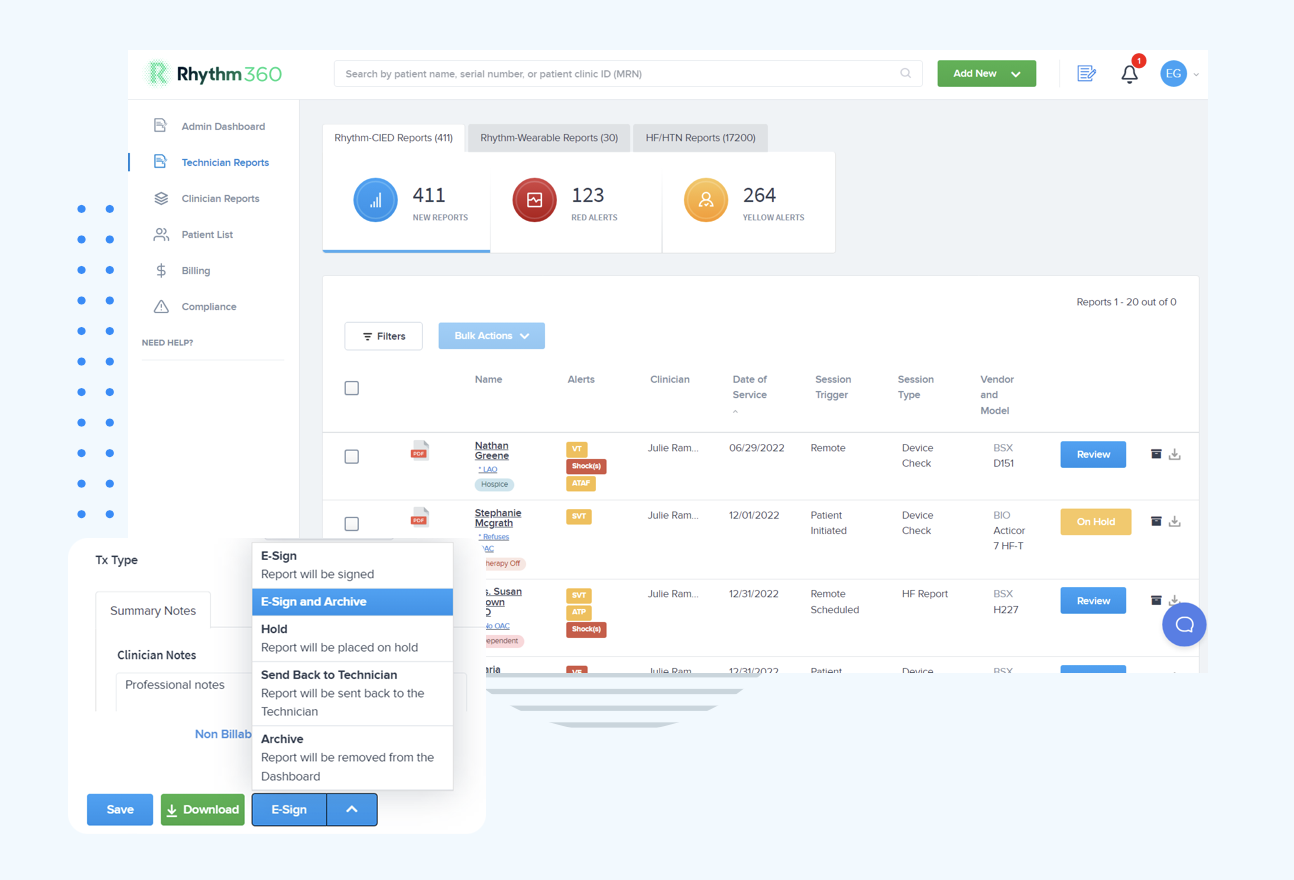
Rhythm360 automatically tracks device-specific CPT pairings, including the 90-day cycles for pacemakers and ICDs (93294, 93295, 93296) and the 30-day cycles for physiologic monitors and loop recorders (93297 and 93298, each billable once per 30 days and each splittable into professional and technical components). This automation prevents device-type mismatch denials and unbilled technical components, two of the most common and costly errors in cardiology remote monitoring billing.
Bi-directional EHR integration with Epic, Cerner, Athenahealth, eClinicalWorks, Greenway Health, and others via HL7 ensures that documentation generated in Rhythm360 flows directly into the patient record. This supports audit-ready workflows without adding manual transcription steps. AI-powered data reliability, achieved through redundant data feeds, computer vision, and AI-powered extrapolation, delivers greater than 99.9% data transmissibility. As a result, the transmission logs that underpin 99454 and 93297 and 93298 claims remain complete and accurate.
Practices using Rhythm360 have achieved up to an 80% reduction in critical alert response times and up to a 300% increase in revenue capture. Other platforms in the cardiac remote monitoring space include Murj, Implicity, Rhythm Management Group, and Octagos.
Get a Personalized Compliance Walkthrough
Practices should confirm that devices continue to transmit data reliably while patients travel or stay at secondary residences. The billing practitioner remains responsible for meeting data-day thresholds and interactive communication requirements, even when patients are out of state. Teams should document any travel-related gaps in transmission and select the correct code, such as 99445 for 2–15 days of data, when travel reduces the number of billable days.
When a patient transmits data on only 2–15 days in a 30-day period, the practice should bill 99445 instead of 99454 if all other requirements are met. If the patient transmits data on 0–1 days, no device supply code is billable for that period. Billing teams should review platform logs before claim submission and adjust codes to match the documented day count.
Practices should verify at enrollment that no other practitioner is billing RPM or RTM for the patient and should document that verification in the chart. Teams can add a brief note to the enrollment template confirming that staff checked internal records and, when appropriate, contacted external providers. As covered above, only one practitioner may bill RPM per patient in a 30-day period.





