Medicare covers RPM for any beneficiary with a chronic or acute condition, including hypertension, when an FDA-cleared, internet-connected device automatically transmits physiological data. The core code set for hypertension RPM spans device setup, device supply, and care management. Effective January 1, 2026, CMS updated the Physician Fee Schedule to add 99445 for device supply at 2–15 transmission days and 99470 for the first 10 minutes of care management, which fills gaps that previously left shorter-engagement patients uncompensated.
These new thresholds increase tracking complexity for billing teams, especially when practices manage large hypertension panels. See how Rhythm360 automates threshold tracking and time logging across every hypertension RPM code.
CPT 99453 covers initial device setup and patient education. It is billable only once per device per patient and no more than once per calendar month, even when multiple devices are supplied. The 2026 national average Medicare rates appear in the table below.
CPT 99454 vs. 99445 govern device supply. CPT 99454 applies when a patient transmits blood pressure data on 16 or more days within a 30-day period, and CPT 99445 applies when data is transmitted on 2–15 days. The two codes are mutually exclusive in the same 30-day window. The blood pressure monitor must be an FDA-cleared medical device that automatically and digitally transmits data, and manual patient entry does not qualify.
CPT 99457 and 99458 cover care management. CPT 99457 requires at least 20 minutes of clinical staff time plus one real-time interactive communication per calendar month, and CPT 99458 is an unlimited add-on billed in additional 20-minute increments after the 99457 threshold is met.
SMBP codes 99473 and 99474 apply when a patient self-measures blood pressure outside of standard RPM. These codes are reimbursed by Cigna for primary hypertension under its commercial policy.
CMS requires documented patient consent before device supply begins, and consent must acknowledge cost-sharing responsibilities and be recorded in the medical record prior to the first billing cycle.
Practices can bill CPT 99454 for device supply and CPT 99457 for care management in the same month because these codes address different RPM components and are not mutually exclusive with each other. Device supply codes 99445 and 99454 follow 30-day billing cycles, while care management codes 99470, 99457, and 99458 follow calendar-month rules. CMS advises submitting all RPM claims together by calendar month to keep reporting aligned.
The mutual exclusivity rules that do apply are straightforward. Bill either 99445 or 99454 based on transmission days, and bill either 99470 or 99457 based on total clinical time. Ten to nineteen minutes trigger 99470, and 20 or more minutes trigger 99457. While these codes cannot be billed together within their pairs, RPM as a whole may be billed concurrently with CCM, PCM, BHI, and RTM in 2026 when clinical time is tracked separately and not double-counted. This approach enables per-patient monthly revenue of $300–500+ for qualifying patients enrolled in multiple programs.
Payer variation remains significant. Aetna covers RPM for hypertension but has been slower to adopt 99445 and 99470, largely retaining the traditional 16-day requirement. Anthem covers RPM for a broad range of chronic conditions with no hypertension restriction, provided data transmits automatically from an FDA-cleared device. UnitedHealthcare delayed a proposed policy that would have limited RPM to heart failure and hypertensive disorders of pregnancy until later in 2026, so coverage remains broad pending further updates. Always verify eligibility before enrollment.
A compliant monthly hypertension RPM billing workflow follows these steps:
| CPT Code | Description | 2026 Medicare National Average | Key Requirements |
|---|---|---|---|
| 99453 | Device setup & patient education | $21.71 | Once per device; FDA-cleared device; documented consent & education |
| 99445 | Device supply, 2–15 transmission days | ~$52 | Mutually exclusive with 99454; FDA-cleared device; auto-transmission required |
| 99454 | Device supply, 16–30 transmission days | ~$52 | Mutually exclusive with 99445; 16-day minimum; FDA-cleared device |
| 99470 | Care management, first 10–19 minutes | ~$26 | Mutually exclusive with 99457; one interactive communication required |
| 99457 | Care management, first 20+ minutes | $51.77 | Mutually exclusive with 99470; one interactive communication required |
| 99458 | Care management, each additional 20 minutes | $41.42 | Add-on to 99457 only; unlimited increments; time-stamped logs required |
| 99473 | SMBP setup & education | Payer-variable | SMBP for primary hypertension; patient self-measurement |
| 99474 | SMBP separate self-measurements, 2 readings/day ≥12 days | Payer-variable | SMBP for primary hypertension; documented patient readings |
Rates reflect 2026 Medicare non-facility national averages under the CY 2026 Physician Fee Schedule Final Rule. Actual payments vary by geographic locality.
Telehealth-related denials jumped 84% in 2025 per MDaudit’s Benchmark Report analyzing over 1.2 million providers, so denial prevention now represents a financial priority for any hypertension RPM program. The most common triggers and their fixes include:
Practices that implemented structured RPM workflows saw claim denial rates fall from 15% to 5%, driven by improved documentation and billing compliance.
These codes can appear together when billing follows Medicare rules. CPT 99453 is a one-time setup code billed only in the enrollment month. In subsequent months, bill one device supply code and one care management code based on the thresholds described earlier, plus any applicable 99458 add-ons. All four codes address distinct service components and are not mutually exclusive across categories, only within their own category pairs. Claims should be submitted together on a calendar-month basis with matching ICD-10 I10 diagnosis codes and the billing provider’s NPI.
Consent must be obtained and documented in the medical record before RPM services are furnished or billed. For Medicare, consent may be verbal but must inform the patient of applicable cost-sharing, the single-provider-per-month rule, and the right to discontinue services. Consent is generally required only once annually for Medicare, though state Medicaid programs such as California and Alabama may impose additional documentation requirements. Practices should obtain consent during the enrollment visit, before the device is shipped, to avoid retroactive denial of the 99453 setup claim.
Cigna commercial plans exclude primary hypertension from standard RPM coverage. Practices billing 99453, 99454, or 99457 for a Cigna commercial patient with a primary hypertension diagnosis may face denial. The compliant alternative is to enroll those patients in the SMBP pathway using CPT 99473 for setup and education and 99474 for separate self-measurements. Cigna does cover standard RPM for hypertensive disorders of pregnancy, COPD, diabetes, and heart failure, so the exclusion is condition-specific. Payer eligibility verification at enrollment helps route patients to the correct billing pathway before services begin.
CPT 99445 and 99470 are new 2026 Medicare codes that create a lower-threshold billing pathway for patients with shorter engagement periods. Use 99445 instead of 99454 when a patient transmits blood pressure data on 2–15 days within a 30-day period, and use 99454 when transmission reaches 16 or more days. Use 99470 instead of 99457 when total clinical staff time for the month is 10–19 minutes, and use 99457 when time reaches 20 or more minutes. Both pairs are mutually exclusive within their category. Reimbursement for 99445 is similar to that of 99454, and 99470 provides reimbursement for shorter engagement periods, so practices can now capture revenue for patients who previously fell below the 16-day or 20-minute thresholds and generated no billable claim.
Compliant 2026 hypertension RPM billing depends on matching the right device supply code, 99445 or 99454, to actual transmission days and selecting the correct care management code, 99470, 99457, or 99458, based on documented clinical time. Practices also need to apply SMBP codes for Cigna commercial patients with primary hypertension and maintain an audit-ready record of every threshold, interaction, and consent event. Structured RPM programs have been associated with annual savings per patient with hypertension through reductions in hospitalizations, but those gains only materialize when billing compliance stays consistent.
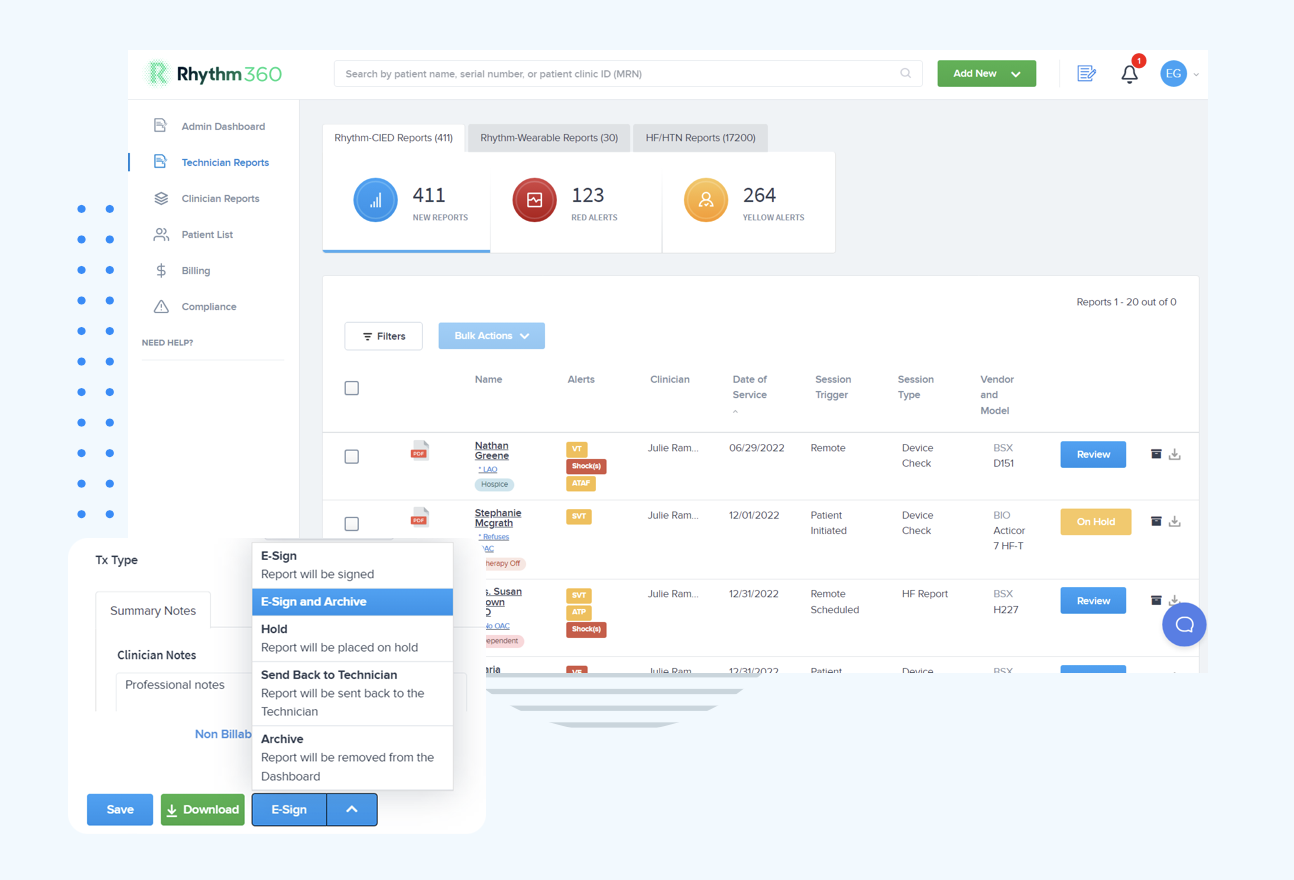
Rhythm360 automates FDA-cleared device data ingestion, 16-day and 2-day threshold monitoring, time-stamped clinical staff logs, and payer-specific rule flags across the full 2026 CPT code set so cardiology practices capture full reimbursement without manual tracking or fragmented portals.
Book a demo to recover the RPM revenue your current workflow is leaving uncaptured.