New 2026 CMS CPT codes 99445 and 99470 cover short-duration RPM monitoring under 16 days and management time under 20 minutes, which expands billing options for cardiac practices.
CPT 99457 requires at least 20 minutes of documented interactive communication each month for critical alerts like VTach and AFib, along with a documented minimum of 16 days of data transmission to avoid denials.
Cardiac practices can combine RPM codes (99453-99458) with device interrogation codes (93297-93298) for complete billing, as long as documentation clearly connects alerts to clinical actions.
Rhythm360 unifies data from Medtronic, Abbott, and Boston Scientific, automates compliant documentation, and has delivered revenue gains of up to 300% by removing OEM portal fragmentation.
Talk with Rhythm360 about a tailored demo to automate CPT billing, cut alert response times by 80%, and stay aligned with 2026 CMS rules.
Cardiac practices need a clear view of how RPM and device codes work together across setup, monitoring, and clinical management. The table below summarizes the core 2026 CPT codes that support critical cardiac alert workflows, from device supply to physician interpretation.
CPT Code | Description | Requirements/Frequency | 2026 Reimbursement |
|---|---|---|---|
99453 | RPM setup and patient education | Initial setup, one-time per episode | $22 |
99454 | RPM device supply (16-30 days) | ≥16 days data transmission per 30-day period | $47 |
99457 | RPM treatment management (first 20 min) | 20+ minutes interactive communication monthly | $52 |
99458 | RPM treatment management (additional 20 min) | Each additional 20 minutes per month | $41 |
99445 | NEW: RPM device supply (2-15 days) | 2-15 days data transmission per 30-day period | $47 |
99470 | NEW: RPM treatment (first 10 min) | 10+ minutes interactive communication monthly | $26 |
93297 | Implantable device interrogation | 90-day global period, technical component | Varies by device type |
93298 | Implantable device analysis | Physician interpretation and report | Varies by device type |
CMS introduced two new CPT codes for 2026 to close gaps in reporting for monitoring periods under 16 days (99445) and management time under 20 minutes (99470). The 2026 Physician Fee Schedule also permits virtual supervision for CPT 93296, which lets practices capture both professional and technical components for implantable device monitoring more efficiently.
CPT 99457 delivers significant RPM revenue for critical cardiac alerts, but it demands precise documentation. Use this connected workflow to support clean claims.
Alert Triage: AI-powered systems identify critical events such as new-onset AFib, ventricular tachycardia, or device malfunction that require immediate clinical review. Once the system flags a critical alert, it triggers the next step in your billable workflow.
Interactive Communication: The triaged alert leads to at least 20 minutes of interactive virtual communication with the patient or caregiver, with timestamped clinical notes. This interaction creates the clinical context for your management decisions.
Clinical Decision Making: Based on that interaction, the clinician documents treatment modifications, medication adjustments, or care plan changes that result from the alert review. These decisions then flow into the EHR as structured data.
EHR Integration: Bidirectional data flow creates a complete audit trail that links the original alert to the documented clinical response. This connection supports both compliance and downstream billing.
Monthly Submission: At month end, the team submits claims with this supporting documentation, which ties alert triage, communication time, and decisions into a single, defensible record.
Compliance Checklist for CPT 99457:
Patient Consent: Documented opt-in for RPM services.
Device Qualification: FDA-defined medical device with automatic digital transmission.
Data Transmission: Meet the 16-day minimum mentioned above for each 30-day period.
Interactive Time: At least 20 minutes of documented interactive communication each month.
HIPAA Compliance: Secure data transmission and storage protocols.
Clinical Supervision: Oversight by a qualified healthcare professional.
Clinical Scenario: A patient’s implantable cardioverter defibrillator transmits a ventricular tachycardia episode on Saturday morning. The clinical team reviews the alert within 2 hours, spends 15 minutes on symptom assessment with the patient, then coordinates with the electrophysiologist for device programming changes for another 10 minutes.
The team documents the updated care plan in the EHR. This 25-minute interaction supports CPT 99457, and the extra 5 minutes can contribute toward 99458 when combined with other monthly interactions.
Common Denial Prevention: Document interactive communication with specific timestamps and clinical rationale. Automated data collection without documented clinical interaction does not qualify for 99457 billing.
While 99457 captures the clinical management time for critical alerts, practices also need to bill for device supply and data transmission that enable those alerts. CPT 99454 and device interrogation codes 93297 and 93298 cover that technical and professional work.
CPT 99454 Requirements:
Data Transmission: The same 16-day transmission requirement applies here for each 30-day period.
Device Qualification: FDA-cleared medical devices with digital transmission capabilities.
Billing Frequency: Once per 30-day period, not per calendar month.
Documentation: Audit logs that capture all automated transmissions.
CPT 93297/93298 Workflow:
93297 (Technical): Remote interrogation of implantable cardiac devices with a 90-day global period.
93298 (Professional): Physician analysis and interpretation of device data with a formal report.
Critical Alert Integration: Post-alert interrogations that assess device function and programming needs.
Billing Coordination: Careful code selection that avoids bundling violations when combined with RPM codes.
Clinical Scenario: After a critical arrhythmia alert, the practice performs remote device interrogation (93297) and physician interpretation (93298) to evaluate lead integrity and programming parameters. When the same patient receives RPM monitoring for heart failure parameters, the practice can bill 99454 separately for the physiological monitoring component.
These technical and professional codes sit within a broader policy environment that continues to evolve. The 2026 CMS changes shape how cardiac practices design RPM programs and capture revenue.
CMS’s 2026 Physician Fee Schedule introduces several changes that expand billing opportunities for cardiac monitoring and reward documented outcomes.
Short-Duration Codes: New CPT 99445 and 99470 support billing for monitoring periods under 16 days and management time under 20 minutes.
Virtual Supervision: CPT 93296 technical components now allow virtual physician supervision instead of physical presence.
Value-Based Criteria: Additional payments become available when monitoring prevents ER visits or reduces readmissions.
AI-Assisted Eligibility: Clearer criteria support technology-assisted clinical decision making.
Rhythm360’s vendor-neutral platform removes OEM fragmentation and supports compliant billing by connecting data, triage, documentation, and revenue capture into one workflow.
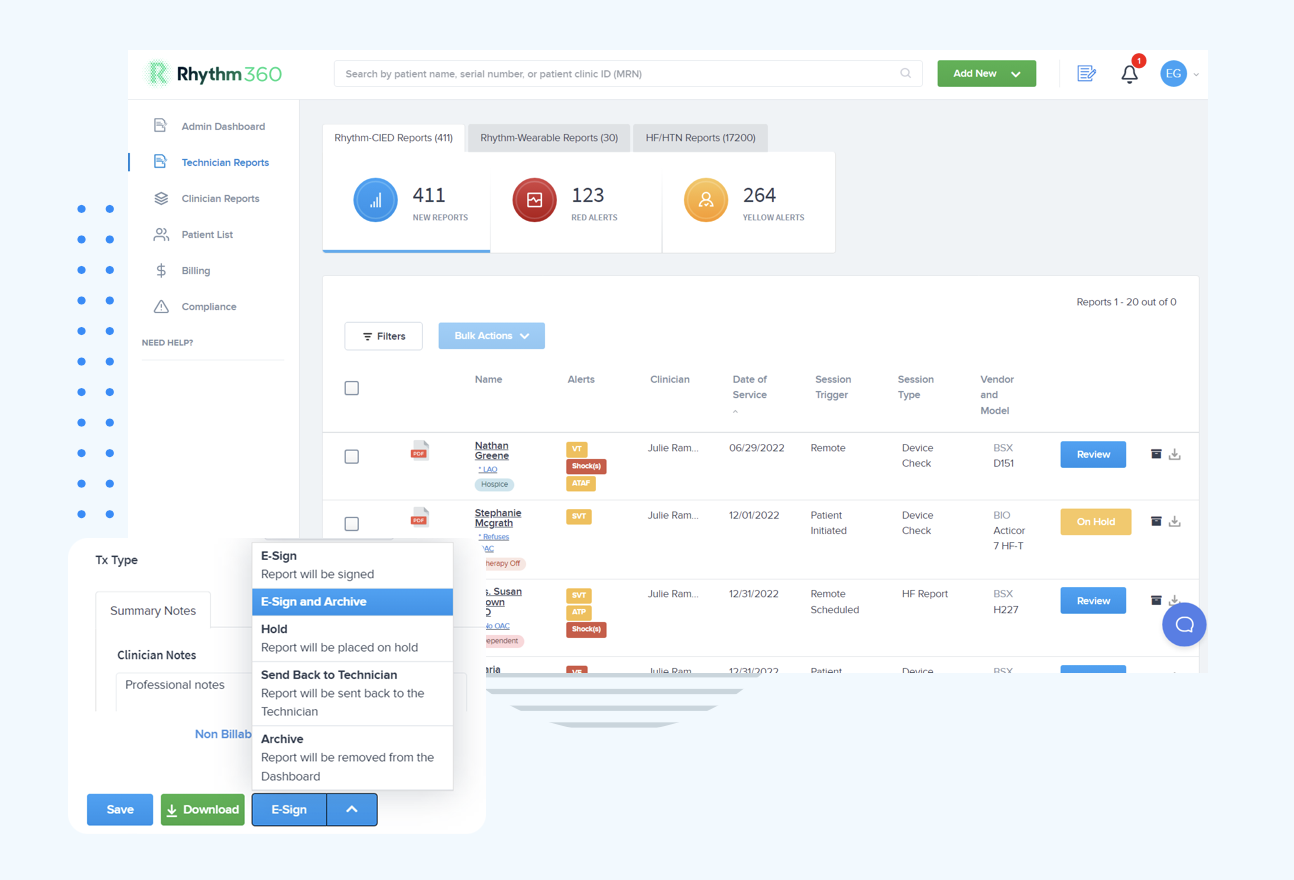
Unified Data Integration: The platform achieves more than 99.9% data transmissibility by ingesting information from all major device manufacturers (Medtronic, Abbott, Boston Scientific, Biotronik) through APIs, HL7, XML, and computer vision-powered PDF parsing. This unified data foundation replaces manual logins to multiple OEM portals.
AI-Powered Alert Triage: Building on that consolidated data stream, advanced algorithms filter non-actionable alerts and prioritize critical events such as ventricular tachycardia, atrial fibrillation, and device malfunctions. This approach reduces response times by up to 80% while ensuring that no critical alerts are missed.
Automated CPT Documentation: The prioritized alerts then feed directly into automated documentation workflows for all RPM codes. The system tracks billable minutes, interactive communications, and data transmission requirements, while bidirectional EHR integration with Epic, Cerner, and other major systems keeps clinical teams in their native workflow.
Revenue Optimization: With these pieces in place, practices using Rhythm360 have achieved up to a 300% increase in revenue through more complete CPT code capture, better staff efficiency, and the addition of new RPM service lines for HF and HTN management.
Pro Tip: Rhythm360’s audit trail functionality creates denial-ready documentation by timestamping all clinical interactions and linking them to specific alert events, which supports CMS requirements for interactive communication.
See how Rhythm360’s unified platform transforms your workflow and experience how consolidated data management strengthens both compliance and revenue.
Nearly 15-20% of all medical claims are denied on first submission, and RPM claims often follow predictable denial patterns that practices can address with better systems.
Insufficient Alert Linkage: Payers deny claims when documentation does not connect critical alerts to billable management time. Solution: Rhythm360 flags alert-triggered interactions and generates linked documentation automatically.
Frequency Violations: Overbilling monthly codes or missing the required monitoring thresholds. Solution: Real-time dashboard tracking prevents billing outside allowed frequencies and confirms that the 16-day minimum has been met.
Interactive Communication Gaps: Missing documentation for required patient interactions. Solution: Automated time tracking and communication logs provide audit-ready evidence.
Device Qualification Issues: Use of non-FDA approved devices or reliance on manual data entry. Solution: The platform restricts integration to qualified devices and verifies automatic transmission.
Practices using Rhythm360’s automated documentation achieve high first-pass approval rates for RPM claims, with the same substantial revenue gains mentioned earlier.
Discover how automated documentation eliminates denials and unlocks your practice’s full RPM revenue potential.
Once your team has mastered core RPM billing for critical alerts, you can apply these advanced tactics to expand services and align with 2026 rules.
Advanced Billing Strategies:
Combine 99454 with 93298 for complete device and physiological monitoring coverage when documentation supports both services.
Use new 99445 for short-term post-procedure monitoring that does not meet the standard 16-day threshold.
Scale population health programs by using AI-assisted alert prioritization to focus staff on the highest-risk patients.
Apply value-based billing criteria where available to capture outcome-driven reimbursement.
CPT 99457 requires at least 20 minutes of documented interactive communication between qualified healthcare professionals and patients per calendar month. For cardiac alerts, this time includes alert review, patient assessment, treatment modifications, and care coordination. The patient must transmit physiological data for at least the same 16-day minimum per 30-day period using FDA-qualified devices with automatic digital transmission.
Rhythm360 supports CPT 93297 technical components and 93298 professional components by integrating with all major device manufacturers, capturing interrogation data, creating physician-ready analysis reports, and maintaining complete audit trails for compliance.
Critical VTach alerts qualify for RPM billing when they trigger documented clinical management activities. Requirements include AI or clinical triage of the alert, interactive patient communication by phone, video, or secure messaging, clinical decision making with documented treatment changes, and EHR integration with timestamped notes.
The alert response must contribute to the minimum 20-minute monthly requirement for 99457 or the 10-minute requirement for new code 99470.
The 2026 CMS rule change allows virtual supervision for CPT 93296 technical components, which lets practices bill for remote device interrogations without physician physical presence. CMS expects to extend this model to all major ECG and monitoring codes by 2027, which will expand revenue opportunities for practices with strong remote monitoring programs.
Denial-resistant documentation includes patient consent for RPM services, verification that devices meet qualification rules, automated transmission logs that show required monitoring thresholds, timestamped clinical interactions linked to specific alerts, treatment modification records, and complete audit trails.
Rhythm360’s automated system generates these documentation elements while maintaining HIPAA compliance and CMS audit readiness.
Get started with compliant, automated billing today and transform your cardiac monitoring program with reliable revenue capture.
Cardiac practices that master 2026 CPT billing guidelines for critical alerts rely on technology that unifies fragmented OEM data and supports evolving CMS requirements. Rhythm360’s vendor-neutral platform reduces administrative burden, cuts critical response times by 80%, and unlocks up to 300% revenue increases through automated documentation and accurate code capture.
Explore a Rhythm360 demo tailored to your practice and position your team for sustainable growth in remote cardiac monitoring.