

Last updated: June 24, 2026
The table below maps each 2026 RPM CPT code to its required documentation elements and the automation triggers a compliant billing platform must support.
| CPT Code | Service Description | Required Documentation | Automation Trigger |
|---|---|---|---|
| 99453 | Initial patient setup and education on RPM device | Device type, patient consent, education date, staff name | Onboarding checklist completion, one-time per patient |
| 99454 | Device supply and data transmission, 16+ days in 30-day period | FDA-cleared device confirmation, transmission day count (≥16), clinical purpose | Transmission-day counter reaching 16-day threshold within billing period |
| 99445 | Device supply and data transmission, 2–15 days in 30-day period (CMS 2026 addition) | FDA-cleared device type, days transmitted (2–15), clinical purpose, care influence statement | Transmission-day counter reaching 2-day threshold, cannot bill with 99454 in same period |
| 99457 | First 20 minutes of RPM management time, interactive communication required | Date, provider or staff name, activity description, exact time logged, patient interaction record | Time-tracking module reaching 20-minute threshold with confirmed patient contact |
| 99458 | Each additional 20 minutes of RPM management time | Same as 99457, additive to same calendar month | Time-tracking module logging each subsequent 20-minute increment |
CMS introduced CPT 99445 in the 2026 Physician Fee Schedule at an estimated reimbursement of about $47, which resolves the prior all-or-nothing structure of 99454 that required 16 or more transmission days. Adding 99445 increases RPM revenue by capturing shorter monitoring windows that previously went unbilled.
Common causes of RPM claim denials include fewer than two days of transmitted data, use of non-FDA-cleared devices, missing patient consent documentation, incomplete clinical notes, and multiple providers billing the same patient period. Each of these failure points maps directly to a manual workflow gap.
A vendor-neutral billing platform addresses denial risk by automating the four most common failure points. First, transmission-day counters flag incomplete monitoring windows before claim submission, which prevents the “fewer than two days” denial trigger. Second, device-eligibility verification confirms FDA-cleared status at onboarding, which eliminates non-compliant device claims. Third, consent documentation is stored within the patient record with a full audit trail, so the missing-consent gap never reaches the payer. Finally, duplicate-billing logic detects overlapping provider claims for the same monitoring period, which prevents coordination-of-benefits denials when multiple practices bill the same patient.
The University of Chicago Medicine (UCM) implemented a centralized remote monitoring platform and reported “We have improved billing and accountability for our patients after the integration.” UCM now manages over 73,000 reports annually with stable dismissal rates, a scale that manual OEM portal workflows cannot support without significant denial exposure.
These two codes often cause confusion because both apply within the same 30-day monitoring period, yet they reimburse entirely different services.
99454 reimburses the supply of an FDA-cleared monitoring device and the automated transmission of physiological data. It requires 16 or more days of data transmission within the 30-day period and does not require any clinician time or patient interaction. It functions as a device-and-data code.
99457 reimburses the first 20 minutes of clinical management time spent reviewing RPM data and communicating with the patient or caregiver. It can be combined with 99458 for additional 20-minute increments and with 99445 when the transmission window falls below 16 days, but it cannot substitute for 99454 when the transmission threshold is met.
The practical billing implication is straightforward. A practice can bill both 99454 and 99457 in the same month for the same patient when the transmission-day threshold is met and 20 minutes of documented management time is logged with a confirmed patient interaction. Missing either element forfeits the corresponding reimbursement.
Medicare requires that RPM services be ordered by a physician or qualified healthcare professional, that devices be FDA-cleared and automatically transmit data, and that patient consent be documented before services begin. Devices must automatically transmit physiological data, and manually entered readings do not satisfy the transmission requirement.
Federally Qualified Health Centers (FQHCs) bill RPM under an all-inclusive prospective payment system rate rather than individual CPT codes, which means RPM services are bundled into the encounter rate. FQHCs should confirm with their MAC whether supplemental RPM billing is permissible for their specific patient population and service configuration.
Commercial payers vary significantly. Many follow Medicare coverage logic but apply their own transmission-day thresholds, consent language requirements, and prior-authorization rules. A compliant billing platform must support payer-specific rule sets rather than applying a single Medicare template to all claims.
Time-tracking compliance for 99457 and 99458 requires documentation of the date, provider or staff name, specific activities performed, and exact time spent. Aggregate time logs without activity-level detail create a common audit vulnerability.
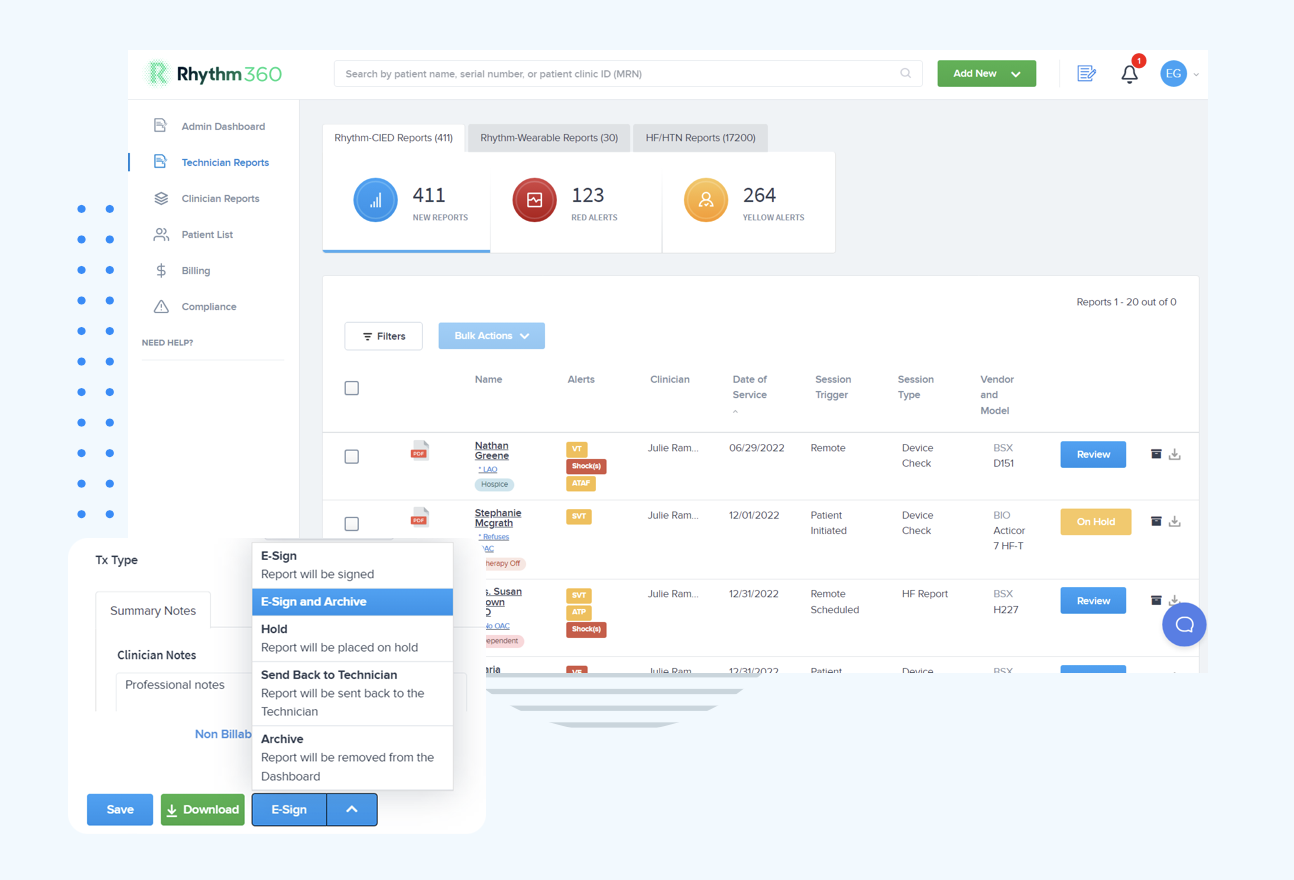
The table below compares data-ingestion capabilities between a vendor-neutral platform and a single-OEM legacy portal across four technical dimensions relevant to CPT compliance.
| Capability | Vendor-Neutral Platform (e.g., Rhythm360) | Single-OEM Legacy Portal | Compliance Relevance |
|---|---|---|---|
| API integration | Multi-manufacturer (Medtronic, Boston Scientific, Abbott, Biotronik) | Single manufacturer only | Transmission-day counts require data from all active devices |
| HL7 / XML ingestion | Supported, bi-directional EHR sync | Limited or absent, manual export required | Automated CPT documentation requires structured data exchange |
| Computer-vision PDF parsing | AI-powered OCR normalizes unstructured OEM reports | Not available, staff manually re-enter data | Reduces transcription errors that cause incomplete clinical notes |
| Redundant data feeds | Fail-safe feed activates if OEM server is unavailable, greater than 99.9% transmissibility | Single feed, downtime creates transmission gaps | Transmission-day gaps below threshold trigger denials for 99454 and 99445 |
UCM physicians described pre-implementation multi-portal workflows as “a major challenge and incredibly difficult,” and noted that “staffing was always an issue for our center, because our device clinic, like many other medical centers, had struggled with technician turnover and timely weekend coverage.”
A structured onboarding sequence reduces disruption and accelerates time-to-revenue for new RPM service lines.
Request your practice-specific implementation plan based on your current device mix and EHR environment.
Revenue impact from a vendor-neutral CPT billing platform scales with patient volume and the number of previously uncaptured billing events. Two third-party-verifiable outcomes anchor the financial case:
For a practice managing CIED patients, stronger capture of RPM billing codes can generate significant monthly recurring revenue before adding HF or HTN RPM service lines. UCM’s post-implementation data confirms that centralized review by trained personnel was “a big piece” of achieving scalable, auditable monitoring at high volume.
FQHCs operate under a prospective payment system in which most services are bundled into an all-inclusive per-visit rate. Under current CMS guidance, RPM services furnished by an FQHC are generally included in the encounter rate and are not separately billable using individual RPM CPT codes. FQHCs considering a standalone RPM program should consult their Medicare Administrative Contractor for a coverage determination specific to their patient population, service structure, and state Medicaid rules, because policies can vary and change with annual fee schedule updates.
Each billing entry for 99457 or 99458 must include the calendar date the service was performed, the name and credentials of the provider or clinical staff member who performed the service, a description of the specific activities completed during that time increment, and the exact number of minutes spent. Aggregate monthly time logs that lack activity-level detail do not satisfy audit requirements.
At least one interactive communication with the patient or caregiver must be documented per calendar month before either code can be billed. A compliant billing platform captures this data automatically at the point of care rather than requiring retrospective reconstruction.
CPT 99445 and CPT 99454 are mutually exclusive within the same 30-day monitoring period because they cover different transmission-day ranges for the same service category. CPT 99454 applies when a patient transmits data on 16 or more days, and CPT 99445 applies when transmission occurs on 2 to 15 days.
A billing platform must apply logic that selects the appropriate device-supply code based on the actual transmission-day count at the close of each 30-day period. Both codes can be paired with management codes 99457 and 99458 in the same month when the time-tracking and patient-interaction requirements are independently satisfied.
Medicare requires that any device used to support an RPM claim be FDA-cleared as a medical device and capable of automatically transmitting physiological data to the ordering provider. Consumer-grade fitness trackers, wellness applications, and devices that rely on manual data entry by the patient do not meet this standard.
The device type must be documented in the patient record along with the clinical purpose of monitoring and a statement describing how the transmitted data influenced care decisions. Practices using a multi-manufacturer device population should confirm that each device model in their inventory carries an active FDA clearance before enrolling patients in a billable RPM program.
Manual OEM portal workflows create denial risk at multiple points. Transmission-day counts are tracked in separate systems and may not be reconciled before claim submission, patient consent records may be stored outside the billing workflow, and time logs for 99457 and 99458 are often reconstructed after the fact rather than captured in real time.
A vendor-neutral platform closes these gaps by centralizing transmission data from all device manufacturers into a single record, automating transmission-day counters that trigger the correct device-supply code, storing consent documentation within the auditable patient record, and logging management time at the point of service. The result is a claim that reaches the payer with complete supporting documentation, which reduces the primary causes of RPM denials before submission.
The 2026 RPM billing landscape rewards practices that can document transmission days, management time, patient interactions, and device eligibility automatically and at scale. Fragmented OEM portal workflows cannot meet that standard without significant manual overhead and ongoing denial risk.
The evaluation criteria for any CPT code billing platform remain clear. Practices need unified data ingestion across all active device manufacturers, automated CPT capture triggered by real clinical events, and auditable documentation that satisfies both Medicare and commercial payer requirements without additional staff burden.
Practices that have centralized these workflows report the alert-response and revenue improvements detailed above, outcomes that reflect both the clinical and financial cost of fragmentation. The monthly per-patient revenue outlined earlier is recoverable, but only with a platform built to capture every billable event compliantly.
See how Rhythm360 captures your full RPM reimbursement by unifying CIED and chronic-condition data and automating compliant CPT documentation.





