

Last updated: July 14, 2026
Device clinics managing patients across multiple manufacturers, including Medtronic, Boston Scientific, Abbott, and Biotronik, must log into separate, non-interoperable portals to retrieve transmission data. This fragmentation is not a minor inconvenience. It is a structural patient safety risk.
Cardiac device clinics process a high volume of transmissions each year. A substantial share of those alerts carry no clinical relevance. When staff manually reconcile that volume across multiple portals, the result is alert fatigue, a well-documented condition in which clinical staff become desensitized to electronic alerts due to excessive alarm volume, leading to delayed or missed responses to genuinely critical events.
The consequences show up in the data. The Joint Commission documented 98 alarm-related sentinel events between January 2009 and June 2012, of which 80 resulted in patient death, a toll driven in part by the same fatigue described above. That fatigue does more than cause missed events directly. It also erodes clinician wellbeing, contributing to burnout and anxiety that further impair decision-making and encourage deliberate alarm silencing as a self-protective response.
Fragmented workflows also cause direct revenue leakage. Without a centralized system tracking billable remote monitoring events, clinics routinely miss documentation requirements for CPT codes such as 93298, 93299, and 99454. The result is rejected claims and unrealized revenue.
These clinical and financial risks share one root cause: disconnected systems that force staff to piece together a full picture manually. The sections below define what counts as critical, then show how a unified workflow closes these gaps. See how consolidation works before diving into the alert categories themselves.
Critical alerts are device- or sensor-generated notifications indicating a condition with immediate or near-term potential for patient harm. They span three domains: arrhythmia detection, device system integrity, and physiologic thresholds.
Arrhythmia-domain critical alerts include:
Device-integrity critical alerts include:
Physiologic-threshold critical alerts for remote physiological monitoring (RPM) include:
Cardiac remote monitoring alerts fall into four functional categories based on clinical urgency and the type of information conveyed. These categories form the basis of any triage workflow that separates actionable events from background noise.
1. Emergent Alerts (Red). These require immediate response, typically within minutes to hours. Examples include VF/VT with ICD shock delivery, SpO2 below 90%, and BP above 180/120 mmHg. They represent the smallest share of total alert volume but carry the highest patient risk.
2. Urgent Alerts (Yellow-High). These require same-day or next-business-day review. Examples include new-onset AFib with high burden, ERI/RRT notification, lead impedance out of range, and rapid weight gain in heart failure patients. CardiQ's color-coded triage algorithm assigns RED and YELLOW priority levels to guide staff through standardized response workflows for these events.
3. Routine Clinical Alerts (Yellow-Low / Green). These are scheduled transmissions confirming device function and patient stability, such as pacing percentage checks and battery status within normal range. Abbott classifies these as Clinical Alerts that clinics can program and tune to local policy.
4. Informational Alerts. These are non-critical system notifications documenting device behavior without requiring action. Abbott defines Informational Alerts as non-critical system information useful for performance logs and audit documentation.
All four categories land in the same portal queue. Without intelligent filtering, staff spend the same amount of time processing an informational alert as an emergent VT event. That equal treatment of unequal risks is a workflow design failure, and it is the direct cause of alert fatigue.
The table below shows how clinical urgency maps to expected response timelines across common alert types. It illustrates the core problem: when every alert looks the same in a cluttered queue, staff cannot apply these timelines consistently, and the response window for a true emergency can be lost among routine noise.
| Alert Type | Clinical Urgency | Typical Response Timeline |
|---|---|---|
| VF/VT with ICD therapy delivery | Emergent | Immediate (same day) |
| SpO2 <90% | Emergent | Immediate nurse contact; ER referral if sustained |
| BP >180/120 mmHg | Emergent | Immediate nurse contact; ER referral if symptomatic |
| New-onset AFib / High AT/AF burden | Urgent | Same day to next business day |
| ERI / RRT (battery depletion indicator) | Urgent | Within 1-2 business days |
| Lead impedance out of range | Urgent | Within 1-2 business days |
| Weight gain >2 lbs in 24 hours | Urgent | Nurse callback within 4 hours |
| Routine pacing percentage check | Routine | Standard review cycle (days) |
| Informational device log entry | Non-actionable | Documentation only; no clinical action required |
A structured post-alert workflow converts raw device notifications into documented clinical actions. This sequence reflects evidence-based practice for CIED and RPM programs.
Rhythm360's AI triage and optional 24/7 CCT oversight compress this entire sequence, achieving the response-time gains noted in the Key Takeaways above, while maintaining greater than 99.9% data transmissibility through redundant data feeds and AI-powered extrapolation.
Alert fatigue in device clinics has two root causes: volume and fragmentation. Most physiological monitor alarms are non-actionable, and when those alarms arrive across five separate OEM portals, the cognitive burden on staff multiplies.
At the University of Chicago Medicine, high dismissal rates in CIED monitoring reflect a safety-first design, with most OEM-generated alerts nonactionable across more than 73,000 reports reviewed annually. That scale is exactly why filtering matters more than manual review capacity. As Andrew Beaser, MD, at UCM put it, "Decision support, including AI-assisted decision support, will become increasingly important as data volumes grow." That is precisely the shift the industry is making: next-generation remote monitoring replaces static thresholds with AI-driven trajectory analysis and intelligent triage to prioritize events most likely to benefit from intervention.
Rhythm360 applies this approach through a single dashboard that consolidates all CIED and RPM data, eliminating redundant logins and manual reconciliation. Intelligent filtering separates emergent events from informational noise before alerts reach clinical staff, cutting the cognitive load that drives burnout and missed events.
Bi-directional EHR integration with Epic, Cerner, Athenahealth, eClinicalWorks, and others puts patient context in front of the clinician at the moment of alert review, not through a separate workflow step.
Accurate alert handling links directly to CPT billing compliance. Remote monitoring codes, including 93298 (ICD remote interrogation), 93299 (pacemaker remote interrogation), 99454 (device supply with daily recording), and 99457 (remote physiologic monitoring treatment management, first 20 minutes), all require documented evidence of transmission review, clinical decision-making, and time spent. Staff must document all interactions for CPT billing compliance, including 20 or more minutes per month for code 99457.
Manual, fragmented alert workflows make documentation gaps inevitable. Rhythm360's automated reporting generates timestamped audit trails for every transmission review and clinical action, giving clinics the documentation infrastructure compliant billing requires. Practices implementing Rhythm360 have seen the revenue gains referenced in the Key Takeaways, driven by optimized CPT code capture, improved staff efficiency, and new RPM service lines for heart failure and hypertension management.
These billing gains and the clinical improvements above come from the same source: a single platform replacing scattered, manual processes. That is the design principle behind Rhythm360's full feature set.
Rhythm360 is a cloud-based, HIPAA-compliant platform built for the operational and clinical realities of high-volume cardiac device programs. Its core capabilities cover the full alert management lifecycle.
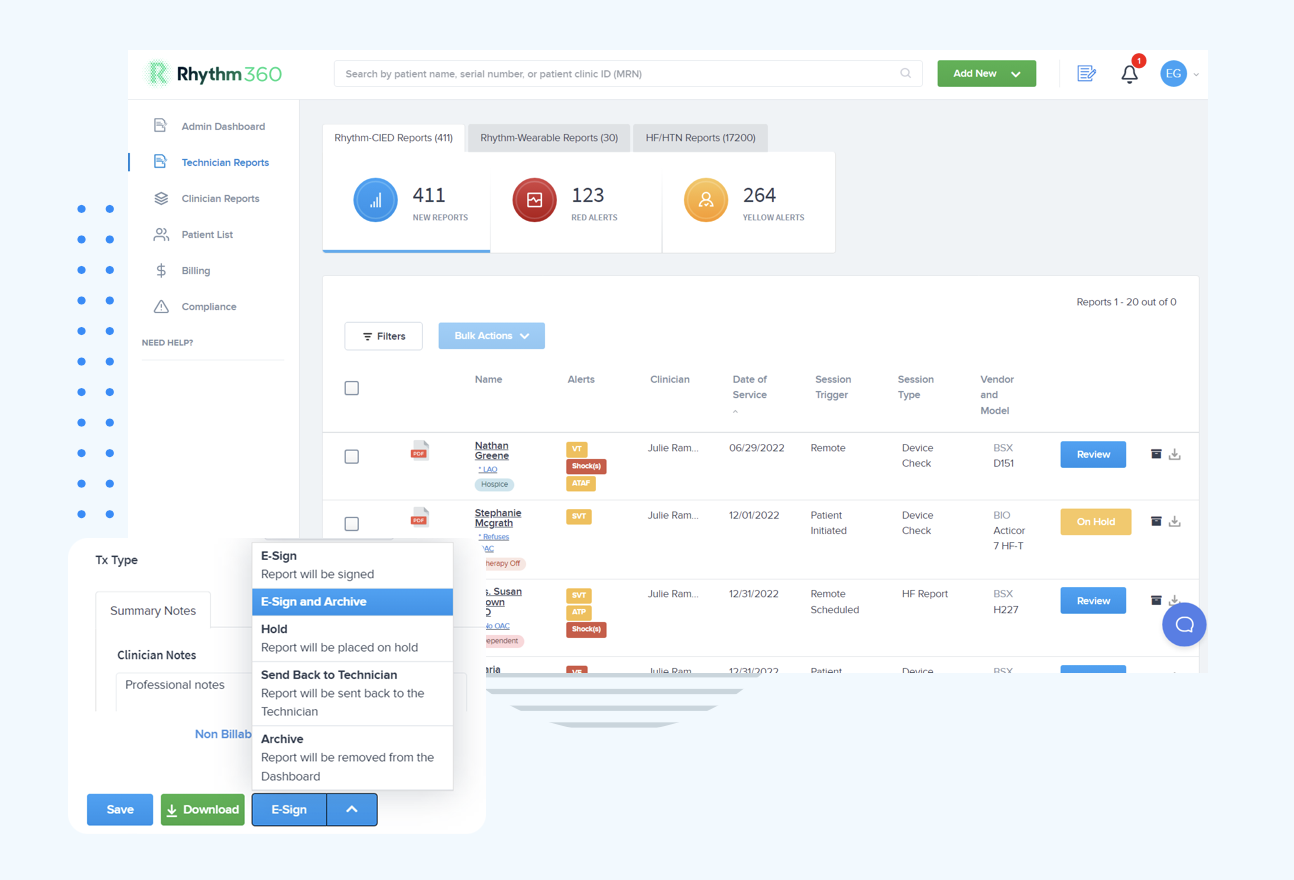
Other cardiac device management platforms exist, but few combine CIED monitoring, RPM for heart failure and hypertension, AI triage, EHR integration, and billing documentation in one vendor-neutral system.
Request a walkthrough to see how this single platform cuts response times and tightens billing compliance for your device clinic.
Remote cardiac monitoring uses implanted or wearable devices to collect cardiac data, including heart rhythm, device function, and physiologic parameters, and send it to a secure platform for clinician review. Implanted devices like pacemakers, ICDs, and loop recorders transmit automatically on a schedule or when a programmed threshold is crossed. RPM programs for heart failure or hypertension rely on connected scales, blood pressure cuffs, and pulse oximeters that transmit readings daily. Clinicians review incoming data, triage by urgency, and document actions taken. Rhythm360 consolidates transmissions from all manufacturers and RPM modalities into one dashboard, with AI triage and EHR integration built in.
Alert fatigue sets in. As device populations grow, the share of non-actionable alerts, routine checks, informational logs, and false positives, grows alongside genuinely critical events. When staff review every alert manually with no filtering, the cognitive burden becomes unsustainable, and clinicians grow desensitized to notifications. This raises the risk that a critical event gets delayed or missed entirely. Practices using multiple OEM portals face a compounded version of this problem, since staff must log into separate systems and reconcile data by hand. Rhythm360 addresses this through AI triage that filters noise before it reaches staff, combined with one dashboard that removes portal fragmentation altogether.
CPT codes for remote monitoring, such as 93298, 93299, 99454, and 99457, each require specific documented evidence: transmission review, clinical decision-making, and time spent on the account. Code 99457, for instance, requires at least 20 minutes of documented time per month. Clinics relying on manual tracking across multiple portals frequently miss these requirements, which leads to rejected claims. Automated, timestamped audit trails close this gap by capturing every review and action as it happens, rather than relying on staff to reconstruct records after the fact.
Fragmented OEM portals, high non-actionable alert volumes, and manual reconciliation workflows are not isolated inconveniences. They are interconnected causes of missed critical events, staff burnout, and revenue leakage in cardiac device clinics. Delayed responses to ventricular arrhythmias, undetected AF, and missed ERI notifications carry direct patient harm potential. Incomplete CPT documentation and rejected claims erode the financial sustainability of device programs at the same time.
Rhythm360 addresses both sides of this problem through vendor-neutral data ingestion, AI-powered alert triage, high-reliability data transmissibility, optional 24/7 CCT oversight, mobile access, and automated billing documentation, delivering the response-time and revenue improvements outlined in the Key Takeaways above.
Talk to our team about reducing critical alert response times, eliminating alert fatigue, and improving billing compliance in your cardiac device program.





