Last updated: July 14, 2026
The 2026 CMS Physician Fee Schedule added two new RPM codes and raised reimbursement rates across the board. These national average non-facility rates now apply to cardiology RPM programs:
At high engagement levels, monthly RPM revenue per patient can exceed $150. Stack CCM codes on top, and combined monthly revenue can exceed $211 per patient.
Documentation failures remain the leading cause of claim denials. CPT 99445 requires documentation of the exact number of days readings were received, and CPT 99470 must specify 10–19 minutes of time. Vague entries are the primary audit trigger. Miss the 16-day threshold for 99454, and the practice loses the highest-value device-supply code entirely. Codes 99445 and 99454 are also mutually exclusive, so only one may be billed per patient per 30-day period. These documentation rules matter because they directly shape which pricing model makes sense for a given practice.
Each pricing model distributes the cost of critical-alert handling, AI triage, and 24/7 oversight differently. That distribution has direct consequences for net margin.
Per-Patient-Per-Month (PPPM) Subscription: Vendors charge $40–$80 PPPM for full-service RPM, bundling devices, software, and clinical monitoring. Providers bill CMS approximately $104–$245 PPPM, yielding profit margins of $40–$160 PPPM. Critical-alert handling is nominally included, but high-acuity CIED programs generate alert volumes that exceed standard contract assumptions. That mismatch triggers overage fees or degraded response times.
Hybrid Model: Providers pay only device and platform fees, typically around $30 per patient, while using their own staff for monitoring. This can yield significant net monthly revenue for 500-patient panels at typical reimbursement rates. That lower vendor fee comes at a cost, however. Because alert-fatigue handling falls entirely on internal staff, the standard ratio of one clinical monitor per 150–250 patients breaks down rapidly once CIED alert volumes spike without AI triage support.
Turnkey Model: Providers retain 70–80% of Medicare reimbursement after revenue sharing, generating substantial net monthly revenue for 500 patients. The vendor supplies all devices, software, and clinical monitoring staff. Startup investment is lowest, but margin is capped, and practices give up control over alert triage quality and CPT documentation standards.
Alert fatigue can impose notable costs in cardiology programs when non-actionable notifications aren't filtered upstream. PPPM and turnkey contracts routinely obscure this cost in bundled pricing, which makes the choice of AI triage support a pricing decision, not just a clinical one.
AI-powered alert filtering is the single most impactful lever for reducing per-patient operational cost in high-volume cardiac RPM programs. It improves care manager to patient ratios and reduces per-patient staffing costs.
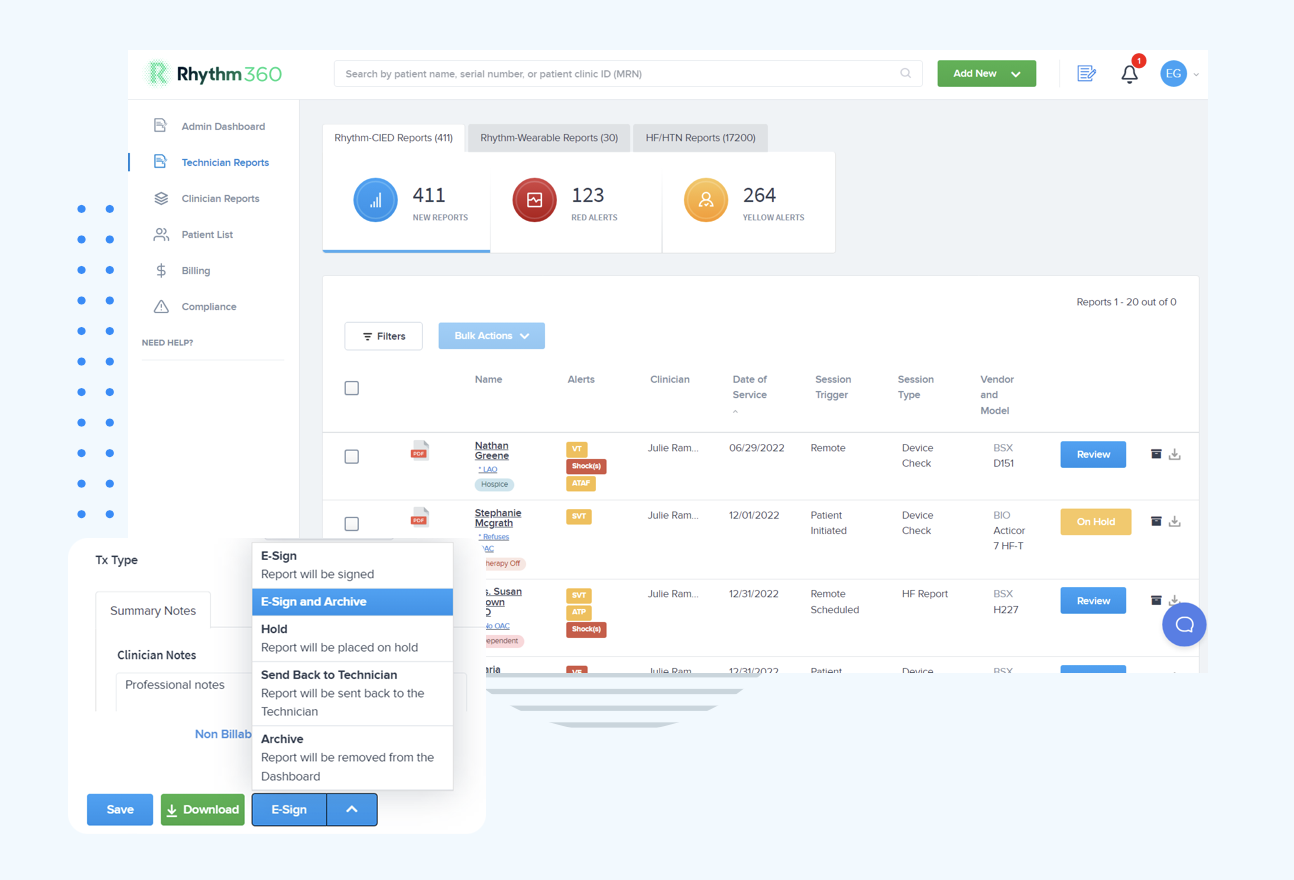
Rhythm360's AI-powered alert triage system filters non-actionable notifications and prioritizes clinically significant events, reducing critical-alert response times by up to 80%. The platform's real-world performance at scale is documented at University of Chicago Medicine (UCM), where Rhythm360 processed more than 73,000 reports annually, averaging more than 18,000 per quarter, with stable dismissal rates. That volume demonstrates scalable monitoring in a high-volume cardiology environment.
Andrew Beaser, MD, Associate Professor of Medicine at UCM, noted: "Decision support, including AI-assisted decision support, will become increasingly important as data volumes grow." Gaurav A. Upadhyay, MD, FACC, FHRS, at UCM, added: "That was a big piece for us, to have an integrated review of data from trained personnel."
AI-driven alert models that analyze multi-variable trends reduce false positives by 50–70% compared with simple threshold alerts. This directly protects the CPT 99458 time-documentation revenue that alert fatigue routinely causes practices to miss. That protection matters even more once you consider how differently CIED and wearable monitoring generate alerts in the first place.
Alert workload differs substantially between CIED monitoring and wearable-based heart failure and hypertension RPM. This difference has real implications for staffing ratios and pricing model selection.
CIED monitoring, covering pacemakers, ICDs, implantable loop recorders (ILRs), and CRT/CCM devices, generates structured, device-initiated transmissions from OEM platforms including Medtronic, Boston Scientific, Abbott, and Biotronik. High dismissal rates in CIED monitoring are a structural feature of safety-first remote monitoring, since most OEM-generated alerts are nonactionable, a pattern reflected in the 73,000+ annual reports at UCM mentioned earlier. Without centralized triage, staff must log into multiple non-interoperable OEM portals to reconcile each transmission. That workflow scales poorly as device populations grow.
Wearable HF and HTN monitoring generates continuous physiological data streams, such as weight, blood pressure, and SpO2, that require different alert logic. Personalized thresholds in RPM programs reduce alert fatigue and support high rates of billing capture for eligible monthly CPT codes.
Rhythm360 consolidates both modalities, Rhythm-CIED and HF/HTN RPM, into a single vendor-neutral platform. Redundant data feeds, computer vision, and AI-powered extrapolation deliver greater than 99.9% transmissibility across all device types. Neither CIED nor wearable data gaps create billing threshold failures or missed critical events.
The strategic trade-off between turnkey and hybrid pricing centers on control over alert triage quality and CPT documentation accuracy. Turnkey arrangements offer fast launch timelines and low administrative burden. But fully outsourced RPM staffing carries the highest per-patient cost and provides the least direct control over critical alert triage, patient outreach, and quality standards.
Hybrid models preserve internal clinical oversight but expose practices to the full cost of alert fatigue when platform tooling is inadequate. The most common staffing failure is delaying dedicated hiring past 30–50 patients, which causes alert response delays, incomplete time documentation, CPT 99458 revenue leakage, and patient disengagement.
Hidden 24/7 oversight fees, often excluded from headline PPPM rates, surface only when critical-alert volume exceeds contracted thresholds.
Rhythm360's usage-scaled SaaS pricing eliminates the revenue-sharing arrangements that cap turnkey margins and the staffing exposure that undermines hybrid programs. Cost scales with clinic size and platform usage, not with alert volume, so practices aren't penalized for the structural reality of high-acuity CIED monitoring. UCM's implementation confirmed: "We have improved billing and accountability for our patients after the integration." Practices weighing these trade-offs can see exactly how the numbers apply to their own patient panel with a closer look at Rhythm360's tiered pricing structure below.
Pick a tier based on your alert volume and current margin pressure. Practices with smaller CIED panels and lower alert complexity fit the Essentials tier, while EP clinics facing high alert volumes benefit most from Advanced's AI triage layer.
| Pricing Tier | Key Features | CPT-Capture Outcomes |
|---|---|---|
| Essentials (small practices, usage-scaled SaaS) | Vendor-neutral CIED data consolidation across all major OEMs, single-dashboard alert triage, bi-directional EHR integration (Epic, Cerner, Athenahealth, eClinicalWorks), HIPAA-compliant mobile app | Automated documentation supports 99453, 99454, 99457 capture; 99454 pays ~$52.11/month per compliant patient |
| Advanced (mid-size EP clinics, usage-scaled SaaS) | All Essentials features plus AI-powered alert triage with 80% faster critical-alert response, HF/HTN RPM service line (99454/99457/99458), redundant data feeds with >99.9% transmissibility, integrated Twilio communication hub with full audit trail | Supports 99454 + 99457 + 99458 stack; maximum monthly revenue per patient exceeding $150 at full engagement; billing capture above 95% of eligible monthly CPT codes documented in comparable deployments |
| Enterprise (large health systems, usage-scaled SaaS) | All Advanced features plus optional 24/7/365 oversight by certified cardiac technicians (CCTs) supervised by physicians, CardioMEMS and ILR support, population-level compliance dashboard, multi-site EHR integration, new 2026 code support (99445, 99470) | Full CPT stack including 99445, 99470, 99457, 99458; combined RPM + CCM stacking exceeds $211 per patient per month; revenue gains up to 300% versus fragmented OEM workflows, measured against pre-consolidation baselines |
Implementation readiness criteria include an active CIED patient panel of 50 or more, at least one OEM portal currently in use, an established EHR system, and a designated clinical lead for alert triage. Onboarding and EHR integration typically complete within a few days to a few weeks.
Three operational errors consistently erode RPM margins in cardiology practices managing critical alerts.
Underestimating 24/7 oversight costs. Turnkey and PPPM contracts frequently bundle oversight at headline rates that assume average alert volumes. High-acuity CIED programs exceed those assumptions. Outsourced clinical monitoring services can add a notable cost beyond device and software platform fees, a line item that disappears into bundled pricing until contract renewal.
Failing to consolidate multi-OEM data streams. Practices implanting devices from more than one manufacturer face non-interoperable portals that create data silos and manual reconciliation burdens. Each disconnected stream is a potential 16-day threshold failure for CPT 99454 and a missed critical-alert event. Rhythm360's redundant data feeds and AI-powered extrapolation address this directly, maintaining greater than 99.9% transmissibility across all connected OEMs.
Choosing rigid pricing that doesn't scale with clinic size. Net margin per patient generally improves at enterprise scale compared to pilot programs, because technology costs get amortized across more patients and billing threshold performance rises with volume. That improvement has a limit, though: RPM programs commonly hit scaling problems beyond 150 patients without upgraded architecture and alert management. Rhythm360's scalable SaaS model is built specifically to carry practices through that threshold.
Yes, and they are common across all three pricing models. In turnkey arrangements, 24/7 oversight is often bundled at rates calibrated to average alert volumes, not the elevated volumes typical of CIED programs. When alert counts exceed contract assumptions, vendors may apply overage fees or reduce response-time guarantees. In PPPM subscription models, outsourced clinical monitoring is frequently priced as a separate line item on top of device and software fees. Hybrid models shift alert-handling costs entirely to internal staff, where they show up as salary and overtime rather than vendor invoices. Practices should require vendors to disclose per-alert and per-escalation costs explicitly before signing, and should model total cost of ownership against projected CIED alert volumes rather than average RPM program benchmarks.
Rhythm360's implementation process, including EHR integration, typically completes within a few days to a few weeks, depending on the complexity of the existing IT environment and the number of OEM portals being consolidated. Rhythm360 supports bi-directional integration with Epic, Cerner, Athenahealth, eClinicalWorks, Greenway Health, and other systems via HL7, along with direct connections to major device manufacturers including Medtronic, Boston Scientific, Abbott, and Biotronik. The platform's onboarding framework includes patient enrollment checklists and automated billing documentation setup, so practices can begin capturing CPT codes, including the new 2026 codes 99445 and 99470, from the first billing cycle after go-live.
Practices consolidating fragmented OEM workflows onto a unified platform consistently report improvements in CPT code capture rates, documentation completeness, and billing cycle times. The primary drivers are automated report generation that eliminates manual transcription errors, real-time compliance dashboards that flag patients approaching the 16-day threshold for CPT 99454, and integrated time-tracking that supports accurate 99457 and 99458 documentation. Rhythm360 clients have achieved revenue gains as high as the 300% uplift noted earlier, driven by optimized CPT code billing, improved staff efficiency, and new HF/HTN RPM service lines. Revenue outcomes depend on patient panel size, payer mix, and compliance rates. Rhythm360's administrative dashboard gives real-time visibility into captured and potential revenue by CPT code.
AI triage changes the staffing math for high-volume CIED programs by filtering non-actionable alerts before they reach clinical staff. Without AI, a standard ratio of one clinical monitor per 150–250 patients degrades rapidly as CIED alert volumes grow, since most OEM-generated alerts are nonactionable and need manual review to dismiss. With AI triage, care manager ratios can extend to 1:75–100 patients for standard chronic conditions and 1:50–75 for complex multi-condition populations, cutting per-patient staffing costs significantly. This scale of volume, the same 73,000+ annual reports at UCM mentioned earlier, would be operationally unsustainable under manual triage workflows. For practices planning to scale beyond 150 patients, deploying AI triage before hitting that threshold is the critical decision point for maintaining both response times and financial margins.
The 2026 Medicare RPM landscape rewards practices that match their pricing model to the true cost of critical-alert management. New CPT codes 99445 and 99470 expand billable opportunities for lower-engagement patients, while the full 99454 + 99457 + 99458 stack delivers up to $181 per patient per month for high-engagement CIED populations. Capturing that revenue consistently requires a platform that consolidates multi-OEM data, automates CPT documentation, and applies AI triage to eliminate the alert fatigue that drives staffing costs and missed billing thresholds.
Rhythm360's flexible, usage-scaled SaaS model ties cost to outcomes rather than to alert volume. This lets cardiology practices scale from pilot to enterprise without the pricing rigidity that caps margins in turnkey arrangements or the staffing exposure that undermines hybrid programs. Between the transmissibility rate, response-time improvement, and revenue uplift figures covered throughout this guide, Rhythm360 gives cardiology practices a clear path to managing CIED and chronic heart-failure populations in 2026.