Last updated: September 22, 2026
See How Rhythm360’s Reporting Works In Practice
Month-end reporting that cannot isolate denial rates by TIN, by OEM, or by technical versus professional component creates a systemic billing gap. Staff log into separate, non-interoperable portals for each manufacturer and reconcile data manually. They still lack clear answers about which payer is denying 93296, which TIN is underperforming on net collection, and which transmissions missed the billing window.
The financial consequences are direct. A claim audit of 61,400 cardiology claims found that 9% of device interrogation and remote monitoring claims were denied for frequency, with an average denied charge of $94 per claim. The same audit found that professional and technical component errors appeared on 7% of in-office diagnostic claims. Both denial patterns trace back to data fragmentation, which creates duplicate work, stale data, missed billing, and audit risk.
Four report types determine whether a cardiac device billing program captures or loses revenue:
Rhythm360’s customizable reporting surfaces each of these report types in a single dashboard so administrators can act on them quickly.
Review Your Reporting Gaps With Rhythm360
The reporting layer matters because coding errors are a major source of lost revenue. CPT 93294 (pacemaker professional) and CPT 93295 (ICD professional) are the physician interpretation and reporting codes for remote pacemaker and ICD interrogation. CPT 93296 is the technical code covering data acquisition, receipt of transmissions, technician review, and distribution of results for both pacemakers and ICDs. All three run on 90-day cycles. CPT 93296 can only be billed by the physician practice if the physician personally performed the technical service or employs the staff member who did, which makes accurate reporting and audit trails essential.
For physiologic monitors and loop recorders on 30-day cycles, two device-specific codes apply. CPT 93297 covers implantable cardiovascular physiologic monitors that report hemodynamic data such as pulmonary artery pressure, while CPT 93298 covers subcutaneous cardiac rhythm monitors that record heart rhythm. A heart failure patient with a pressure sensor such as CardioMEMS is billed under 93297. A syncope patient with a loop recorder is billed under 93298. Each is billable once per 30 days and can be billed global, -26, or -TC.
For RPM on 30-day cycles, four codes apply:
The CY 2026 Physician Fee Schedule final rule introduced CPT 99445 for device supply covering 2–15 transmission days per 30-day period, and CPT 99470 for the first 10–19 minutes of treatment management per calendar month. CPT 99445 and 99454 are mutually exclusive within the same 30-day period, and CPT 99470 and CPT 99457 are mutually exclusive within the same calendar month. Rhythm360 tracks device-specific CPT pairings, flags conflicts, and prevents device-type mismatch denials across these code families. Accurate reporting on denial patterns by code family shows where these rules affect revenue.
These coding mechanics sit on top of fragmented OEM portals, which makes a unified reporting layer essential for catching errors before claims go out.
A typical cardiac remote-monitoring workflow fragments patient data across three or more systems: device manufacturer portals (Medtronic, Boston Scientific, Abbott, Biotronik), the EHR, and adjacent platforms for scheduling, billing, and patient communication. None of these systems talk to the others by default. Each OEM’s remote monitoring hardware is siloed to its own device ecosystem, so a practice implanting devices from more than one manufacturer must maintain separate portal logins, workflows, and data reconciliation processes.
Reporting accuracy depends on complete, normalized data from every manufacturer. Rhythm360 ingests data from Medtronic, Boston Scientific, Abbott, and Biotronik via API, HL7, XML, and PDF parsing via computer vision, then normalizes these data streams into a single dashboard. This vendor-neutral ingestion makes customizable reporting possible. Without it, denial-rate analysis by OEM or by device type remains structurally impossible.
Ingestion closes only half of the loop. The other half is getting clean billing documentation back into the chart.
Real interoperability in cardiac remote monitoring requires both inbound data pulled from the EHR on demand and outbound write-back of encounter creation, e-signed reports, discrete data elements, and billing information into the EHR without manual re-entry. Without bi-directional write-back, billing documentation and audit trails stay incomplete, and auditors treat missing documentation the same as services not rendered.
Rhythm360 provides bi-directional EHR integration with Epic, Cerner, Athenahealth, eClinicalWorks, and Greenway Health via HL7. Every transmission, signed report, and billing event flows back into the chart automatically, which supports clean claims and defensible audits.
Rhythm360 by RhythmScience is a vendor-neutral, HIPAA-compliant, AI-powered platform built specifically for cardiac device billing and remote monitoring. University of Chicago Medicine reviewed more than 73,000 reports annually through Rhythm360 in calendar year 2025, averaging more than 18,000 reports per quarter. A UCM administrator summarized the impact: “We have improved billing and accountability for our patients after the integration.”
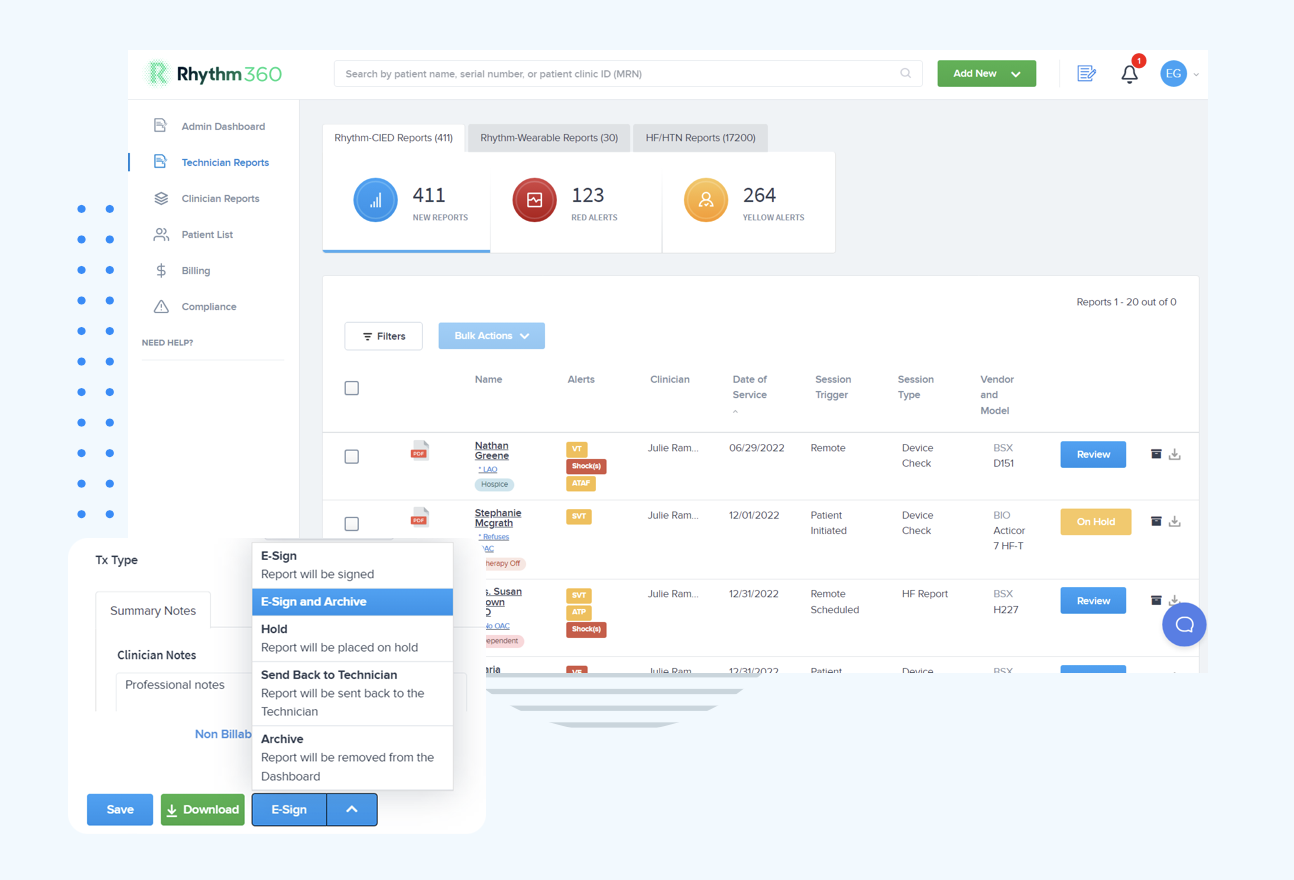
Key platform capabilities include:
Rhythm360 helps practices reduce critical alert response times by up to 80% and increase revenue capture and profitability by as much as 300%.
Explore Rhythm360 In A Live Walkthrough
The table below maps each reporting and automation need discussed above to the specific Rhythm360 capability that addresses it, so you can verify coverage before a demo.
| Reporting & Automation Need | Rhythm360 Capability |
|---|---|
| Multi-TIN roll-up | Customizable reporting surfaces aggregated or isolated denial rates, net collection rates, and days in A/R across multiple Tax IDs. |
| Component fee split | Tracks separate technical and professional fee splits for device implants and remote sessions. |
| Denial-rate by payer | Provides visibility into which payers are denying which codes and why. |
| Transmission-window compliance | Tracks 2–15 day vs. 16+ day thresholds to prevent mutual exclusivity coding penalties. |
| CPT automation | Automated CPT code capture and documentation for 90-day and 30-day device cycles. |
| OEM vendor-neutral ingestion | Consolidates data from Medtronic, Boston Scientific, Abbott, and Biotronik into one platform. |
| Bi-directional EHR write-back | Integrates bi-directionally with Epic, Cerner, Athenahealth, eClinicalWorks, and Greenway Health via HL7. |
Multiple vendors operate in the cardiac device monitoring and billing space, and each claims strong automation and AI. Effective due diligence focuses on how each platform handles reporting depth, OEM ingestion completeness, and EHR write-back fidelity in real workflows. As data volumes grow, AI-assisted decision support will become increasingly important, so ask vendors to show specific alert triage rules, escalation paths, and denial-prevention workflows.
Rhythm360 combines vendor-neutral data ingestion, AI-powered alert triage, automated CPT capture, and customizable multi-TIN reporting in a single platform designed for the full operational complexity of cardiac device billing.
Use these questions at every vendor demo to evaluate reporting depth, CPT automation, and denial management capabilities:
Rhythm360’s implementation process is structured to minimize disruption. EHR integration typically takes a few days to a few weeks depending on the health system’s configuration and EHR environment. The onboarding process includes data flow scoping, interface mapping, validation testing, and role-based training before go-live. Dedicated support remains available throughout and after launch.
RPM billing in cardiology uses CPT codes 99453, 99454, 99457, and 99458 on 30-day and calendar-month cycles. CPT 99453 is billed once per episode of care for device setup and patient education, and CPT 99454 requires transmitted readings on at least 16 days within a 30-day period. For patients transmitting on only 2–15 days, the 2026 CMS Physician Fee Schedule introduced CPT 99445 as an alternative device supply code. CPT 99457 covers the first 20 minutes of treatment management per calendar month and requires at least one documented real-time interactive communication, and CPT 99458 covers each additional 20-minute increment. Rhythm360 automates CPT capture and documentation for these codes and surfaces denial trends by payer.
Look for a platform that provides multi-TIN roll-ups showing aggregated or isolated denial rates, net collection rates, and days in A/R across multiple Tax IDs. Without this capability, administrators managing multiple practice locations or billing entities cannot identify which TIN is underperforming or which payer is driving denials at a specific site. Rhythm360’s customizable reporting surfaces these metrics in a single dashboard and allows drill-down by TIN, payer, or CPT code family.
Rhythm360 maps each device type to its appropriate CPT family and billing cycle. The platform validates CPT combinations against payer rules, flags mutual exclusivity conflicts such as 99445 vs. 99454 and 99470 vs. 99457, and alerts staff before claims go out. Denial-rate-by-payer reporting then shows where device-type mismatches previously occurred so workflows can be refined.
Rhythm360 provides bi-directional EHR integration with Epic, Cerner, Athenahealth, eClinicalWorks, and Greenway Health via HL7. Bi-directional write-back means encounter creation, e-signed reports, discrete data elements, and billing information flow back into the EHR automatically, without manual re-entry. This capability closes documentation gaps and reduces revenue leakage from services that never generate a charge.
Fragmented OEM portals and disconnected reporting cost cardiology practices revenue through missed billable events, device-type mismatch denials, and unbilled technical components. The reporting layer, multi-TIN roll-ups, component fee splits, denial-rate visibility by payer, and transmission-window compliance, turns processed data into improved billing outcomes. Rhythm360 unifies all OEM data into one vendor-neutral, AI-powered platform with automated CPT capture, auditable documentation, and customizable reporting built for the operational complexity of cardiac device billing.
Book A Reporting And Revenue Walkthrough