

Last updated: July 14, 2026
Alert fatigue creates one of the highest operational risks in CIED remote monitoring. High volumes of non-actionable notifications from legacy or OEM-specific systems crowd out clinically significant events. New-onset atrial fibrillation, ventricular tachycardia, lead malfunction, or device end-of-life indicators can be delayed or missed entirely.
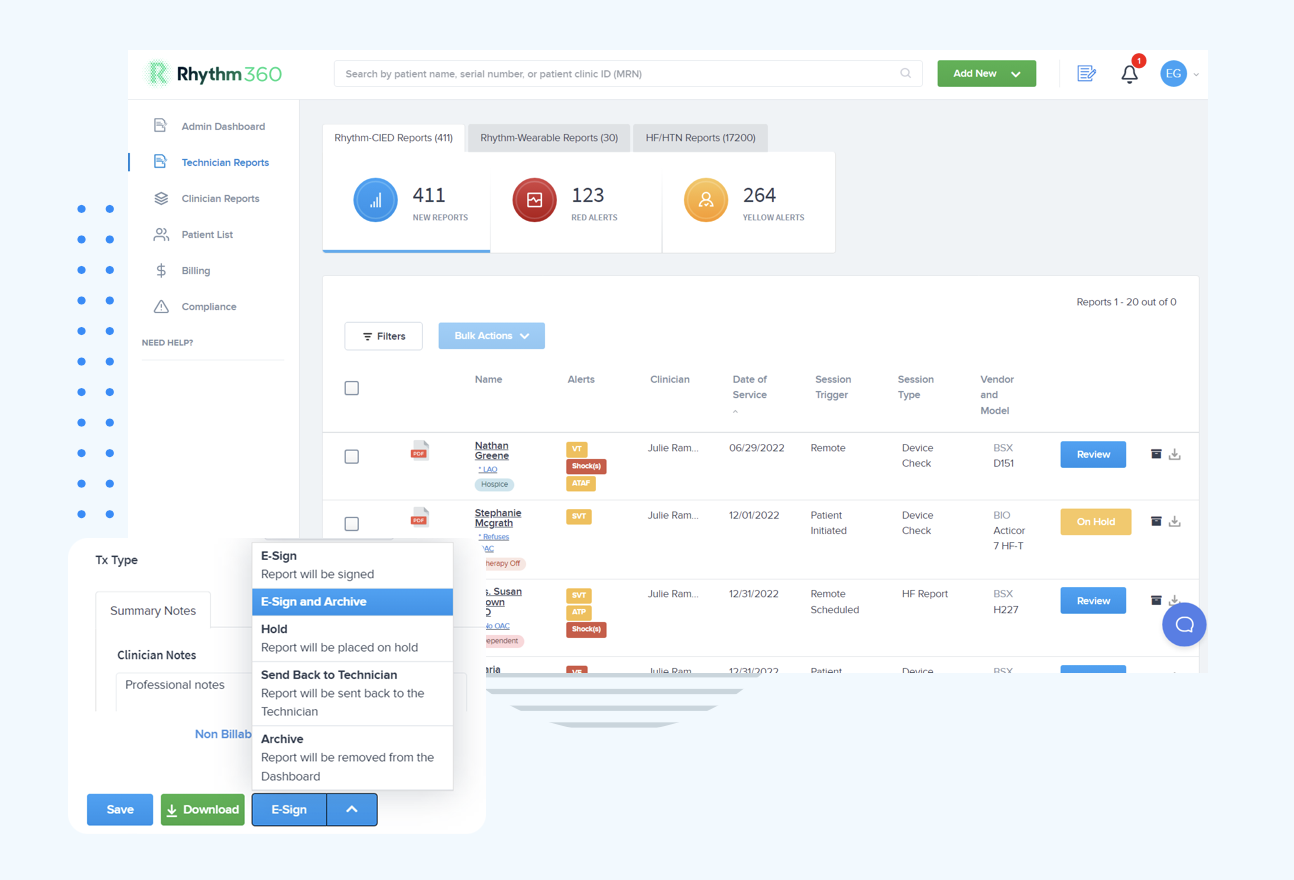
Unified platforms address this risk with AI-powered triage that filters non-actionable transmissions and surfaces prioritized, clinically relevant alerts. University of Chicago Medicine (UCM), after implementing Rhythm360, reported that clinicians reviewed more transmissions daily and identified more abnormalities. The institution processed more than 73,000 reports annually, averaging more than 18,000 per quarter, while maintaining stable dismissal rates.
UCM's clinical team noted: "We are able to address these issues earlier; rather than waiting for a 3-month visit, we can call patients in for evaluation." That shift from reactive to proactive management comes directly from centralized, automated triage.
Rhythm360 cuts critical alert response times by up to 80% by pairing AI-powered alert prioritization with optional 24/7/365 oversight from certified cardiac technicians (CCTs) supervised by physicians. Data transmissibility above 99.9% stays intact through redundant data feeds and AI-powered extrapolation that fills gaps when an OEM server goes down. OEM-specific portals cannot replicate this cross-manufacturer fail-safe.
Bi-directional EHR integration connects a CIED platform to the broader clinical record. Without that link, device data stays siloed and clinicians must manually re-enter findings into Epic, Cerner, Athenahealth, or another system that holds the legal medical record. Manual transcription increases error rates and consumes staff time.
The 2026 interoperability landscape adds complexity beyond a simple “EHR integration” label. HL7 v2 remains the dominant standard for 95% of U.S. hospitals for real-time messaging. At the same time, EHR vendors increasingly support FHIR and health systems are rolling out FHIR-enabled APIs. Production integrations often run on legacy protocols beneath a modern API surface. USCDI Version 3 became the mandatory baseline for certified health IT on January 1, 2026, which expanded required data classes and raised the compliance bar for any platform that writes data back to the EHR.
Operational hurdles sit on top of these technical demands. Write-back integrations that modify the legal medical record trigger stricter security reviews, clinical governance sign-offs, and heavier testing than read-only access. Epic deployments vary widely across hospitals due to custom Z-segments in HL7 messages, site-specific FHIR extensions, and local terminology overrides. Every site becomes a unique integration project.
Rhythm360 manages this complexity with pre-built, bi-directional integrations with Epic, Cerner, Athenahealth, eClinicalWorks, Greenway Health, and other systems via HL7. UCM's implementation team observed: "We have improved billing and accountability for our patients after the integration." Rhythm360’s onboarding process, including EHR integration setup, typically finishes in days to weeks instead of the months often seen in enterprise health IT projects.
Remote cardiac monitoring remains one of the most consistently underbilled service lines in cardiology. Practices that manage 200 or more device patients and do not systematically bill CPT codes 93285 and 93291 every 90 days carry a recurring revenue gap that compounds each quarter.
Automated CPT documentation tools track billable events in real time, generate compliant documentation, and flag codes that meet threshold requirements. The relevant code set for CIED and RPM programs includes 93298, 93299, 99453, 99454, 99457, and 99458, among others. Significant monthly RPM reimbursement per Medicare patient becomes possible when clinics fully use codes such as 99454, 99457, 99458, and 99091. RPM utilization and Medicare spending continue to grow at a substantial rate.
Practices that adopt AI-driven billing automation report measurable gains across several dimensions:
Rhythm360 automates CPT capture and documentation across its Rhythm-CIED and HF/HTN service lines. The administrative dashboard shows a real-time view of captured and potential revenue based on CPT code requirements. Practice administrators gain the visibility to close billing gaps before they become permanent losses. Practices that implement Rhythm360 have reported revenue increases of up to 300% through improved CPT code capture, higher staff efficiency, and new RPM service lines. If your clinic manages 200 or more device patients and suspects billing gaps, schedule a demo to see how Rhythm360 captures RPM revenue your clinic may be leaving on the table.
Implementation timelines for CIED automation platforms depend on clinic size, EHR environment, and the number of device manufacturers in the patient panel. A phased readiness framework lowers risk and speeds time to value.
Three preparatory workstreams largely determine how quickly a clinic can go live:
Rhythm360's implementation process, including EHR integration, typically completes in days to weeks. The platform is accessible through a secure, HIPAA-compliant mobile application, so clinicians can review transmissions, sign reports, and coordinate care from smartphones. That capability directly addresses the staffing and weekend coverage challenges that UCM identified as a persistent issue before implementation: "Staffing was always an issue for our center, because our device clinic, like many other medical centers, had struggled with technician turnover and timely weekend coverage."
Rhythm360 uses a SaaS-based pricing model that scales with clinic size and platform usage. This approach avoids the large upfront capital expenditures that come with on-premise legacy systems.
The following table summarizes Rhythm360's core capabilities, the clinical and operational benefits, and the performance benchmarks EP clinics can expect after implementation.
| Capability | Description | Clinical / Operational Benefit | Benchmark |
|---|---|---|---|
| Multi-vendor data aggregation | Ingests data from Medtronic, Boston Scientific, Abbott, Biotronik, and others via API, HL7, XML, and PDF parsing with computer vision | Eliminates multiple OEM portal logins, creating a single source of truth for all device patients | >99.9% data transmissibility |
| AI-powered alert triage | Filters non-actionable transmissions, prioritizes clinically significant events, and offers optional 24/7 CCT oversight | Reduces alert fatigue and speeds response to critical arrhythmias and device malfunctions | Up to 80% reduction in critical response times |
| Bi-directional EHR integration | Pre-built integrations with Epic, Cerner, Athenahealth, eClinicalWorks, Greenway Health, and others via HL7 | Eliminates manual transcription and supports write-back of reports and documentation to the legal medical record | Go-live in days to weeks |
| CPT billing automation | Automated documentation and CPT capture for codes including 93298, 93299, 99453, 99454, 99457, 99458, plus a real-time revenue dashboard | Closes billing gaps, reduces claim denials, and supports HF/HTN RPM service line launch | Up to 300% revenue increase |
| Secure mobile access | HIPAA-compliant mobile app for iOS and Android that supports transmission review, report signing, and care coordination | Enables on-call coverage without workstation dependency and addresses weekend staffing gaps | Available at go-live |
| Multi-modality chronic disease management | Integrated service lines for Rhythm-CIED and HF/HTN RPM, including CardioMEMS pulmonary artery monitor support | Single platform for rhythm disorders, heart failure, and hypertension that reduces vendor sprawl | Turnkey RPM service line launch |
Automation initiatives in EP clinics fail for predictable reasons, but these failure modes are well documented and avoidable. Recognizing these pitfalls before implementation prevents costly rework and speeds time to value.
Continued reliance on multiple OEM logins. Adopting a new platform while keeping parallel OEM portal workflows erases efficiency gains and preserves the data silos the platform should remove. A clean cutover plan, backed by staff training, is necessary to realize the full benefit of aggregation.
Underestimating change management. Device technicians and clinical staff who rely on OEM-specific workflows need structured onboarding. UCM's implementation highlighted the value of having "an integrated review of data from trained personnel" as a core design principle, not an afterthought.
Weak documentation leading to rejected claims. Automated CPT capture only produces revenue when the underlying documentation meets payer requirements. Coding errors cost the average medical practice $125,000 annually in lost revenue from denials, delayed reimbursements, and compliance risks. Platforms must generate auditable, payer-compliant documentation, not just flag billable events.
Clinics that quantify automation impact track metrics across three domains starting in the first month after go-live.
Clinical metrics:
Operational metrics:
Financial metrics:
Rhythm360's implementation process, including EHR integration setup, typically takes from a few days to a few weeks. Timelines depend on clinic size, the number of device manufacturers in the patient population, and the complexity of the EHR environment. RhythmScience provides structured onboarding support for stakeholder alignment, data migration, and staff training. Clinics that complete a pre-implementation data quality audit and name clinical champions before go-live consistently move faster.
Rhythm360 includes a HIPAA-compliant mobile application for iOS and Android devices. On-call clinicians can review device transmissions, sign reports, and coordinate patient care directly from smartphones without a dedicated workstation. This capability helps close weekend and after-hours coverage gaps that have historically limited CIED monitoring programs.
Rhythm360 uses a SaaS-based pricing model that scales with clinic size and platform usage. This model avoids large upfront capital expenditures and ongoing maintenance costs tied to on-premise legacy systems. Total cost of ownership should include staff hours recovered through automation, revenue captured through improved CPT billing, lower claim denials, and the removal of costs tied to multiple OEM portal workflows. Practices that implement Rhythm360 have reported revenue increases of up to 300%, which materially shifts the net cost equation compared with legacy approaches.
Rhythm360 ingests device data through several technical pathways at the same time. Direct API connections retrieve structured data from OEM servers in near real time. HL7 messaging manages bidirectional data exchange with EHR systems. XML feeds provide structured transmission data from manufacturers that support that format. For manufacturers or legacy systems that deliver data only as PDF reports, Rhythm360 applies computer vision and optical character recognition (OCR) to extract and normalize the clinical data. A redundant data feed system acts as a fail-safe when an OEM server goes down, which keeps transmissibility above 99.9% even during third-party outages. AI-powered extrapolation fills remaining data gaps and cross-checks inputs for fidelity before surfacing information to clinicians.
Managing CIED remote monitoring programs across multiple OEM portals in 2026 creates an unsustainable operational burden for clinics of any size. Fragmented data, alert fatigue, manual transcription, and under-captured RPM billing all stem from the same structural gap. Clinics lack a unified, vendor-neutral platform that aggregates, triages, documents, and integrates device data automatically.
Rhythm360 closes that gap through multi-vendor data aggregation with greater than 99.9% transmissibility, AI-powered alert triage with optional 24/7 CCT oversight, and bi-directional EHR integration with Epic, Cerner, Athenahealth, and other systems. The platform also delivers automated CPT documentation across CIED and RPM service lines and secure mobile access for on-call clinicians. An implementation timeline measured in days to weeks and a SaaS-based pricing model make Rhythm360 accessible to solo EP practices and large integrated health systems.
Clinics that have implemented Rhythm360 report up to an 80% reduction in critical alert response times and revenue increases of up to 300% through improved CPT capture and new RPM service line activation.
Schedule a demo to evaluate whether Rhythm360 fits your device clinic's 2026 workflow strategy.




