Last updated: July 13, 2026
The 2023 Heart Rhythm Society consensus statement positions remote monitoring as the primary follow-up mode for pacemakers, ICDs, CRTs, and implantable loop recorders. CMS reimbursement ties directly to CPT codes 93294–93299, with strict documentation and monitoring-period rules that portal-by-portal workflows rarely meet consistently.
When a practice implants devices from Medtronic, Boston Scientific, Abbott, and Biotronik, staff juggle four separate portals to retrieve patient data. Each portal uses different formats, alert thresholds, and reporting conventions. The result is predictable: manual transcription errors, missed billable events, alert fatigue, and compliance gaps. Other platforms address pieces of this problem. Rhythm360 treats it as a single, integrated five-step workflow challenge.
A compliant CIED workflow starts with one ingestion layer that normalizes data from every OEM without manual portal logins. Rhythm360 ingests data via API, HL7, XML, and unstructured PDF parsing using computer vision and AI-powered extrapolation. A redundant data feed system provides a fail-safe when an OEM server is unavailable, maintaining greater than 99.9% data transmissibility across the patient population.
Device technicians log into one dashboard to view holistic transmission reports for any patient, whether the device is a pacemaker, ICD, CRT, implantable loop recorder, or CardioMEMS pulmonary artery monitor. This single entry point removes the administrative burden of managing disparate portals and creates the data foundation that every downstream validation step depends on. To keep that foundation reliable, validation begins as soon as data enters the system.
Aggregation without normalization produces noise, not insight. At the ingestion stage, Rhythm360 applies field-level checks to confirm that incoming records contain the minimum data elements required for compliant billing: patient demographics, device type and manufacturer, monitoring period dates, and a clinician interpretation note addressing device function, programmed parameters, and actionable findings. Records that fail these checks are flagged before they enter the clinical review queue.
Layered validation turns raw transmissions into audit-defensible documentation instead of billable-looking records that collapse under CMS review. Rhythm360 applies two distinct validation tiers at the data-processing stage.
The validation checks enforce the documentation requirements established in Step 1, blocking records that lack required demographics, device identifiers, or monitoring period data and flagging borderline conditions that need human review.
| Check Type | Trigger Condition | System Response | Billing Impact |
|---|---|---|---|
| Hard Check | Missing patient demographics or device identifier | Record blocked, workflow halted until resolved | Claim suppressed until corrected |
| Hard Check | Monitoring period below CPT minimum threshold | Record blocked, CPT code mapping suspended | Prevents non-compliant claim submission |
| Soft Check | Interpretation note present but lacks actionable finding documentation | Warning flag, workflow continues with reviewer prompt | Claim held for clinician attestation |
| Soft Check | Transmission day count approaching but not yet meeting 99454 threshold | Advisory alert to care coordinator | Proactive outreach to patient to ensure 16-day minimum |
| Soft Check | Interactive communication not yet logged for current billing month | Staff task generated | Protects 99457 eligibility |
RPM programs require at least 16 days of transmitted data within each 30-day period to support 99454 billing, plus at least 20 minutes of documented clinical staff time for 99457. Hard checks enforce these thresholds automatically. Soft checks surface near-miss conditions before they become denied claims.
HIPAA requires covered entities to retain audit logs and related documentation for six years from the date of creation or last effective date. Rhythm360's validation layer writes a timestamped audit trail at every checkpoint, satisfying this requirement without additional staff effort.
Data that lives only inside a monitoring platform creates a documentation gap. Rhythm360 supports bidirectional integration with Epic, Cerner, Athenahealth, eClinicalWorks, Greenway Health, and additional systems via HL7. Transmission reports, alert notifications, and clinician interpretation notes flow directly into the patient EHR record. Updated patient demographics, medication changes, and scheduling data flow back into Rhythm360, keeping both systems synchronized without manual transcription.
AI-guided suggestions now auto-generate integrations in workflow platforms, lowering barriers for implementing bidirectional EHR connections in cardiology practices. Rhythm360's implementation process, including EHR integration setup, typically completes within a few days to a few weeks.
Bidirectional flow introduces a cross-record validation requirement. When a transmission report is written back to the EHR, Rhythm360 confirms that the patient identifier, device serial number, and monitoring period in the outbound record match the source transmission. Mismatches trigger a soft check and hold the record for staff review, which prevents documentation errors from entering the permanent medical record.
Alert fatigue creates a clinical safety risk when every transmission generates an undifferentiated notification. Clinicians then deprioritize the queue, and critical events get buried. AI-enabled workflows for medical device data triage detect subtle or intermittent patterns that rule-based systems often miss and combine multiple data streams into a single consolidated view to reduce clinician review burden in electrophysiology settings.
Rhythm360's AI triage engine scores incoming transmissions by clinical urgency and separates actionable alerts such as ventricular fibrillation, new-onset AFib, lead malfunction, and ERI/RRT indicators from routine, non-actionable transmissions. Clinicians receive a prioritized worklist instead of an undifferentiated inbox. For practices that need additional coverage, Rhythm360 offers optional 24/7/365 oversight by IBHRE-certified cardiac technicians (CCTs) supervised by physicians. The clinical value of AI-assisted triage has been validated in academic settings where data volumes make manual review unsustainable.
As Andrew Beaser, MD, Associate Professor of Medicine at UCM, noted: "Decision support, including AI-assisted decision support, will become increasingly important as data volumes grow." UCM's implementation enabled clinicians to review more transmissions daily and identify more abnormalities. Beaser observed: "We are able to address these issues earlier; rather than waiting for a 3-month visit, we can call patients in for evaluation."
Effective AI triage of CIED and remote monitoring data requires transparent system design so clinicians can interrogate outputs, verify reasoning against patient context, and retain final responsibility for clinical decisions. Rhythm360's triage layer surfaces the reasoning behind each alert classification, which keeps the clinician in control.
Every AI-classified alert generates a validation record that confirms the data inputs used for the classification, the urgency score assigned, and the timestamp of clinician acknowledgment. This creates an auditable chain of custody from transmission receipt to clinical action and supports both quality review and CMS audit defense.
CPT code mapping errors frequently cause revenue leakage in CIED monitoring programs. The 2026 Medicare update introduced specific changes, including removing the prior 16-day minimum for certain remote monitoring codes to accommodate shorter periods. These changes enable reimbursement for shorter ILR transmission periods such as post-ablation or AF burden assessment, which manual workflows often miss.
Rhythm360 maps each completed transmission record to the appropriate CPT code, including 93294, 93295, 93297, 93298, 93299, 99454, 99457, and others, based on device type, monitoring period length, documented clinical time, and interactive communication confirmation. Compliance gates block claim generation for any record that fails a hard check. OIG 2026 audit signals include patient enrollment spikes exceeding 150% in a single month and billing months in which patients did not receive all three required components. Rhythm360's compliance gates align with these audit triggers.
As Gaurav A. Upadhyay, MD, at UCM, observed: "We have improved billing and accountability for our patients after the integration." Practices implementing Rhythm360 have achieved up to 300% revenue increases through more complete CPT code capture and stronger documentation.
Audit-defensible RPM documentation must include proof of an established patient relationship with a prior E/M visit, documented consent with cost-sharing explanation, device transmission reports showing exact day counts, time logs with dates and activities, and records of interactive communications including date and substance. Rhythm360 assembles and stores each of these elements as structured data fields, not free-text notes, which makes them easy to retrieve and verify during an audit.
Rhythm360's administrative dashboard consolidates the operational data that practice administrators and EP lab directors need to manage a CIED program at scale. The following metrics are available in real time:
This dashboard removes reliance on a single "super-user" who knows which portal to check for each patient. Any trained staff member can assess program status, identify bottlenecks, and take corrective action without escalation.
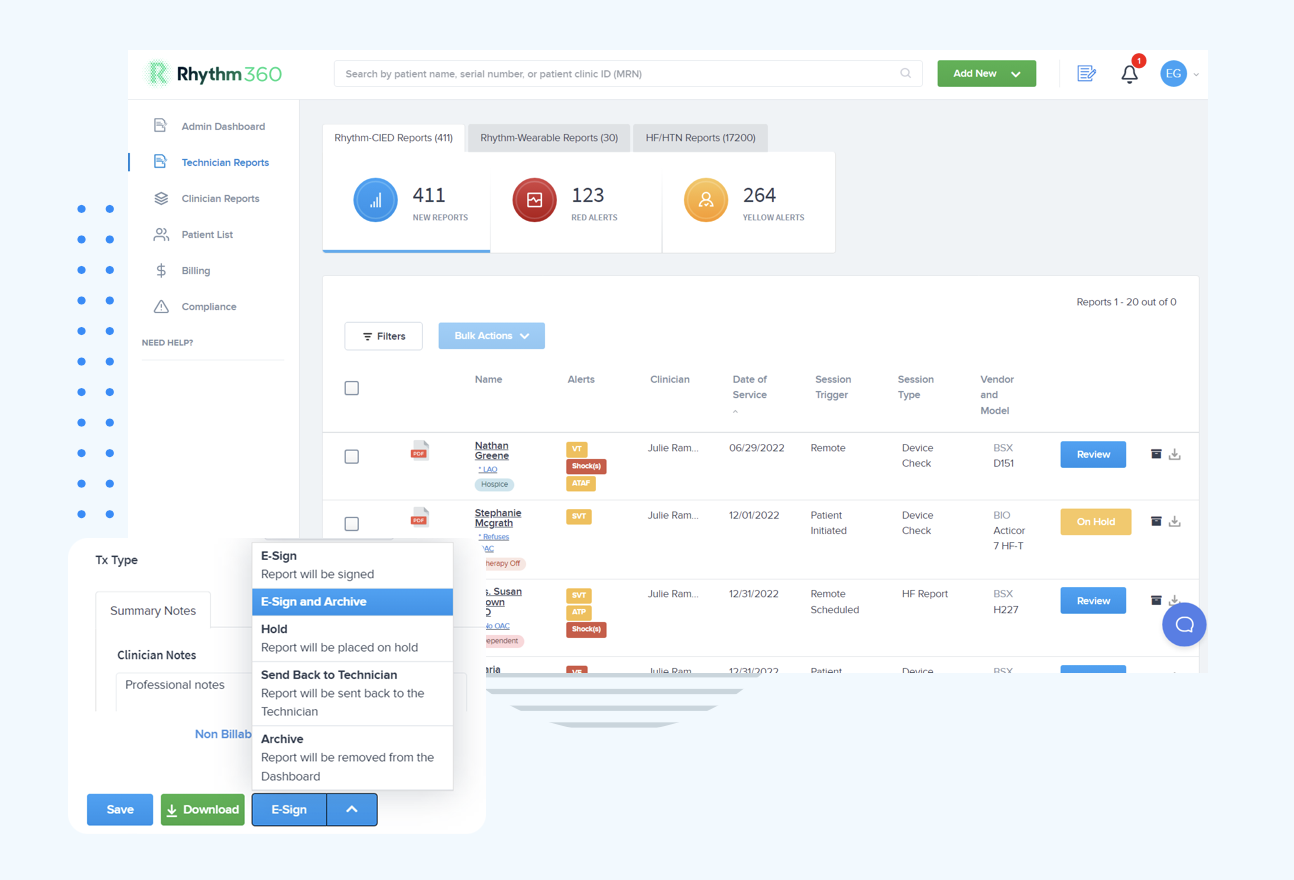
Critical arrhythmia events occur around the clock, not only during business hours. Rhythm360's secure, HIPAA-compliant mobile application allows clinicians to review transmissions, sign reports, and coordinate care from any location. A nurse practitioner who receives a prioritized AFib alert on a Saturday morning can initiate anticoagulation protocols before the patient's condition deteriorates, which legacy workstation-bound workflows rarely support reliably.
The mobile app maintains full audit trail functionality. Every review, signature, and communication action logged through the app is timestamped and written to the patient record, meeting the same documentation standards as desktop-based interactions.
Successful implementation begins with a quick readiness review across four dimensions that work together to support a smooth rollout:
As noted earlier, onboarding timelines depend on practice size and EHR complexity, with straightforward configurations completing at the lower end of the range. The platform's SaaS-based pricing scales with clinic size and usage, which avoids the large upfront capital commitments associated with legacy on-premise systems.
Vendor-neutral means the platform ingests and normalizes data from all major cardiac device manufacturers, including Medtronic, Boston Scientific, Abbott, Biotronik, and others, without separate logins or manual data reconciliation for each OEM. This approach matters because most cardiology practices implant devices from multiple manufacturers. Without a vendor-neutral aggregation layer, staff maintain separate workflows for each portal, which creates data silos, inconsistent documentation, and significant administrative overhead. A vendor-neutral platform creates a single patient record that reflects all device data regardless of manufacturer and supports consistent validation, compliant billing, and reliable alert triage.
Hard checks enforce non-negotiable compliance requirements. When a record fails a hard check, such as a monitoring period shorter than the CPT code's minimum threshold, the workflow stops and the record cannot proceed to billing until staff correct the deficiency. Soft checks flag conditions that require human judgment but do not automatically block the workflow. A record that fails a soft check, such as a transmission approaching but not yet meeting the 16-day threshold for CPT 99454, generates a staff task or advisory alert. The record continues through the queue, and a staff member reviews and resolves the flag before claim submission. Together, the two tiers prevent both hard compliance violations and subtler documentation gaps that generate denials and audit exposure.
Rhythm360 supports the full range of CIED and RPM billing codes, including 93294, 93295, 93297, 93298, 93299, 99453, 99454, 99457, and related codes. The platform's CPT mapping logic reflects current CMS rules, including the 2026 change that removed the prior 16-day minimum for certain remote monitoring codes. This change enables reimbursement for shorter ILR transmission periods such as post-ablation monitoring or AF burden assessment that previously fell outside the billable threshold. Rhythm360's compliance gates apply the correct threshold for each code automatically so practices capture newly eligible billing opportunities without manual rule tracking.
Implementation, including EHR integration, typically completes within a few weeks depending on practice size and EHR complexity. The process runs in parallel with existing workflows during the transition period so patient monitoring continues without interruption. Rhythm360's SaaS architecture removes the hardware installation and IT infrastructure requirements associated with legacy on-premise systems, which often extend implementation timelines. Practices with straightforward EHR configurations and pre-compiled OEM portal credentials usually complete onboarding at the lower end of the range.
Rhythm360 generates structured, timestamped records for every step of the monitoring and billing workflow, including transmission receipt, validation check results, alert classification and acknowledgment, clinician interpretation notes, interactive communication logs, CPT code mapping rationale, and claim submission status. The audit trail is maintained for six years from the date of its creation or last effective date in accordance with HIPAA requirements. Each record includes the patient identifier, device serial number, monitoring period dates, and the identity of the staff member or clinician who took each action. This structured documentation approach allows audit responses to be assembled directly from platform records rather than reconstructed from disparate sources under time pressure.
Fragmented OEM portals, manual validation, and disconnected billing workflows no longer scale to current cardiology patient volumes. The five-step framework of vendor-neutral aggregation, layered hard and soft validation, bidirectional EHR integration, AI-powered alert triage, and automated CPT mapping addresses each failure point in the legacy workflow with clear operational and financial gains. Practices that have implemented this approach have reduced critical alert response times by up to 80% and captured the revenue improvements described earlier.
Rhythm360 delivers these outcomes within a compliant, auditable, and mobile-accessible platform that scales from solo EP practices to high-volume academic medical centers. The University of Chicago Medicine's experience, including 73,000 reports reviewed annually, earlier clinical interventions, and improved billing accountability, shows what a unified CIED data workflow can achieve at scale.