
Data Governance Frameworks for Cardiology Programs
Build a HIPAA-compliant data governance framework for CIED & remote monitoring. Rhythm360 unifies OEM portals to protect billing and patient care.

Last updated: June 19, 2026
Key Takeaways
- A data governance framework organizes policies, processes, roles, and metrics to manage CIED and remote physiologic monitoring data while maintaining HIPAA compliance, CPT billing accuracy, and FDA traceability.
- The four pillars of governance directly shape alert response times, billing integrity, and regulatory compliance in multi-OEM cardiology programs.
- Fragmented OEM portals create data silos that delay critical interventions and increase revenue leakage. Unified, vendor-neutral platforms reduce these risks through automated ingestion and normalization.
- Successful implementation follows a six-step roadmap that covers readiness assessment, policy drafting, platform selection, EHR integration, staff training, and ongoing audit cycles.
- Contact Rhythm360 to turn your data governance framework into a working, AI-supported workflow for your cardiology practice.
Executive Overview
The four pillars of data governance in cardiology are policies, processes, roles, and metrics. Each pillar carries direct regulatory and clinical impact. Policies define alert triage thresholds and data access rules that satisfy HIPAA's Privacy and Security Rules. Processes govern how CIED transmissions move from ingestion to normalization and then to the correct clinician. Roles assign accountability, often to a certified cardiac technician (CCT) or a designated data steward, so that no critical event goes unreviewed. Metrics track CPT capture rates, alert response times, and audit pass rates to confirm that the framework performs as intended.
When any pillar is missing, practices experience fragmented workflows, missed critical arrhythmia events, and revenue loss from incomplete billing documentation. Healthcare organizations generate 30% of the world's total data, and cardiology programs sit at the high-complexity end of that volume because they manage continuous device transmissions from multiple OEMs.
Rhythm360 by RhythmScience functions as the execution layer for each pillar. The platform consolidates multi-OEM CIED and RPM data into a single, AI-powered, vendor-neutral environment that applies governance policies inside daily clinical workflows.
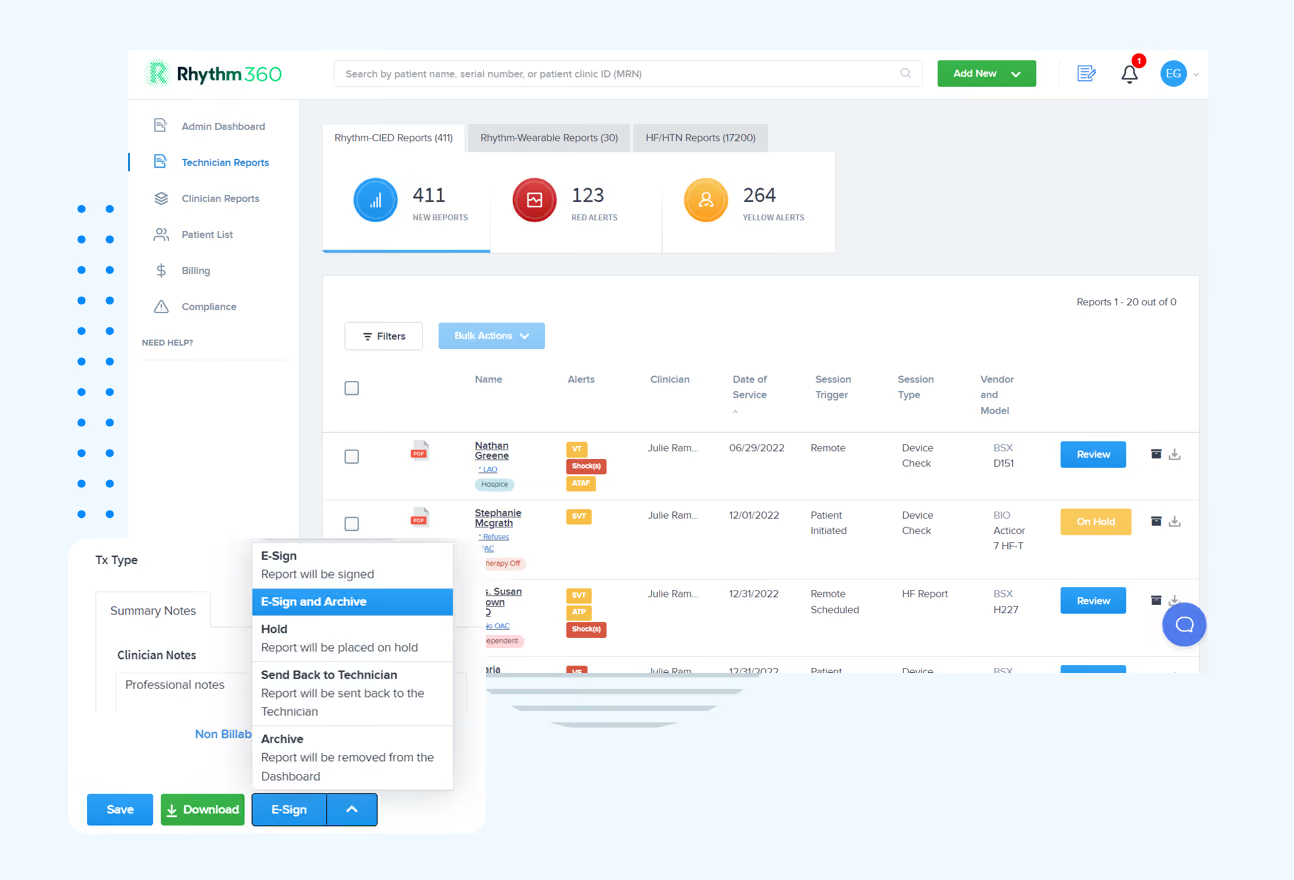
Schedule a demo to see how Rhythm360 activates all four pillars for your practice.
The Healthcare Landscape: Multi-OEM CIED Data Flows and Why They Need Governance
Before you apply the four pillars, you need a clear view of the data environment they must control. A practice that implants devices from Medtronic, Boston Scientific, Abbott, and Biotronik maintains separate logins, learns separate portal interfaces, and reconciles non-interoperable data formats, all before a single clinical decision occurs. This fragmentation is not a minor inconvenience. It represents a structural governance failure that creates data silos, delays alert response, and weakens billing integrity.
Medicare began covering remote patient monitoring in 2019, and the number of patients receiving these services has increased each year. As RPM volume grows, the administrative burden of siloed OEM portals grows in parallel unless a unified platform applies consistent ingestion and normalization rules across all device manufacturers.
Enhancing interoperability between EHRs and rapidly expanding new devices should be prioritized through close collaboration between technology developers and EHR vendors, as most current EHRs are not equipped to pull data directly from novel digital health technologies. Vendor-neutral platforms that bridge OEM data streams to EHR systems through HL7, API, and XML pipelines address this gap directly. They replace manual transcription with automated, auditable data flows.
Core Framework: The Four Pillars of Data Governance for Cardiac Device Programs
Pillar 1 — Policies: Compliance and security as a governance pillar encompass access controls, encryption, data masking, logging, classification, retention policies, and regular audits to meet industry-specific mandates. In cardiology, this translates into written policies that define alert severity tiers, escalation pathways for ventricular tachycardia or device malfunction, and data retention schedules aligned with HIPAA's six-year minimum. Policies also cover FDA adverse-event reporting obligations, since digital health providers must report adverse events and product failures so that regulatory agencies can monitor product safety and implement corrective actions.
Pillar 2 — Processes: Data management as a governance pillar includes data architecture, metadata management, master data management, integration pipelines, and lifecycle management to eliminate duplication and maintain consistency across systems. In a CIED program, this means redundant ingestion pipelines that still capture transmissions when an OEM server is temporarily unavailable. It also means automated report generation that timestamps every clinical action for CPT audit purposes.
Pillar 3 — Roles: Data stewardship assigns clear ownership and accountability through defined roles, training programs, governance committees, and escalation processes to prevent siloed systems and inconsistent policy application. CCTs, supervising electrophysiologists, and billing coordinators need documented role definitions, access permissions scoped to their function, and escalation contacts for after-hours critical events.
Pillar 4 — Metrics: Data governance frameworks incorporate metrics and monitoring for data quality, compliance, adoption rates, and business impact to verify effectiveness. For cardiac programs, core KPIs include alert response time, CPT capture rate for codes such as 93298 and 99454, transmission completeness rate, and HIPAA audit pass rate.
Download the free Cardiology Data Governance Template (includes CPT 93298 and 99454 fields) to map each pillar to your current workflows and identify gaps before you begin implementation.
Implementation Roadmap: Six Steps to Turn Governance into Daily Workflow
Step 1 — Readiness Assessment: Start with an audit of current OEM portal logins, EHR integration points, staff roles, and existing billing documentation processes. Identify which CPT codes you miss today and where alert response delays begin.
Step 2 — Policy Drafting: Create written policies that cover data access tiers, alert escalation thresholds, retention schedules, and HIPAA Business Associate Agreement (BAA) requirements. A robust governance framework includes data classification to identify PHI flows, BAAs with all vendors that process patient data, audit capabilities to review data access, and ongoing bias monitoring across demographic groups.
Step 3 — Platform Selection: Evaluate platforms for vendor neutrality, transmission reliability, EHR integration depth, and CPT documentation automation. Confirm that the platform meets FDA device-data requirements and supports CMS's three required RPM billing components: patient education and device setup, supply of an FDA-defined connected device, and ongoing treatment management.
Step 4 — EHR Integration: Configure bi-directional HL7 or API connections between the cardiac data platform and your EHR, such as Epic, Cerner, or Athenahealth. This connection removes manual transcription and creates a complete audit trail.
Step 5 — Staff Training: Train CCTs, nurses, and billing coordinators on role-specific workflows, alert triage protocols, and CPT documentation requirements. Assign a named data steward who remains accountable for ongoing policy adherence.
Step 6 — Ongoing Audit Cycles: Schedule quarterly reviews of CPT capture rates, alert response times, and transmission completeness. Use these metrics to identify policy gaps and update procedures before the next CMS audit cycle.
Strategic Decisions After Implementation: Platform, Architecture, and Staffing
Once you complete the six-step roadmap, several strategic choices determine long-term sustainability and cost. Building a proprietary cardiac data governance infrastructure requires sustained investment in engineering, compliance expertise, and OEM API maintenance. Most cardiology practices do not maintain those resources. Purchasing a purpose-built platform shifts that maintenance burden to a specialized vendor and provides pre-validated HIPAA and FDA compliance controls.
Centralized governance models, where a single platform aggregates all OEM data under one policy framework, reduce inconsistency and simplify auditing. Federated models, where each OEM portal retains its own data silo, preserve flexibility but increase compliance risk and staff workload. For multi-OEM CIED programs, centralization consistently outperforms federation on alert response time and billing accuracy.
Staffing trade-offs focus on whether to build an in-house CCT team or supplement with a platform that offers optional 24/7 oversight by certified technicians. A hybrid or outsourced model reduces dependency on a single super-user and protects business continuity during staff turnover. This protection matters because burnout among device technicians who manage high-volume alert queues is well documented.
Common Pitfalls That Undermine Cardiac Data Governance
Data silos from multiple OEM logins represent the most common pitfall. Each separate portal uses its own schema, which makes cross-patient population analysis and unified reporting structurally impossible without a normalization layer.
These silos create a direct path to missed critical events. A ventricular tachycardia alert that arrives in one OEM portal while a technician is logged into another remains unseen until the next manual check. That delay can have irreversible clinical consequences.
The resulting workflow, constant portal switching to avoid missed alerts, drives alert fatigue. When governance policies do not define actionable alert thresholds, clinicians receive high volumes of low-priority notifications from multiple systems. Over time, this pattern desensitizes staff to genuinely urgent transmissions.
Revenue leakage from incomplete CPT documentation reflects the financial impact of the same fragmentation. To help prevent fraud in RPM billing, providers must furnish all three components mentioned in Step 3, as many patients do not receive education or assistance with device setup. Without automated documentation that proves each component occurred, practices cannot demonstrate compliance during an audit.
Measurement and Optimization: KPIs That Prove Framework Value
Clinical KPIs: Alert response time serves as the primary clinical metric. Practices that adopt a unified, AI-supported governance platform have achieved an 80% reduction in critical alert response times, which enables earlier intervention. For example, clinicians can initiate anticoagulation for new-onset AFib on a weekend rather than waiting for a scheduled office visit, as described in the University of Chicago Medicine's implementation of Rhythm360, where clinicians reported: "We are able to address these issues earlier; rather than waiting for a 3-month visit, we can call patients in for evaluation."
Operational KPIs: Transmission completeness rate, with a target above 99%, shows whether every device report reaches your team. Additional metrics include staff hours saved each week on manual data retrieval and the reduction in redundant OEM portal logins. UCM managed over 73,000 reports annually with stable dismissal rates, which demonstrates that high-volume monitoring remains sustainable under a structured governance model.
Financial KPIs: CPT capture rate for codes 93298, 93299, 99454, and 99457 serves as the primary revenue metric. Practices have recovered significant additional revenue through improved CPT documentation, with UCM reporting: "We have improved billing and accountability for our patients after the integration."
Compliance KPIs: HIPAA audit pass rate, BAA coverage percentage across all data-processing vendors, and FDA adverse-event reporting timeliness complete the compliance dashboard.
Frequently Asked Questions
What are the 4 pillars of data governance?
The four pillars of data governance are policies, processes, roles, and metrics, as detailed in the Core Framework section above. The key insight for cardiology practices is that all four pillars must operate at the same time. A program that defines policies but lacks assigned roles or measurable metrics will not maintain compliance or clinical performance over time. For example, without written policies that define what counts as a critical alert, your processes have no threshold to enforce. Without assigned roles, your metrics have no accountable owner.
What are the 5 C's of data governance?
The 5 C's of data governance are commonly described as Completeness, Consistency, Correctness, Currency, and Compliance. In a cardiac device program, Completeness means every CIED transmission is captured, including those from OEM portals with intermittent connectivity. Consistency means patient identifiers and device data are normalized to a single schema across all manufacturers. Correctness means clinical data is validated against known device parameters before it reaches a clinician's dashboard. Currency means transmissions are reviewed within the timeframes required by CMS for RPM billing eligibility, specifically data collected on at least two days every 30 days. Compliance means all data handling satisfies HIPAA, FDA adverse-event reporting obligations, and CMS billing documentation requirements. Platforms that automate ingestion and normalization support all five C's at once and reduce the manual burden on clinical staff.
Will AI replace data governance?
AI supports data governance but does not replace it. AI-powered tools, such as alert triage algorithms and computer vision-based PDF parsing, increase the speed and accuracy of data processing. These tools still operate within boundaries set by human-defined governance policies. Without written policies that define what constitutes a critical alert, AI has no threshold to enforce. Without assigned roles, AI-generated flags have no designated recipient. Without compliance metrics, you have no mechanism to detect when an AI model begins producing biased or inaccurate outputs.
Regulatory frameworks reinforce this relationship. The ONC's HTI-1 rule requires predictive decision support interventions to include documented source attributes, risk analysis, governance processes, bias management, and ongoing validity monitoring. In cardiac monitoring, AI reduces alert fatigue by filtering non-actionable transmissions, but a CCT or supervising physician remains accountable for final clinical decisions. Governance provides the accountability structure that keeps AI clinically safe and legally defensible.
Conclusion: Turning Data Governance into Measurable Cardiac Care
A structured data governance framework forms the operational foundation that determines whether a cardiology practice can safely and profitably manage a growing CIED and RPM population in 2026. The four pillars of policies, processes, roles, and metrics map directly to HIPAA compliance, FDA traceability, CPT billing accuracy, and patient safety outcomes.
Practices that implement a unified, vendor-neutral platform as the execution layer for their governance framework demonstrate faster critical alert response times and stronger revenue capture through improved CPT documentation. The University of Chicago Medicine's experience with Rhythm360 shows what becomes possible at scale. Their team reviewed more transmissions, identified abnormalities earlier, and improved billing accountability, all within a sustainable operational model.
The right technology closes the gap between a governance framework on paper and one that functions inside daily clinical workflow. Rhythm360 delivers AI-powered ingestion, intelligent alert triage, bi-directional EHR integration, and automated CPT documentation that convert governance policy into measurable patient and financial outcomes.
.avif)