

Last updated: July 14, 2026
Cardiac workflow automation for device clinics applies software-driven processes, including AI-powered alert triage, vendor-neutral data normalization, automated CPT documentation, and bi-directional EHR integration, to replace manual, portal-by-portal workflows in monitoring, review, and billing for cardiac implantable electronic device (CIED) and remote physiological monitoring (RPM) patient populations.
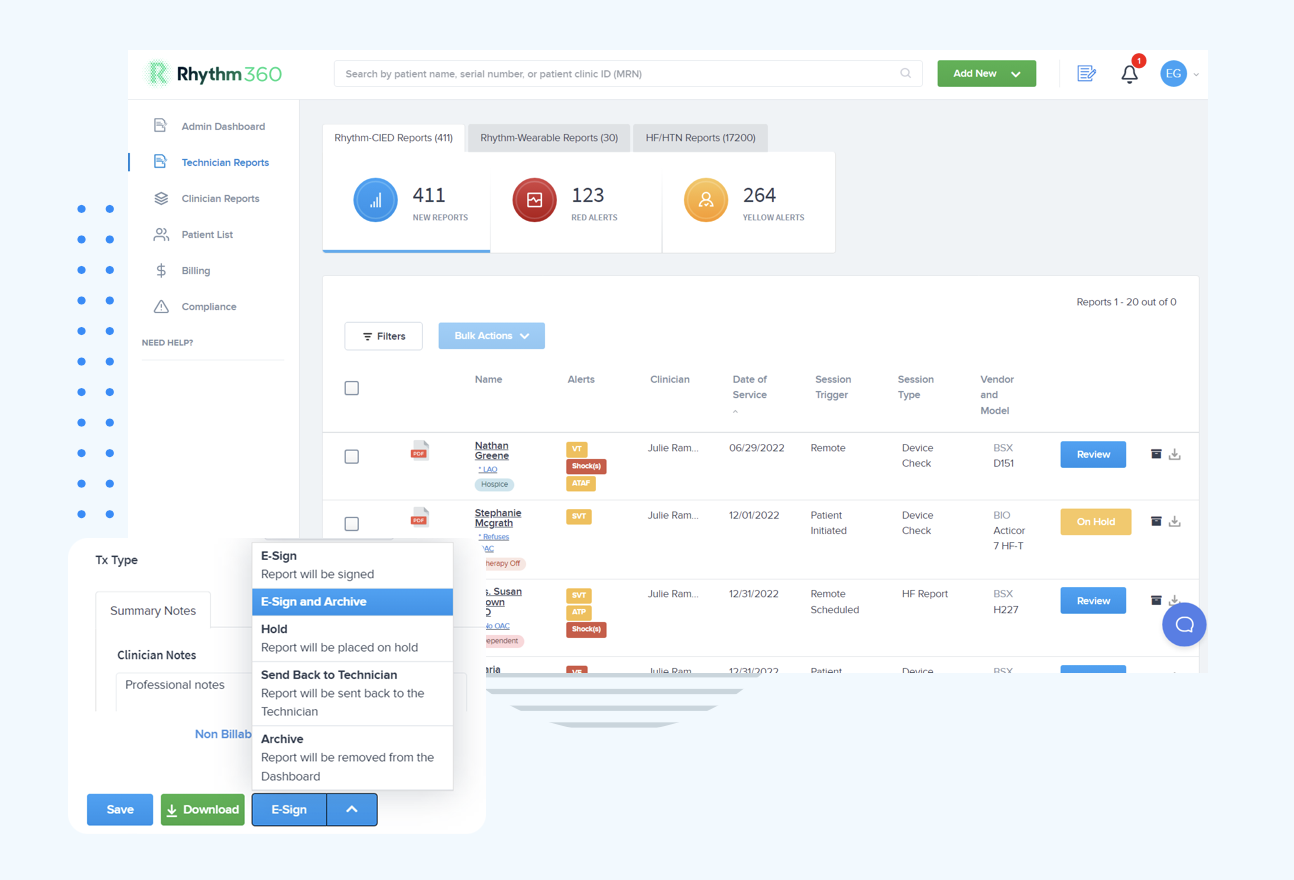
A fully automated device clinic workflow follows a consistent sequence of steps.
Understanding the workflow sequence is only the first step. To decide whether automation fits your clinic, you need to see how each component solves a specific operational problem.
Cardiac workflow automation serves four interconnected purposes, and each purpose maps to specific clinic roles and measurable outcomes.
Alert triage is the first and most time-sensitive function. For electrophysiologists and CCTs, the daily burden of reviewing every incoming transmission, regardless of clinical significance, is unsustainable. A study published in the Journal of Cardiovascular Electrophysiology demonstrated that guideline-based reprogramming can reduce non-actionable alerts by 74% without increasing adverse outcomes. Automated triage applies similar logic at the platform level and ensures clinicians spend time on events that require action.
Data normalization addresses the structural problem identified by the HRS White Paper on CIED interoperability. The paper notes that each manufacturer has developed proprietary nomenclature, technical standards, and communication protocols, which makes cross-vendor data management difficult for traditional EHRs. A vendor-neutral platform resolves this problem by converting heterogeneous device data into a unified, queryable format.
Billing documentation directly affects practice administrators and physician-owners. When monitoring systems cannot deliver structured reporting to the EHR, the patient record fails to reflect the complexity of work performed and creates billing risk. Automated CPT capture closes this gap by linking clinical activity to compliant documentation at the point of care.
EHR integration benefits every role in the clinic. Nurses and NPs avoid duplicate data entry. Physicians access complete patient records without leaving the chart. Administrators gain audit-ready documentation. Automated workflows deliver audit-ready evidence through immutable logs, time-stamped approvals, and machine-verifiable data lineage, which satisfies HIPAA Security Rule requirements.
Alert fatigue in device clinics represents a patient safety issue, not merely an operational inconvenience. When clinicians receive an overwhelming volume of non-actionable notifications, the risk of missing a genuinely critical event increases. The same 2025 Heart Rhythm O2 survey identified initial transmission review as one of the three most burdensome tasks that clinic staff were most willing to outsource.
Rhythm360 addresses alert fatigue through two complementary mechanisms. Its AI-powered triage engine first classifies incoming transmissions by clinical urgency and separates actionable events from routine checks before a clinician opens the queue. The platform then offers optional 24/7/365 oversight by IBHRE-certified cardiac technicians supervised by physicians, which ensures that critical alerts such as ventricular fibrillation, lead malfunction, and new-onset AFib receive timely human review regardless of time of day. This combination reduces critical alert response times by up to 80% and enables same-day intervention that prevents hospitalizations.
For CCTs, electrophysiologists, and NPs, the daily experience of device clinic work changes substantially when automation is in place. Tasks that previously required navigating multiple OEM portals, each with its own login, interface, and data format, consolidate into a single prioritized worklist. The HRS White Paper notes that clinicians managing large CIED populations must pull together data from multiple vendors and settings, a process traditional EHRs are not well suited to handle. A unified platform removes that burden entirely.
Mobility adds a practical benefit for on-call clinicians. Rhythm360's HIPAA-compliant mobile application allows clinicians to review transmissions, sign reports, and coordinate care from their smartphones. A critical arrhythmia flagged on a Saturday morning can receive attention by Saturday afternoon, with anticoagulation initiated or a device reprogrammed, rather than waiting until Monday. This shift from reactive to proactive care is the operational outcome that device specialists consistently identify as the most meaningful change automation delivers.
Vendor-neutral architecture in device clinic automation reflects a simple reality. Most practices implant devices from more than one manufacturer. The HRS White Paper explicitly identifies the need for interoperability because clinicians are primarily concerned with evaluating battery status, programmed parameters, arrhythmias, and therapies delivered across mixed device populations. These data points exist in incompatible proprietary formats across OEM portals.
Rhythm360 achieves greater than 99.9% transmissibility through a multi-layered ingestion architecture. Direct API connections handle structured data from OEM servers. HL7 and XML feeds process semi-structured transmissions. For unstructured PDF reports, which are common across legacy OEM portals, computer vision and OCR extract and map data fields automatically. A redundant data feed system acts as a fail-safe when an OEM server experiences downtime and ensures no transmission is lost because of a third-party infrastructure failure. The result is a complete, cross-referenced patient record that clinicians can trust for clinical decision-making.
Schedule a demo to see Rhythm360's vendor-neutral data normalization across all major OEMs.
Bi-directional EHR integration turns cardiac workflow automation from a monitoring tool into a complete clinical workflow solution. Outbound integration pushes completed reports and structured device data into the patient EHR record and eliminates manual transcription. Inbound integration pulls care plan updates, medication changes, and patient demographics back into the monitoring platform so that monitoring logic reflects the patient's current clinical status.
Rhythm360 supports bi-directional integration with Epic, Cerner, Athenahealth, eClinicalWorks, Greenway Health, and other systems via HL7. Implementation, including integration setup, typically takes from a few days to a few weeks. Integration engines that support HL7 v2, FHIR, and X12 standards enable reliable, observable data movement with message validation and end-to-end traceability. These capabilities satisfy both clinical continuity and HIPAA audit requirements.
On the compliance side, automated CPT documentation within Rhythm360 tracks billable activities against the specific time and data thresholds required for codes including 93298, 93299, 99453, 99454, and 99457. Every clinical action is logged with a time-stamped, tamper-evident audit trail, which supports both claims submission and payer audit defense.
Cardiac workflow automation delivers documented operational and financial outcomes at scale. Rhythm360 clients have achieved an 80% reduction in response times for critical patient alerts and up to a 300% increase in revenue through improved CPT code capture, higher staff efficiency, and the addition of new RPM service lines.
The University of Chicago Medicine (UCM) implementation provides a high-volume reference point. UCM reviewed more than 73,000 reports annually through Rhythm360 in calendar year 2025, averaging more than 18,000 reports per quarter, with stable dismissal rates that demonstrate scalable monitoring without proportional staffing increases. Andrew Beaser, MD, Associate Professor of Medicine at UCM, noted that the implementation enabled clinicians to review more transmissions daily and identify more abnormalities. The clinical team reported: "We are able to address these issues earlier; rather than waiting for a 3-month visit, we can call patients in for evaluation." On the billing side, UCM stated: "We have improved billing and accountability for our patients after the integration."
The UCM case also illustrates the value of centralized data review. The team reported: "That was a big piece for us, to have an integrated review of data from trained personnel." At more than 73,000 annual reports, the ability to maintain consistent triage quality without expanding headcount represents the defining operational outcome of a mature cardiac workflow automation implementation.
Rhythm360 is structured around two distinct but integrated service lines. Rhythm-CIED covers the full spectrum of implantable cardiac electronic devices, including pacemakers, ICDs, implantable loop recorders, CRT and CCM devices, and CardioMEMS pulmonary artery monitors. The platform provides automated transmission review, alert triage, and CPT documentation for remote monitoring of rhythm disorders.
The HF/HTN service line extends the platform's capabilities to remote physiological monitoring for heart failure and hypertension patients. Supported devices include weight scales, blood pressure monitors, and other connected tools. Turnkey patient onboarding checklists, automated patient messaging via an integrated Twilio framework, and billing support for RPM-specific CPT codes 99453, 99454, and 99457 allow practices to launch a new, recurring-revenue service line with minimal logistical overhead. U.S. RPM revenue reached $12.76 billion in 2024 and is projected to reach $32.17 billion by 2032, which reflects the scale of the opportunity available to practices that operationalize RPM effectively.
Managing both service lines within a single platform gives a practice administrator one dashboard, one billing workflow, and one audit trail for the entire monitored patient population, regardless of whether a patient has an implanted device, a connected scale, or both.
An OEM remote monitoring portal is a manufacturer-specific tool that provides access to data from that manufacturer's devices only. A cardiac workflow automation platform ingests and normalizes data from all major device manufacturers into a single interface, adds AI-powered alert triage, automates CPT documentation, and integrates bi-directionally with the practice EHR. In practice, a device technician using a single OEM portal must still log into separate portals for every other manufacturer's devices and manually reconcile data across systems. A workflow automation platform removes those redundant steps and replaces them with a unified, prioritized worklist.
Cardiac workflow automation platforms use AI-driven triage to classify incoming transmissions by clinical urgency before they reach a clinician review queue. Non-actionable transmissions, such as routine scheduled checks with no abnormal findings, are processed and documented automatically. Transmissions that meet defined clinical thresholds for arrhythmias, device malfunction, or physiologic deterioration are escalated immediately. Rhythm360 supplements this AI layer with optional 24/7 oversight from IBHRE-certified cardiac technicians, which provides a human review layer for complex or ambiguous cases. The combination reduces alert volume without reducing sensitivity to critical events and allows clinicians to focus attention where it has the greatest clinical impact.
For CIED remote monitoring, the primary CPT codes supported include 93298, which covers remote monitoring of a pacemaker system, and 93299, which covers remote monitoring of an ICD system, along with associated interrogation and analysis codes. For remote physiological monitoring service lines that cover heart failure and hypertension, the relevant codes include 99453 for device setup and patient education, 99454 for device supply with daily recording, and 99457 for remote physiologic monitoring treatment management for the first 20 minutes. Rhythm360 tracks the time and data thresholds required for each code automatically and generates compliant documentation at the point of clinical activity rather than requiring retrospective reconstruction for billing.
Implementation timelines vary based on the complexity of the EHR environment and the number of OEM data feeds that need connection. For Rhythm360, the full onboarding process, including EHR integration with systems such as Epic, Cerner, or Athenahealth, typically takes from a few days to a few weeks. The platform's SaaS-based architecture removes the infrastructure provisioning delays associated with on-premise systems, and the implementation team manages the technical integration work, which reduces the burden on clinic IT staff. Practices can begin reviewing transmissions in the unified platform and capturing automated CPT documentation shortly after go-live.
Fragmented OEM portals, manual data entry, alert fatigue, and incomplete CPT documentation are not inevitable features of running a device clinic. They are symptoms of a workflow architecture that predates the current scale of remote monitoring. The 2023 HRS consensus standards, the growing CIED implant volume, and the documented staffing pressures facing device clinics all point toward the same operational requirement: a single, vendor-neutral platform that automates work that should not require human attention and accelerates work that does.
Rhythm360 delivers that platform. From multi-OEM data normalization at greater than 99.9% transmissibility, to AI-powered alert triage, to bi-directional Epic and Cerner integration, to automated CPT documentation for both CIED and HF/HTN RPM service lines, every component is designed to reduce the operational burden on device clinic staff while improving the speed and completeness of clinical response. The outcomes at University of Chicago Medicine, including more than 73,000 annual reports, earlier interventions, and improved billing accountability, demonstrate what that architecture produces at scale.





