Last updated: July 14, 2026
Heart failure cases are projected to rise 46% by 2030, with associated costs more than doubling. Population aging and improved post-acute survival drive this growth. As patient volumes grow, practices relying on fragmented OEM portals face mounting administrative burdens.
Staff log into separate, non-interoperable systems for each device manufacturer. They manually reconcile conflicting data and chase billing documentation for complex CPT codes, all while critical alerts compete for attention.
A 2026 Cardiology Journal viewpoint defines next-generation remote monitoring as AI systems that analyze longitudinal physiological and behavioral signals to generate context-aware alerts while reducing clinical workload. Scaling these systems requires three things: EHR integration, explicit alert prioritization, and clear escalation pathways. These are exactly the capabilities that separate a unified platform from a collection of siloed OEM portals.
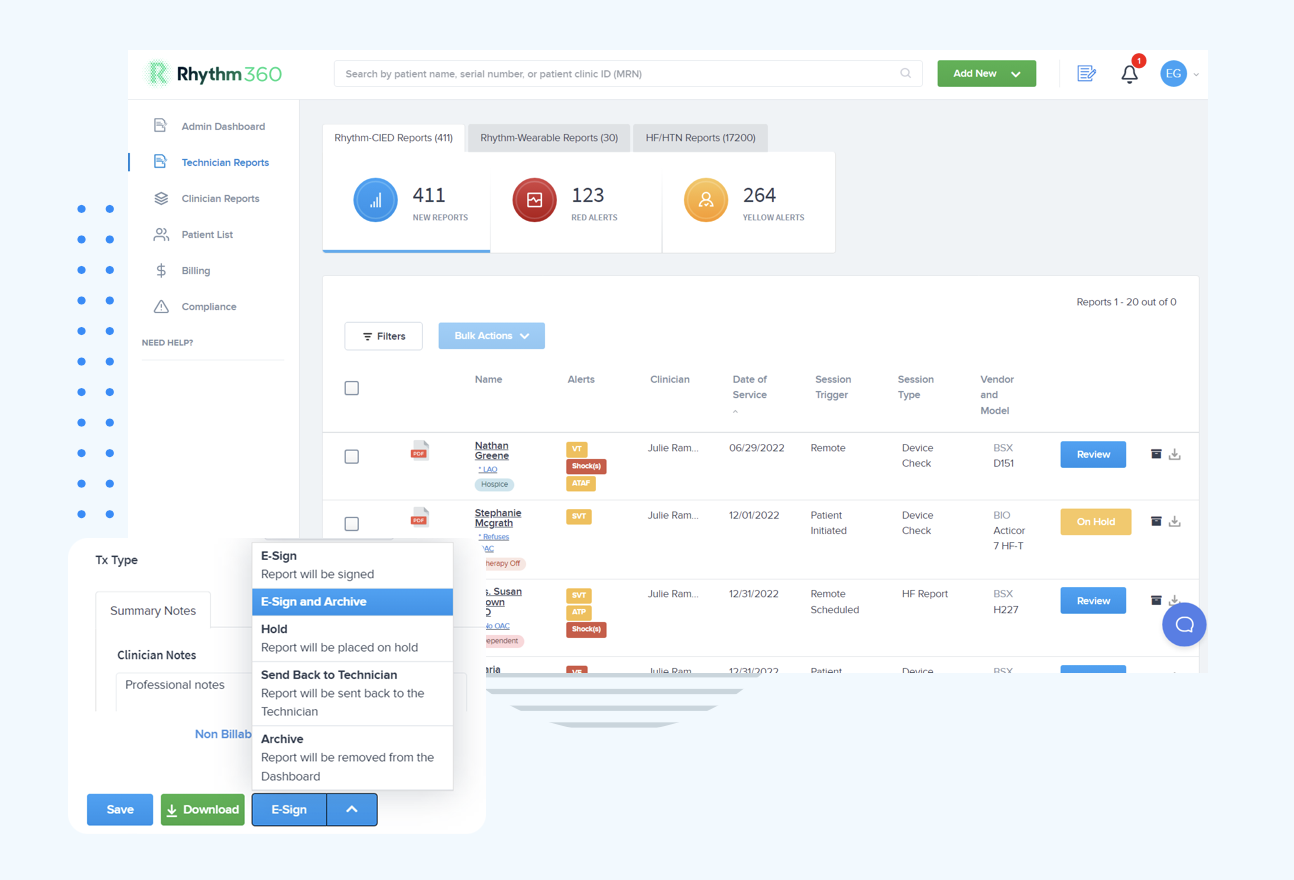
The University of Chicago Medicine (UCM) put this into practice. After implementing Rhythm360, UCM reviewed more than 73,000 reports annually, averaging over 18,000 per quarter, while maintaining stable dismissal rates in a high-volume academic environment. That scale only works when data aggregation, triage, and reporting run through one automated workflow.
Schedule a demo to see how Rhythm360 handles this volume in practice.
Next-generation remote monitoring replaces static thresholds with AI-driven trajectory analysis that prioritizes events most likely to need intervention. Legacy systems generate high volumes of non-actionable notifications because they apply uniform thresholds across different patient populations. AI-powered platforms learn individual baselines and flag deviations that carry real clinical significance.
In the LINK-HF2 trial, clinicians reviewed 95% of AI-generated alerts within 24 hours, and 26.7% of reviewed alerts led to clinical actions such as therapy adjustment. That action rate reflects well-calibrated triage, not noise. Separately, a machine learning model at a large academic medical center suppressed a substantial portion of medication alerts while keeping false negatives low, showing that aggressive filtering doesn't have to compromise safety.
Rhythm360 tackles alert fatigue through an AI-powered triage layer that filters non-actionable transmissions and surfaces prioritized events. Optional 24/7/365 oversight from certified cardiac technicians, supervised by physicians, adds a human-in-the-loop layer for practices that want it. Together, these features cut critical-alert response times by up to 80%.
EHR connectivity is the most critical integration requirement for RPM programs. It synchronizes patient demographics, device data, vital signs, and clinical documentation between RPM platforms and EHR systems like Epic and Cerner. Without bidirectional flow, clinicians must manually transcribe device findings into the EHR. That process introduces errors, wastes staff time, and creates documentation gaps that put CPT billing at risk.
Modern RPM integration relies on HL7 FHIR APIs and SMART on FHIR standards, which map directly to clinical concepts and let RPM apps embed inside EHR workflows. Rhythm360 supports this architecture natively, with integrations covering Epic, Cerner, Athenahealth, eClinicalWorks, Greenway Health, and others via HL7.
A cardiology practice deploying Rhythm360 follows this checklist:
Dr. Anjali B. Thakkar of the American College of Cardiology's Health Care Innovation Council envisions "data from remote monitoring devices flowing directly into our existing clinical systems to facilitate easier use of this data in clinical decision-making." Rhythm360 meets that standard today.
The 2026 CMS Physician Fee Schedule added two new RPM codes that expand billing opportunities for heart failure practices. CPT 99445, effective January 1, 2026, covers device supply for 2 to 15 days of monitoring in a 30-day period at roughly $47 to $52 nationally, removing the prior 16-day threshold required by CPT 99454. CPT 99470 provides a billing pathway for the first 10 minutes of treatment management at roughly $26 nationally.
The full 2026 RPM code set relevant to heart failure monitoring, with national average reimbursement:
A fully billed program using CPT codes 99454, 99457, and 99458 generates substantial monthly revenue per patient at Medicare rates. Stacking Chronic Care Management on top of RPM for eligible patients adds $211 or more per patient per month.
Rhythm360 automates CPT code capture and generates auditable documentation that meets these requirements, helping practices recover revenue they previously lost. Gaurav A. Upadhyay, MD, at UCM, said: "We have improved billing and accountability for our patients after the integration." Practices implementing Rhythm360 have reported revenue increases up to 300% through better CPT code capture and staff efficiency. Beyond billing, that same efficiency shows up in how and where clinicians can act on data.
On-call clinicians can't stay tethered to a workstation. A platform that limits review and sign-off to a desktop creates delays that aren't acceptable when a patient transmits a critical arrhythmia at 11 p.m. on a Friday. Rhythm360's HIPAA-compliant mobile app lets clinicians review transmissions, sign reports, and coordinate care from their phones, from anywhere, at any time.
Andrew Beaser, MD, at UCM, noted: "I am more likely to sign off on these while in meetings because I can easily access them on my phone." That shift, from deferred review to real-time action, shrinks the window between a critical event and clinical intervention.
The table below summarizes the capabilities that let Rhythm360 replace fragmented OEM logins with a single, auditable workflow.
| Feature | Rhythm360 Specification | Clinical Impact |
|---|---|---|
| Dashboard | Single, vendor-neutral dashboard for all OEM device data | Eliminates multiple OEM logins; one source of truth for all CIED and HF data |
| Data Transmissibility | Greater than 99.9% via redundant data feeds, computer vision, and AI-powered extrapolation | Critical events aren't missed due to OEM server downtime or data gaps |
| Critical-Alert Response Time | Up to 80% reduction versus legacy workflows (as noted earlier) | Earlier intervention for arrhythmias, device malfunctions, and HF decompensation |
| Onboarding Timeline | Days to a few weeks, including EHR integration | Minimal disruption to existing clinical operations |
| Mobile App | HIPAA-compliant iOS/Android app for transmission review, report sign-off, and care coordination | On-call clinicians act on critical alerts without returning to a workstation |
| Revenue Impact | Up to 300% increase in revenue through automated CPT capture (discussed above) | Recovers previously lost billing revenue; supports 2026 CPT codes 99445 and 99470 |
At 7:14 a.m. on a Saturday, a patient's ICD transmits data flagging new-onset ventricular tachycardia. In a fragmented workflow, this transmission sits in an OEM portal until a technician logs in Monday morning. That's a 48-hour delay carrying real stroke and syncope risk.
With Rhythm360, the sequence plays out differently. The AI triage layer classifies the event as clinically significant and generates a prioritized alert. The on-call NP gets a push notification on the Rhythm360 mobile app, reviews the transmission, and starts anticoagulation protocols, all before 9 a.m. By Saturday afternoon, the patient has been evaluated and managed.
Andrew Beaser, MD, described the shift: "We are able to address these issues earlier; rather than waiting for a 3-month visit, we can call patients in for evaluation." That earlier intervention window is the core clinical value of unified, AI-powered remote monitoring, available every day of the week, not just during office hours.
Standard RPM EHR integration in the industry takes three to six months for small implementations. Rhythm360 compresses this to days or a few weeks using pre-built connectors for Epic, Cerner, Athenahealth, eClinicalWorks, and Greenway Health, plus HL7 data normalization that handles APIs, XML, and unstructured PDFs via computer vision.
Before scheduling an implementation kickoff, practices should confirm:
Practices that keep operating through separate OEM portals face compounding operational and financial risks as patient volumes grow. Each additional login and manual reconciliation step adds friction that a unified platform removes. Administrators weighing point solutions against one integrated system should consider these documented costs together, since they compound rather than occur in isolation:
Rhythm360 eliminates each of these failure points through a single, AI-powered, vendor-neutral architecture that scales from solo EP practices to large health systems managing thousands of CIED patients.
OEM portals from manufacturers like Medtronic, Boston Scientific, Abbott, and Biotronik serve their own device ecosystems and don't share data with each other. A practice implanting devices from multiple manufacturers must maintain separate logins, learn separate interfaces, and manually reconcile data across systems. Rhythm360 ingests and normalizes data from all major OEMs into a single dashboard, removing redundant logins and creating one auditable source of truth. It also adds AI-powered alert triage, automated CPT documentation, bi-directional EHR integration, and mobile access, capabilities no individual OEM portal offers.
Rhythm360 automatically captures the data elements needed for compliant billing across the full 2026 RPM code set: CPT 99453, 99445, 99454, 99457, 99458, and 99470. The platform tracks transmission days, documents clinical staff time, and generates audit-ready reports, cutting manual work for billing staff and reducing claim rejections. This is the same automated capture behind the revenue gains discussed earlier in this guide.
Onboarding, including EHR integration, typically takes a few days to a few weeks. This is far shorter than the three to six months usually needed for small implementations, thanks to pre-built connectors and HL7 data normalization. The process covers EHR configuration, OEM data feed setup, staff training, and go-live validation, supported by the RhythmScience implementation team.
Yes. Rhythm360 includes a HIPAA-compliant mobile app for iOS and Android that lets clinicians review transmissions, sign reports, and coordinate care from their phones. This matters most for on-call scenarios, where a critical arrhythmia or decompensation alert needs immediate action outside office hours.
Rhythm360 achieves greater than 99.9% data transmissibility through redundant OEM data feeds, computer vision for parsing unstructured PDF reports, and AI-powered extrapolation that fills gaps during OEM server downtime. A critical device alert, such as a ventricular fibrillation episode or lead malfunction, still reaches the clinical team even if the originating OEM system goes down. For heart failure patients, where a missed transmission can mean a missed decompensation event, this transmissibility rate is a patient safety requirement, not just a technical spec.
Cardiology practices face a clear operational choice this year. They can keep managing fragmented OEM portals with manual triage and incomplete billing documentation, or consolidate onto a single, AI-powered, vendor-neutral platform that unifies CIED and heart failure data.
Rhythm360 delivers bi-directional EHR integration, a HIPAA-compliant mobile app, over 99.9% data transmissibility, and onboarding measured in days rather than months, all in one workflow. UCM processed more than 73,000 reports annually through the platform while maintaining stable dismissal rates and enabling earlier interventions. The 2026 CPT code expansion, including 99445 and 99470, creates revenue opportunities that automated billing documentation is built to capture from day one.