

Last updated: July 13, 2026
The administrative burden of CIED remote monitoring keeps growing. Staff reconcile data across multiple OEM portals, manually transcribe findings into the EHR, and make time-pressured clinical decisions without a shared framework for urgency.
Alert fatigue emerges directly from this environment. A cross-manufacturer analysis of 2,659 rhythm episodes from 1,710 patients presented at the 2026 European Heart Rhythm Association Congress found that even in AI-equipped implantable cardiac monitors, 32.9% of rhythm episodes were non-actionable. In devices without proprietary AI, that figure rose to 45.4%. When nearly half of all alerts require review yet do not change care, the burden becomes operational and clinical, pulling attention from patients who truly need intervention.
Missed critical events create serious risk. A ventricular tachycardia episode or new-onset atrial fibrillation that sits unreviewed over a weekend can lead to stroke, syncope, or hospitalization. At the same time, incomplete CPT documentation for codes 93294–93298 leaves earned revenue uncaptured. A cardiology practice with 200 device patients can generate substantial recurring revenue from properly billed remote monitoring, yet manual, fragmented workflows often lose that income.
Staff burnout then amplifies every other issue. Device technicians and nurses who spend their days in clunky portals and non-actionable alerts are less likely to stay. Their departure removes institutional knowledge and further degrades workflow quality.
Addressing fragmented data, alert fatigue, missed events, revenue leakage, and burnout requires a single platform that unifies the entire CIED workflow. Rhythm360 provides that hub.
Rhythm360 is a vendor-neutral, HIPAA-compliant, cloud-based platform that ingests and normalizes data from all major CIED manufacturers into one dashboard. It removes the need for multiple OEM logins and presents a real-time view of the entire device population.
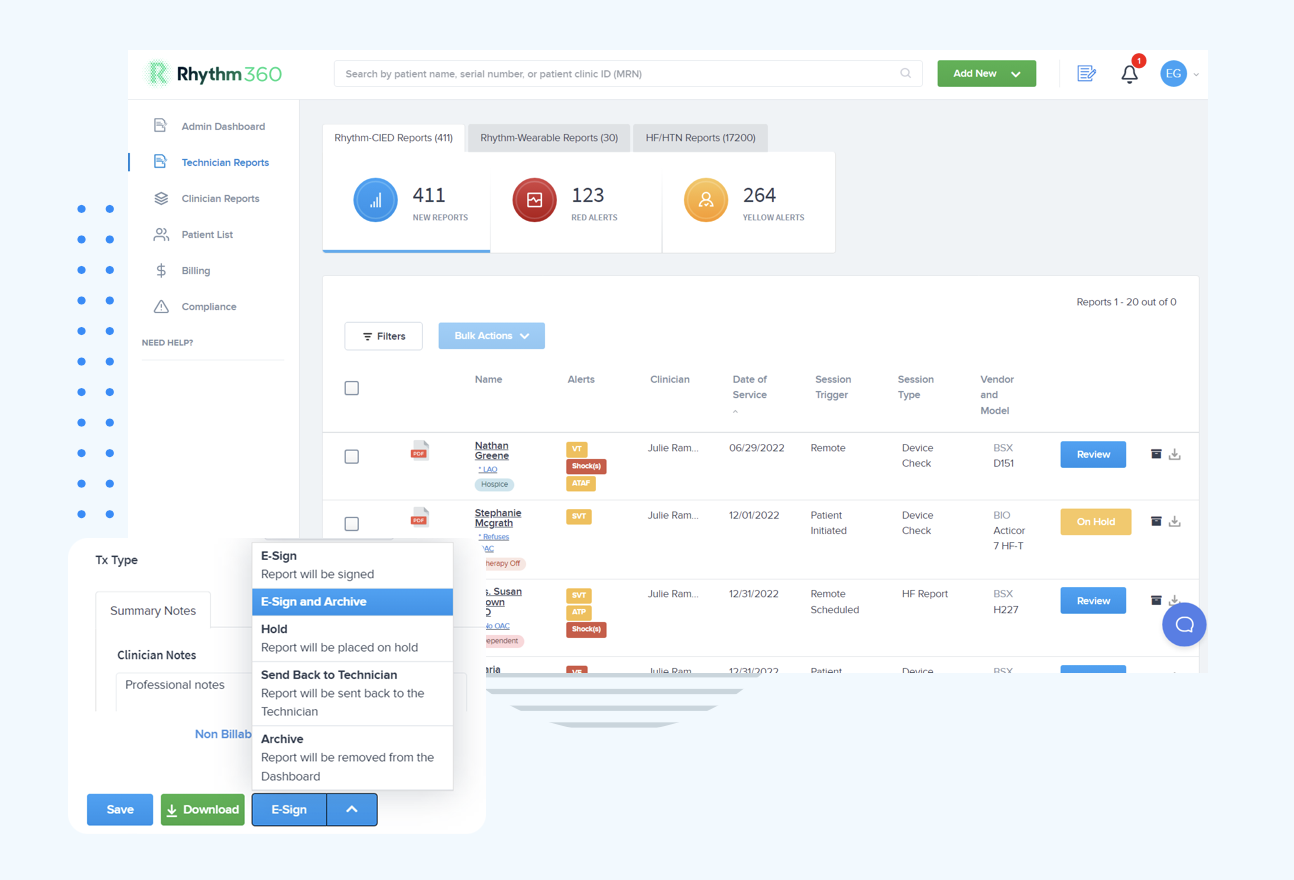
Key platform capabilities include:
The University of Chicago Medicine implemented Rhythm360 and now reviews more than 73,000 reports annually, averaging more than 18,000 reports per quarter, while identifying more abnormalities and intervening earlier.
Schedule a demo to see how Rhythm360 consolidates your CIED workflow into one platform.
The Rule of 3 sorts every incoming CIED alert into one of three tiers based on clinical risk. Consistent tier definitions across manufacturers and device types form the base of an efficient triage workflow.
The Rule of 3 organizes alerts by the immediacy of clinical risk. Tier 1, Red / Immediate, captures life-threatening events such as sustained ventricular tachycardia or fibrillation (VT/VF), high-voltage shock delivery, end-of-service (EOS) or elective replacement indicator (ERI), and complete lead failure. These events require response within one hour, around the clock, because delay can result in sudden cardiac death.
Tier 2, Yellow / High Priority, includes clinically significant findings that do not pose immediate mortality risk but can lead to stroke or hospitalization if ignored. Examples include new-onset atrial fibrillation with high burden, frequent non-sustained VT (NSVT), significant lead impedance changes, and pacing threshold elevation. These alerts warrant response within 24 hours on business days and same-day review on weekends.
Tier 3, Green / Routine, covers technical and administrative notifications. These include connectivity alerts, non-urgent battery status updates, and scheduled transmission confirmations with no abnormal findings. Clinics can address these within the standard 30–90 day billing cycle because they do not indicate active clinical risk.
Abbott's Merlin.net assigns alerts to red (high priority) or yellow (lower priority) levels and displays red alerts first in the viewer queue to support triage ordering, which reflects a manufacturer-level acknowledgment that tiered prioritization is operationally necessary. Rhythm360's AI automatically assigns incoming transmissions to the appropriate tier across all manufacturers and removes the need for manual sorting.
Clinicians can apply a simple five-question screen to every Tier 1 or Tier 2 alert before escalation or documentation. Rhythm360 surfaces these decision points automatically based on alert type and patient history.
Rhythm360 auto-routes alerts based on answers to these questions. Tier 1 events go directly to the on-call clinician's mobile device, while Tier 3 events queue for batch review during scheduled workflow windows.
Alert fatigue reflects excess noise rather than excess alerts. Many alerts tied to reprogramming interventions disappear after targeted device reprogramming, and unscheduled transmissions often decrease as well.
Guideline-based reprogramming of CIEDs can reduce non-actionable alerts by 74% without increasing adverse outcomes, according to a study published in the Journal of Cardiovascular Electrophysiology. Alert protocols that match individual patient clinical context, rather than manufacturer defaults, drive this reduction.
Clinics can apply three practical suppression strategies:
Rhythm360's customization settings let clinicians configure alert thresholds at the patient level and apply AI-driven suppression rules that evolve as data accumulates. This approach reduces noise while preserving sensitivity for life-threatening events.
A triage framework that works only during business hours leaves a major gap. Missed weekend events remain one of the most preventable failure modes in CIED remote monitoring programs. Missed remote monitoring alerts and unclear escalation pathways rank among the most common preventable system failures in cardiac device programs, especially in community and hybrid care settings.
An effective 24/7 routing architecture requires three integrated components. First, bi-directional EHR integration ensures that alert documentation flows directly into the patient record without manual transcription and maintains a complete audit trail regardless of when the alert arrives.
Second, mobile push notifications configured to bypass Do Not Disturb settings guarantee that Tier 1 alerts reach the on-call clinician immediately, even outside business hours. Third, a defined weekend escalation pathway with named on-call coverage and documented handoff protocols ensures that every alert has a clear destination and accountability chain, rather than waiting in a queue until Monday.
Rhythm360's secure, HIPAA-compliant mobile application allows clinicians to review transmissions, sign reports, and coordinate care from any location. Its optional 24/7 CCT oversight layer keeps a certified cardiac technician on incoming Tier 1 alerts at all hours, including weekends and holidays, with physician escalation built into the protocol.
Remote monitoring services for CIEDs use device-specific CPT codes rather than general remote physiologic monitoring codes. CPT 93294 covers remote interrogation device evaluation, including analysis, review, and report by a physician or qualified professional, for single, dual, multiple-lead, or leadless pacemaker systems over a period of up to 90 days. CPT 93295 covers remote interrogation device evaluation of single, dual, or multiple-lead ICD systems for a period of up to 90 days. CPT 93296 represents the technical component billed for these remote monitoring services.
CPT 93297 covers remote interrogation device evaluation of an implantable cardiovascular physiologic monitor system, distinct from ILR or ICM, and applies to periods up to 30 days. CPT 93298 covers remote interrogation device evaluation, up to 30 days, for an implantable loop recorder or subcutaneous cardiac rhythm monitor system, including analysis of recorded heart rhythm data and physician review and report.
Minimum documentation for each billable event must include patient demographics, device type and manufacturer, monitoring period dates, and a clinician interpretation note that addresses device function, programmed parameters, and actionable findings. Incomplete documentation remains the primary cause of claim rejection and revenue leakage in device clinics.
Rhythm360 automates CPT code capture by generating compliant documentation at the point of transmission review. Every alert review, interpretation note, and clinical action is logged with a full audit trail so billable events are captured without extra administrative work from clinical staff.
Schedule a demo to learn how Rhythm360 automates CPT documentation for your device population.
Measurement turns a static triage workflow into a system that improves over time. An international survey of 471 device clinic staff across 44 countries found that 45% of clinics do not measure remote monitoring performance in any structured way, and among those that do, only 29% track quality-related metrics.
High-performing CIED programs focus on a small set of metrics. These include critical alert response time, with a target such as an 80% reduction from baseline, non-actionable alert rate by device type and manufacturer, CPT code capture rate and revenue per monitored patient, and staff-reported alert fatigue indicators such as overtime hours and voluntary turnover.
Rhythm360's real-time administrative dashboard surfaces these metrics in a single view. Clinic managers and cardiology leaders can spot bottlenecks, adjust alert thresholds, and demonstrate program value to health system leadership. As Andrew Beaser, MD, Associate Professor of Medicine at the University of Chicago Medicine, noted, “Decision support, including AI-assisted decision support, will become increasingly important as data volumes grow.”
Once the six-step workflow runs smoothly, practices can extend their monitoring infrastructure to capture additional clinical and financial value. Population-level compliance dashboards within Rhythm360 highlight patients who miss scheduled transmissions, which supports proactive outreach before gaps in monitoring create compliance or billing issues.
Rhythm360 also supports integrated service lines for Heart Failure and Hypertension remote physiological monitoring using CPT codes 99453, 99454, and 99457. Practices that already operate a CIED monitoring infrastructure can add HF and HTN RPM with minimal extra overhead, expanding clinical reach and recurring revenue without proportional increases in staff workload.
Red-tier escalation pathways need three defined elements. Clinics should name an on-call clinician or team available 24/7, use a communication channel that bypasses standard Do Not Disturb settings, and set a documented response time target, typically within one hour of alert generation. The pathway should appear in a formal standard operating procedure, receive review by the full cardiac rhythm management team, and undergo testing at least quarterly. For practices without in-house overnight coverage, Rhythm360's optional 24/7 CCT oversight layer provides certified cardiac technician review with physician escalation built into the protocol so red-tier alerts never sit in a queue until morning.
The non-actionable rate varies by device type and by use of manufacturer AI algorithms. Rates range from roughly one third of rhythm episodes in AI-equipped monitors to more than 45 percent in devices without proprietary AI, as detailed in the research discussed earlier. These levels reflect the safety-first design of remote monitoring, where devices flag anything potentially significant. As covered in the alert customization section, guideline-based reprogramming tailored to individual patient context can reduce non-actionable alerts by up to 74% without increasing adverse outcomes, which makes ongoing alert protocol review one of the highest-impact operational interventions for device clinics.
Most cardiology practices implant devices from several manufacturers. Each OEM portal, including Medtronic, Boston Scientific, Abbott, and Biotronik, operates independently with its own login, data format, and alert display logic. Staff who manage multiple portals spend large amounts of time on data retrieval and reconciliation instead of clinical decision-making. A vendor-neutral platform consolidates all manufacturer data into a single dashboard, removes redundant logins, reduces the risk of missed alerts from portal switching, and enables population-level views that siloed data cannot provide. Rhythm360 ingests data from all major manufacturers via API, HL7, XML, and AI-powered PDF parsing and normalizes it into a single source of truth.
Rhythm360 is built as a HIPAA-compliant platform from the infrastructure level up. All data transmission between OEM portals, the Rhythm360 platform, and integrated EHR systems is encrypted in transit and at rest. The platform maintains a full audit trail for every alert review, clinical action, and communication event within the patient record.
Automated CPT documentation captures the required elements, including patient demographics, device type and manufacturer, monitoring period dates, and clinician interpretation, in a format that satisfies CMS LCD documentation requirements. The optional 24/7 CCT oversight layer operates under physician supervision with documented escalation protocols, and the secure mobile application enforces role-based access controls so clinicians see only the patient data relevant to their scope of care.
Efficient CIED alert management is a solvable operational challenge. The six-step workflow described here, which includes the Rule of 3, the 5-question rapid triage screen, guideline-based noise suppression, 24/7 routing, automated CPT documentation, and quality tracking, gives device clinics a structured, repeatable system for handling high-volume transmissions without sacrificing clinical vigilance or staff well-being.
Rhythm360 executes every step of this workflow faster and more reliably than manual processes. It consolidates data from all major manufacturers into a single AI-powered platform and delivers the response time and revenue improvements outlined in Step 6 while capturing previously lost CPT revenue. Implementation typically takes days, not months.
Schedule a demo and see how Rhythm360 transforms your CIED alert management workflow.





