Last updated: July 14, 2026
EHR-integrated cardiac device monitoring software ingests transmission data from implantable loop recorders, pacemakers, ICDs, and CRT devices. It normalizes that data across manufacturers and writes structured clinical information back into the EHR bidirectionally. This eliminates manual transcription, creates an auditable documentation trail, and surfaces actionable alerts inside the clinician's existing workflow instead of a separate login.
For practices managing hundreds or thousands of active device patients, integration depth directly affects patient safety, staff capacity, and revenue capture.
A typical electrophysiology clinic implanting devices from Medtronic, Boston Scientific, Abbott, and Biotronik requires staff to maintain separate credentials across four manufacturer portals. Each portal uses its own alert taxonomy, report format, and transmission schedule. When a patient with a Biotronik device transfers from a Medtronic-heavy practice, the receiving team must onboard to yet another system just to retrieve historical data.
The operational cost is measurable. Device technicians spend hours each week logging in, downloading reports, reconciling conflicting data, and manually entering findings into the EHR. This burden contributes directly to burnout and turnover among specialized cardiac technicians, a workforce that is already hard to recruit and retain.
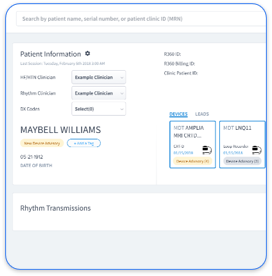
Rhythm360 consolidates data from all major manufacturers into a single vendor-neutral dashboard. API connections, HL7 feeds, XML parsing, and AI-powered computer vision OCR normalize disparate data formats into one unified patient record. University of Chicago Medicine reviewed more than 73,000 reports annually through Rhythm360 in 2025, averaging over 18,000 reports per quarter, a volume that would be unmanageable across fragmented OEM portals.
Alert fatigue is a documented clinical risk in cardiac device monitoring. A 2026 multicenter study in JACC: Clinical Electrophysiology analyzed 25,826 ECG-verified alerts from 1,140 patients across 25 centers. It found that loop recorders still generate substantial false-positive alerts despite AI-based enhancements. Positive predictive values for AF detection varied significantly by manufacturer, with Boston Scientific showing the highest values.
Niraj Varma, MD, PhD, of Cleveland Clinic, noted that false positives remaining after manufacturer filtering tend to be subtle and clinically ambiguous. These are exactly the alerts that still require careful adjudication. When a clinical team receives dozens of ambiguous alerts daily, the risk of missing a genuinely critical event increases.
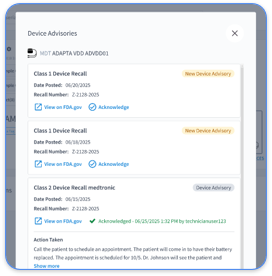
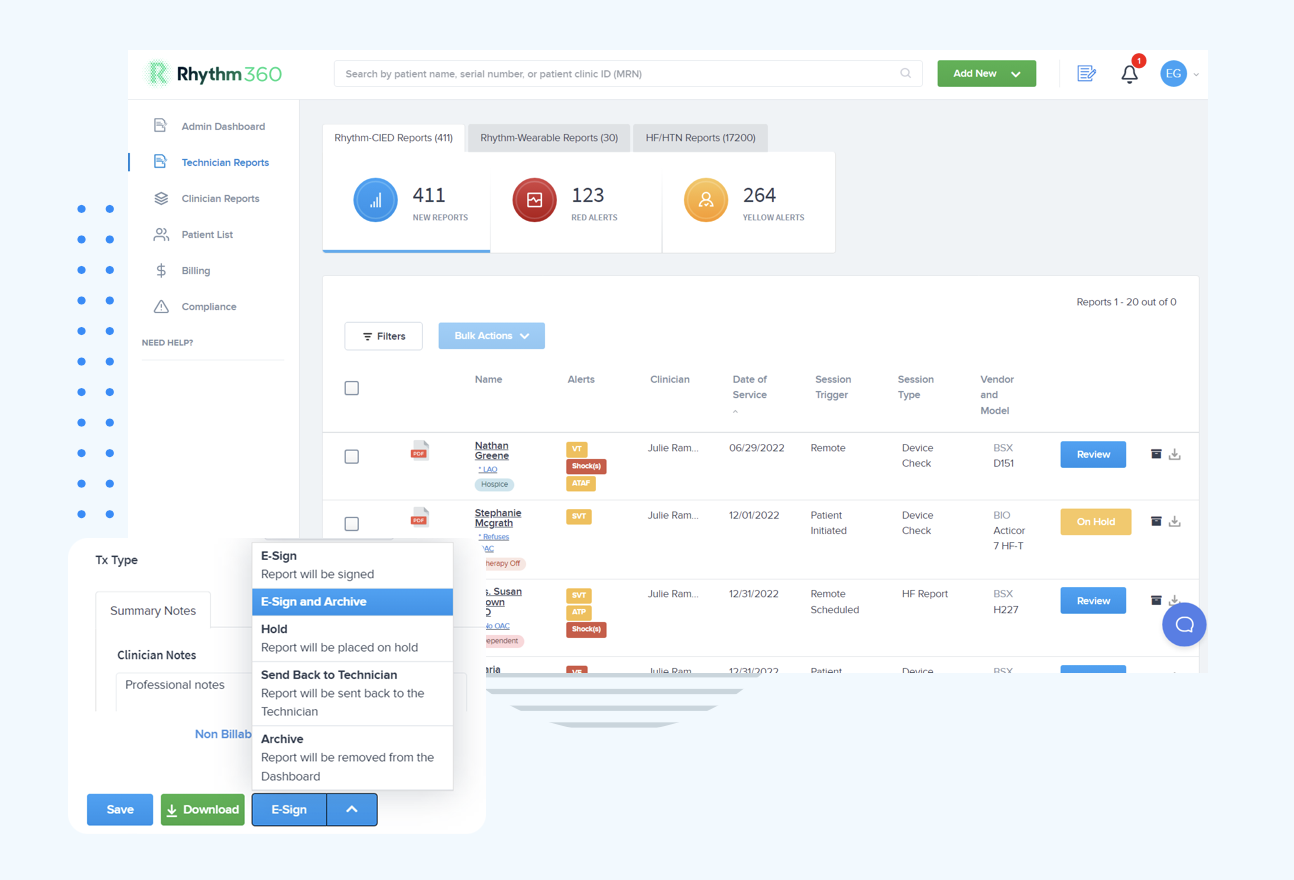
Rhythm360's AI-powered alert triage filters non-actionable transmissions and surfaces clinically significant events, including ventricular fibrillation, new-onset AFib, lead malfunction, and ERI indicators, with priority ranking. As noted earlier, this triage cuts critical alert response times by up to 80%, shifting clinical teams from reactive firefighting to proactive patient management. Andrew Beaser, MD, Associate Professor of Medicine at UCM, said decision support, including AI-assisted support, will become increasingly important as data volumes grow.
Revenue leakage from missed or underdocumented remote monitoring CPT codes is a persistent problem for cardiology practices without automated billing workflows. Under the CMS CY 2026 Physician Fee Schedule, CPT 99454 reimburses at approximately $47 per patient per month, and CPT 99457 reimburses at approximately $52. Practices billing the full complement of applicable RPM codes can generate $100 to $245 per patient per month in ongoing remote monitoring revenue.
Manual workflows make consistent CPT capture difficult. When documentation is incomplete or timestamps are missing, claims get denied or underbilled. Rhythm360 automates CPT code tracking and generates compliant documentation for codes including 93298, 99454, and 99457. Gaurav A. Upadhyay, MD, at UCM, said billing and accountability improved for patients after the integration. Practices implementing Rhythm360 have documented revenue increases of up to 300% through better CPT capture, improved staff efficiency, and new RPM service lines for heart failure and hypertension management.
Talk to our team about capturing the CPT revenue your practice may currently be leaving on the table. Realizing these billing gains depends on how quickly a practice can get the platform running.
Implementation timelines for EHR-integrated cardiac monitoring software vary by EHR system, integration depth, and vendor approach. Rhythm360 onboarding for Epic typically takes a few days to a few weeks. Oracle Health (Cerner Millennium) bidirectional integrations typically take 10 to 14 weeks industry-wide.
Rhythm360's pre-built integration infrastructure with Epic, Oracle Health, and athenahealth compresses this timeline significantly. The foundational integration work is already done, so new practice implementations typically take days to weeks rather than months. The platform connects via HL7, API, and OCR-based data normalization, so practices are not starting from a blank slate.
Quick implementation means little if on-call clinicians still can't respond to alerts outside business hours. Critical alerts often arrive at night or on weekends, but access to patient data is frequently tied to a workstation or VPN-dependent desktop app. A Saturday morning alert for new-onset atrial fibrillation demands the same response as a weekday alert. Without mobile access, the reviewing clinician must drive to the office or defer action until Monday.
Rhythm360's HIPAA-compliant mobile app lets clinicians review transmissions, sign reports, and coordinate care from a smartphone. Andrew Beaser, MD, at UCM, said he's more likely to sign off on reports during meetings because he can access them easily on his phone. A Saturday morning AFib alert reviewed on a mobile device can lead to anticoagulation initiation or device reprogramming by Saturday afternoon, an outcome that isn't possible without mobile access.
Vendor-neutral support and broad EHR compatibility are non-negotiable for practices managing diverse device populations. The table below summarizes Rhythm360's supported systems and integration methods.
| Category | Supported System | Integration Method |
|---|---|---|
| EHR | Epic | API (FHIR) |
| EHR | Oracle Health (Cerner) | API |
| EHR | athenahealth | API (FHIR) |
| EHR | eClinicalWorks | HL7 |
| EHR | Greenway Health | HL7 |
| Device Manufacturer | Medtronic | API, HL7, OCR |
| Device Manufacturer | Boston Scientific | API, HL7, OCR |
| Device Manufacturer | Abbott | API, HL7, OCR |
| Device Manufacturer | Biotronik | API, HL7, OCR |
This broad, vendor-neutral coverage is backed by redundant data feeds, computer vision, and AI-powered extrapolation, giving Rhythm360 greater than 99.9% data transmissibility. If an OEM server goes down, the platform's fail-safe architecture keeps capturing and normalizing patient data without gaps in the clinical record.
Beyond system compatibility, practice administrators and electrophysiologists typically evaluate a platform on integration speed, alert accuracy, billing automation, and mobile access. Here's how those criteria connect to what's covered above.
| Buyer Criterion | What to Look For | Why It Matters |
|---|---|---|
| Bi-directional EHR integration depth | Pre-built connections across major EHR systems | Faster go-live, less custom engineering work |
| AI alert prioritization | Triage that filters non-actionable transmissions | Reduces time clinicians spend chasing false positives |
| Data reliability | Redundant feeds plus OCR and AI extrapolation | Keeps the clinical record complete during OEM outages |
| CPT billing automation | Automated documentation tied to specific billing codes | Reduces denied and underbilled claims |
| Mobile access | HIPAA-compliant app for review and sign-off | Enables faster off-hours clinical response |
| Vendor-neutral manufacturer support | Coverage across the major device makers | Avoids re-onboarding when patients transfer care |
For practices implementing Rhythm360, EHR integration typically takes a few days to a few weeks. Rhythm360 has pre-built integration infrastructure for Epic, Oracle Health, athenahealth, eClinicalWorks, and Greenway Health. The platform uses HL7 messaging, API connections, and OCR-based data normalization, so practices are not building integrations from scratch. Exact timelines depend on the EHR system, the number of sites, and the depth of bidirectional data exchange required.
Rhythm360 uses a SaaS-based pricing model that scales with clinic size and platform usage. This avoids the large upfront cost tied to on-premise legacy systems. Pricing reflects the actual scope of deployment rather than a fixed enterprise fee, making it accessible for solo practitioners and electrophysiology clinics as well as large integrated health systems.
Rhythm360 is a HIPAA-compliant, cloud-based platform with security controls applied across data ingestion, storage, transmission, and access. The mobile app used for on-call review and report signing meets the same security standards as workstation access. Patient communications through the platform's integrated Twilio messaging framework are logged with a full audit trail in the patient record, supporting both clinical and compliance documentation needs.
Rhythm360's onboarding includes EHR integration setup, data normalization configuration for all connected device manufacturers, and training for clinical and administrative staff. The platform reduces reliance on a single super-user, so business continuity holds even when key staff are unavailable. Practices also get optional 24/7/365 oversight from certified cardiac technicians supervised by physicians, adding clinical support during and after the transition.
Cardiology practices managing patients across multiple device manufacturers face a clear choice. They can keep absorbing the cost of fragmented OEM portals, manual workflows, and missed CPT revenue, or consolidate onto one platform built for the complexity of modern cardiac device monitoring.
Rhythm360 delivers bi-directional EHR integration, vendor-neutral data ingestion from the major device manufacturers, AI-powered alert triage, automated CPT documentation, high data transmissibility, and a HIPAA-compliant mobile app that keeps clinicians connected regardless of location. At University of Chicago Medicine, the platform helped clinicians identify abnormalities earlier. Andrew Beaser, MD, said the team can now call patients in for evaluation instead of waiting for a 3-month visit.
The platform handling tens of thousands of annual reports at a major academic medical center is built to scale for practices of every size. Connect with Rhythm360 to unify your cardiac monitoring program.