Last updated: June 16, 2026
See how Rhythm360 delivers these benefits through a single, vendor-neutral cardiac data platform.
The World Health Organization states that EHRs can support improved care coordination and may help reduce the risk of medication errors when patient histories, current medications, and allergy records are readily accessible. This visibility is especially critical in cardiology, where patients frequently carry complex polypharmacy regimens such as anticoagulants, antiarrhythmics, diuretics, and beta-blockers that increase the risk of dangerous drug interactions. The ONC documents that structured digital records support better clinical decision-making by giving providers access to complete patient histories at the point of care. When allergy flags and drug-interaction alerts surface automatically during order entry, clinicians can catch potential problems early and materially reduce adverse events that could trigger arrhythmia or device interaction.
Cardiology patients routinely move between electrophysiologists, heart failure specialists, interventional cardiologists, and primary care physicians. Fragmented paper or siloed digital records create handoff gaps that delay treatment decisions and increase the risk of conflicting plans. Interoperability frameworks such as FHIR R4 APIs and health information exchange networks now span hundreds of millions of patient records, enabling specialty practices to access outside data and device information from non-native systems. Unified records mean that a cardiologist reviewing a patient post-ablation can immediately see the electrophysiologist's procedural notes, device interrogation results, and current medication list without placing a phone call or waiting for a fax.
Centralized EHR systems serve as unified platforms that automate documentation, orders, billing, and follow-ups, while providing real-time insights, quality reporting, and coordinated care essential for value-based reimbursement and compliance. In cardiology, duplicate echocardiograms, redundant Holter orders, and repeated electrolyte panels represent both unnecessary cost and patient burden. When prior results are visible at the point of ordering, clinicians can make evidence-based decisions about whether a new test adds diagnostic value. Making this visibility effective requires standardization, because healthcare data now includes imaging, wearables, and remote monitoring devices, and EHR platforms convert this unstructured data into standardized formats essential for clinical decisions, analytics, AI tools, and reporting.
An integrated EHR with built-in claims management removes the manual bridge between clinical documentation and billing, which may reduce claim processing time and help reduce submission errors that trigger rejections from insurers. Specialty-specific EHRs are especially valuable in complex fields such as cardiology because tailored templates, dashboards, and coding improve efficiency, accuracy, and billing performance, enabling correct procedure and diagnosis codes, fewer claim denials, and faster reimbursements. For EP clinics managing high volumes of device transmissions, automated documentation workflows directly translate to staff hours recovered and overhead reduced.
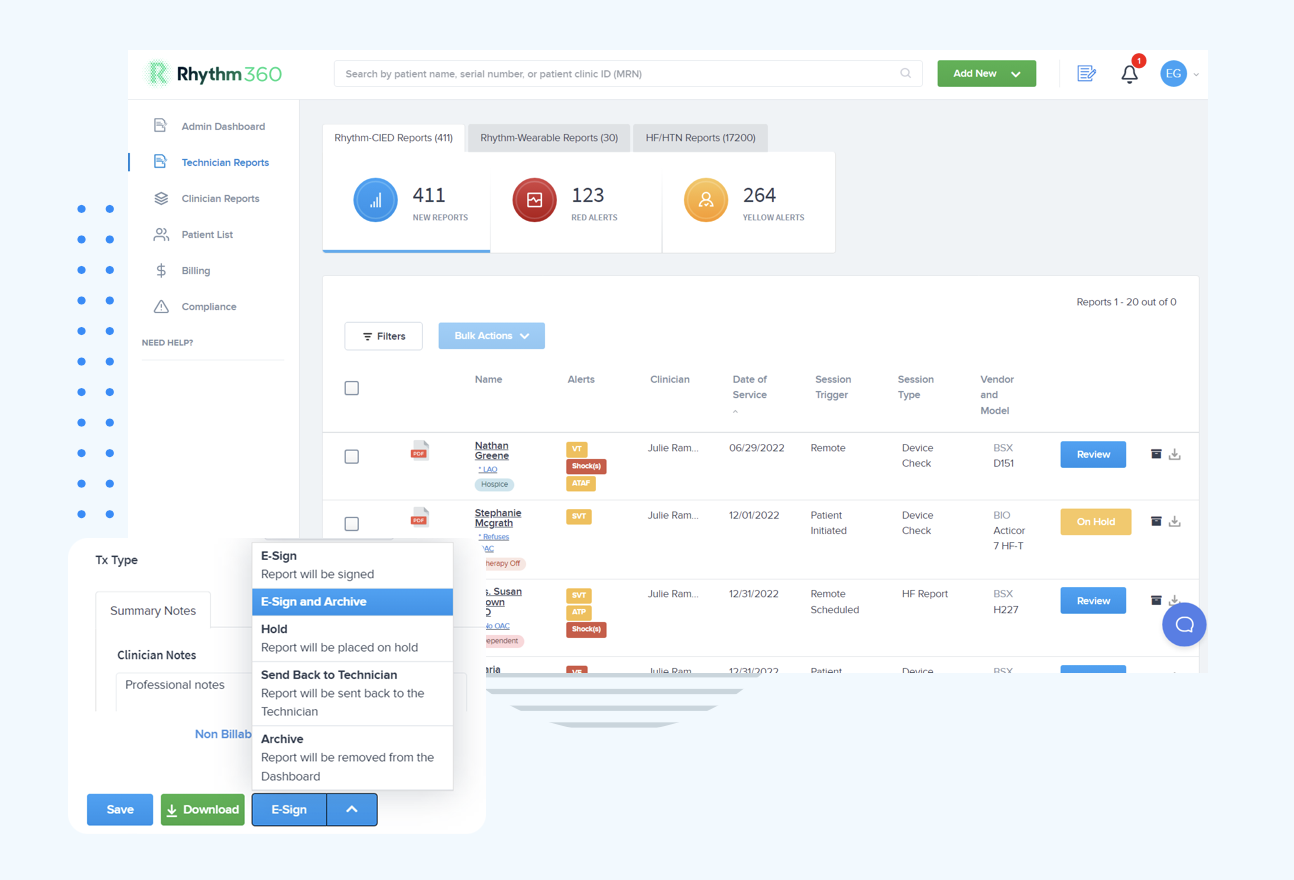
Practices implanting devices from multiple manufacturers such as Medtronic, Boston Scientific, Abbott, and Biotronik historically required staff to log into separate, non-interoperable OEM portals to retrieve transmission data. This fragmentation creates data silos and unsustainable administrative burden. Vendor-neutral platforms that ingest and normalize data from all major manufacturers into a single dashboard eliminate redundant logins and manual transcription. University of Chicago Medicine reviewed more than 73,000 reports annually through a unified cardiac data platform in calendar year 2025, averaging more than 18,000 reports per quarter, a volume that would be operationally impossible to sustain through fragmented OEM portals alone. Aggregating this volume of data creates a new challenge: identifying which transmissions require immediate clinical attention.
In 2024, 71% of U.S. hospitals reported using predictive AI integrated with the EHR, up from 66% in 2023. In cardiac remote monitoring, AI-driven alert triage filters non-actionable transmissions and surfaces clinically significant events such as new-onset atrial fibrillation, ventricular tachycardia, lead malfunction, or early device replacement indicators for immediate review. Without active governance, EHR best-practice alerts can contribute to alert fatigue in clinical workflows. AI triage layers address this directly by prioritizing signal over noise and enabling clinicians to act on what matters. UCM's implementation of a unified cardiac data platform enabled clinicians to review more transmissions daily and identify more abnormalities.
Learn how Rhythm360 integrates with your existing EHR such as Epic, Cerner, Athenahealth, and eClinicalWorks without requiring a platform replacement.
While the table above outlines general EHR trade-offs, cardiology practices gain additional specialized benefits when their EHR integrates with remote monitoring platforms. The following sections detail these cardiology-specific advantages.
Revenue leakage from incomplete or non-compliant CPT documentation is a persistent problem in EP clinics. Remote monitoring codes such as 93298, 93299, 99454, and 99457 require specific documentation thresholds that manual workflows frequently fail to capture consistently. This automation, which removes the manual bridge between clinical documentation and billing mentioned earlier, is especially valuable for remote monitoring codes. When remote monitoring platforms automatically generate compliant reports and push structured data into the EHR billing workflow, practices capture billable events that would otherwise go undocumented. “We have improved billing and accountability for our patients after the integration,” noted a physician at University of Chicago Medicine following Rhythm360 deployment.
Cloud-based EHRs allow clinicians to securely access records anytime, anywhere, supporting telehealth visits, home healthcare, and remote patient monitoring as standard practices. For on-call electrophysiologists and cardiologists, mobile access to CIED transmission data, alert notifications, and patient records removes the requirement to be physically present at a workstation to make time-sensitive clinical decisions. A critical arrhythmia flagged on a Saturday morning can be reviewed, triaged, and acted upon, such as initiating anticoagulation or scheduling urgent device reprogramming, before the patient deteriorates. HIPAA-compliant mobile applications that surface prioritized alerts and allow report sign-off from a smartphone extend the clinical reach of any cardiology team without adding headcount.
AI tools integrated with EHRs can analyze biometric trends, lab values, and historical patterns to flag early signs of cardiovascular disease before clinical symptoms appear. Population-health dashboards extend this capability to device compliance monitoring by surfacing patients overdue for transmission, tracking alert dismissal rates, and identifying revenue gaps from uncaptured CPT events. “We are able to address these issues earlier; rather than waiting for a 3-month visit, we can call patients in for evaluation,” observed a clinician at UCM. Real-time compliance dashboards make this proactive posture systematic rather than dependent on individual clinician recall.
The nine benefits outlined above demonstrate how EHRs improve cardiology practice operations. However, cardiology practices managing CIED populations require a layer of integration that standard EHR deployments do not provide natively. Vendor-neutral remote monitoring platforms address this gap by ingesting data from all major OEM portals via API, HL7, XML, and PDF parsing and by normalizing disparate data streams into a single structured record that flows bi-directionally into Epic, Cerner, Athenahealth, eClinicalWorks, and Greenway Health environments.
As the UCM case demonstrates, centralized, vendor-neutral data aggregation enables trained personnel to review integrated data from all manufacturers in a single workflow. Redundant data feed architecture, including computer vision-based OCR for unstructured PDF reports, achieves greater than 99.9% transmissibility and helps ensure that critical events are not missed due to OEM server outages or connectivity failures.
Quantified return on investment from EHR-integrated remote monitoring in cardiology is substantial. Practices implementing unified cardiac data platforms have documented an 80% reduction in response times for critical patient alerts and revenue increases of up to 300% through optimized CPT code capture, improved staff efficiency, and the addition of remote physiological monitoring service lines for heart failure and hypertension. The 15,700-hour time savings from AI scribes noted earlier translates directly, in a cardiology practice, to additional patient capacity and reduced administrative overhead. The combination of faster alert response, automated billing documentation, and population-health oversight creates a compounding ROI that scales with patient volume.
Electronic health records deliver proven safety, coordination, and efficiency gains across clinical settings. For cardiology practices managing CIED populations, the full value of EHR investment appears only when those systems integrate seamlessly with vendor-neutral remote monitoring platforms that aggregate multi-manufacturer device data, apply AI-powered alert triage, and automate CPT billing documentation. The result is a practice that responds faster to critical events, captures more billable revenue, and operates with less administrative burden, without requiring additional staff.
Connect your EHR to every major CIED manufacturer and transform cardiac remote monitoring into a scalable, revenue-positive clinical operation.
Implementation timelines vary by practice size and the complexity of existing EHR infrastructure. For cardiology-specific remote monitoring platforms like Rhythm360, onboarding that includes EHR integration with systems such as Epic, Cerner, or Athenahealth typically takes from a few days to a few weeks. This pace is substantially faster than enterprise EHR implementations, which can require months to years for full deployment. Practices with existing HL7-capable EHR environments generally experience the shortest onboarding timelines, because bi-directional data flows can be configured without replacing core infrastructure.
Any platform handling protected health information (PHI) in a cardiology context must meet HIPAA Security Rule requirements, including encryption at rest and in transit, role-based access controls, audit logging, and business associate agreements with all third-party vendors. Cloud-based platforms purpose-built for cardiac monitoring maintain HIPAA compliance through end-to-end encryption, secure mobile access protocols, and full audit trails for every patient communication and clinical action. Practices should verify that any remote monitoring platform they evaluate maintains these controls natively and can demonstrate compliance documentation during vendor review.
A well-implemented vendor-neutral remote monitoring platform reduces staff workload rather than increasing it. By consolidating multi-OEM portal logins into a single dashboard, automating report generation, and pushing structured data directly into the EHR, platforms remove the manual data retrieval and transcription tasks that currently consume device technician and nursing time. AI-powered alert triage further reduces the volume of non-actionable notifications that staff must review. Practices that have deployed unified cardiac data platforms report that clinical staff can review more transmissions in less time, with fewer missed events, enabling the same team to manage a larger patient population without proportional headcount increases.
Key performance indicators for EHR-integrated cardiac remote monitoring fall into three categories. Clinical metrics include critical alert response time, transmission review completion rates, and the rate of early interventions triggered by remote data rather than scheduled office visits. Operational metrics include staff hours spent on data retrieval, number of OEM portal logins eliminated, and report generation time per patient. Financial metrics include CPT code capture rates for remote monitoring codes, claim rejection rates, and total revenue attributed to remote monitoring service lines. Practices should establish baseline measurements before implementation and track changes at 30, 90, and 180 days post-deployment to quantify ROI accurately.
Vendor-neutral remote monitoring platforms are designed to integrate with existing EHR systems rather than replace them. Bi-directional HL7 integration allows structured cardiac data such as device transmissions, alert notifications, and billing documentation to flow into and out of the EHR without requiring a platform migration. This approach means practices using Epic, Cerner, Athenahealth, eClinicalWorks, or other major EHR systems can add unified CIED monitoring and automated CPT documentation capabilities as a complementary layer, preserving their existing clinical workflows while closing the gaps that OEM portals and manual processes leave open.