Last updated: July 14, 2026
Single-vendor monitoring portals were built for one manufacturer's devices. Once a practice implants devices from more than one OEM, such as Medtronic, Boston Scientific, Abbott, or Biotronik, staff must reconcile data across systems that don't talk to each other. The Heart Rhythm Society has documented that clinicians must pull together data from multiple settings and multiple vendors to manage large numbers of CIED patients.
Vendor-neutral enterprise platforms solve this by ingesting and normalizing data from all major OEMs into one clinical workspace. Three functional pillars define the category.
Practices evaluating alternatives to single-vendor systems should check whether a platform covers all three pillars or only one or two. Partial coverage still requires supplemental portals and manual reconciliation. Curious how the three-pillar approach applies to your OEM mix? Talk to the Rhythm360 team.
The device ecosystem relevant to enterprise arrhythmia monitoring spans implantable and wearable modalities. Each generates data in a different format and transmission cadence.
Implantable devices covered by CIED remote monitoring programs include single- and dual-chamber pacemakers, implantable cardioverter-defibrillators (ICDs), cardiac resynchronization therapy devices (CRT-D), implantable loop recorders (ILRs) such as the Medtronic LINQ and Abbott Confirm Rx, and implantable hemodynamic monitors such as CardioMEMS pulmonary artery sensors. External modalities include Holter monitors, mobile cardiac outpatient telemetry (MCOT) devices, patch monitors, and FDA-approved consumer wearables. At Atrium Health, a single platform already handles loop recorders, pacemakers, and ICDs, with the team working to bring Apple Watch and AliveCor tracings into similar workflows to support consistent review, documentation, and reimbursement.
Each device type maps to specific CPT codes with distinct reporting periods and documentation requirements.
Billing codes 93294, 93295, and 93296 more than once per 90-day period, rather than per transmission or per day, produces frequency-based denials. An enterprise platform with automated billing documentation tracks each patient's reportable window by device type and flags claims before submission. Manual workflows cannot reliably replicate this at scale.
For remote physiologic monitoring of heart failure and hypertension patients, 2026 CPT updates added code 99445 for 2 to 15 days of device supply with data transmission and code 99470 for 10 to 19 minutes of treatment management services. These additions expand reimbursement pathways for shorter-duration intensive monitoring that previously lacked an exact code match. These billing gains only matter if practices also close the technology gaps driving alert volume, which is where 2026's platform advances come in.
Three developments are reshaping enterprise arrhythmia monitoring this year: AI-powered alert triage, bi-directional EHR integration using FHIR R4, and mobile clinical sign-off.
AI-powered alert triage addresses a volume problem that has become unsustainable in high-growth device clinics. Some clinics have experienced 250% growth in their device population since 2018 and now manage nearly 9,000 devices. That scale increase, without algorithmic filtering, leaves clinicians facing an unsustainable volume of non-actionable notifications. As Marcus Pritchett, Cardiac Device Specialist at the Kansas City Heart Rhythm Institute, explained: "Having alert systems clear urgent versus non-urgent is the timeline difference."
Bi-directional EHR integration moves beyond read-only data pulls. Modern API-driven integration using the FHIR standard requests current patient context, including medications, diagnoses, hospitalizations, and labs, from the EHR the moment a report opens. Cached batch snapshots reflect a prior state instead. This matters for atrial fibrillation alerts, where anticoagulation status and recent hospitalization history directly determine the right clinical response. Epic controls EHR records for 42.3% of U.S. acute care hospitals and 46.5% of all acute care hospital beds as of 2024, making certified Epic integration a baseline requirement for most enterprise deployments.
Mobile clinical sign-off removes the requirement that clinicians sit at a specific workstation to act on urgent alerts. A HIPAA-compliant mobile application that supports transmission review, report signing, and care coordination enables weekend and on-call coverage without physical presence in the device clinic. This directly addresses the staffing challenges documented across academic and community cardiology centers.
Common pitfalls in 2026 implementations include:
Measurable success metrics for a fully implemented enterprise platform include reductions in critical alert response time, increases in transmissions reviewed per staff member per day, improvement in CPT capture rates across 93294 to 93298 and RPM codes, and audit-readiness scores on documentation completeness. Rhythm360 was built around exactly these metrics.
Rhythm360 by RhythmScience is a vendor-neutral, HIPAA-compliant, cloud-based platform built for the multi-OEM environment that defines modern cardiology practice. Its architecture addresses fragmentation at the data layer, the clinical workflow layer, and the billing documentation layer at once.
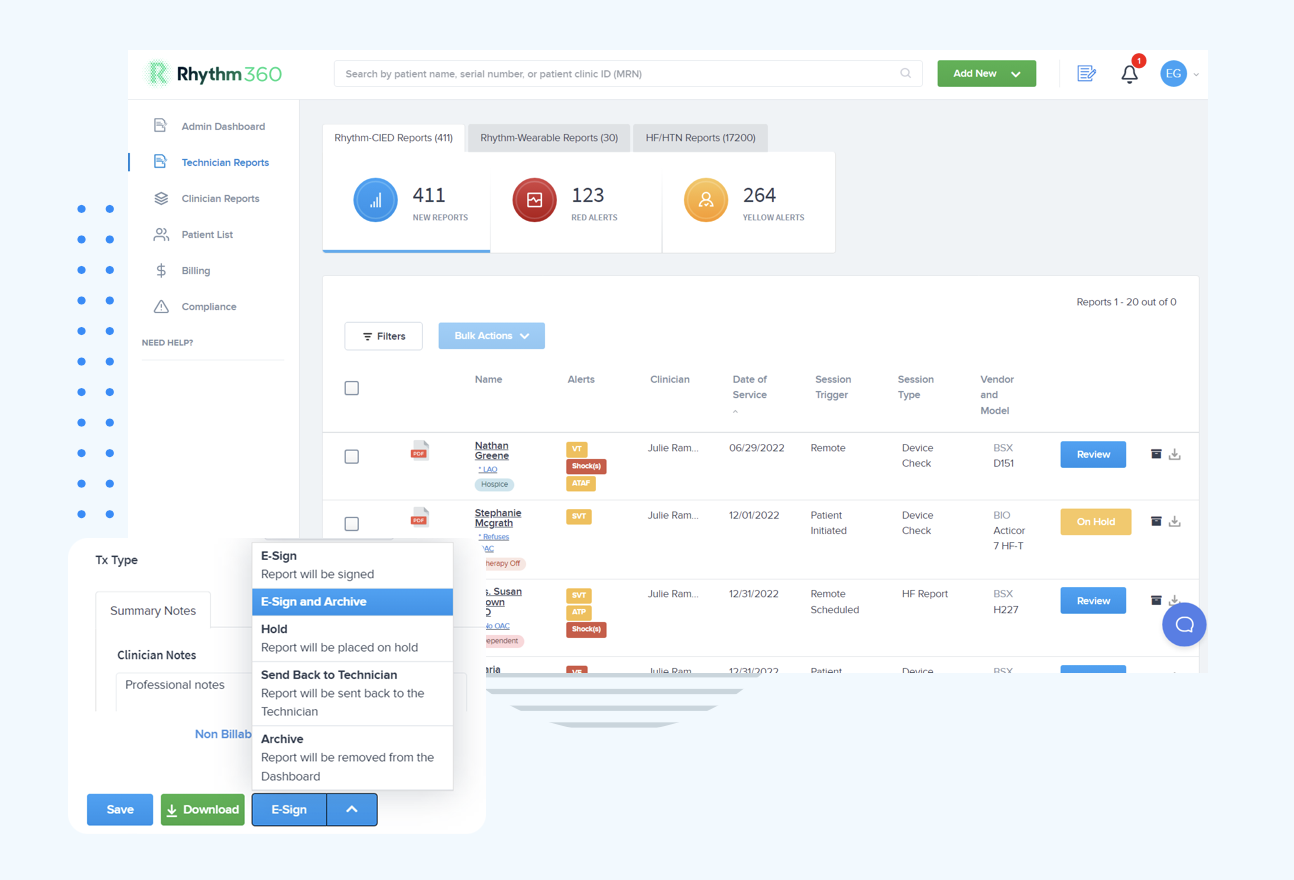
At the data layer, Rhythm360 ingests transmissions from all major device manufacturers, including Medtronic, Boston Scientific, Abbott, and Biotronik, using API connections, HL7 feeds, XML parsing, and computer vision-based PDF extraction. A redundant data feed system acts as a fail-safe when an OEM server goes down, producing greater than 99.9% data transmissibility. This reliability metric isn't theoretical. The University of Chicago Medicine reviewed more than 73,000 reports annually through Rhythm360 in 2025, averaging more than 18,000 reports per quarter, with stable dismissal rates that indicate consistent data quality at scale.
Before implementing Rhythm360, UCM's clinical leadership described the operational environment in direct terms. Andrew Beaser, MD, Associate Professor of Medicine at UCM, described pre-implementation workflows as "a major challenge and incredibly difficult." Gaurav A. Upadhyay, MD, FACC, FHRS, Professor of Medicine and Director of the Pacing & Defibrillation Device Clinic at UCM, noted: "Staffing was always an issue for our center, because our device clinic, like many other medical centers, had struggled with technician turnover and timely weekend coverage."
Post-implementation, Dr. Beaser observed: "We are able to address these issues earlier. Rather than waiting for a 3-month visit, we can call patients in for evaluation." Dr. Upadhyay added: "We have improved billing and accountability for our patients after the integration." Those staffing and billing gains trace directly back to the triage engine described below.
At the clinical workflow layer, Rhythm360's AI-powered triage engine filters non-actionable transmissions and surfaces clinically significant events, including new-onset atrial fibrillation, ventricular tachycardia, lead malfunction, ERI/RRT indicators, and significant weight gain in heart failure patients. Priority classification directs the right alert to the right clinician at the right time. Practices using the platform have documented an 80% reduction in critical alert response times. Optional 24/7/365 oversight by certified cardiac technicians, supervised by physicians, adds a further triage layer for high-volume or understaffed clinics. See the alert triage engine in action, schedule a demo.
At the billing documentation layer, Rhythm360 automates CPT code capture and generates interpretation documentation that satisfies CMS LCD requirements for codes 93294 to 93298 and RPM codes including 99454, 99457, 99445, and 99470. The platform tracks each patient's reportable window by device type, preventing the lookback-window violations that generate CO-18 duplicate denials. Practices implementing Rhythm360 have achieved up to a 300% increase in revenue through optimized CPT code capture, improved staff efficiency, and new RPM service lines for heart failure and hypertension management.
Bi-directional integration with Epic, Cerner, Athenahealth, eClinicalWorks, Greenway Health, and other EHR systems via HL7 eliminates manual data transcription. Device data lands directly in the clinical workflow alongside medications, labs, and hospitalization history. A secure, HIPAA-compliant mobile application supports transmission review, report signing, and care coordination from any location.
Practices evaluating enterprise arrhythmia monitoring platforms should apply a structured set of criteria that maps platform capabilities to operational, clinical, and financial requirements.
The table below shows how Rhythm360 measures up against each criterion. The pattern that stands out: every metric ties back to the same three-layer architecture (data, workflow, billing) described above, rather than isolated features.
| Evaluation Criterion | Rhythm360 Attribute | Documented Metric |
|---|---|---|
| Data transmissibility | Redundant OEM feeds, AI gap-filling, computer vision PDF parsing | See transmissibility rate above |
| Alert response time | AI-powered triage with optional 24/7 CCT oversight | See response-time reduction above |
| Revenue impact | Automated CPT capture for 93294–93298, 99454, 99457, 99445, 99470 | See revenue increase above |
| EHR integration | Bi-directional Epic, Cerner, Athenahealth, eClinicalWorks, Greenway Health via HL7 | Implementation in days to a few weeks |
| Scale (reference site) | Vendor-neutral ingestion across all major OEMs | 73,000+ reports reviewed annually at University of Chicago Medicine in 2025 |
| Mobile access | HIPAA-compliant mobile app for transmission review, report signing, care coordination | Full clinical sign-off from any location |
| Pricing model | SaaS-based, scales with clinic size and platform usage | Flexible, value-adjusted investment |
Other platforms operate in the enterprise arrhythmia monitoring space. Practices should evaluate each one against the criteria above based on their specific OEM mix, EHR environment, staffing model, and volume.
The core challenge for cardiology practices in 2026 isn't a shortage of monitoring data. It's the inability to act on that data efficiently when it arrives through fragmented, non-interoperable systems. An enterprise arrhythmia monitoring platform resolves fragmentation at the data, workflow, and billing layers at once, converting raw transmission volume into actionable clinical decisions and compliant revenue capture.
Evaluation should center on integration depth, alert triage model, data reliability, CPT automation coverage for both CIED codes (93294 to 93298) and 2026 RPM updates (99445, 99470), implementation timeline, and total cost of ownership. Practices that apply these criteria systematically reduce administrative burden, improve patient safety outcomes, and recover previously lost billing revenue.
A vendor-neutral arrhythmia monitoring platform ingests and normalizes data from cardiac implantable electronic devices made by multiple manufacturers, such as Medtronic, Boston Scientific, Abbott, and Biotronik, into a single clinical workspace. Staff no longer need to log into each OEM's proprietary portal separately. This matters because most active cardiology practices implant devices from more than one manufacturer, and each additional OEM portal adds a separate login, data format, and workflow. Over time, this fragmentation creates data silos, increases the risk of missed critical alerts, and generates administrative overhead that reduces staff capacity for direct patient care. A vendor-neutral platform eliminates these silos by serving as a single source of truth for the entire device population, regardless of manufacturer.
Alert fatigue occurs when clinicians receive a high volume of notifications, a significant portion of which are clinically non-actionable, causing them to deprioritize or miss genuinely urgent events. In high-volume device clinics, transmission volume from pacemakers, ICDs, loop recorders, and wearables can exceed thousands of events per month. AI-powered triage applies machine learning models to classify incoming transmissions by clinical urgency, separating events such as new-onset atrial fibrillation, ventricular tachycardia, or lead malfunction from routine checks and non-actionable noise. Clinicians receive a prioritized worklist rather than an undifferentiated queue. This reduces the cognitive burden of alert review and shortens the time between a critical event and a clinical response. Rhythm360's triage engine, combined with optional oversight from certified cardiac technicians, has produced the response-time improvement noted earlier for practices using the platform.
The primary CPT codes for remote CIED monitoring are 93294 (pacemaker remote interrogation, professional component, 90-day period), 93295 (ICD remote interrogation, professional component, 90-day period), 93296 (technical component for pacemaker and ICD remote interrogation), 93297 (implantable loop recorder and implantable cardiovascular physiologic monitor remote interrogation, 30-day period), and 93298 (technical component for subcutaneous cardiac rhythm monitor monitoring, 30-day period). The most common billing errors include reporting 93294 or 93295 more than once per 90-day period, which triggers CO-18 duplicate denials, applying a uniform monthly billing cycle to all device types regardless of the correct reporting window, and submitting claims without documentation elements required by CMS LCD policies, including device manufacturer and model, monitoring period dates, and a clinician interpretation note. For remote physiologic monitoring of heart failure and hypertension patients, 2026 added CPT 99445 for 2 to 15 days of device supply with data transmission and CPT 99470 for 10 to 19 minutes of treatment management services, expanding reimbursement for shorter-duration monitoring programs.
Implementation timelines vary based on practice size, EHR system, and the number of OEM data feeds that require configuration. For ambulatory cardiology practices and electrophysiology clinics, a well-structured implementation typically moves from contract signature to first billable encounter within 30 to 60 days. Larger health systems with multiple integration touchpoints, including bi-directional Epic or Cerner connections, multiple device clinic locations, and complex user permission structures, generally require longer timelines. Rhythm360's implementation process, including EHR integration setup, is designed to complete in a few days to a few weeks for most practice configurations, with onboarding support that covers EHR integration, staff training, and OEM feed activation. Practices should ask prospective vendors for reference timelines from comparable deployments and confirm whether the quoted timeline includes full EHR integration or only basic platform access.
Financial outcomes from a unified remote monitoring platform come from three sources: recovery of previously unbilled or under-billed CPT codes, reduction in claim denials caused by documentation errors or lookback-window violations, and the ability to launch new revenue-generating service lines such as remote physiologic monitoring for heart failure and hypertension patients. A cardiology practice with 200 device patients that properly bills remote monitoring codes for pacemakers, ICDs, and loop recorders can capture $80,000 to $120,000 in annual recurring revenue from those codes alone. As noted earlier, practices implementing Rhythm360 have documented revenue gains of up to 300%, driven primarily by recovering previously unbilled CPT codes and launching new RPM service lines. These outcomes come from the platform's automated billing documentation and CPT window tracking, which reduce the manual effort required to generate compliant claims and ensure billable events get captured within the correct reporting period.