Last updated: July 14, 2026
These criteria reflect the operational, clinical, financial, and security requirements most relevant to large cardiology practices in 2026. Each one gets addressed in detail below.
Each new device vendor added to a cardiology practice introduces its own login, portal, and workflow. These silos grow unsustainable as patient volumes scale. Staff managing Medtronic, Boston Scientific, Abbott, and Biotronik devices at once must reconcile data across non-interoperable systems, which raises error risk and administrative hours. Gordon Wesley, SVP and Chief Strategy and Clinical Integration Officer at University of Chicago Medicine AdventHealth, put it directly: "We have a lot of cats in the cardiovascular service line, so how do you really bring those together under one platform?"
Rhythm360 solves this with a vendor-neutral architecture that ingests data from all major CIED manufacturers via API, HL7, XML, and PDF parsing using computer vision and AI-powered normalization. A redundant data feed system maintains continuity when an OEM server goes down, producing greater than 99.9% transmissibility across the monitored device population. This reliability is what makes centralized review possible in the first place, a point Gaurav A. Upadhyay, MD, FACC, FHRS, Director of the Pacing and Defibrillation Device Clinic at University of Chicago Medicine, underscored: "That was a big piece for us, to have an integrated review of data from trained personnel."
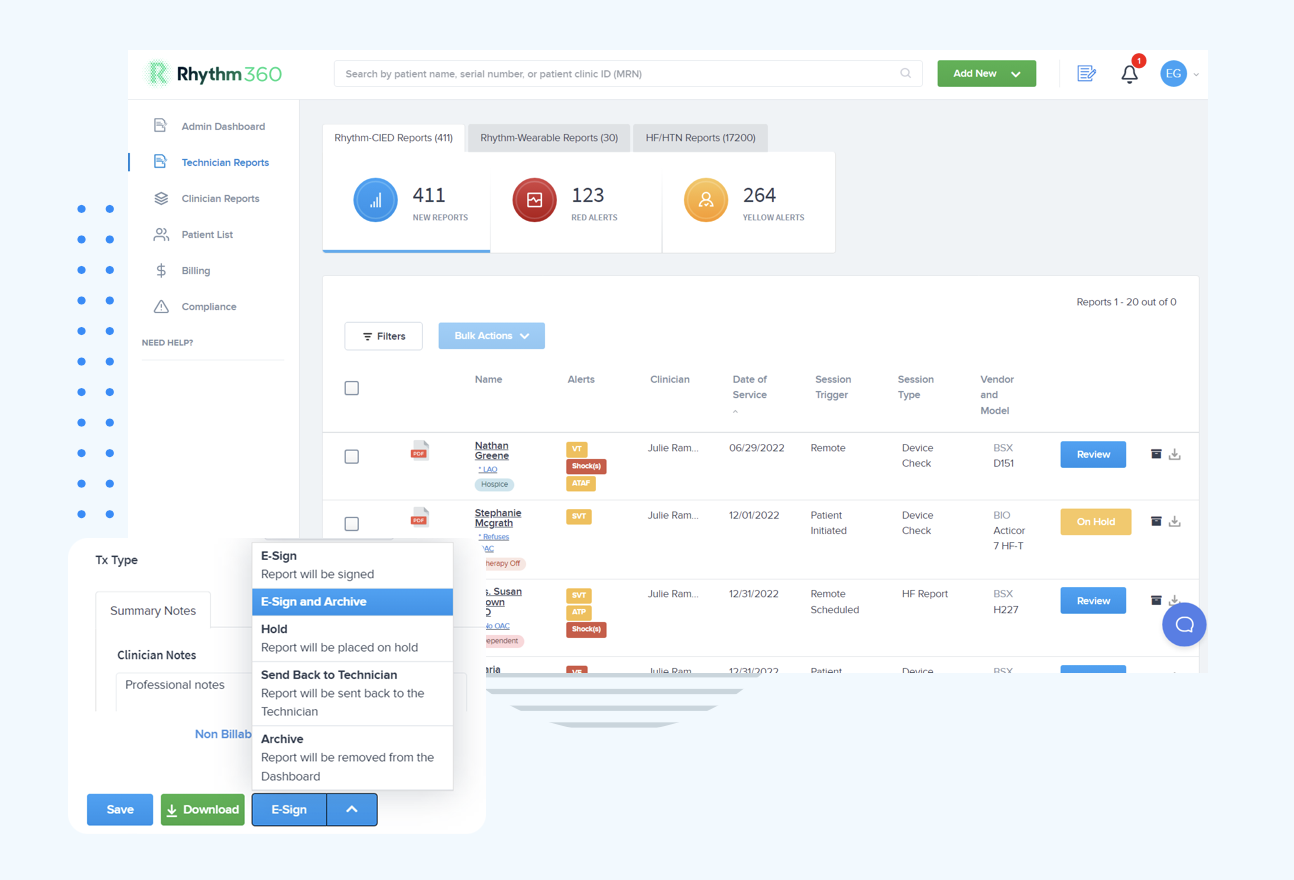
Only 1–15% of clinical alarms require any clinical intervention, yet clinical staff in high-volume CIED environments must process every notification. The Joint Commission's Sentinel Event database logged 98 alarm-related events between January 2009 and June 2012, and 80 of those resulted in death. The numbers show the patient safety cost of unmanaged alert volume. Troy Leo, MD, MHCM, FACC, Service Line Leader for Heart and Vascular at Atrium Health, noted that "physicians' time is too valuable to manually process every transmission."
Rhythm360's AI-powered alert triage filters non-actionable notifications and surfaces clinically significant events, cutting critical alert response times by up to 80%. The impact shows up most in time-sensitive scenarios. When the platform flags new-onset atrial fibrillation or ventricular tachycardia on a weekend morning, the clinical team can start anticoagulation or device reprogramming that same day instead of waiting for a scheduled visit. Andrew Beaser, MD, Associate Professor of Medicine at University of Chicago Medicine, described the shift: "We are able to address these issues earlier; rather than waiting for a 3-month visit, we can call patients in for evaluation." He added that "decision support, including AI-assisted decision support, will become increasingly important as data volumes grow."
See Rhythm360's AI alert triage in action in a live enterprise environment.
Fixing alert fatigue solves half the workflow problem. The other half is getting that data into the EHR without manual entry, which is a primary source of documentation errors and lost staff time in large practices. Under the 2026 CMS code updates, billing eligibility expands for patients transmitting data between two and 15 days per month, but capturing that revenue requires proactive monitoring workflows and upstream infrastructure. Without bi-directional EHR integration, capturing these newly eligible billing events requires manual reconciliation that most practices cannot sustain at scale.
Rhythm360 delivers bi-directional HL7 integration with Epic, Cerner, Athenahealth, eClinicalWorks, Greenway Health, and other major EHR systems. Data flows both ways: patient demographics and orders enter Rhythm360 from the EHR, while completed reports, alert documentation, and billing codes return to the EHR without manual re-entry. Full implementation, including EHR integration setup, typically takes a few days to a few weeks. Deep bidirectional EHR integration with inpatient systems is essential for managing orders, documentation, and care transitions in high-acuity remote monitoring programs, and Rhythm360's architecture meets that bar at enterprise scale.
EHR integration solves the data flow problem. Staffing capacity is a separate constraint entirely. Gaurav A. Upadhyay, MD, at University of Chicago Medicine, named it directly: "Staffing was always an issue for our center, because our device clinic, like many other medical centers, had struggled with technician turnover and timely weekend coverage." Infrastructure that cannot absorb volume growth without proportional headcount increases puts a ceiling on practice expansion.
University of Chicago Medicine processed more than 73,000 reports annually through Rhythm360 in 2025, averaging over 18,000 per quarter, with stable dismissal rates throughout. AI-assisted signal review and workflow automation carries a +2.0% impact on CAGR forecast in North America and Europe, enabling real-time predictive analytics and lighter technician workload in large-scale telemetry settings. Rhythm360's SaaS-based pricing scales with clinic size and usage, avoiding the fixed-cost infrastructure constraints of legacy on-premise systems.
Incomplete CPT documentation is a structural revenue leak in multi-OEM CIED environments. CPT 93298 covers remote interrogation device evaluation for implantable loop recorders, including analysis of recorded rhythm data and a physician report. It's a billable event that requires complete, timely documentation to capture. New 2026 CMS RPM code 99445 covers device supply for 2–15 days of data transmission per 30-day period, while 99470 covers 10–20 minutes of treatment management time, expanding the billable surface for practices equipped to track these events automatically.
Rhythm360 automates CPT code capture and documentation across CIED and RPM code sets, including 93298, 99453, 99454, 99457, and 99458. The administrative dashboard shows real-time visibility into captured and potential revenue by CPT code, so practices can close billing gaps before claim windows close. Practices using Rhythm360 have seen revenue growth of up to 300% through optimized CPT capture, better staff efficiency, and new RPM service lines for heart failure and hypertension management. Dr. Upadhyay confirmed the impact: "We have improved billing and accountability for our patients after the integration."
Data privacy and cybersecurity concerns tied to connected health devices, plus EHR interoperability issues, are major factors slowing growth of the U.S. remote patient monitoring market at enterprise scale. Enterprise procurement teams need vendors to prove security posture through independently audited certifications, not self-assessed frameworks.
Cardiology directors and health system procurement teams evaluating CIED remote monitoring vendors treat ISO/IEC 27001:2022 certification from an ANAB-accredited body as the gold standard, viewing HIPAA compliance and SOC 2 attestation as necessary but not sufficient alone. That certification requires organizations to build, independently audit, and continuously improve a security program spanning 93 controls covering access management, cryptography, incident response, supplier relationships, and business continuity. Rhythm360 is HIPAA-compliant and aligns to ISO/IEC 27001:2022 standards, giving procurement teams the security foundation they need for BAA execution.
Strong certifications matter little if clinicians can't act on data outside a fixed workstation. On-call clinicians at multi-site practices need access to patient data, transmission reviews, and report signing wherever they are. Legacy systems that restrict access to one terminal create coverage gaps during evenings, weekends, and cross-site coverage. The Safer Telemetry Architecture framework requires mandatory backup coverage protocols and automated alert routing with timed bi-directional escalation to prevent single-point failures at enterprise scale.
Rhythm360 provides a secure, HIPAA-compliant mobile app that lets clinicians review transmissions, sign reports, and coordinate care from any location. Every action taken through the app is logged with a full audit trail in the patient record, preserving documentation integrity for compliance and billing. The integrated communication hub, built on a Twilio framework, tracks all patient messaging and call logs in the same record, cutting redundant outreach and supporting coordinated multi-site teams.
The table below maps each of the eight evaluation criteria to Rhythm360's implementation timeline and scalability outcomes, so you can compare capabilities side by side before a deeper vendor discussion.
| Evaluation Criterion | Rhythm360 Capability | Implementation Timeline | Scalability Notes (5k–100k+ Patients) |
|---|---|---|---|
| Vendor-Neutral CIED Data Aggregation | Ingests data from Medtronic, Boston Scientific, Abbott, Biotronik, and others via API, HL7, XML, and computer vision PDF parsing; redundant feeds maintain continuity during OEM outages | Configured during onboarding (days to weeks) | Greater than 99.9% transmissibility demonstrated at University of Chicago Medicine (see above) |
| AI Alert Triage | AI-powered filtering prioritizes clinically significant events; optional 24/7/365 oversight by certified cardiac technicians supervised by physicians | Active at go-live | Up to 80% reduction in critical alert response time; built for high-volume, multi-OEM environments |
| Bi-Directional EHR Integration | Bi-directional HL7 integration with Epic, Cerner, Athenahealth, eClinicalWorks, Greenway Health, and others | Days to weeks including EHR setup | Single platform supports simultaneous connections to multiple EHR endpoints across sites |
| Scalability for Large Patient Volumes | Cloud-based SaaS architecture scales with clinic size; no fixed on-premise infrastructure required | SaaS deployment; no hardware provisioning delays | Proven at 73,000+ annual reports (see scalability section above) |
| CPT Billing Automation | Automated documentation for CIED codes (93279–93298 series) and RPM codes (99453, 99454, 99457, 99458, 2026 codes 99445 and 99470) | Active at go-live | Up to 300% revenue lift documented; dashboard tracks billable events across the full patient population |
| Security and Compliance | HIPAA-compliant; ISO/IEC 27001:2022 alignment; full audit trail; BAA execution supported | Compliance documentation available during procurement | Meets enterprise health system security requirements for multi-site deployments |
| Mobile Access | Secure, HIPAA-compliant mobile app for transmission review, report signing, and care coordination | Available at go-live | Supports on-call coverage across multiple sites without workstation dependency |
| Implementation Timeline | Streamlined onboarding including EHR integration; SaaS-based pricing scales with usage | Days to weeks (full EHR integration included) | No high setup fees; flexible pricing accommodates 5,000 to 100,000+ patients |
A structured RFP process cuts evaluation time and makes sure vendor responses address the operational, clinical, and security requirements specific to large cardiology practices. The checklist below covers criteria relevant to practices managing 5,000 to 100,000 or more patients across multiple sites and OEMs.
Data Aggregation and OEM Coverage
AI Alert Triage and Clinical Workflow
EHR Integration
Scalability and Multi-Site Support
CPT Billing Automation
Security Certifications and Compliance
Mobile Access and Continuity of Care
Implementation and Onboarding
Large cardiology practices evaluating telemetry platforms in 2026 face a decision that touches patient safety, staff capacity, billing compliance, and infrastructure strategy at once. The eight criteria above give you a structured basis for comparing vendors against your practice's specific requirements. Rhythm360's documented performance across vendor-neutral aggregation, AI alert triage, bi-directional EHR integration, and CPT billing automation makes it a platform built for practices managing 5,000 to 100,000 or more patients.
Get a tailored walkthrough of Rhythm360 for your patient volume and OEM mix.
Full onboarding, including EHR integration with systems like Epic, Cerner, Athenahealth, and eClinicalWorks, typically takes a few days to a few weeks. The timeline depends on the number of EHR endpoints, the complexity of existing OEM connections, and the scope of workflow configuration needed. Rhythm360's SaaS architecture eliminates hardware provisioning delays. The implementation team follows a structured process covering planning, configuration, testing, and go-live support, and practices adding new OEM connections or EHR endpoints later follow that same process.
Rhythm360 is HIPAA-compliant and aligns to ISO/IEC 27001:2022 standards, the benchmark for information security management discussed earlier in this guide. Enterprise procurement teams can request documentation of the platform's security posture, certification scope, and BAA terms during evaluation. Every platform action, including those taken through the mobile app, is logged with a full audit trail to support compliance audits.
As covered in the CPT billing section above, practices have seen revenue growth of up to 300% through optimized code capture and new RPM service lines. The platform tracks the 2–15 day transmission threshold and 20-minute clinical time threshold required for RPM code eligibility automatically, cutting the documentation burden on clinical and administrative staff. A real-time dashboard tracks captured and potential revenue by CPT code across the full patient population.
As noted earlier, University of Chicago Medicine's 73,000+ annual report volume shows this scalability in a real academic medical center setting, with stable dismissal rates across a high-volume, multi-OEM environment. For multi-site practices, the platform supports simultaneous connections to multiple EHR endpoints, each with separate routing and workflow rules, plus a centralized dashboard for population-level visibility across sites. SaaS pricing adjusts with clinic size and usage, so practices grow from 5,000 to 100,000 or more patients without a platform migration.
Fragmented OEM portals, manual alert workflows, and incomplete CPT documentation are not isolated inefficiencies. They compound across patient volume, staff capacity, and billing cycles into measurable clinical and financial risk. Rhythm360 delivers a vendor-neutral, AI-powered platform that consolidates multi-OEM CIED and RPM data, cuts critical alert response times by up to 80%, automates CPT code capture across the 2026 CMS code set, and integrates bi-directionally with Epic, Cerner, and other major EHR systems in days to weeks. University of Chicago Medicine's experience processing 73,000+ annual reports through the platform shows what that looks like in an academic medical center.
For practices evaluating platforms against the eight criteria above, the next step is a direct demonstration against your specific patient volume, OEM mix, and EHR environment.
Talk to the Rhythm360 team about your enterprise rollout.