

Last updated: July 14, 2026
The clinical case for structured remote monitoring in heart failure is settled. A 2026 meta-analysis found that remote monitoring reduced heart failure hospitalizations and all-cause mortality compared with standard care. These benefits held across age, sex, LVEF, NYHA class, and geography.
Fragmentation carries real operational costs. Poor EMR integration for remote monitoring programs forces clinical staff to manually re-enter data, increasing administrative burden. The 2026 joint scientific statement from the Heart Failure Society of America and the American Association of Heart Failure Nurses says remote monitoring only improves outcomes when data pairs with defined workflows, clinician accountability, and fast clinical responses. A platform that delivers data without unifying the workflow around it does not close that gap.
The U.S. remote patient monitoring market is projected to grow from $17.2 billion in 2026 to $49.5 billion by 2033, a 16.3% CAGR driven partly by Medicare reimbursement through CPT codes 99453, 99454, and 99457. Capturing that growth depends on billing accuracy. Practices that cannot reliably document the 16-of-30-day transmission threshold required for 99454 leave recurring monthly revenue uncaptured on every qualifying patient.
These six criteria define a complete enterprise HF management platform for 2026. Each one addresses a documented failure mode of fragmented or single-category solutions.
Enterprise heart failure management platforms fall into two broad categories. Knowing the distinction matters for procurement decisions.
Device-centric platforms are built around CIED data management. Their core function is ingesting, organizing, and triaging transmissions from implantable devices, including pacemakers, ICDs, CRT devices, and implantable loop recorders.
Chronic-care platforms are built around non-device RPM. Their core function is managing physiologic data from wearables and home monitoring equipment, such as connected scales, blood pressure cuffs, and pulse oximeters, for populations with heart failure, hypertension, and related conditions. Broad EHR ecosystems such as Epic and Cerner offer modules in this space, as do dedicated RPM vendors.
The structural gap between these two categories is the central procurement challenge of 2026. A practice that implants devices and also manages a chronic HF population, which describes most cardiology groups and all integrated health systems, needs coverage of both populations in one workflow. Operating two separate platforms means two onboarding processes, two billing workflows, two alert queues, and two sets of integration maintenance obligations. That structural gap is exactly what a scoring framework needs to expose before a contract gets signed.
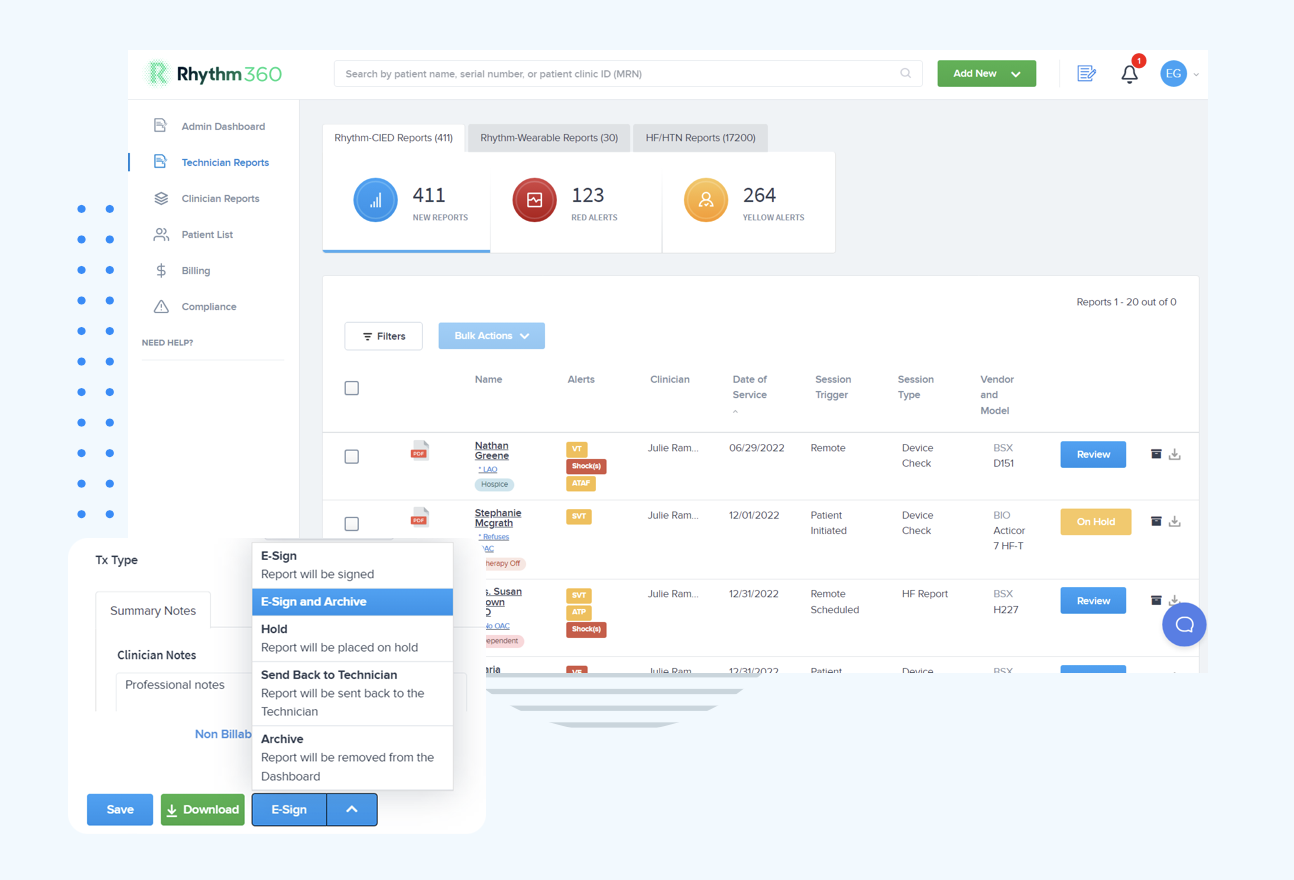
Rhythm360 earns the maximum score across all six criteria in the weighted scoring table below. Each criterion carries a point value reflecting its operational and clinical weight, and the scores reflect documented platform capabilities rather than marketing claims.
| Evaluation Criterion | Maximum Points | Rhythm360 Score | Basis |
|---|---|---|---|
| Vendor Neutrality and Data Reliability | 20 | 20 | All major OEMs supported; transmissibility above 99.9% |
| AI-Powered Alert Triage | 20 | 20 | Reduces critical-alert response times by 80%; filters non-actionable transmissions |
| Bi-Directional EHR Integration | 20 | 20 | Epic, Cerner, Athenahealth, eClinicalWorks, Greenway Health, and others via HL7 and FHIR |
| CPT-Compliant Billing Capture | 15 | 15 | Automated documentation for device and RPM codes; revenue gains up to 300% |
| Population Coverage (Device + Non-Device HF) | 15 | 15 | Rhythm-CIED and HF/HTN RPM service lines in a single workspace |
| Implementation Speed and TCO | 10 | 10 | Days-to-weeks onboarding; scalable SaaS pricing; mobile access included |
| Total | 100 | 100 |
| Capability | Rhythm360 Specification |
|---|---|
| Data Transmissibility | Above 99.9% via redundant OEM feeds, computer vision (OCR), and AI-powered gap extrapolation |
| Critical-Alert Response Time Reduction | Up to 80%, matching the figure cited above, through AI triage and optional 24/7/365 CCT oversight |
| Revenue Improvement via Automated CPT Capture | Up to 300%; codes include 93298, 93299, 99453, 99454, 99457, 99458 |
| EHR Integration | Bi-directional; Epic, Cerner, Athenahealth, eClinicalWorks, Greenway Health, and others via HL7/FHIR |
| Population Coverage | CIED (pacemakers, ICDs, CRT, ILR, CardioMEMS) and non-device HF/HTN RPM |
| Mobile Access | HIPAA-compliant mobile app for transmission review, report signing, and care coordination |
| Onboarding Timeline | Days to weeks, including EHR integration setup |
| Pricing Model | Scalable SaaS; adjusts to clinic size and platform usage |
| Enterprise Scale Validated | University of Chicago Medicine processed over 73,000 reports annually through Rhythm360 in 2025 |
These capabilities translate differently depending on organization size and priorities. The shortlists below break down fit by practice type.
Solo EP Clinics
Mid-Size Cardiology Groups
Large Health Systems
Total cost of ownership extends beyond licensing fees. Implementation timelines, integration complexity, staff training, and maintenance obligations all shape the true cost of a platform decision.
Rhythm360's onboarding, including EHR integration setup, finishes in days to weeks, not the 4 to 8 months that enterprise Epic or Cerner marketplace integrations can require from vendors without established integration infrastructure. That speed compounds with the SaaS pricing model, which scales with clinic size and usage and removes the large upfront capital expense tied to on-premise or custom-built systems.
The mobile app also removes the cost of tethering staff to a fixed workstation for on-call coverage. Optional 24/7/365 oversight by certified cardiac technicians, supervised by physicians, extends monitoring hours without adding headcount.
University of Chicago Medicine reported improved billing and accountability after integrating Rhythm360, and noted that AI-assisted decision support becomes more valuable as data volumes grow, a direct reflection of the scalability challenge large health systems face when monitoring tens of thousands of patients.
Rhythm360 addresses all six criteria for both CIED and non-device HF populations in one workspace, earning the maximum score in the RFP framework above.
For procurement teams preparing RFPs, the six criteria and scoring weights in this guide are built to be reusable. Apply them directly to any vendor response to spot gaps in population coverage, integration depth, or billing automation before signing a contract.
For clinical and operational leaders ready to evaluate Rhythm360 against their own patient population and workflow requirements, the next step is a direct platform walkthrough. Request a personalized walkthrough with the RhythmScience team.
Rhythm360 supports bi-directional data exchange using HL7 v2 and FHIR, the two primary standards governing remote monitoring integration with certified EHR systems. HL7 ORU messages handle high-volume observation result feeds, while FHIR R4 APIs support modern app-layer workflows and patient-facing data access. The platform integrates with Epic, Cerner, Athenahealth, eClinicalWorks, Greenway Health, and other major EHR systems. This dual-standard architecture supports compliance with the CMS rule referenced earlier while maintaining backward compatibility with HL7 v2 infrastructure already in place at most health systems. All data exchange runs under HIPAA-compliant protocols, including TLS encryption in transit, role-based access controls, and full audit logging of PHI access and transmissions.
Rhythm360's AI triage classifies incoming transmissions by clinical urgency before they reach the clinical team's queue. Non-actionable transmissions, such as routine device checks, minor parameter fluctuations, and connectivity confirmations, get filtered and logged without generating active alerts. Transmissions meeting configurable urgency thresholds, such as new-onset atrial fibrillation, ventricular tachycardia, lead malfunction, or significant weight gain in HF patients, escalate immediately with prioritized notifications. This triage approach drives the 80% reduction in response times mentioned earlier, since clinicians spend less time sorting through non-relevant notifications. Organizations needing additional coverage can add optional 24/7/365 oversight by certified cardiac technicians supervised by physicians, adding a human layer of triage on top of the AI classification.
Rhythm360 runs two integrated service lines within a single platform: Rhythm-CIED for implantable device monitoring and HF/HTN RPM for non-device chronic care management. For CIED patients, the platform automates documentation for device interrogation and remote monitoring codes 93298 and 93299. For non-device HF and hypertension patients monitored through connected scales, blood pressure cuffs, and pulse oximeters, the platform tracks the 16-of-30-day transmission threshold required for CPT 99454 and generates compliant documentation for 99453, 99457, and 99458. The administrative dashboard shows real-time visibility into captured and potential revenue across both populations, so administrators can catch patients approaching billing thresholds before the monthly window closes. Because both service lines run on the same platform, billing staff work from one documentation system instead of reconciling records across two tools, contributing to the revenue gains cited earlier.
Rhythm360's implementation, including EHR integration setup, is designed to finish in days to weeks. The cloud-based SaaS architecture eliminates hardware procurement and on-site installation requirements tied to legacy on-premise systems. EHR integration runs through standard HL7 and FHIR connections that RhythmScience's implementation team configures with the practice's IT staff. OEM portal connections for all supported device manufacturers activate as part of the standard onboarding workflow. Clinical staff train on the unified dashboard, which consolidates data streams that previously required separate logins. The mobile app is available immediately upon account activation, so clinicians can start reviewing transmissions and signing reports from their smartphones without waiting for full desktop deployment. The SaaS pricing model avoids large upfront capital commitments and scales as the monitored population grows.
The 2026 enterprise heart failure management software landscape gives cardiology practices and health systems a clear structural choice. Practices can continue operating fragmented device-centric and chronic-care tools with separate workflows, billing systems, and alert queues, or consolidate both populations into a single vendor-neutral platform built for the full scope of the problem.
The clinical evidence for remote monitoring in heart failure is settled, and the operational and financial costs of fragmentation are well documented. The six evaluation criteria and 100-point RFP scoring framework in this guide give any 2026 procurement team a reusable structure. Rhythm360 meets all six criteria for both CIED and non-device HF populations, with enterprise-scale validation, automated CPT capture, AI-powered triage, and bi-directional EHR integration in one implementation.
Talk to the RhythmScience team to evaluate Rhythm360 against your organization's patient population, workflow requirements, and procurement criteria.





