Last updated: July 13, 2026
The seven criteria below represent the minimum requirements for any enterprise-grade CIED remote monitoring platform. Each criterion includes a checklist that administrators can apply to any vendor under consideration.
These seven criteria create a practical evaluation framework. Rhythm360 aligns with each requirement while replacing legacy workflows that rely on multiple OEM portals.
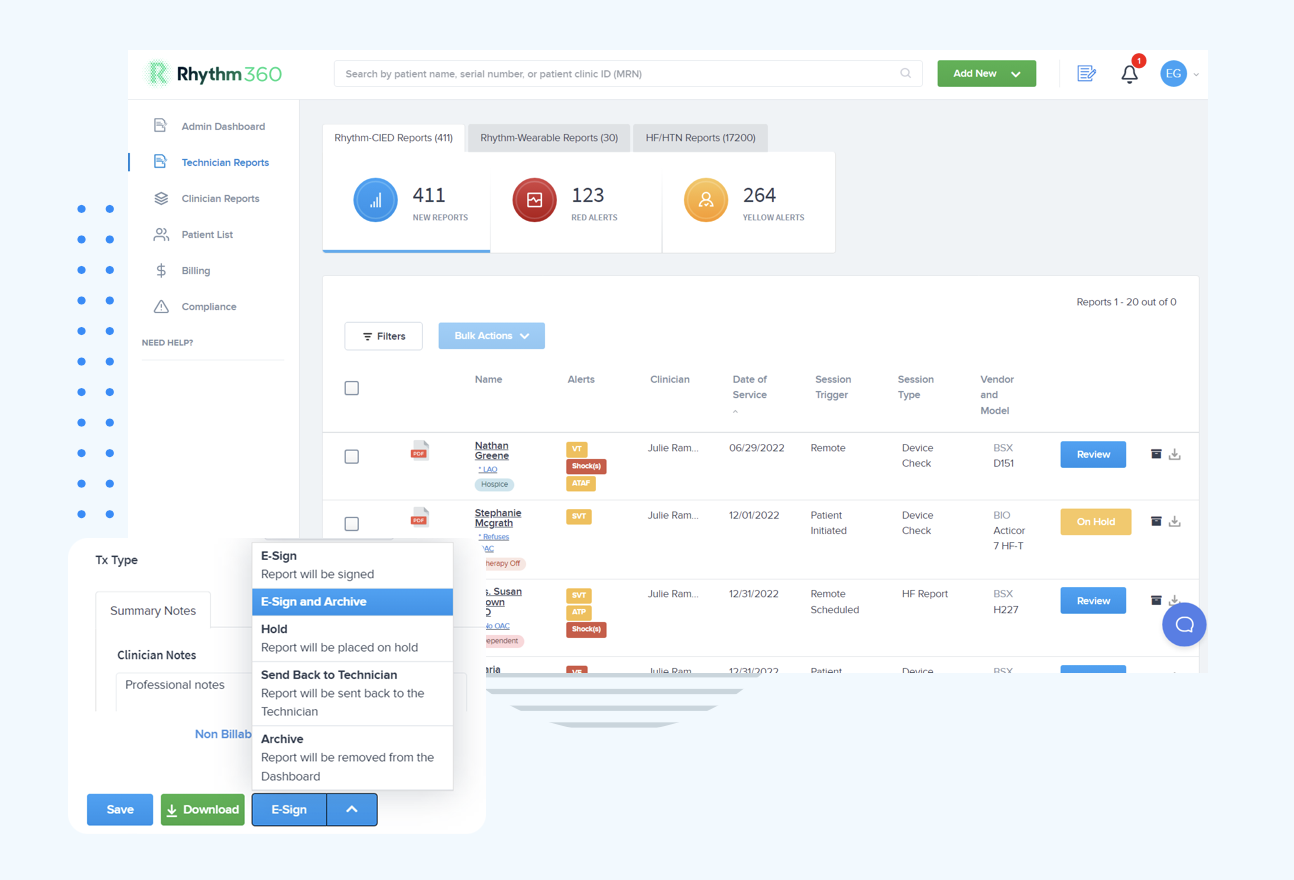
Legacy multi-portal workflows require device technicians to log into separate OEM systems for each manufacturer, manually reconcile conflicting data, and transcribe findings into the EHR. This process creates data silos, introduces transcription errors, and consumes staff hours that could be directed toward patient care. Rhythm360 replaces this fragmented model with a single cloud-based workspace that ingests data from all major device manufacturers simultaneously.
On vendor-neutral aggregation, Rhythm360 uses a combination of API connections, HL7 messaging, XML parsing, and computer vision-based OCR to normalize unstructured PDF reports from OEM portals. A redundant data feed system acts as a fail-safe when an OEM server is unavailable, achieving greater than 99.9% transmissibility. University of Chicago Medicine reviewed more than 73,000 reports annually through Rhythm360 in calendar year 2025, averaging more than 18,000 reports per quarter, which demonstrates the platform's capacity in a high-volume academic medical center environment.
On AI-powered alert triage, the platform's filtering engine separates clinically significant events from non-actionable transmissions before notifications reach clinical staff. Guideline-based reprogramming combined with algorithmic filtering can reduce non-actionable alerts by 74% without increasing adverse outcomes. Rhythm360's triage layer applies this logic automatically, and practices using the platform have achieved an 80% reduction in critical alert response times. This speed improvement translates directly to clinical outcomes. For example, on a Saturday morning, Rhythm360 can flag new-onset atrial fibrillation in a patient whose transmission would otherwise have waited until Monday. By Saturday afternoon, the care team has initiated anticoagulation and prevented a potential stroke. UCM clinicians noted they are able to address issues earlier; rather than waiting for a 3-month visit, they can call patients in for evaluation.
On bi-directional EHR integration, Rhythm360 connects with Epic, Cerner, Athenahealth, eClinicalWorks, Greenway Health, and others. Data flows in both directions. Completed reports push into the patient chart, and relevant clinical context pulls back into the monitoring workspace. The key differentiator for interoperability in 2026 is data readiness, the ability to reliably ingest, normalize, validate, and activate data across sources, rather than simply achieving data access. Rhythm360's integration architecture follows this principle.
On CPT billing support, Rhythm360 automates documentation for codes 93298, 93299, and 99454, which expands reimbursement eligibility to a broader patient population. Practices implementing Rhythm360 have increased revenue capture by up to 300% through stronger CPT documentation and the addition of RPM service lines for heart failure and hypertension. UCM reported improved billing and accountability for patients after the integration.
The table below functions as a ready-to-use scorecard. Administrators can apply the weights to any platform under evaluation and compare total scores. Rhythm360's capabilities are listed for each criterion.
| Criterion | Weight | Rhythm360 Capability | Score (1–5) |
|---|---|---|---|
| Vendor-Neutral Device Aggregation | 20% | All major OEMs unified via API, HL7, XML, and computer vision OCR, greater than 99.9% transmissibility via redundant feeds | 5 |
| AI-Powered Alert Triage | 20% | AI-driven filtering with optional 24/7/365 CCT oversight, 80% reduction in critical alert response times | 5 |
| Bi-Directional EHR Integration | 20% | Deep integration with Epic, Cerner, Athenahealth, eClinicalWorks, Greenway Health, and others via HL7, full audit trail | 5 |
| Automated CPT Documentation | 15% | Automated documentation for CPT 93298, 93299, and 99454, audit-ready with timestamps | 5 |
| HIPAA-Compliant Mobile Access | 10% | Secure mobile app with role-based access, end-to-end encryption, and full audit logging | 5 |
| Implementation Timeline and TCO | 10% | Full onboarding in days to a few weeks, SaaS pricing scaled to clinic size with no large upfront capital requirement | 5 |
| Scalability | 5% | Supports single-site clinics to large health systems, enterprise-volume tested at more than 73,000 reports per year at a single institution | 5 |
Walk through this scorecard with a Rhythm360 specialist using your practice's data.
Rhythm360's onboarding process, including EHR integration configuration, is completed in days to a few weeks. The platform does not require on-premise hardware installation. All data is processed in a HIPAA-compliant cloud environment with zero-trust API architecture, role-based access controls, end-to-end encryption, and audit logging built into the data model. Cybersecurity in 2026 is a patient safety and care continuity risk, and the average healthcare data breach cost $9.77 million according to IBM's 2024 Cost of a Data Breach Study, the highest of any sector. Rhythm360's security architecture is designed to satisfy enterprise procurement evaluations at multi-site health systems.
Scalability is validated by real-world volume. University of Chicago Medicine processed more than 73,000 reports annually through Rhythm360, with stable dismissal rates across quarters, which confirms that the platform maintains consistent performance at enterprise scale. The SaaS pricing model adjusts to clinic size and usage, making the platform accessible to solo EP practices and large integrated health systems alike.
Practices can use the following framework to identify which scorecard criteria carry the most weight for their specific situation.
Multi-OEM device mix: Any practice implanting devices from more than one manufacturer should weight vendor-neutral aggregation and AI alert triage at the top of the scorecard. The administrative burden of managing separate portals scales directly with the number of OEMs in the device mix.
Revenue recovery priority: Practices experiencing rejected claims or underbilling on CPT codes 93298, 93299, and 99454 should weight automated CPT documentation heavily.
Staff retention and burnout: Practices losing device technicians to administrative overload should prioritize AI alert triage and EHR integration depth. Standardized triage protocols and greater automation in alert prioritization reduce nonrelevant alerts and improve timeliness and specificity of alert management, which directly reduces the cognitive burden on clinical staff.
Multi-site health systems: Organizations managing CIED populations across multiple locations should weight scalability and EHR integration depth. Health systems seek unified platforms that integrate diverse data streams into a single EHR and clinical alerting system rather than adopting multiple disconnected tools.
Across all practice profiles, Rhythm360 scores at the maximum on every criterion in the scorecard above.
Rhythm360 achieves greater than 99.9% transmissibility by combining redundant data feeds, computer vision-based OCR for unstructured PDF reports, and AI-powered gap-filling. If an OEM server experiences downtime, the redundant feed system maintains data continuity. This architecture ensures that critical events are not missed due to technical failures at the manufacturer level, which is a documented risk in single-feed monitoring environments. This high reliability supports consistent clinical decision-making.
Alert fatigue decreases when the triage layer is built on validated clinical logic rather than simple threshold filtering. Rhythm360's AI triage engine distinguishes between non-actionable transmissions and clinically significant events such as new-onset atrial fibrillation, ventricular tachycardia, lead malfunction, and device battery depletion indicators. The platform also offers optional 24/7/365 oversight by certified cardiac technicians supervised by physicians, which adds a human clinical layer to the automated triage. Practices using Rhythm360 have achieved an 80% reduction in critical alert response times, which shows that faster triage and reduced alert volume can occur together without sacrificing safety.
Most practices achieve full onboarding, including EHR integration configuration and mobile access setup, in days to a few weeks. Timeline depends on the complexity of the EHR environment and the number of integration points required. Rhythm360 connects with Epic, Cerner, Athenahealth, eClinicalWorks, Greenway Health, and other systems via HL7. The mobile application is available immediately upon account provisioning and provides the same alert review, report signing, and care coordination capabilities as the desktop platform, with HIPAA-compliant encryption and role-based access controls enforced at the device level.
Rhythm360 uses a SaaS-based pricing model that scales with clinic size and platform usage, which eliminates large upfront capital expenditures. Onboarding is completed in days to a few weeks, which is significantly faster than legacy on-premise systems. Total cost of ownership should be evaluated over a multi-year horizon that accounts for platform subscription, security and compliance operations, and support. Administrators should also factor in the revenue impact. Practices have increased CPT billing capture by up to 300% after implementation, and this improvement in most cases offsets platform costs within the first billing cycle. The administrative dashboard provides real-time visibility into captured and potential revenue based on CPT code requirements, giving administrators a continuous TCO and ROI view.
The operational and financial stakes of this platform decision are high. Fragmented OEM portals create administrative overload, expose practices to missed critical events, and produce measurable revenue leakage through underbilling and rejected claims. The U.S. RPM market is projected to exceed $18 billion by 2026, and practices that do not implement compliant, automated documentation workflows will struggle to capture their share of that growth.
Rhythm360 delivers vendor-neutral aggregation with the transmissibility rates detailed above, AI-powered alert triage with an 80% reduction in critical response times, deep bi-directional EHR integration, automated CPT documentation, HIPAA-compliant mobile access, rapid implementation, and enterprise-scale capacity. These capabilities are validated by real-world deployments, including University of Chicago Medicine's processing of more than 73,000 reports annually. Every criterion in the weighted scorecard above returns a maximum score for Rhythm360.