Last updated: June 22, 2026
A cardiology practice that implants devices from more than one OEM immediately faces a multi-portal access problem. Each manufacturer runs a proprietary web portal with its own login, data format, alert thresholds, and export schema. Device technicians and nurses cycle through these portals every day, manually transcribing findings into the EHR and reconciling conflicting data representations. Andrew Beaser, MD, Associate Professor of Medicine at the University of Chicago Medicine (UCM), described pre-implementation workflows as “a major challenge and incredibly difficult.” Gaurav A. Upadhyay, MD, FACC, FHRS, Professor of Medicine and Director of the Pacing & Defibrillation Device Clinic at UCM, noted: “Staffing was always an issue for our center, because our device clinic had struggled with technician turnover and timely weekend coverage.”
The multi-portal workflow amplifies this staffing strain by generating alert fatigue that makes remaining staff less effective. Alert fatigue compounds the staffing problem in a specific way. Legacy portal notification systems generate high volumes of non-actionable alerts alongside genuinely critical events such as new-onset atrial fibrillation, ventricular tachycardia, or significant thoracic impedance shifts from CardioMEMS sensors. When clinicians cannot reliably separate signal from noise, critical events are delayed or missed. Billing systems suffer in parallel. Without a centralized record of transmission reviews, CPT documentation remains incomplete, claims are rejected, and revenue leaks from every billing cycle.
Direct OEM API connections give a practice a structured data feed from one manufacturer, but each additional manufacturer requires a separate API agreement, a separate data normalization layer, and ongoing maintenance as OEMs update their schemas. Middleware aggregators normalize data from multiple OEMs but often lack bidirectional EHR write-back and AI triage capabilities. Vendor-neutral platforms such as Rhythm360 consolidate all OEM feeds via API, HL7, XML, and PDF parsing through computer vision into a single normalized pipeline with bidirectional Epic and Cerner integration and AI-powered alert prioritization built in. The table below highlights how vendor-neutral platforms address integration gaps that direct OEM APIs and middleware aggregators leave unresolved, especially around reliability, maintenance effort, and automated billing capture.
| Dimension | Vendor-Neutral Platform (Rhythm360) | Direct OEM APIs | Middleware Aggregator |
|---|---|---|---|
| Data transmissibility | >99.9% via redundant feeds and AI gap-fill | Dependent on individual OEM server uptime, no cross-OEM redundancy | Variable, typically no redundant feed layer |
| EHR integration | Bidirectional HL7 into Epic, Cerner, and others | Unidirectional or limited, requires custom EHR build per OEM | Often unidirectional, bidirectional requires additional development |
| AI alert triage | Built-in with structured escalation paths | Not included, OEM alert logic only | Limited, varies by vendor |
| Maintenance burden | Single vendor manages multi-OEM data normalization | Practice IT manages each OEM API contract and update cycle | Aggregator manages normalization, EHR integration remains practice responsibility |
| CPT documentation automation | Automated capture for 93298, 99454, 99457, and others | None, manual documentation required | Typically none |
| Implementation timeline | Days to weeks including EHR integration | Weeks to months per OEM, multiplied across manufacturers | Weeks to months, EHR integration separate |
Explore a Rhythm360 integration walkthrough to see how vendor-neutral architecture consolidates multi-OEM device data into a single EHR-connected workflow.
Epic and Cerner both support FHIR R5 and HL7 v2.x messaging for device data ingestion, yet the integration steps differ in practice. The workflows below reflect the 2026 integration path for each system.
Epic Integration Path:
Cerner Integration Path:
UCM’s implementation of Rhythm360 enabled clinicians to review more transmissions daily and identify more abnormalities, with the system processing more than 73,000 reports annually in 2025, averaging more than 18,000 reports per quarter. Upadhyay stated: “That was a big piece for us, to have an integrated review of data from trained personnel.”
AI in heart failure care functions primarily as a triage adjunct rather than a full replacement for clinician review, with the goal of expediting diagnosis and prioritizing patients who need faster attention. Rhythm360’s AI triage layer applies this principle by scoring incoming transmissions for clinical urgency, suppressing non-actionable notifications, and routing high-priority alerts such as ventricular fibrillation, lead malfunction, significant impedance shifts, and ERI or RRT indicators to the appropriate clinician inbox within the EHR.
Effective use of AI-generated alerts requires integration into structured clinical workflows with defined escalation paths and accountability mechanisms to reduce alert fatigue and preserve clinical utility. In the LINK-HF2 remote-monitoring trial, 95% of AI-generated alerts were reviewed by clinicians within 24 hours and 26.7% led to clinical action such as therapy adjustment, which shows that embedding AI alerts in structured workflows materially speeds review and intervention. Rhythm360 applies this same principle, combining AI triage with structured escalation paths, to achieve up to 80% reductions in critical alert response times, with optional 24/7/365 oversight by certified cardiac technicians (CCTs) for practices that need continuous coverage. Beaser noted: “We are able to address these issues earlier; rather than waiting for a 3-month visit, we can call patients in for evaluation.” Andrew Beaser, MD, also observed: “Decision support, including AI-assisted decision support, will become increasingly important as data volumes grow.”
Automated CPT documentation delivers one of the highest returns from an integrated device monitoring platform. The 2026 CMS Physician Fee Schedule introduced two new RPM codes alongside existing cardiac monitoring codes. CPT 99445, effective January 1, 2026, covers device supply for 2 to 15 days of monitoring in a 30-day period at approximately $47 nationally. CPT 99470, also effective January 1, 2026, covers the first 10 minutes of treatment management services per calendar month at approximately $26 nationally. These codes complement established codes such as CPT 93298 for remote interrogation of implantable cardiovascular monitors, CPT 99454 (~$47) for device supply with 16–30 days of transmitted data, and CPT 99457 (~$50) for the first 20 minutes of clinical management time.
CMS requires at least one live, real-time interactive communication with the patient or caregiver during the calendar month to bill CPT 99457, 99458, or 99470. Remote weight monitoring data must maintain time-stamped audit trails of readings, alerts, and clinical responses to support CMS compliance and billing documentation. Rhythm360 captures these documentation requirements directly within the EHR-connected patient record, including consent records, transmission timestamps, clinician review logs, and interactive communication records, which removes the manual gaps that cause claim rejections. Practices using Rhythm360 have increased revenue capture by up to 300% through more complete CPT code documentation and the addition of new RPM service lines.
These revenue gains grow when paired with the clinical outcomes that well-documented RPM programs can deliver. A 2024 Journal of Cardiac Failure study showed that remote monitoring reduced monthly costs by 52% in Medicare patients with heart failure with reduced ejection fraction. UMass Memorial Health’s AI-supported RPM program achieved a 50% reduction in 30-day readmission rates for heart failure patients through real-time data transmission and early intervention, outcomes that depend on reliable, auditable documentation infrastructure that supports sustainable billing.
Request a billing workflow review to see how Rhythm360’s automated CPT documentation closes revenue leakage in your device monitoring program.
A successful integration starts with alignment across four stakeholder groups before go-live: clinical leadership, device clinic staff, IT, and revenue cycle. The checklist below covers the critical pre-implementation steps and why each one matters.
Rhythm360’s implementation timeline, including EHR integration, runs from a few days to a few weeks. Common pitfalls include incomplete patient demographic matching between the RPM platform and the EHR, alert threshold misconfiguration during the first 30 days, and failure to document patient consent before billing activation.
Post-implementation measurement should track metrics across four domains, because a successful integration creates value in all four at once. Clinical improvements depend on operational efficiency, which then supports financial performance and compliance standing. Clinically, key metrics include critical alert response time with a target of at least an 80% reduction from baseline, 30-day heart failure readmission rate, and rate of abnormalities identified per 1,000 transmissions. These clinical gains rely on operational improvements such as reduced staff hours spent on manual data retrieval and transcription, fewer OEM portal logins, and higher transmission review volume per FTE.
Financial metrics should cover CPT capture rate per eligible transmission, revenue per monitored patient per month, and claim rejection rate for remote monitoring codes. Compliance metrics include HIPAA audit trail completeness, patient consent documentation rate, and availability of time-stamped alert response logs for payer audit. Upadhyay confirmed: “We have improved billing and accountability for our patients after the integration.”
The full implementation process, including EHR integration with Epic or Cerner, follows the timeline described earlier, typically a few days to a few weeks depending on the complexity of the existing IT environment and the number of OEM device feeds being onboarded. RhythmScience provides a dedicated implementation team that manages HL7 interface configuration, patient demographic matching, alert routing setup, and staff training. Practices do not need to dedicate significant internal IT resources to the project. A phased rollout allows clinical staff to begin reviewing transmissions through Rhythm360 while EHR bidirectional write-back is validated in parallel.
The healthcare organization retains full ownership of all patient data processed through Rhythm360. RhythmScience operates as a Business Associate under HIPAA, and the platform maintains a complete, auditable data trail for every transmission, alert, clinician review, and patient communication. Data is stored in a HIPAA-compliant cloud environment with role-based access controls. Organizations can export their full patient dataset at any time, and data portability is contractually guaranteed. No patient data is used for any purpose outside of the contracted clinical workflow and billing support functions.
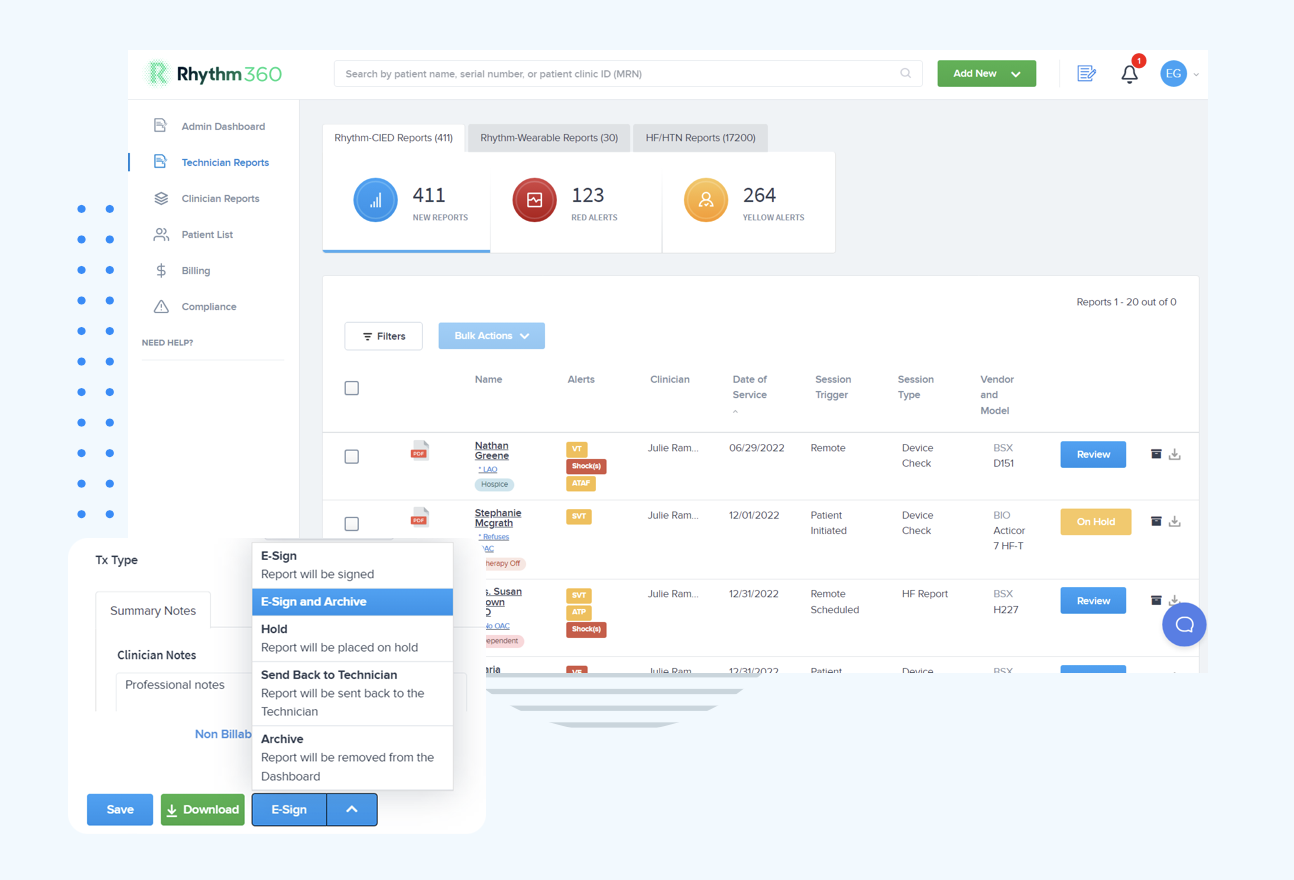
Clinicians can access Rhythm360 alerts and transmissions securely from outside the office. Rhythm360 includes a HIPAA-compliant mobile application that allows electrophysiologists, cardiologists, nurse practitioners, and other authorized clinicians to review device transmissions, sign reports, respond to AI-triaged alerts, and coordinate care from any location. This capability is particularly relevant for weekend and on-call coverage, which often presents the greatest operational challenge for CIED monitoring programs. The mobile app uses the same alert routing and escalation logic as the desktop platform, so clinicians receive prioritized notifications rather than raw alert volumes.
Rhythm360’s automated billing documentation engine captures the documentation requirements for CPT 99445 and 99470 effective January 1, 2026. For 99445, the platform tracks the number of days with transmitted device data within each 30-day billing period and flags eligible patients when the 2-to-15-day threshold is met. For 99470, the platform logs clinical management time and interactive communication events, then generates the documentation required to support the first 10-minute management services claim. The system also enforces the CMS rule that 99445 and 99454 cannot be billed together for the same 30-day period, which prevents duplicate billing errors before claims are submitted.
Rhythm360 uses a redundant data feed architecture as a safeguard against OEM server outages. When a primary OEM data feed becomes unavailable, the platform’s AI-powered extrapolation and computer vision capabilities maintain data continuity by processing alternative data sources, including PDF-based transmission reports parsed via optical character recognition. This redundancy is the foundation of the transmissibility rate noted earlier. Practices receive real-time notifications of any connectivity issues through the administrative dashboard, and the platform logs all interruptions with timestamps for compliance documentation.
Fragmented OEM portals, manual transcription workflows, and disconnected billing systems cannot keep pace with the transmission volumes cardiology programs manage in 2026. The clinical, operational, and financial costs of the status quo, including missed critical events, technician burnout, rejected CPT claims, and incomplete audit trails, are measurable and addressable. Rhythm360 delivers a vendor-neutral, AI-powered, FHIR R5 and HL7-compliant integration platform that consolidates CIED, CardioMEMS, and impedance sensor data into a single source of truth within Epic or Cerner workflows, and automates CPT documentation for the full 2026 code set while delivering the alert response time improvements described earlier. The UCM implementation shows what this architecture can produce at scale, with more than 73,000 annual reports processed, earlier clinical interventions, and measurably improved billing accountability. Directors of Cardiology Services, EP Lab Managers, and practice administrators evaluating a platform decision within the next 90 days can use Rhythm360 as a proven model for integrated heart failure device workflows.
Talk with Rhythm360 about your multi-vendor device integration plan and see how your heart failure device data can flow directly into your EHR workflow.