Last updated: July 13, 2026
A unified remote patient monitoring (RPM) platform for cardiology brings together data from cardiac implantable electronic devices (CIEDs), including pacemakers, ICDs, implantable loop recorders, CRT, and CCM devices. It also incorporates hemodynamic sensors such as CardioMEMS and chronic-condition monitoring for heart failure and hypertension into a single, vendor-neutral clinical workspace. CPT billing compliance in this model relies on automated documentation of device setup, data transmission, and clinical review time aligned to CMS codes 99453, 99454, 99457, and 99458. This structure can generate substantial monthly revenue per patient when cardiology practices maintain high enrollment and monitoring compliance.
The evidence base for remote monitoring now supports this shift. A 2026 meta-analysis by Scholte et al. in npj Digital Medicine of 79 randomized trials including 31,669 heart failure patients reported that remote monitoring reduced total HF hospitalizations (incidence rate ratio 0.81, 95% CI 0.72–0.91) and all-cause mortality (risk ratio 0.90, 95% CI 0.84–0.95) compared with standard care. The iCARDIO Alliance Global Implementation Guidelines on Heart Failure 2025 recommend non-invasive home telemonitoring to decrease hospitalization and cardiovascular death. Rhythm360 by RhythmScience translates these guideline recommendations into daily workflows at the practice level.
A typical cardiology practice that manages patients with CIEDs from multiple manufacturers, including Medtronic, Boston Scientific, Abbott, Biotronik, and others, must maintain separate logins across non-interoperable OEM portals to retrieve transmission data. Each portal uses proprietary data formats, alert logic, and reporting structures. When teams add heart failure monitoring through wearables or hemodynamic sensors, the operational complexity increases further.
The operational consequences are well documented. Fragmented RPM workflows force staff to manage separate dashboards, disconnected communication systems, multiple logins, and manual documentation processes, which slows care coordination. No 2023 systematic review of RPM alert systems exists in the evidence. Override rates exceeding 90% for remote transmissions appear in a 2026 paper, largely because alerts lack actionability and clinical context. As Troy Leo, MD, MHCM, FACC, Service Line Leader for Heart and Vascular at Atrium Health, noted, physicians’ time is too valuable to manually process every transmission.
Health systems are already moving toward integrated models. Atrium Health manages loop recorders, pacemakers, and ICDs on a single centralized platform and integrates Apple Watch and AliveCor tracings into consistent review, documentation, and reimbursement workflows. Practices that delay this consolidation face compounding revenue leakage. The 2026 CMS code updates expand billing eligibility for remote monitoring services to patients transmitting data between two and 15 days per month. Practices need robust upstream infrastructure to capture this expanded revenue.
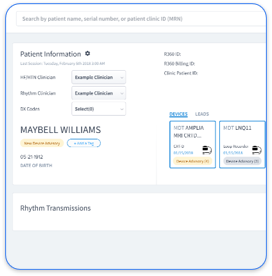
Rhythm360 addresses these challenges through a unified technical architecture designed for vendor-neutral consolidation. The platform ingests data from all major CIED manufacturers and hemodynamic sensors using a multi-modal approach that includes direct API connections, HL7 feeds, XML parsing, and AI-powered computer vision (OCR) for unstructured PDF reports. A redundant data feed system acts as a fail-safe when an OEM server is unavailable. This design supports greater than 99.9% data transmissibility across the patient population.
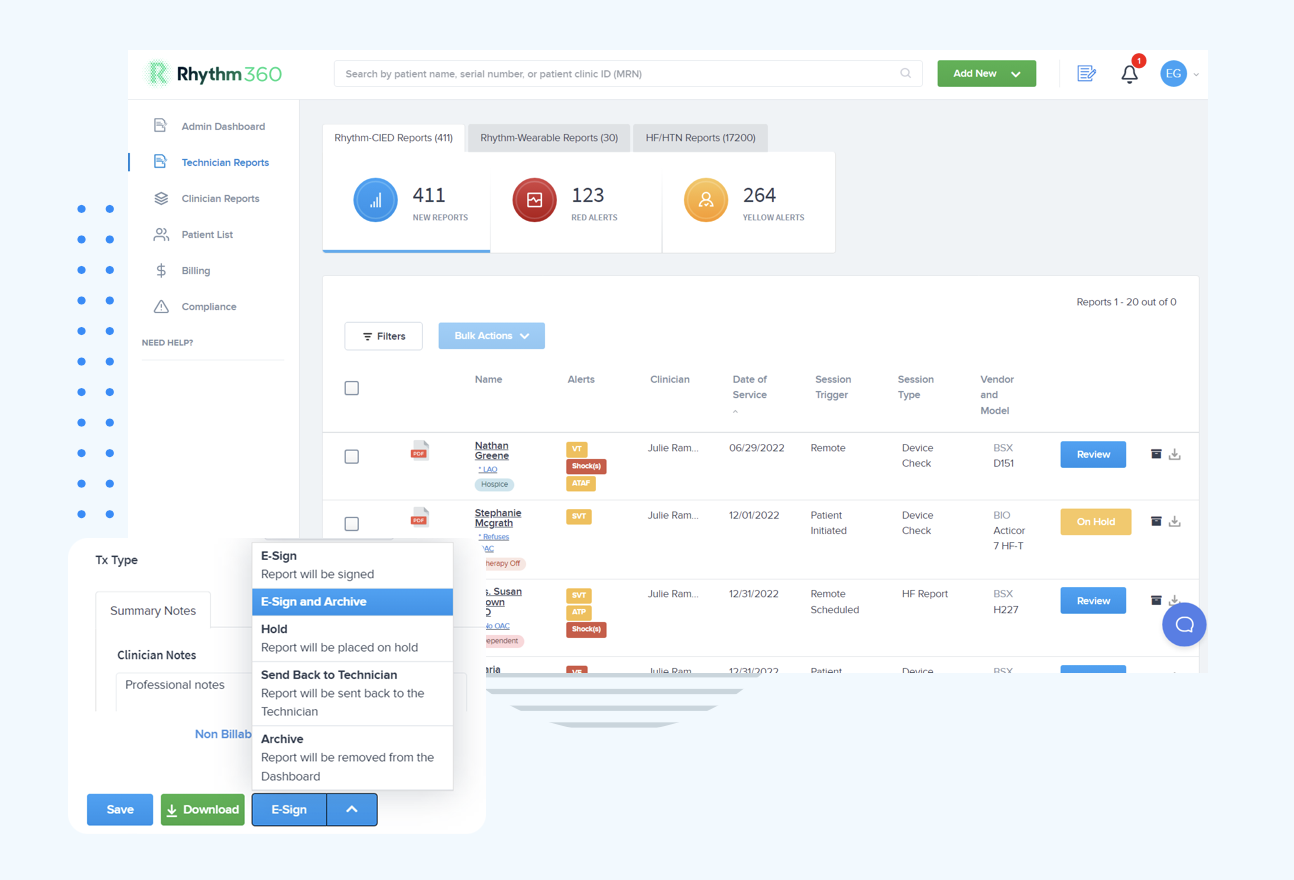
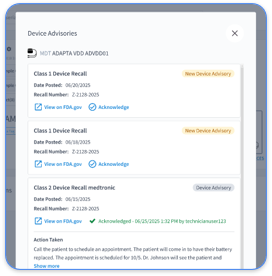
The AI-powered alert triage layer filters non-actionable transmissions and surfaces clinically significant events in prioritized order. These events include new-onset atrial fibrillation, ventricular tachycardia, lead malfunction, ERI or RRT indicators, and significant weight gain in heart failure patients. As Andrew Beaser, MD, Associate Professor of Medicine at the University of Chicago Medicine, observed, decision support, including AI-assisted decision support, will become increasingly important as data volumes grow. UCM reviewed more than 73,000 reports annually through Rhythm360 in calendar year 2025, averaging more than 18,000 reports per quarter, which demonstrates the platform’s scalability in high-volume environments.
Automated reporting generates near-real-time documentation for routine checks and urgent alerts. Bi-directional EHR integration with Epic, Cerner, Athenahealth, eClinicalWorks, Greenway Health, and other systems via HL7 pushes encounter notes, alert documentation, time logs, and monthly summary reports directly into the patient chart. This approach removes manual transcription work. A Twilio-powered integrated communication hub logs all patient interactions, including automated messages and manual calls, with a full audit trail. These logs support CPT billing compliance and reduce redundant outreach.
Optional 24/7/365 oversight by certified cardiac technicians (CCTs) supervised by physicians adds another triage layer. Practices can shift from reactive to proactive patient management with this coverage. Rhythm360 implementations have documented up to an 80% reduction in critical alert response times.
The central strategic decision for cardiology practices evaluating RPM platforms concerns vendor-neutral versus single-vendor architecture. Single-vendor approaches offer deep integration with one manufacturer’s device ecosystem. They also create new silos when patients carry devices from other OEMs, which occurs in nearly every active practice. Vendor-neutral platforms require more sophisticated data normalization infrastructure. In return, they deliver a unified view regardless of device manufacturer.
Data centralization introduces additional considerations. Without enterprise standardization, alert thresholds and escalation pathways differ between facilities, which creates clinical risk and blocks network-level quality measurement. Practices need to define alert ownership before go-live. If no one can clearly identify who responds to alerts, the program is collecting data, not delivering care.
Staffing model design strongly influences ROI. A 500-patient RPM program can generate $850K–$960K in annual revenue from CPT codes 99453–99458 with dedicated clinical staffing. Tiered staffing models assign medical assistants to daily dashboard review, RNs to escalated alerts, and physicians to complex cases. With this structure, one provider can oversee up to 80 patients without adding headcount. Delegating RPM tasks from NPs to lower-cost clinical staff, or using AI for personalized feedback and reminders, can substantially reduce per-patient costs while maintaining care quality.
Integration complexity often receives too little attention during planning. EHR integration costs for RPM platforms range from $15,000 for a single read-only connection to more than $150,000 for bidirectional suites, with ongoing maintenance of $3,000–$15,000 per interface per year. Rhythm360’s implementation process, including EHR integration, typically completes in a period measured in days to a few weeks, which remains substantially below industry averages for comparable platforms.
Schedule a demo to discuss how Rhythm360’s vendor-neutral architecture fits your practice’s device mix and EHR environment.
Successful implementation starts with alignment across clinical, administrative, and IT stakeholders before any technology goes live. Workflow maturity, including documented escalation protocols, defined roles, and existing data quality standards, determines how quickly a practice can absorb a new platform.
A phased rollout approach reduces disruption.
Training must cover both clinical and administrative users. Implementation experience from multidevice telemonitoring programs shows that digital literacy gaps among clinical staff are frequently underestimated. Structured onboarding and role-specific training therefore become essential. Compliance processes, particularly documentation of the 16-day measurement threshold required for CPT 99454 reimbursement, need to sit inside the workflow from day one. Retrofits after billing discrepancies emerge create avoidable rework and revenue loss.
The most frequently cited failure modes in heart failure RPM programs usually stem from weak workflow design rather than technology limitations. Most failures of AI-powered remote patient monitoring programs result from weak data quality and weak workflow design, not from choosing the wrong model.
Specific pitfalls include:
A robust measurement framework spans four domains.
Monthly performance reviews using these metrics allow practices to recalibrate alert thresholds, adjust staffing ratios, and identify patients at risk of falling below transmission compliance thresholds before revenue is lost.
| Dimension | Traditional / Fragmented Model | Rhythm360 Unified RPM Platform | Evidence Basis |
|---|---|---|---|
| Data access | Multiple non-interoperable OEM portals, manual login per manufacturer | Single vendor-neutral dashboard ingesting all CIED and RPM data via API, HL7, XML, and AI-powered PDF parsing | Fragmented portals create unsustainable administrative burden and data silos |
| Data transmissibility | Variable, OEM server outages create gaps with no fail-safe | Greater than 99.9% transmissibility via redundant data feeds and AI-powered extrapolation | RhythmScience platform specification; UCM managed 73,000+ reports annually through Rhythm360 with stable dismissal rates |
| Critical alert response time | Manual triage across portals, high rates of alerts overridden or ignored | AI-powered triage reduces critical alert response times by up to 80% | Override rates exceeding 90% for remote transmissions cited in 2026 paper; RhythmScience documented 80% response-time reduction |
| Revenue capture | Manual CPT documentation, elevated claim denial rates, significant billing leakage | Automated CPT code capture and documentation, up to 300% revenue improvement, reduced claim denial rates with integrated EHR | Integrated EHR systems can reduce claim denials; RhythmScience documented up to 300% revenue improvement |
Rhythm360 uses the phased implementation approach described earlier, which covers platform configuration, OEM data feed connections, alert threshold calibration, staff training, and billing workflow setup. This structure requires minimal internal IT resources from the practice. The reduced internal workload lowers the operational burden of onboarding and shortens the time to first billed RPM encounters.
Rhythm360 supports flexible staffing models that match local resources. Practices can assign daily dashboard review to medical assistants or device technicians, escalated alert management to RNs or NPs, and complex case review to cardiologists or electrophysiologists. For practices that prefer additional support, Rhythm360 offers optional 24/7/365 oversight by certified cardiac technicians (CCTs) supervised by physicians, who handle triage and ensure timely intervention. Clear role definition and documented escalation protocols should be in place before go-live to prevent alert ownership gaps that undermine program effectiveness.
CPT 99457 requires at least 20 minutes of interactive communication with the patient or caregiver per calendar month, along with documented clinical staff time spent reviewing RPM data. Rhythm360 automates tracking of clinical review time and logs all patient communications through its integrated Twilio-powered messaging hub with a full audit trail. The platform generates compliant documentation aligned to CMS requirements for codes 99453, 99454, 99457, and 99458. This automated documentation reduces the risk of denied claims from incomplete time logs or missing interaction records, which remain among the most common causes of RPM billing audits.
Rhythm360 operates as a HIPAA-compliant, cloud-based platform with end-to-end data security across all ingestion pathways, including API, HL7, XML, and PDF. The platform’s mobile application, which allows clinicians to review transmissions, sign reports, and coordinate care from smartphones, also meets HIPAA requirements. All patient communications and clinical interactions are logged with a full audit trail within the patient record. These logs support compliance documentation and accountability during any regulatory review.
Effective measurement spans four domains. Clinical metrics include critical alert response time, 30-day HF readmission rate, and patient transmission compliance rate. Operational metrics include staff hours per 100 patients for data review, alert override rate as a proxy for alert fatigue, and time from transmission receipt to clinician review. Financial metrics include monthly revenue per enrolled patient from CPT codes 99453, 99454, 99457, and 99458, claim denial rate, and overall revenue improvement against pre-implementation baseline. Compliance metrics include documentation completeness for each billed CPT code and audit-readiness of patient interaction logs. Monthly performance reviews using these metrics allow practices to recalibrate thresholds and staffing ratios before operational or financial problems compound.
The shift from fragmented, visit-based heart failure management to unified remote patient monitoring now functions as a 2026 operational and clinical imperative. Guidelines from the iCARDIO Alliance, HFSA or AAHFN, and JACC all point toward integrated digital tools, automated alerts, and EHR-connected workflows as the emerging standard of care. The evidence base confirms that structured remote monitoring reduces HF hospitalizations, lowers all-cause mortality, and improves quality of life at scale.
As Andrew Beaser, MD, at the University of Chicago Medicine, summarized, teams can address issues earlier rather than waiting for a three-month visit, and can call patients in for evaluation when needed. That shift from reactive to proactive care becomes operationally sustainable at any practice volume when a unified RPM platform supports the work.
Practices evaluating platforms in 2026 can apply a consistent lens. Key criteria include vendor neutrality across all device manufacturers, greater than 99.9% data transmissibility, AI-powered alert triage with documented response-time reductions, bi-directional EHR integration, automated CPT billing documentation, and an implementation timeline measured in days to weeks rather than months. Rhythm360 by RhythmScience is built to meet each of these criteria.
Schedule a demo to evaluate how Rhythm360 can consolidate your practice’s cardiac monitoring workflows, reduce critical alert response times by up to 80%, and improve revenue capture by up to 300%.