See How Rhythm360 Automates Your HF Billing
Heart failure management billing functions as a stack of interacting pathways, and denials cluster where those pathways intersect. Mutually exclusive combinations, missed timing rules, and undocumented initiating visits drive most avoidable write-offs. CCM time cannot be billed during TCM's 29-day post-discharge service period, and CCM and PCM are mutually exclusive for the same patient in the same month. These rules govern everyday HF billing scenarios.
The stakes are rising. CMS finalized the Ambulatory Specialty Model (ASM) as part of the CY 2026 Medicare Physician Fee Schedule Final Rule, with performance beginning January 1, 2027. Under ASM, payment adjustments of up to 9–12% apply to all Medicare Part B services based on cost, quality, improvement activities, and interoperability performance. Correct sequencing now directly affects revenue.
The workflow action: map every HF patient to a billing pathway before the next claim run. Start by identifying which codes are active and which cycles are open. Then check whether any exclusivity rules apply before submission so you catch conflicts before they become denials.
Even a perfectly sequenced claim will fail if the diagnosis codes do not support it. That is where ICD-10 specificity becomes critical.
In ICD-10-CM, the I50.2x family represents systolic heart failure (HFrEF), the I50.3x family represents diastolic heart failure (HFpEF), and the I50.4x family represents combined systolic and diastolic heart failure. Acuity appears in the fourth character identically across all subfamilies.
| Code | Type | Acuity |
|---|---|---|
| I50.21 | Systolic (HFrEF) | Acute |
| I50.22 | Systolic (HFrEF) | Chronic |
| I50.23 | Systolic (HFrEF) | Acute on Chronic |
| I50.31 | Diastolic (HFpEF) | Acute |
| I50.32 | Diastolic (HFpEF) | Chronic |
| I50.33 | Diastolic (HFpEF) | Acute on Chronic |
| I50.41 | Combined Systolic and Diastolic | Acute |
| I50.42 | Combined Systolic and Diastolic | Chronic |
| I50.43 | Combined Systolic and Diastolic | Acute on Chronic |
Use acute codes when the provider documents a new decompensation or worsening that requires active intervention. Use chronic codes for stable, ongoing HF under management. Use acute-on-chronic when a patient with established HF presents with a new acute episode layered on their baseline condition.
When hypertension and heart failure coexist, ICD-10-CM presumes a causal relationship and requires the combination code I11.0 (hypertensive heart disease with heart failure) sequenced first, with the specific I50.x type added second. When heart failure coexists with both hypertension and chronic kidney disease, use combination category I13, and assign an additional code from category I50 to identify the type of heart failure, plus a code from category N18 to specify CKD stage. The FY 2027 ICD-10-CM files are effective October 1, 2026.
The documentation action: the provider's assessment or plan must explicitly state the HF type and acuity. An ejection fraction in an echo report without a matching provider diagnosis does not support a specific I50.2x, I50.3x, or I50.4x code.
The table below summarizes which HF billing codes can and cannot be billed together in the same month for the same patient. It reflects CMS concurrent billing rules and CCM exclusivity guidance.
| Code Pair | Can Bill Together? | Key Condition |
|---|---|---|
| CCM + RPM | Yes | Time must not overlap; document separately |
| CCM + TCM | No | Mutually exclusive in the same month |
| CCM + PCM | No | Mutually exclusive in the same month |
| RPM + TCM | Yes | Each service's requirements met independently |
| E/M + CCM | Yes | E/M time not counted toward CCM minutes |
| RPM + RTM | No | CMS declined to permit concurrent billing in CY 2026 |
CCM and RPM (CPT 99453–99458) can be billed in the same month for the same patient, but the staff time counted toward each program must be separate and non-overlapping. The same 20 minutes cannot support both codes. Document each service's minutes independently and confirm that the RPM management code (99457 or 99458) includes evidence of at least one real-time interactive communication with the patient. For a deeper look at RPM-specific billing rules, see the guide on heart failure RPM billing.
PCM (CPT 99424–99427) is designed for one high-risk condition rather than CCM's two-or-more chronic conditions, and the two programs are not billed together for the same patient in the same month. For a heart failure patient who also carries diabetes, hypertension, or CKD, CCM is typically the appropriate pathway because it covers multi-condition coordination. PCM fits when the practice manages a single high-complexity condition, such as advanced HF, and the patient does not meet CCM's two-condition threshold or the practice prefers condition-specific documentation.
The workflow action: configure the billing system to flag any claim where CCM and TCM, or CCM and PCM, appear together for the same patient in the same month before submission.
After a heart failure hospitalization, TCM (CPT 99495 or 99496) governs the 29-day post-discharge service period. CCM time cannot be billed during that 29-day TCM period, and CCM billing can resume the month after that period closes if the patient still qualifies. RPM can run concurrently with TCM when each service's requirements are met independently and time is not double-counted.
The initiating visit rule for CCM applies at re-enrollment after a gap. A new CCM patient, or one not seen by the billing practitioner within the past year, requires a qualifying face-to-face initiating visit first, such as an Annual Wellness Visit, Initial Preventive Physical Exam, or regular E/M.
Post-discharge billing checklist:
Review Your Post-Discharge HF Billing With Rhythm360
Device-specific billing for heart failure requires a precise match between the CPT code and the device type. Device-type mismatches remain a leading cause of denials.
CardioMEMS (Implantable Cardiovascular Physiologic Monitor): CPT 93297 is the correct code for remote monitoring of an implantable cardiovascular physiologic monitor such as CardioMEMS. It is billable once per 30 days and can be billed global, with modifier -26 for the professional interpretation, or with modifier -TC for the technical component. CPT 93264 covers remote monitoring of a wireless pulmonary artery pressure sensor for up to 30 days, including at least weekly downloads of pulmonary artery pressure recordings, interpretation(s), trend analysis, and report(s) by a physician or other qualified health care professional. Anthem's medical policy MED.00115 classifies implantation of a pulmonary artery pressure sensor for wireless ambulatory heart failure monitoring as investigational and not medically necessary, and CMS issued National Coverage Determination #20.36 effective January 13, 2025, covering implantable pulmonary artery pressure sensors only in the context of approved clinical studies or under Coverage with Evidence Development. Verify payer-specific coverage before billing.
HeartMate 3 (Left Ventricular Assist Device): LVAD billing uses a consolidated code structure. The implant procedure is reported with the appropriate surgical CPT code. Remote monitoring of the device is reported separately. Confirm the correct HCPCS and CPT codes with the device manufacturer's billing guide and the applicable MAC local coverage determination, because LVAD monitoring codes differ from those used for pacemakers, ICDs, and physiologic monitors.
30-Day And 90-Day Cycle Distinction: Physiologic monitors (93297) and subcutaneous cardiac rhythm monitors or loop recorders (93298) operate on a 30-day billing cycle. Pacemakers and ICDs operate on a 90-day cycle. The codes are 93294 (pacemaker professional), 93295 (ICD professional), and 93296 (pacemaker or ICD technical). Never apply 93297 to a loop recorder or 93298 to a physiologic monitor, and never describe 93297 and 93298 as a professional or technical pair, because they are device-specific codes for different device categories.
The documentation action for device billing: record the device manufacturer, model, and serial number. Confirm the monitoring period dates align with the applicable cycle. Split professional and technical components only when different entities perform each function.
The CMS Ambulatory Specialty Model (ASM) is a mandatory Innovation Center model with five performance years running from January 1, 2027, through December 31, 2031. For the ASM heart failure cohort, CMS considers physicians with a specialty type of cardiology for participation; clinicians must bill under the Medicare Physician Fee Schedule, practice in a selected mandatory geographic area, and have historically been attributed at least 20 heart failure episodes per year.
The final ASM participant list, published September 15, 2026, includes 2,215 clinicians in the HF cohort. ASM participation is mandatory with no opt-out or hardship exemption pathway for clinicians meeting the criteria within selected geographic markets.
ASM evaluates participants across four categories: Quality, Cost, Improvement Activities, and Improving Interoperability. For heart failure, quality measures include blood pressure control, functional status assessments, avoidable cardiovascular hospitalizations, and guideline-directed medical therapy adherence. ASM participants must collect and submit data on five MIPS quality measures, including MIPS #337: Functional Status Assessments for HF, starting January 1, 2027.
The concrete billing workflow changes ASM forces:
The FY 2027 ICD-10-CM files are effective October 1, 2026, so verify that your billing system has loaded the updated code set before the first ASM performance year begins.
ASM readiness action: check the CMS ASM Participants dataset to confirm whether your NPI appears on the final participant list. Then download the ACC's ASM For HF Readiness Guide to assess workflow gaps before January 1, 2027.
The most common HF billing denial patterns map to five documentation failures:
Documentation checklist for HF billing teams:
Audit workflow action: run a pre-submission claim audit against this checklist monthly. Pull every active CCM enrollee to confirm that month's minutes cleared the billed tier's threshold and that no other practice has surfaced as a competing biller since intake.
Consider a 68-year-old Medicare patient with chronic systolic heart failure (I50.22) and hypertension, coded as I11.0 plus I50.22, enrolled in CCM and RPM, who is hospitalized for acute decompensation in month two of the quarter.
Month 1 (Stable Outpatient):
Month 2 (HF Hospitalization And Discharge):
Month 3 (Post-TCM, Return To Stable Management):
This sequence bills cleanly because TCM blocks CCM in month two, RPM runs independently throughout, and device monitoring codes match the device type with the correct cycle length.
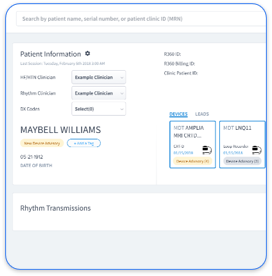
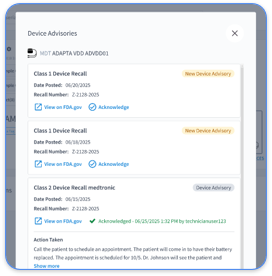
Rhythm360 by RhythmScience is a vendor-neutral, HIPAA-compliant, cloud-based remote patient monitoring platform that unifies CIED and HF or HTN data into a single source of truth. For practices managing the multi-pathway HF billing stack described above, Rhythm360 automates CPT code capture and documentation, tracks device-specific CPT pairings, including 90-day cycles for pacemakers and ICDs (93294, 93295, 93296) and 30-day cycles for physiologic monitors (93297) and loop recorders (93298), and prevents device-type mismatch denials and unbilled technical components.
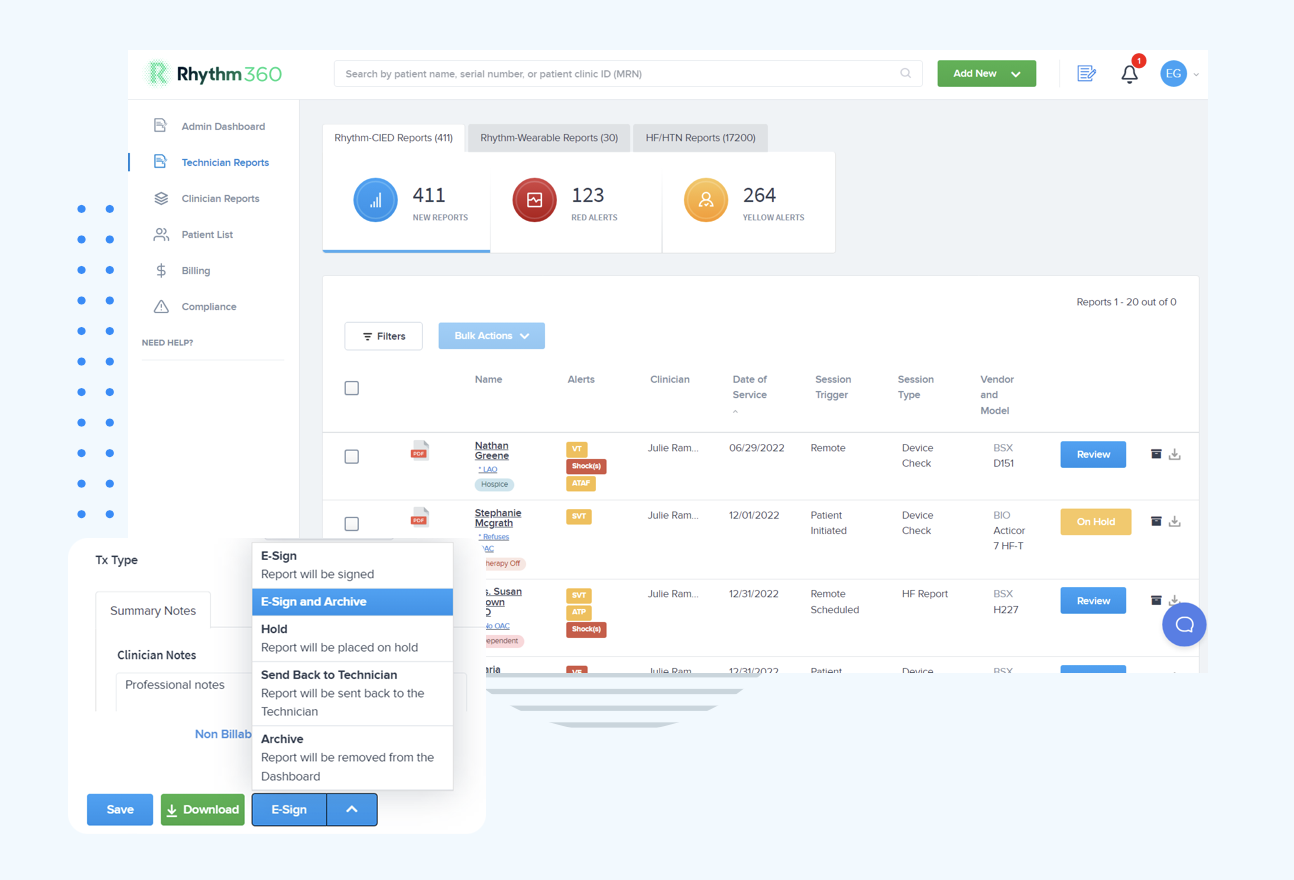
Rhythm360 helps practices capture previously lost revenue through more complete CPT code billing, with documented results including up to an 80% reduction in critical alert response times and up to a 300% increase in revenue capture and profitability. University of Chicago Medicine reviewed more than 73,000 reports annually through Rhythm360 in calendar year 2025, averaging more than 18,000 reports per quarter, and a UCM clinician confirmed: "We have improved billing and accountability for our patients after the integration."
Rhythm360 offers bi-directional EHR integration with Epic, Cerner, Athenahealth, eClinicalWorks, and Greenway Health via HL7, and device manufacturer integration with Medtronic, Boston Scientific, Abbott, and Biotronik. Onboarding, including EHR integration, typically takes a few days to a few weeks. Other platforms in the remote cardiac monitoring space include Murj, Implicity, Rhythm Management Group, and Octagos.
Talk With Rhythm360 About Your HF Billing Stack
The questions below reinforce the core HF billing rules covered in this playbook and give your team quick reference points.
Yes. CMS expressly permits CCM and RPM to be billed in the same month for the same heart failure patient, provided the time documented for each service does not overlap.
Use this playbook to tune your pathways, update your documentation habits, and prepare for ASM performance. Then equip your team with tools that keep every claim aligned with these rules.
See A Rhythm360 Workflow Walkthrough For HF Billing