

Last updated: July 14, 2026
The clinical evidence for quadruple GDMT and remote monitoring is unambiguous. The operational reality inside most practices is not. Real-world registry data confirm persistent underutilization of foundational GDMT and low rates of target-dose achievement in HFrEF. This undertreatment compounds with follow-up gaps: nearly half of patients receive no dose escalation after a heart failure hospitalization, and many discharged patients never see a cardiologist within the critical 14-day window.
On the monitoring side, practices implanting devices from more than one manufacturer must log into separate, non-interoperable OEM portals to retrieve patient data. The result is alert fatigue, missed critical events, and incomplete CPT documentation that leaves billable revenue uncaptured. Remote monitoring revenue leakage stems from engagement gaps rather than billing processes. When organizations fail to actively pull data or ensure patient transmissions, they lose both clinical visibility and the ability to bill for services.
Rhythm360 is a vendor-neutral, HIPAA-compliant, cloud-based platform that unifies CIED and HF/HTN data streams into a single clinical workspace. It ingests data from all major device manufacturers, including Medtronic, Boston Scientific, Abbott, and Biotronik, using API, HL7, XML, and PDF parsing via computer vision. This achieves greater than 99.9% data transmissibility through redundant feeds and AI-powered extrapolation.
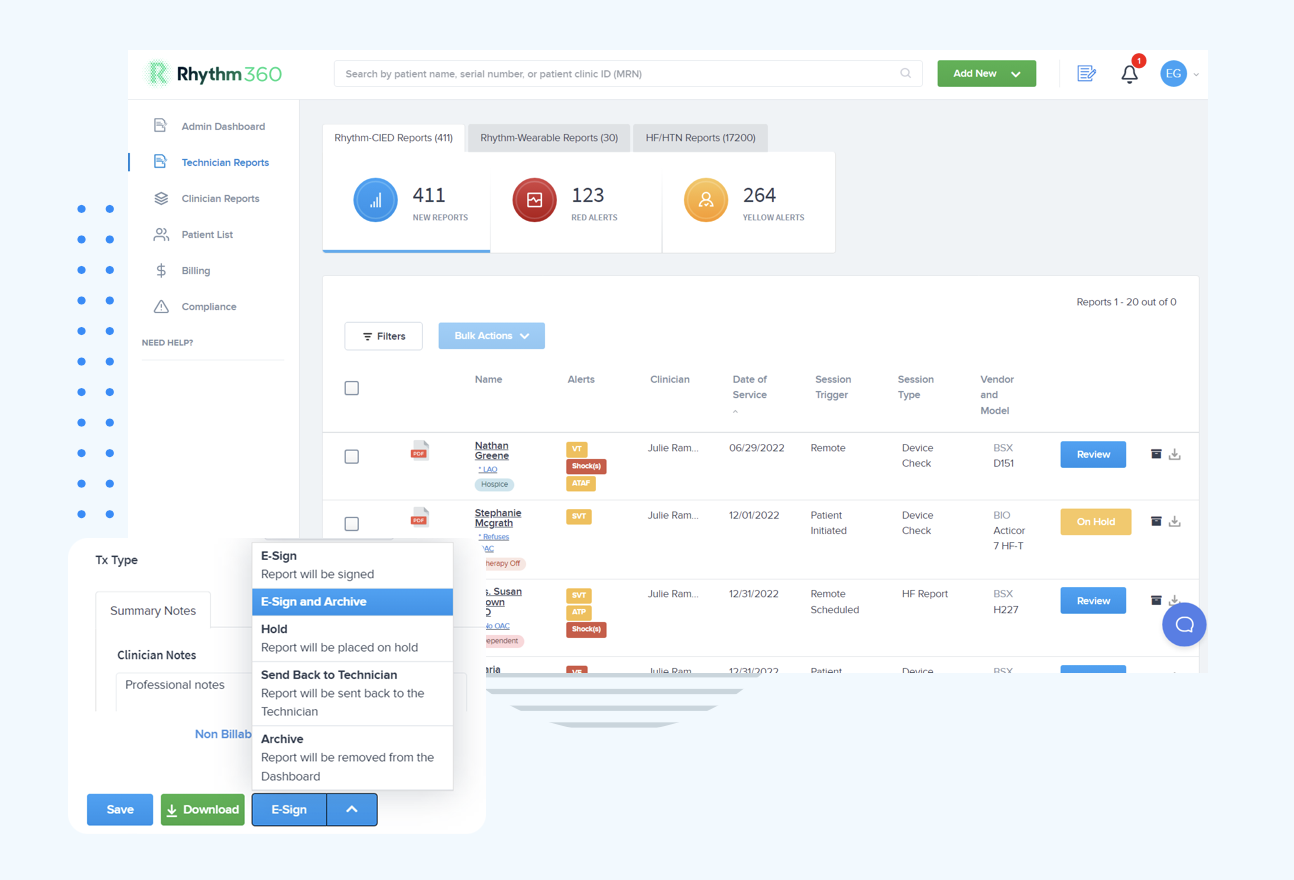
Key platform capabilities include:
As Andrew Beaser, MD, Associate Professor of Medicine at the University of Chicago Medicine, noted after implementing Rhythm360: "We have improved billing and accountability for our patients after the integration."
See a live walkthrough of how Rhythm360 consolidates your CIED and HF data feeds. Contact our team to get started.
With that infrastructure in place, practices can turn to the first operational priority: getting patients onto full GDMT as quickly and safely as possible.
A 2026 clinical review recommends the "four drugs in 4 weeks" strategy for HFrEF. This means initiating all four GDMT classes at low doses within the first month after diagnosis or stabilization, then following with systematic up-titration. Most mortality benefit derives from treatment initiation itself, even at submaximal doses.
The four agents and their sequencing priorities are:
Structured follow-up within 1 to 2 weeks after initiation or dose adjustment is required to monitor blood pressure, heart rate, renal function, and electrolytes. Rhythm360 eliminates manual titration tracking by automating weight and blood pressure transmission alerts, flagging patients who miss scheduled readings, and generating time-stamped documentation that supports CPT 99457 billing for each clinical management interaction.
Pro Tip: Legacy OEM portals generate high volumes of non-actionable notifications. Rhythm360's AI triage layer filters this noise before it reaches clinical staff, preserving the focused attention needed for safe GDMT up-titration.
Multidisciplinary team decision-making is associated with reductions in in-hospital mortality, 30-day all-cause mortality, and 30-day readmission. A 2025 meta-analysis of 74 trials confirmed that multidisciplinary HF management programs reduce HF admissions and all-cause mortality.
An effective multidisciplinary HF clinic assigns clear roles:
Rhythm360's single dashboard eliminates the need for each role to maintain separate logins across OEM portals. Automated reporting routes the right alert to the right team member based on clinical priority, replacing manual data reconciliation with a structured, auditable workflow.
Two statistics explain why practices need a standardized approach to fluid management. The pooled 30-day unplanned readmission rate among chronic heart failure patients is 17.7%, and residual congestion persists in 30.9% of patients at discharge, independently linked to higher mortality and readmission. Together, these numbers point to the same root cause: patients are leaving the hospital before fluid status is fully controlled.
A standardized diuretic pathway includes:
The 7-day post-discharge checklist, supported by Rhythm360, includes:
A 2026 meta-analysis of 79 randomized controlled trials including 31,669 heart failure patients found that remote monitoring reduced total HF hospitalizations, first HF hospitalizations, and all-cause mortality compared with standard care. Remote CIED monitoring shows similar reductions in cardiovascular hospitalization rates compared with standard in-office monitoring.
For practices deploying CardioMEMS or other implantable hemodynamic sensors, Rhythm360 ingests pulmonary artery pressure data alongside CIED transmissions and RPM device readings into a single workspace. Coverage rules for this technology are still evolving. The 2022 ACC/AHA guideline characterizes wireless PA pressure monitoring as providing uncertain value in selected NYHA class III patients, and CMS covers implantable PA pressure sensors only under Coverage with Evidence Development. Practices should confirm payer policy before deployment, and Rhythm360's unified workspace makes it easier to track that data regardless of how coverage evolves.
For the broader RPM population, the numbers add up to a meaningful revenue stream once billing is captured consistently. The 2026 CPT code set breaks down as follows:
Rhythm360 automatically tracks transmission days, logs interactive communication time, and generates billing-ready documentation for each applicable code. This cuts the manual burden that causes revenue leakage.
Timely referral to advanced heart failure centers prevents avoidable deterioration. The 2022 AHA/ACC/HFSA Guidelines organize these criteria into the "I Need Help" mnemonic. Each letter flags a distinct warning sign, not a ranked priority:
Rhythm360 surfaces the objective data behind each criterion, including weight trends, BP trajectories, transmission gaps, and hospitalization history, within the clinical dashboard. This lets APPs and nurses flag escalation candidates without additional manual chart review.
These escalation triggers only work if the underlying monitoring data is timely and complete, which is where the platform's measurable impact shows up. Practices implementing Rhythm360 have documented an 80% reduction in response times for critical patient alerts and up to a 300% increase in revenue through optimized CPT code capture and new RPM service lines.
At scale, the platform holds up in high-volume environments. University of Chicago Medicine reviewed more than 73,000 reports annually through Rhythm360 in 2025, averaging more than 18,000 reports per quarter. Dr. Beaser later added that the platform allows earlier intervention: "We are able to address these issues earlier; rather than waiting for a 3-month visit, we can call patients in for evaluation."
KPIs to track at the practice level include:
The same Rhythm360 infrastructure that supports HF remote monitoring extends directly to hypertension RPM and CIED management without additional implementation cycles. Practices can launch an HTN RPM service line using the existing patient communication framework, CPT billing automation, and EHR integration already in place. An RPM-HTN program at NYU Langone Health's Cardiology Division demonstrated positive return on investment, showing that expansion beyond HF populations is financially viable on the same platform architecture.
For CIED populations, Rhythm360's Rhythm-CIED service line consolidates transmissions from all manufacturers into the same dashboard, applying the same AI triage and automated reporting logic that governs HF monitoring. As data volumes grow, AI-assisted decision support becomes more important. That capability is built into Rhythm360's core architecture rather than added as an afterthought.
Ready to map your practice's expansion path across HF, HTN, and CIED populations? Talk to our team about next steps.
The questions below cover the details practices ask most often when planning implementation.
The four pillars of heart failure with reduced ejection fraction (HFrEF) management are the four drug classes that make up guideline-directed medical therapy (GDMT): ARNIs or ACE inhibitors/ARBs, evidence-based beta-blockers, mineralocorticoid receptor antagonists, and SGLT2 inhibitors. Each class targets a distinct mechanism, and their combined use produces reductions in hospitalization and mortality that exceed what any single agent achieves alone. Current guidelines recommend initiating all four classes at low doses rather than titrating one agent to target dose before starting the next.
Quadruple therapy means starting all four GDMT drug classes at once in patients with HFrEF, typically within the first four weeks after diagnosis or stabilization. This "four drugs in 4 weeks" approach rests on evidence that most mortality benefit comes from starting treatment, even at low doses, rather than from reaching target doses before adding the next agent. SGLT2 inhibitors and MRAs are often prioritized first in patients with borderline blood pressure because of their modest hemodynamic effects. Structured follow-up within one to two weeks after each initiation or dose adjustment is required to monitor renal function, electrolytes, blood pressure, and heart rate.
Remote physiologic monitoring catches clinical deterioration days before symptoms become severe enough for an emergency visit. Daily weight monitoring identifies fluid overload before it becomes refractory. Blood pressure and heart rate trends inform diuretic and GDMT titration decisions. Implantable device transmissions surface arrhythmias and hemodynamic changes that would otherwise go undetected between scheduled visits. The clinical benefit depends on structured workflows that ensure transmissions are reviewed promptly and escalation thresholds are predefined, conditions that a platform like Rhythm360 is built to support through AI-powered alert triage and automated documentation.
Heart failure remote monitoring in 2026 is billed under two overlapping code sets, detailed earlier in Step 4. Implantable cardiac devices use codes 93294 through 93298 for professional interpretation and technical monitoring. External RPM devices such as cellular weight scales and blood pressure monitors use 99453, 99454, 99445, 99457, 99458, and 99470. Practices must document patient consent, transmission day counts, and interactive communication time separately for each code to support compliant billing.
This playbook covers five steps: rapid quadruple-therapy initiation, multidisciplinary clinic design, standardized diuretic and post-discharge protocols, vendor-neutral remote monitoring, and objective escalation criteria. Together they translate 2026 heart failure guidelines into daily practice workflows. Each step is clinically validated. The barrier to execution is not evidence, it is infrastructure.
Rhythm360 removes that barrier. By consolidating CIED and HF/HTN data streams into a single AI-powered platform, automating CPT-compliant documentation, and cutting critical alert response times by up to 80%, Rhythm360 lets cardiology practices hit guideline-directed outcomes without adding administrative overload. The University of Chicago Medicine's experience, referenced earlier, shows what structured, scalable remote monitoring looks like in practice.
Practices that invest in this infrastructure now will be positioned to capture the RPM revenue, reduce the readmissions, and deliver the outcomes that 2026 guidelines and payers increasingly require.
Want to see this playbook in action for your practice? Get in touch to schedule a walkthrough.





