Last updated: July 13, 2026
An integrated, vendor-neutral heart-failure management platform is a cloud-based clinical system that ingests, normalizes, and presents CIED and chronic HF/HTN remote monitoring data from all device manufacturers in a single workflow. It combines AI-powered alert triage, automated CPT documentation, and bi-directional EHR integration, so teams no longer rely on multiple OEM portals.
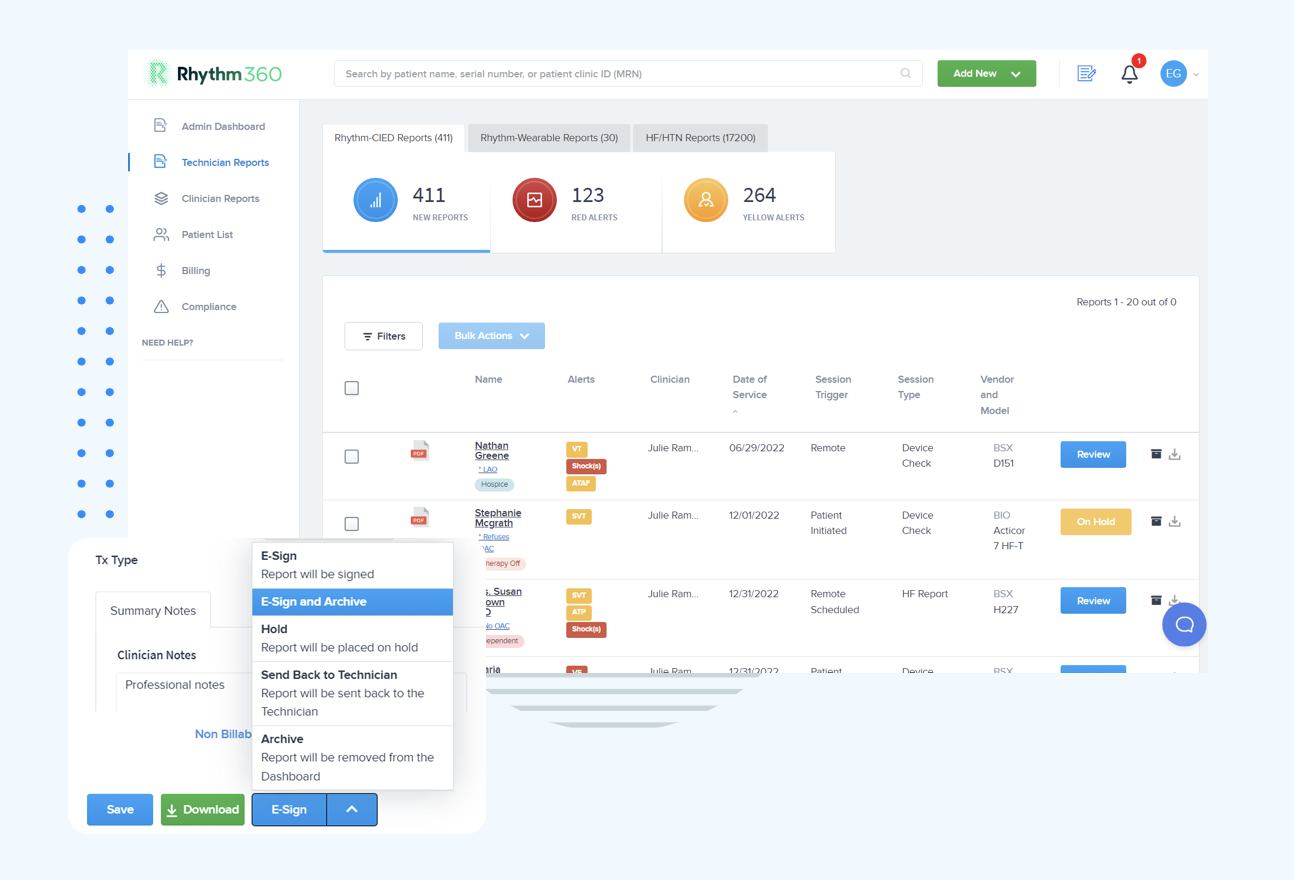
The table below summarizes Rhythm360’s verified platform capabilities.
| Capability | Rhythm360 Specification | Clinical / Operational Benefit |
|---|---|---|
| Data Reliability | >99.9% transmissibility via redundant data feeds, computer vision, and AI-powered extrapolation | Prevents missed transmissions during OEM server outages |
| Critical-Alert Response Time | Up to 80% reduction in response time | Enables earlier intervention for arrhythmias, device malfunctions, and HF decompensation |
| Revenue Impact | Up to 300% revenue uplift through optimized CPT capture | Recovers billing previously lost to incomplete documentation |
| EHR Integration | Bi-directional integration with Epic, Cerner, Athenahealth, eClinicalWorks, Greenway Health, and others via HL7 | Removes manual data entry, with clinical notes filing automatically |
| AI Alert Triage | AI-powered prioritization filters non-actionable alerts, with optional 24/7 CCT oversight | Reduces alert fatigue while maintaining sensitivity for critical events |
| Mobile Access | HIPAA-compliant mobile app for transmission review, report signing, and care coordination | Lets on-call clinicians act from any location |
| Device Coverage | Vendor-neutral: Medtronic, Boston Scientific, Abbott, Biotronik, and others including CardioMEMS | Provides a single dashboard for the entire implanted device population |
| Annual Report Volume (UCM) | 73,000+ reports annually, averaging 18,000+ per quarter at University of Chicago Medicine | Shows proven reliability at enterprise scale |
See how this consolidation works in your practice—schedule a demo
Practices without a unified platform experience predictable, compounding inefficiencies. Clinical staff spend a large share of administrative time on work created solely by disconnected systems, including manual data entry and faxing records. These issues show up in several specific ways.
Each of the six pain points above stems from fragmented data and manual processes. A modern integrated heart failure management platform must replace those gaps with specific, measurable capabilities. Rhythm360 organizes these capabilities into five connected functional areas.
Rhythm360 turns remote monitoring into a repeatable workflow that limits manual work at every step.
Rhythm360 supports bi-directional integration with Epic, Cerner, Athenahealth, eClinicalWorks, Greenway Health, and additional systems via HL7 standards. Effective bi-directional EHR integration requires automatic transmission of device readings to patient charts, bidirectional demographic synchronization, clinical alert routing, and documentation templates for RPM review. Rhythm360 meets each requirement, with data flowing inbound from the EHR, including demographics, diagnoses, and medications, and outbound from Rhythm360, including monitoring reports, alert documentation, and CPT-supporting records.
On the device side, Rhythm360 connects to all major CIED manufacturers, including Medtronic, Boston Scientific, Abbott, Biotronik, and others, along with specialized sensors such as CardioMEMS pulmonary artery monitors. The full implementation process, which covers EHR integration configuration and staff training, usually takes a few days to a few weeks. Practices can begin enrolling monitored patients quickly without assigning dedicated internal IT resources.
The 2026 Medicare Physician Fee Schedule added two new RPM codes and a 2.5% payment increase, which expands billing options for heart failure monitoring programs. The current code set for HF and CIED monitoring includes the following.
CMS permits concurrent billing of RPM with Chronic Care Management, Principal Care Management, Behavioral Health Integration, and Transitional Care Management when each program’s requirements are met, which creates compounding revenue opportunities for mature monitoring programs. Rhythm360’s automated documentation engine tracks time thresholds, transmission day counts, and interactive communication requirements for each code and generates the documentation needed for compliant claims.
Alert fatigue is a patient safety problem, not just an operational nuisance. High volumes of non-actionable notifications increase cognitive load and raise the chance that a critical event is missed or delayed. Score-based and machine-learning alarms lower alarm burden compared with conventional threshold alarms and deliver higher positive predictive value for clinically useful alerts.
Rhythm360 tackles alert fatigue through two complementary mechanisms. First, its AI triage engine applies intelligent prioritization to incoming transmissions and directs clinician attention to events most likely to need intervention. Next-generation remote monitoring systems replace static thresholds with AI-driven trajectory analysis and intelligent alert triage to focus human expertise on high-impact events. Second, Rhythm360 offers optional 24/7/365 oversight by certified cardiac technicians supervised by physicians, which adds a human review layer that filters non-actionable alerts before they reach the clinical team.
The clinical validity of AI-driven prediction already has strong support. In the LINK-HF trial, an AI-enabled wearable system predicted impending heart failure hospitalizations with 76–88% sensitivity and 85% specificity, showing that AI-based decompensation prediction within structured workflows can identify high-risk patients before acute events. Dr. Beaser at UCM noted that “decision support, including AI-assisted decision support, will become increasingly important as data volumes grow.”
The financial and clinical return on an integrated platform is measurable. Rhythm360 clients have achieved the response-time and revenue improvements detailed earlier, with documented outcomes that include faster critical-alert handling, higher CPT capture, and new RPM service lines for HF and HTN management.
At the University of Chicago Medicine, the platform supported the high-volume deployment described in the capabilities table, with stable dismissal rates that demonstrate scalable monitoring in an enterprise environment. Dr. Upadhyay reported, “We have improved billing and accountability for our patients after the integration.”
Population-level data supports similar gains. UMass Memorial Health’s AI-supported RPM program cut 30-day heart failure readmission rates by 50%, and a 2024 Journal of Cardiac Failure study found that Medicare HFrEF patients in a structured RPM program saw a 52% reduction in monthly costs, saving $1,076.64 per patient, largely from lower hospital and post-discharge expenses. For practices facing HRRP penalties, these readmission reductions protect Medicare revenue.
Compare these outcomes to your current monitoring volume—request a demo
Practice administrators and clinical leaders can use the following checklist when comparing integrated heart failure management platforms. Solutions such as Paceart, Murj, PaceMate, Implicity, Rhythm Management Group, and Octagos operate in this space, and each option should be measured against these criteria.
Implementation follows the timeline described earlier, typically a few days to a few weeks from contract signing to go-live. Practices do not need to assign internal IT staff to build the integration. RhythmScience manages the technical configuration, including EHR vendor approvals when needed, and provides ongoing support as the program grows.
Rhythm360 supports the full 2026 CPT code set for cardiac remote monitoring. For RPM-based heart failure monitoring, this includes new 2026 codes 99445, covering 2–15 days of device monitoring, and 99470, covering the first 10 minutes of management services, along with established codes 99453, 99454, 99457, and 99458. For CIED-specific monitoring, the platform supports codes 93294 through 93298 for pacemakers, ICDs, CRT devices, and implantable loop recorders. The documentation engine tracks transmission days, time thresholds, and interactive communication requirements for each code and generates compliant support for claims.
Rhythm360 uses an AI-powered triage engine that replaces static threshold-based alerting with trajectory analysis and intelligent prioritization. Instead of sending a notification for every threshold crossing, the system evaluates clinical context and flags events most likely to require intervention. Non-actionable alerts are filtered before they reach the clinical team, while urgent events such as new-onset atrial fibrillation, ventricular tachycardia, significant weight gain in HF patients, and device malfunctions surface immediately. Practices can also enable optional 24/7 oversight by certified cardiac technicians supervised by physicians, which adds a human review layer for after-hours and weekend coverage.
Rhythm360 is fully vendor-neutral. The platform connects to all major CIED manufacturers, including Medtronic, Boston Scientific, Abbott, Biotronik, and others, as well as specialized sensors such as CardioMEMS pulmonary artery monitors. Data flows in via API, HL7, XML, and PDF parsing through computer vision, then normalizes into a single structured format. Practices with mixed-manufacturer device populations see all patient data in one dashboard instead of logging into separate OEM portals. A redundant data feed system maintains continuity if any single OEM server experiences downtime.
Practices usually see a clear drop in administrative burden for device technicians and clinical staff. Automated data ingestion, report generation, and EHR documentation remove the manual steps that consume most technician time in fragmented workflows. The centralized dashboard reduces dependence on a single “super-user” who understands multiple OEM portals, which improves business continuity and lowers risk from staff turnover. The mobile application extends coverage without adding headcount, allowing on-call clinicians to manage urgent alerts remotely and supporting staff retention by easing burnout.
Fragmented OEM portals, manual data entry, alert fatigue, missed CPT capture, and rising HF readmission penalties now have a practical solution. An integrated, vendor-neutral heart-failure management platform with AI triage, automated billing documentation, and bi-directional EHR integration addresses each of these challenges in one system. Rhythm360 delivers greater than 99.9% data transmissibility, an 80% reduction in critical-alert response times, and up to 300% revenue uplift, with outcomes validated at enterprise scale at the University of Chicago Medicine and across diverse cardiology practices. The 2026 CPT code expansion, including new codes 99445 and 99470, adds further billing opportunities that automated documentation makes consistently achievable. For practices ready to move from fragmented workflows to a unified, scalable monitoring program, the operational and financial case is straightforward.
Evaluate Rhythm360 against your practice’s requirements—get started