Talk To A Rhythm360 Specialist
The costs of compliance drop-off compound quickly. Months with fewer than 16 transmission days cannot be billed under CPT 99454, which converts enrolled patients into unbillable overhead. Missed transmissions obscure decompensation signals that, caught early, would have triggered an outpatient intervention instead of a hospitalization. Staff hours shift from clinical action to data retrieval. The medical director’s question about whether the program is worth it becomes harder to answer.
The core thesis of an effective compliance strategy is that compliance is a program-design outcome. Patient motivation reflects that design and often signals underlying workflow problems. Every ranking competitor frames non-compliance as a patient education gap. That framing misidentifies the cause and therefore prescribes the wrong fix.
A 2026 retrospective cohort study by Nieuwenhuys et al., published in JMIR Formative Research, found that lower adherence in remote monitoring programs often stems from program design and patient burden rather than lack of patient motivation, and recommends embedding remote patient management into existing workflows with standardized alert responses to improve integration and efficiency.
A 2026 JMIR meta-synthesis by Zhang et al. analyzing 23 studies involving 424 patients with chronic heart failure found that for heart failure telemonitoring, barriers are often device stability, data transmission reliability, timeliness of feedback, and technical support, rather than interface complexity alone.
Treating compliance as a design problem produces measurable operational benefits. Programs gain predictable transmission rates, defensible billing documentation, earlier clinical intervention, and staff time redirected from chasing data to acting on it.
An 80–85% compliance rate is frequently cited as a benchmark for heart failure RPM programs. Treat that range as a diagnostic tool. It shows whether core design levers support sustained transmission or quietly undermine it.
Four design characteristics separate the top of the range from the bottom: cellular-connected devices matched to patient capability, structured onboarding with caregiver involvement, responsive escalation workflows, and closed-loop feedback that patients can perceive. Programs that sit at the low end often rely on Bluetooth devices for patients without smartphones, compress onboarding into a rushed single visit, leave alert queues without an owner, and never show patients that their data triggered action.
The 2022 AHA/ACC/HFSA Guideline for the Management of Heart Failure serves as the clinical authority anchor for monitoring parameters and intervention thresholds. The AHA daily weight-gain thresholds (heart.org), 2–3 lb in a day or 5 lb in a week, define the standard alert trigger for fluid retention. Clinician-set thresholds take precedence in individual patient care plans.
A compliant program captures and documents eight parameters, but only one, body weight, has a nationally standardized default threshold. The rest depend on clinician-set limits, which makes the documentation column as important as the parameter column.
| Parameter | Frequency | Alert Threshold (Default) | Documentation Requirement |
|---|---|---|---|
| Body weight | Daily | +2–3 lb/day or +5 lb/week (AHA) | Transmission log; clinician review notation |
| Blood pressure / heart rate | Daily | Clinician-set per patient plan | Transmission log; escalation if threshold met |
| SpO2 | Daily | Clinician-set per patient plan | Transmission log; escalation if threshold met |
| Symptom questionnaire | Daily | Any new or worsening symptom | Logged response; nurse review notation |
| Medications | Daily self-report | Missed dose per protocol | Self-report log; care plan notation |
| Sodium / fluid intake | Daily self-report | Clinician-set dietary limits | Self-report log |
| Scheduled appointments / labs | Per care plan | Missed appointment or lab | Outreach log; rescheduling notation |
| Escalation response | Per alert | Day 1 / Day 3 / Day 7 non-transmission | Full audit trail per patient record |
Barriers to sustained compliance rank by operational impact. Each barrier has a corresponding workflow fix that belongs in the program blueprint.
Device selection is the single most upstream compliance lever in an HF RPM program. The wrong device for a given patient creates a structural transmission gap that no amount of outreach can reliably close.
The AzHeC Technology Council reports that cellular-connected RPM devices tend to show higher and more consistent transmission compliance among less tech-comfortable patients because they eliminate pairing, app use, and any dependency on the patient owning or maintaining a compatible smartphone. These devices typically cost more per unit and carry an ongoing data subscription fee.
HealthArc’s August 2026 analysis quantifies the friction difference. A cellular blood pressure cuff requires one patient action between measurement and transmission. A Bluetooth cuff requires six or seven ongoing obligations. The patient must keep the cuff charged, keep the phone nearby and charged, keep Bluetooth on, maintain a working pairing, stay logged into the app, keep permissions and background refresh enabled, and notice when readings stop syncing. Widely circulated compliance figures of roughly 89% for cellular versus 60–75% for Bluetooth trace back to vendor blog posts with no published methodology and should be treated as marketing rather than clinical evidence.
Pew Research Center’s Mobile Fact Sheet, based on a survey of 5,022 US adults fielded February 5 to June 18, 2025, found smartphone ownership at 78% among adults 65 and older. Roughly one in five older HF patients therefore lacks the device that Bluetooth compliance depends on entirely.
Rhythm360 addresses the device-agnostic layer of this problem directly. As a vendor-neutral platform, it unifies all implantable and wearable cardiac device data from Medtronic, Boston Scientific, Abbott, Biotronik, and others via API, HL7, XML, and PDF parsing with computer vision. Redundant data feeds deliver greater than 99.9% transmissibility. Other platforms exist in this space. Rhythm360’s architecture ensures that regardless of which connectivity type a patient uses, the data arrives, is normalized, and is actionable in a single dashboard. Reliable data only helps if someone acts on it, which makes escalation design the next critical lever.
An escalation framework assigns named roles and defined response windows to every non-transmission event. Without this structure, alerts accumulate and nobody owns the follow-up.
A functional day-based escalation structure operates as follows:
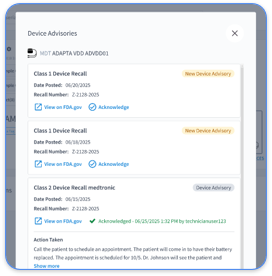
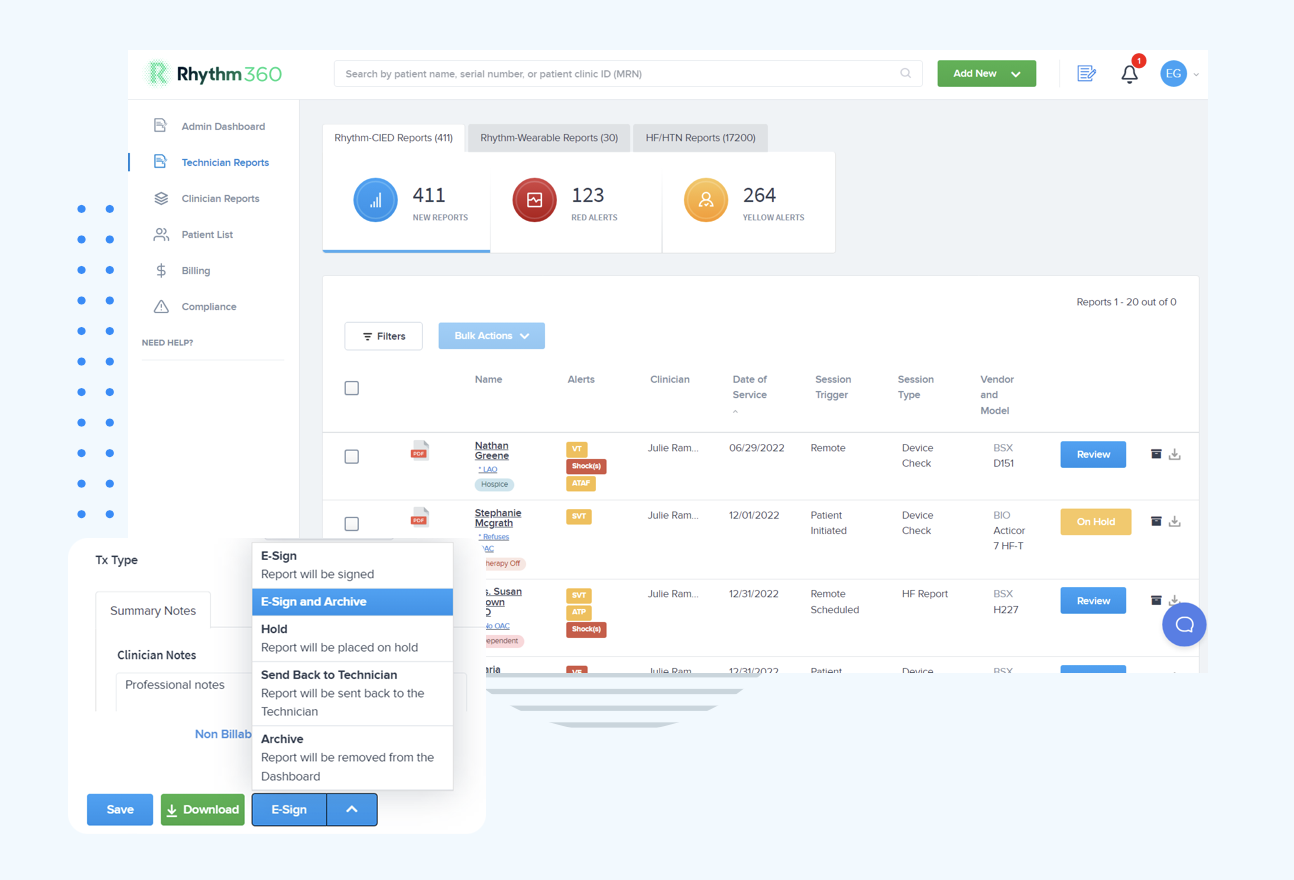
Rhythm360’s integrated communication hub automates the Day 1 messaging via Twilio and logs all subsequent manual outreach, including phone calls, messages, and care plan updates, within the patient record. This creates a complete audit trail that supports both clinical continuity and billing documentation. AI-powered alert triage filters non-actionable noise so that the escalation queue contains only events that warrant staff attention. For programs requiring continuous coverage, optional 24/7/365 oversight by certified cardiac technicians (CCTs) supervised by physicians is available.
The 2026 Nieuwenhuys et al. study found that centralizing RPM with e-nurses as a first filter for alerts could allow specialized nurses to focus on more complex cases, a model that maps directly onto Rhythm360’s tiered escalation architecture.
Automate Your Escalation Workflow
Onboarding is where compliance is won or lost. Programs that treat it as a one-time administrative step, a device handoff and a pamphlet, see the steepest drop-off curves after week three. Programs that treat it as a structured clinical process with caregiver involvement sustain higher transmission rates at month six.
The 2026 Nieuwenhuys et al. study found that time spent on RPM consultations was largely driven by the onboarding process, with the first RPM consultation ranging from 60 to 120 minutes. Home-based onboarding was deemed unsustainable for broader implementation, which led the hospital to shift onboarding to the clinical setting.
Esser et al. (J Med Internet Res, 2026) state that caregiver involvement becomes a key operational component of remote monitoring workflows when frailty or cognitive decline limits direct self-management. Remote monitoring then functions as a coordinated clinical process in which caregivers and nursing teams play central roles.
The Japanese Heart Rhythm Society Expert Consensus Statement on Remote Monitoring of Cardiac Implantable Electronic Devices (Journal of Arrhythmia, Volume 42, Issue 5, e70437, September 2026) recommends that when remote monitoring is initiated, clinicians explain the system to patients, their families, and caregivers.
Rhythm360’s HF/HTN RPM service line includes a structured patient onboarding checklist that covers:
Onboarding implementation, including EHR integration, typically takes a few days to a few weeks. Once patients are transmitting, the next compliance lever is documentation, because undocumented compliance is unbillable compliance.
Undocumented compliance is unbillable compliance. A patient who transmits data every day but whose outreach interactions are not logged produces a record that cannot survive audit.
CMS requires that the internet-connected device collect and transmit health data at least 2 days every 30 days for the service to qualify, and Medicare pays for each of the three main RPM components separately. Setup and education use CPT 99453. Device supply and transmission use CPT 99454, which requires 16 or more days of transmission per 30-day period. Treatment management uses CPT 99457 for the first 20 minutes and CPT 99458 for each additional 20 minutes.
PositiveCheck’s 2026 CMS Care Program Billing Guide states that at audit, missing documentation is treated the same as services not rendered. Documentation of eligibility confirmation, time tracking, and patient engagement functions as a billing-eligibility requirement. Treat it as a clinical obligation, because at audit it is treated as one.
For CIED monitoring, correct CPT code application matters equally. Pacemakers and ICDs operate on a 90-day cycle: 93294 (pacemaker professional), 93295 (ICD professional), and 93296 (pacemaker/ICD technical). Physiologic monitors and loop recorders operate on a 30-day cycle: 93297 is the implantable cardiovascular physiologic monitor code, such as CardioMEMS, and 93298 is the subcutaneous cardiac rhythm monitor or implantable loop recorder code. Each is billable once per 30 days and can be billed global, -26, or -TC. These are device-specific codes, not a professional and technical pair.
Rhythm360 automates CPT code capture and generates compliant documentation, which helps practices improve billing and revenue outcomes.
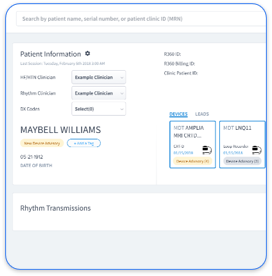
Rhythm360 is a vendor-neutral, HIPAA-compliant platform that consolidates all CIED and RPM data into a single dashboard. It integrates bi-directionally with Epic, Cerner, Athenahealth, eClinicalWorks, Greenway Health, and others via HL7. Redundant data feeds, computer vision, and AI-powered data normalization deliver greater than 99.9% transmissibility.
The platform’s compliance-specific capabilities include:
University of Chicago Medicine reviewed more than 73,000 reports annually through Rhythm360 in calendar year 2025, averaging more than 18,000 reports per quarter. Dr. Upadhyay stated, “We have improved billing and accountability for our patients after the integration.”
Practices implementing Rhythm360 have achieved up to a 300% increase in revenue capture and profitability through improved CPT code billing and better staff efficiency.
Explore The Compliance Dashboard
Organizations evaluating an HF RPM compliance platform should assess several operational dimensions before committing.
As discussed in the compliance-rate section, 80–85% is the commonly cited benchmark for heart failure RPM programs. The design characteristics that separate top-performing programs, including device choice, onboarding, escalation, and feedback, are detailed earlier in this article. The compliance rate a program achieves reflects those design decisions more than patient motivation.
Improving compliance requires addressing four program-design levers in sequence so each one supports the next. Start with device connectivity, because the wrong device creates a structural transmission gap that no amount of onboarding can close. Match the device type to the patient’s technical capability at enrollment, defaulting to cellular for patients who do not reliably use a smartphone.
Onboarding comes next, and it only works if it confirms comprehension. Follow the structured checklist outlined earlier, including device setup, teach-back, caregiver role assignment, and a first-week check-in. Then define the escalation workflow. Assign named roles and response windows to non-transmission events at Day 1, Day 3, and Day 7, with automated messaging for Day 1 and personal outreach for Day 3 and beyond. Finally, build documentation discipline. Log every outreach interaction in the patient record with date, duration, content, and staff identifier so the compliance record supports both clinical continuity and CPT billing eligibility.
The standard daily monitoring parameters for heart failure patients are body weight, blood pressure and heart rate, oxygen saturation, and a symptom questionnaire covering dyspnea, peripheral edema, fatigue, and orthopnea. The AHA defines the default weight-gain alert thresholds as 2–3 lb in a single day or 5 lb in a week, while clinician-set thresholds take precedence in individual care plans. The 2022 AHA/ACC/HFSA Guideline for the Management of Heart Failure serves as the clinical authority anchor for these parameters. Programs should also capture medication adherence self-report, sodium and fluid intake, and scheduled appointment and lab adherence as part of a complete monitoring record.
The Day 1, Day 3, and Day 7 escalation framework is detailed in the escalation section above. In short, an automated message goes out on Day 1, personal outreach occurs on Day 3, and a clinician decision occurs on Day 7, with every interaction logged. This structure ensures that every non-transmission event has an owner and a documented response window.
Compliance documentation functions as a billing-eligibility requirement. As noted earlier, CPT 99454 requires at least 16 transmission days in a 30-day period, and months below that threshold cannot be billed under the code. CPT 99457 requires interactive communication with the patient or caregiver during the calendar month, and the content and duration of that communication must be documented. At audit, missing documentation is treated the same as services not rendered. Documentation standards for RPM require device transmission logs, interactive communication content, patient consent, cumulative monthly clinical staff time, and date, duration, content, and staff identifier for each activity.
Talk To A Compliance Specialist
Heart failure RPM compliance drops off after week three because most programs are designed to enroll patients rather than sustain them. Device selection, onboarding quality, escalation workflow, and documentation discipline determine whether a patient is still transmitting at month six and whether that transmission produces billable, clinically actionable records.
An effective compliance framework treats each lever as an operational design decision. The program team selects a device that fits each patient’s connectivity environment and technical capability. Onboarding is structured to include caregivers and confirm comprehension. Escalation ownership is defined at Day 1, Day 3, and Day 7. Every outreach interaction is logged to support both clinical continuity and CPT billing eligibility. Balancing clinical, operational, and financial considerations across all four levers separates programs that sustain 80% or higher compliance at month six from those that quietly erode.
Rhythm360 operationalizes every one of those levers in a single vendor-neutral platform by consolidating device data, automating escalation messaging, logging all outreach with a full audit trail, and generating the documentation that supports CPT billing eligibility. The University of Chicago Medicine’s experience, cited earlier, demonstrates what a well-designed compliance infrastructure produces at scale.
Start Your Compliance Redesign