Digital Tools To Improve Heart Failure Care And Outcomes
Last updated: October 7, 2026
Key Takeaways
Structured remote patient monitoring with defined clinical review workflows outperforms passive telemonitoring in reducing heart failure hospitalizations and mortality.
Implantable pulmonary artery pressure monitoring (CardioMEMS, Cordella) has the strongest evidence for reducing HF hospitalizations and improving quality of life in NYHA class II–III patients.
Bluetooth-enabled home devices (scales, BP cuffs) only improve outcomes when paired with automated data review, threshold-based alerts, and timely clinician intervention.
Smartphone apps and AI risk prediction tools work best as supplementary layers in mature programs after validation and workflow integration.
Rhythm360 provides a vendor-neutral, AI-powered platform that runs the closed-loop care pathway at scale for heart failure programs.
Evidence Strength Across Heart Failure Digital Tools
The evidence base is tiered. A few tools have randomized-trial support for hard outcomes, while others remain promising but unproven. The ranking below orders them from strongest to most nascent so you can see where to invest first.
Structured Remote Patient Monitoring (RPM): Structured remote patient monitoring reduces all-cause mortality in heart failure patients in aggregate. The benefit comes primarily from structured telephone support. Other modalities such as telemonitoring and implantable device monitoring show less consistent or statistically nonsignificant mortality reductions. A 2026 European consensus paper published in Cardiac Failure Review confirms that digital health tools only improve outcomes when programs integrate them into routine care workflows.
Implantable Pulmonary Artery Pressure Monitoring (e.g., CardioMEMS):The pivotal CHAMPION randomized controlled trial reported a statistically significant 28% decrease in heart failure-related hospitalizations in patients implanted with CardioMEMS compared with usual care. A patient-level meta-analysis of implantable hemodynamic monitoring revealed a significant 25% decrease in mortality in patients with heart failure with reduced ejection fraction. A separate pooled meta-analysis found no difference in mortality between hemodynamic monitoring and control groups. The MONITOR-HF trial showed hemodynamic monitoring significantly improved quality of life on the Kansas City Cardiomyopathy Questionnaire and reduced HF hospitalizations. The GUIDE-HF trial showed a statistically significant 19% reduction in its primary endpoint for patients who completed follow-up before the March 2020 public health emergency declaration. That result was driven by a 28% reduction in HF hospitalization. The PROACTIVE-HF trial evaluating the Cordella System met its primary endpoint with a 6-month event rate of 0.15 events per patient, significantly lower than the prespecified benchmark of 0.43. The 2025 Heart Failure Association of the ESC consensus statement endorses PA pressure-guided management as a tool to prevent hospitalizations, with a high strength of evidence based on RCT data. The 2022 AHA/ACC/HFSA guideline assigns a Class 2b recommendation for wireless PA pressure monitoring in selected NYHA class III patients on maximally tolerated guideline-directed medical therapy.
Bluetooth-Enabled Home Monitoring (Scales, BP Cuffs, Symptom Tracking): These devices form the data-capture layer of a structured RPM pathway and are supported by CPT codes 99453, 99454, and 99457 for HF/HTN management. Their value depends on the workflow that reviews and acts on the data.
Smartphone Apps and AI Risk Prediction:A 2025 ESC-linked consensus statement on digital biomarkers positions smartphone apps and other digital health interventions for heart failure as promising but less mature than established implantable hemodynamic monitoring strategies. Engagement limitations and null primary outcomes in trials such as APPLIMONCOEUR support this tiering.
Structured RPM vs. Passive Telemonitoring: Why Outcomes Differ
The 2026 Cardiac Failure Review consensus paper by Vitale et al. emphasizes that digital health tools only work when programs embed them in routine care workflows. In high-risk heart failure populations, non-invasive telemonitoring that transmits data without a structured, protocol-driven clinical response loop fails to match the reductions in all-cause hospitalization or mortality seen with structured remote patient management.
Structured RPM in practice follows four sequential steps:
Patient measurement via a connected device
Algorithm or clinical review of the transmitted data
Early intervention triggered by defined thresholds
Feedback to the patient closing the loop
This four-step sequence forms the conceptual foundation of the closed-loop care pathway. Programs that skip steps convert data streams into noise instead of clinical signals.
Implantable Pulmonary Artery Pressure Monitoring: Ideal Candidates And Program Role
The FDA-expanded U.S. indication for CardioMEMS includes NYHA class II–III heart failure patients, particularly those with a prior heart failure hospitalization or elevated natriuretic peptides, covering both HFrEF and HFpEF populations.
The 2025 ESC Heart Failure Association consensus statement defines the ideal candidate as an individual with symptomatic heart failure, regardless of left ventricular ejection fraction, classified as NYHA class II or III, with at least one heart failure-related hospitalization or urgent care visit in the past year or elevated natriuretic peptide levels, who does not have end-stage heart failure or significant primary lung disease.
CardioMEMS functions as the hemodynamic data layer within a broader HF program. PA pressure readings enable early detection of congestion before symptoms manifest. Clinicians can then adjust diuretics, vasodilators, or other guideline-directed medical therapy. The Cordella PA Sensor System received FDA approval in 2024 for NYHA Class III patients at home on diuretics and guideline-directed medical therapy, expanding the implantable hemodynamic monitoring landscape beyond a single device.
Heart Failure Mobile Apps: Current Limits And Best Uses
Implantable monitors are not the only digital layer in play. Smartphone apps promise broader reach at lower cost, but the trial record is far less encouraging. The APPLIMONCOEUR trial evaluated a smartphone application for heart failure self-management and did not meet its primary outcome, illustrating the engagement problem that limits this category. A 2026 qualitative systematic review and meta-synthesis in the Journal of Medical Internet Research synthesizing 23 studies across 424 chronic heart failure patients found that engagement with digital interventions varies widely. Implementation burden, technological usability issues, and long-term sustainability constraints limit real-world uptake.
Smartphone apps and AI prediction tools work best as supplementary layers in a mature program rather than as the primary intervention.
Heart Failure Monitoring At Home: What Works In Daily Practice
Home monitoring devices, including Bluetooth-connected scales, blood pressure cuffs, and patient-reported symptom tracking tools, create the data-capture layer of a structured RPM pathway. The 2026 Cardiac Failure Review consensus paper recommends that regular volume assessment and weight monitoring be promoted in heart failure patients, noting that both inappropriate weight gain and weight loss can signal clinical deterioration.
Bluetooth devices only help when their data flows into a monitored platform with a defined review workflow and escalation protocol. Without that workflow, such as when data lands in a portal no one checks on schedule or when patient-reported data lacks a feedback mechanism, the same device produces no clinical benefit. The workflow built around the device is what changes outcomes.
Building The Care Pathway: Turning Data Into Action
The closed-loop care pathway described above expands into five operational stages:
Patient measures and transmits data via implantable device, Bluetooth peripheral, or app
Digital measurement is ingested and normalized by the monitoring platform
Algorithm or clinical review triages the data against defined thresholds
Early intervention is triggered by a clinician or care team member
Feedback is communicated to the patient, closing the loop
Specific escalation protocols within this pathway include:
New-onset AFib: Immediate clinician notification; assess stroke risk and initiate anticoagulation protocol if indicated.
Ventricular tachycardia: Urgent review; determine whether therapy was delivered and whether in-person evaluation is required.
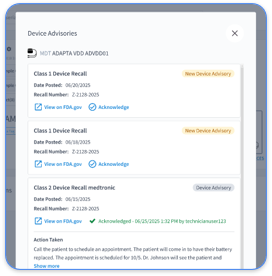
Low battery indicators (ERI/RRT): Schedule device replacement within the manufacturer-specified window; document in the EHR.
Significant weight gain in HF patients: Trigger nurse outreach within 24 hours; assess for fluid retention and adjust diuretic regimen per protocol.
Introducing Rhythm360: Platform For An Executable Closed-Loop Pathway
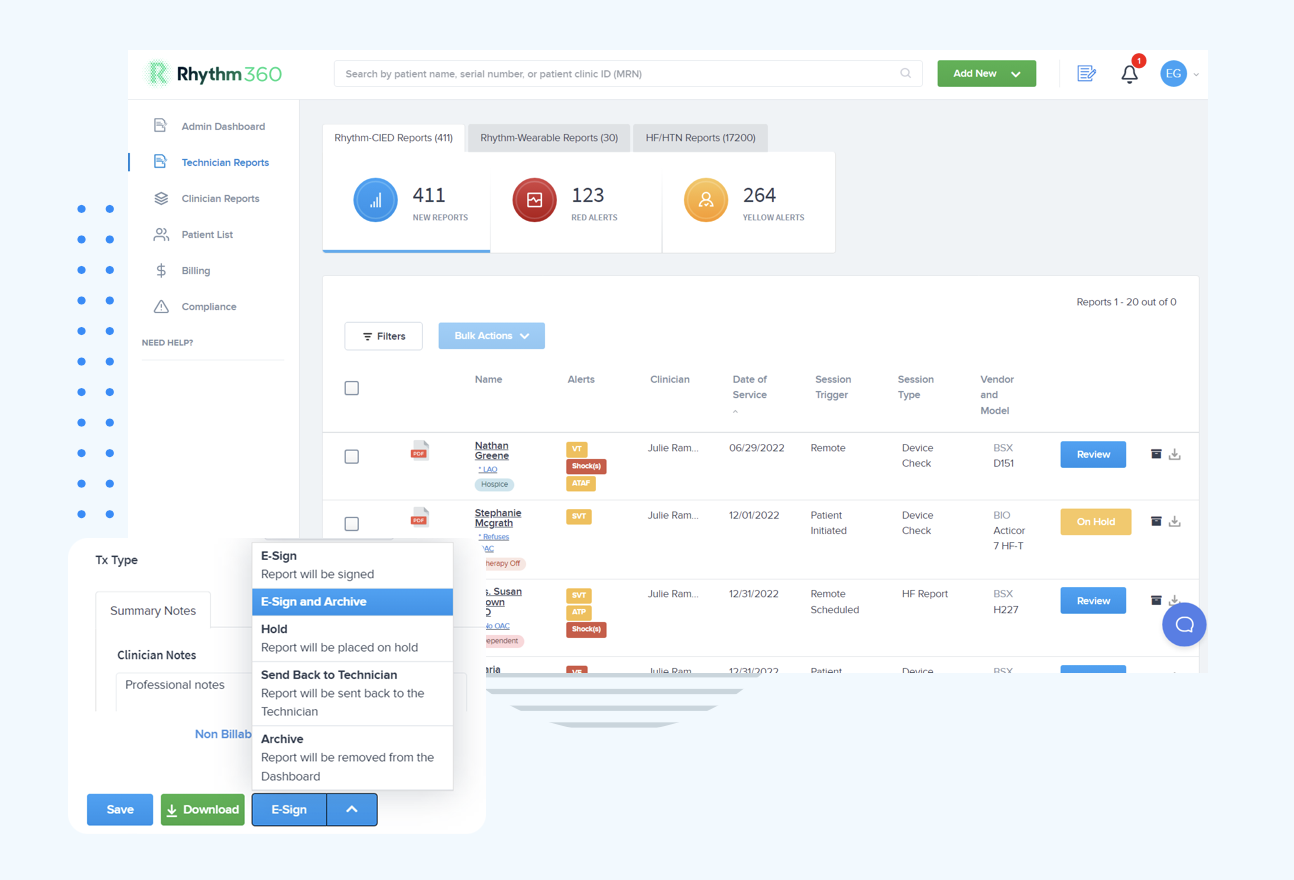
Rhythm360 is a vendor-neutral, HIPAA-compliant, cloud-based platform built to make the closed-loop care pathway executable at scale. Its core capabilities include:
Rhythm360
Vendor-neutral data integration across Medtronic, Boston Scientific, Abbott, and Biotronik, eliminating the need for multiple OEM portal logins.
AI-powered alert triage that filters non-actionable noise and prioritizes clinically significant events, reducing critical alert response times by up to 80%.
Bi-directional EHR integration with Epic, Cerner, Athenahealth, eClinicalWorks, and Greenway Health.
Automated CPT code capture and documentation to prevent revenue leakage from unbilled events.
Secure mobile app for on-call clinician review of transmissions, report signing, and care coordination from any location.
Rhythm360 is one of several platforms in this space; the sections above describe the capabilities a heart failure program should look for regardless of vendor. As data volumes grow, decision support becomes the deciding factor in whether a program scales. Rhythm360’s AI-powered alert triage is built for that shift.
Operational Requirements For A Heart Failure Remote Monitoring Program
The unglamorous operational decisions determine whether a program succeeds or fails. Four areas require deliberate design:
Vendor-Neutral Data Integration: Each major cardiac device manufacturer operates its own proprietary remote monitoring network, including Medtronic CareLink, Boston Scientific LATITUDE, Abbott Merlin.net, and Biotronik Home Monitoring. Clinics with mixed device populations must otherwise log into multiple portals, each with its own interface, alert logic, and report format. A vendor-neutral aggregation layer is a prerequisite for a scalable program.
Alert Triage: A 2023 study published in Pacing and Clinical Electrophysiology found that most CIED alerts (73%) and scheduled transmissions (90%) were nonactionable, with only 7% of alerts leading to in-office follow-up. AI triage that filters non-actionable transmissions before human review is the mechanism that prevents alert fatigue from degrading program performance.
Staff Workflow Design: High transmission volume is consistently cited as one of the leading drivers of turnover in device clinic staff. Workflow design must account for role-based task assignment, escalation pathways, and documentation requirements to prevent burnout and maintain program continuity.
How To Build A Heart Failure Digital Program: A Practical Sequence
A phased implementation approach reduces risk and builds institutional competency progressively:
Phase 1 — Structured RPM and Bluetooth Monitoring: Deploy connected scales, blood pressure cuffs, and symptom tracking with a defined clinical review workflow and escalation protocol. Capture 99453, 99454, and 99457.
Phase 2 — Risk Stratification: Layer in device data from CIEDs and, where indicated, implantable hemodynamic monitors. Establish threshold-based alert triage and assign clinical ownership of each alert category.
Phase 3 — Nurse Intervention Pathways: Formalize nurse-led outreach protocols for weight gain, missed transmissions, and hemodynamic changes. Document all interactions for billing and audit purposes.
Phase 4 — AI Prediction: As the program matures and data volume grows, introduce AI-assisted risk stratification to identify patients at elevated risk of decompensation before symptoms emerge.
Common Mistakes That Derail Heart Failure Digital Programs
Program Pitfalls To Avoid
Passive telemonitoring without structured review: Transmitting data to a portal without a defined clinical review schedule and escalation protocol produces no outcome benefit.
Ignoring alert fatigue: Without AI triage, high transmission volumes overwhelm staff, leading to missed critical events and clinician burnout.
Failing to capture billable events: Orphaned management minutes (99457 never billed), the 16-day data threshold for 99454, and device-type mismatches on 93297/93298 are the most common revenue-leak patterns.
Managing multiple non-interoperable OEM portals manually: Without a vendor-neutral aggregation layer, staff spend hours logging into separate systems, increasing error risk and administrative burden.
Measurable Success Criteria: What “Done Right” Looks Like
A well-executed heart failure digital program produces measurable results across four dimensions:
Reduced critical alert response times: Rhythm360 clients have achieved the 80% response-time reduction noted above for critical patient alerts.
Improved patient compliance: Automated outreach through a remote monitoring platform’s integrated communication hub reduces missed transmissions and disconnected devices by automatically notifying the medical team and sending SMS messages to patients when a disconnection occurs.
Captured billable events: Automated CPT code tracking prevents the revenue leakage that results from manual, error-prone billing workflows, supporting the revenue-capture increase noted earlier.
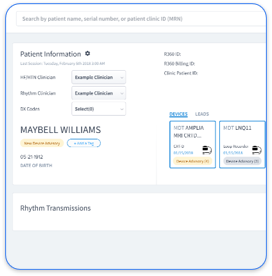
Unified device population view: A single dashboard covering all OEM devices eliminates data silos and provides a real-time population health overview.
Advanced Tips And Next Steps For Mature Programs
Programs that have completed the four-phase implementation sequence can extend their capabilities further:
Add HF/HTN RPM service lines: Rhythm360’s turnkey RPM service line for heart failure and hypertension enables practices to generate new, recurring revenue streams with minimal logistical overhead, supported by automated billing for 99453, 99454, and 99457.
Use optional 24/7/365 oversight by certified cardiac technicians (CCTs): CCTs supervised by physicians provide continuous triage coverage, ensuring critical events are reviewed and escalated even outside business hours.
Use the integrated communication hub for patient follow-up: The Twilio-powered messaging framework logs all patient communications, including automated reminders, manual calls, and follow-up messages, with a full audit trail, reducing redundant outreach and supporting documentation requirements.
Frequently Asked Questions
What Is The Difference Between Structured RPM And Passive Telemonitoring For Heart Failure?
Structured RPM involves four defined steps: patient measurement, algorithm or clinical review of the transmitted data, early intervention triggered by defined thresholds, and feedback to the patient. Passive telemonitoring transmits data to a portal without a guaranteed clinical review workflow or escalation protocol. The outcome evidence favors structured RPM because the clinical response is what reduces hospitalizations, not the transmission of data. Programs built on passive telemonitoring generate data without reliably converting it into action, which makes the distinction clinically and operationally decisive. Rhythm360 is designed to support structured RPM by automating data ingestion, triaging alerts, and documenting clinical responses within a single platform.
Which Heart Failure Patients Qualify For Implantable Pulmonary Artery Pressure Monitoring?
The 2025 Heart Failure Association of the ESC consensus statement defines the ideal candidate as a patient with symptomatic heart failure, regardless of ejection fraction, classified as NYHA class II or III, with at least one heart failure-related hospitalization or urgent care visit in the past year or elevated natriuretic peptide levels, who does not have end-stage heart failure or significant primary lung disease. The FDA-expanded U.S. indication for CardioMEMS covers NYHA class II–III patients with a prior HF hospitalization or elevated natriuretic peptides, including both HFrEF and HFpEF populations. The 2022 AHA/ACC/HFSA guideline specifies that candidates should already be on maximally tolerated guideline-directed medical therapy with optimal device therapy. Rhythm360 supports CardioMEMS data integration alongside all major CIED manufacturers, enabling a unified view of hemodynamic and rhythm data within a single platform.
How Do You Reduce Alert Fatigue In A Heart Failure Remote Monitoring Program?
Alert fatigue results from high volumes of non-actionable transmissions overwhelming clinical staff. Research shows that the majority of CIED alerts and scheduled transmissions are nonactionable, meaning that without triage, clinicians spend most of their review time on data that requires no intervention. AI-powered first-read triage that filters non-actionable transmissions before human review produces a shorter, higher-quality queue of clinically significant events. Rhythm360’s AI alert triage system applies this approach, supporting the 80% reduction in critical alert response times noted above. Optional 24/7/365 oversight by certified cardiac technicians provides an additional human review layer, ensuring that events flagged by the AI are validated before escalation.
What CPT Codes Apply To Heart Failure Remote Monitoring?
Heart failure remote monitoring programs draw on two code families. For HF/HTN RPM using Bluetooth-connected peripherals, 99453 covers setup and patient education (billed once per episode of care), 99454 covers device supply with daily recordings per 30-day period, and 99457 covers the first 20 minutes of RPM treatment management per calendar month. For implantable device monitoring, 93297 covers implantable cardiovascular physiologic monitors such as CardioMEMS (30-day cycle, billable global, -26, or -TC), and 93298 covers subcutaneous cardiac rhythm monitors and implantable loop recorders (30-day cycle, billable global, -26, or -TC). Codes 93294 and 93295 are the professional codes for pacemaker and ICD monitoring respectively on a 90-day cycle, and 93296 is the technical code for pacemaker/ICD monitoring. Rhythm360 automates CPT code tracking and documentation, matching device type to the correct code and preventing the device-type mismatches and orphaned billing events that cause revenue leakage.
How Long Does It Take To Implement A Vendor-Neutral Heart Failure Monitoring Platform?
Rhythm360’s implementation process, including EHR integration with systems such as Epic, Cerner, Athenahealth, eClinicalWorks, and Greenway Health, typically takes from a few days to a few weeks depending on the complexity of the existing device population and EHR environment. The platform’s SaaS-based pricing model scales based on clinic size and usage, avoiding high setup fees and rigid pricing structures common in legacy systems. RhythmScience’s onboarding includes comprehensive implementation support, ongoing technical assistance, and clinical training, along with automated billing compliance features and patient onboarding, to support successful adoption and utilization of the Rhythm360 platform.
Conclusion: A Practical Path To An Executable Closed-Loop Care Pathway
Heart failure programs that invest in digital tools and the care pathway that processes their output can reduce hospitalizations. The evidence is clear: structured RPM and implantable hemodynamic monitoring have the strongest outcome data, and those data translate into results when embedded in a closed-loop system of patient measurement, clinical review, early intervention, and feedback executed consistently at scale.
Rhythm360 is the vendor-neutral, AI-powered platform that makes that pathway executable. From data ingestion across all major device manufacturers to AI-powered alert triage, bi-directional EHR integration, automated CPT code capture, and optional 24/7/365 CCT oversight, Rhythm360 provides every operational layer a heart failure program needs to convert data into action and action into measurable outcomes.