Last updated: July 14, 2026
Establish measurable program goals first. These include readmission reduction targets, CPT capture rates, and alert response benchmarks. Assign ownership clearly: the program director sets targets, the lead cardiologist or heart failure specialist approves clinical criteria, and the practice administrator owns revenue and compliance metrics.
Patient stratification should be risk-adaptive. A 5-year retrospective study of ICD/CRT-D patients found that certain factors were independently associated with significantly higher risks of mortality and cardiovascular events, making these patients the highest-priority enrollment candidates. For older adults, a 2026 JMIR frailty-adaptive framework proposes four monitoring trajectories: robust, prefrail, frail, or palliative. Each trajectory carries distinct monitoring objectives and workflow adaptations. This prevents a one-size-fits-all approach that drives unnecessary alerts for low-risk patients while under-serving high-risk ones.
Effective HF remote monitoring alert triage depends on pre-defined, clinically grounded thresholds applied consistently across the patient population. The green, yellow, red framework below reflects current evidence-based practice for weight scales, blood pressure monitors, and pulse oximeters.
A real-world cardiogeriatric telemonitoring program for older adults with HF used symptom questionnaires and clinical thresholds to generate alert levels, followed by nurse-led structured telephone triage and protocol-driven interventions. Frail patients received differentiated thresholds to reduce irrelevant alerts while maintaining responsiveness to genuine deterioration.
Structured multidisciplinary workflows are the single strongest predictor of program success. Specialized remote management teams for heart failure comprising nurses and cardiologists who evaluate patient status daily are associated with fewer hospitalizations and lower mortality, in contrast to simpler alert-management approaches delegated to less specialized providers that have failed to show benefit.
A functional responsibility matrix for a mid-size program includes these roles and primary accountabilities:
Atrium Health assembled a multidisciplinary team of pharmacists, nurses, navigators, and advanced practice providers who protocolize care or provide warm handoffs to primary care or other partners for remote monitoring transmissions. This structure reserves physician time for decisions that require independent clinical judgment rather than routine data processing.
The standard staffing ratio for RPM programs is one full-time clinical monitor per 150 to 250 patients, with heart failure patients classified as high-acuity and requiring more time per interaction. Three staffing models apply depending on program size.
Training a new RPM clinical monitor typically takes a few days, depending on system complexity. The most common staffing failure is delaying dedicated hiring past 30 to 50 patients. This delay causes alert response times to climb, documentation to fall behind, and CPT 99458 revenue to leak away. RNs are recommended for high-acuity HF panels because they can exercise independent clinical judgment during triage.
Heart failure programs that rely on a single OEM portal or a single data format create structural fragility. A vendor-neutral platform must ingest data from connected weight scales, blood pressure cuffs, pulse oximeters, implantable hemodynamic sensors such as CardioMEMS, and CIEDs from manufacturers including Medtronic, Boston Scientific, Abbott, and Biotronik, without requiring staff to log into separate portals for each.
Several approaches exist for moving RPM device data into EHRs, and the pathway chosen determines how resilient the program is to single-vendor outages. Rhythm360 supports all of these pathways, ingesting data via API, HL7, XML, and unstructured PDFs parsed through computer vision. This architecture achieves greater than 99.9% transmissibility through redundant data feeds and AI-powered gap-filling, so a single OEM server outage never creates a blind spot in patient monitoring.
EHR integration is the operational backbone of a compliant, billable HF remote monitoring program. Without it, clinicians manually transcribe data, documentation lags behind care delivery, and CPT codes go uncaptured. Cardiovascular service lines must build discrete fields in Epic for heart failure metrics so relevant device data lands in the clinical workflow the same way lab results do.
For Epic integrations, SMART on FHIR R4 APIs are the recommended pathway for new 2026 implementations. For Oracle Health (Cerner), HL7 v2 messaging through Cerner Open Interface remains the primary method for real-time clinical event data exchange, while FHIR R4 Ignite APIs are recommended for new projects and patient-portal-facing applications. A middleware translation layer abstracts Cerner-specific FHIR profile requirements from Epic profile requirements, allowing a single internal API for multi-EHR deployments.
Rhythm360's bi-directional EHR integration with Epic, Cerner, Athenahealth, eClinicalWorks, Greenway Health, and others via HL7 typically completes onboarding in days to weeks, not months. Gaurav A. Upadhyay, MD, at the University of Chicago Medicine observed: "We have improved billing and accountability for our patients after the integration."
Clean EHR integration sets up the next challenge: turning a flood of transmissions into actionable clinical decisions. Rhythm360's AI-powered alert triage filters non-actionable transmissions and surfaces clinically significant events with priority rankings, reducing critical response times by up to 80%. The platform also offers optional 24/7/365 oversight by certified cardiac technicians supervised by physicians, a critical capability for programs that cannot staff overnight monitoring internally.
Scale matters here. UCM reviewed more than 73,000 reports annually through Rhythm360 in 2025, averaging more than 18,000 reports per quarter, with stable dismissal rates. This shows that AI-assisted triage handles growing volume without sacrificing specificity. As Andrew Beaser, MD, at the University of Chicago Medicine noted: "Decision support, including AI-assisted decision support, will become increasingly important as data volumes grow."
Digital health equity is a prerequisite for program validity, not an optional add-on. The 2026 frailty-adaptive framework positions remote monitoring as a stratified clinical process rather than a uniform technological intervention, improving relevance and reducing exclusion of patients with cognitive impairment, sensory limitations, or low digital literacy.
Use this equity-focused onboarding checklist for every enrolled patient:
Rhythm360 supports cellular-enabled device strategies and integrates patient communication via an automated Twilio-powered messaging framework, with full audit trails for all patient contacts. This ensures equity-related outreach is documented and billable where applicable.
A structured pilot phase of 30 to 60 days with 20 to 50 patients allows the team to stress-test workflows, identify documentation gaps, and calibrate alert thresholds before scaling. Track the five metrics below weekly. Each one connects directly to the goals and revenue targets set in Step 1: transmission volume drives billing eligibility, alert speed reflects clinical safety, and readmissions and revenue confirm whether the program is working.
At 300+ patients, add a non-clinical program manager to track performance metrics, manage staffing ratios, coordinate with vendors, and drive improvements in compliance and billing capture. This role exists because scaling staffing ahead of patient volume milestones, rather than reacting after the fact, requires dedicated oversight.
A mature HF remote monitoring program meets three measurable criteria at 90 days post-launch:
Remote monitoring of CIED patients reduces cardiovascular hospitalization rates and generates net savings for payers and hospitals after offsetting remote monitoring service and staffing costs. That clinical benefit translates into financial results too: practices implementing Rhythm360 have achieved up to a 300% increase in revenue through optimized CPT code capture and improved staff efficiency. The earlier response time also changes how physicians manage care. Andrew Beaser, MD, at UCM stated: "We are able to address these issues earlier; rather than waiting for a 3-month visit, we can call patients in for evaluation."
Alert fatigue and data silos share a common root cause: manual, fragmented workflows that force clinicians to process every transmission regardless of clinical significance. These pro tips address the most common failure modes.
Common mistakes to avoid:
Pro tips for sustainable alert management:
Multiple 2026 guideline bodies and evidence reviews support broad HF remote monitoring implementation. A 2026 meta-analysis published in npj Digital Medicine confirmed that remote monitoring reduces HF hospitalizations and all-cause mortality compared with standard care, with consistent benefits across age, sex, ejection fraction, NYHA class, and geographic region. Remote pulmonary artery pressure monitoring is effective for appropriately selected high-risk HF patients. NICE guidance HTG769, published February 2026, recommends the CardioMEMS HF System for routine NHS-funded remote monitoring of NYHA Class III chronic HF in adults at risk of hospitalization.
As noted in Step 4, the standard ratio is one monitor per 150 to 250 patients, adjusted upward in acuity for HF panels. Programs under 100 patients can combine roles across a supervising physician, one monitoring RN, an enrollment coordinator, and a billing specialist. Delaying dedicated hiring past 30 to 50 patients remains the most common failure point, regardless of program size. Small programs benefit most from vendor-neutral platforms since they avoid rebuilding integrations later as volume grows.
Programs that skip equity screening systematically exclude the highest-risk patients: older adults with multiple comorbidities and limited digital access who stand to benefit most from proactive remote monitoring. Watch for enrollment patterns that skew toward younger, more digitally fluent patients. That pattern signals the digital literacy and connectivity checks from Step 8 are being skipped or rushed during intake.
A successful heart failure remote monitoring program is not built on technology alone. It runs on a structured implementation framework that aligns patient stratification, tiered alert protocols, multidisciplinary staffing, vendor-neutral data ingestion, bi-directional EHR integration, AI-powered triage, equity-focused onboarding, and rigorous outcome measurement into a single operational system. The 10 steps in this playbook provide that framework, grounded in 2026 clinical evidence and real-world program data.
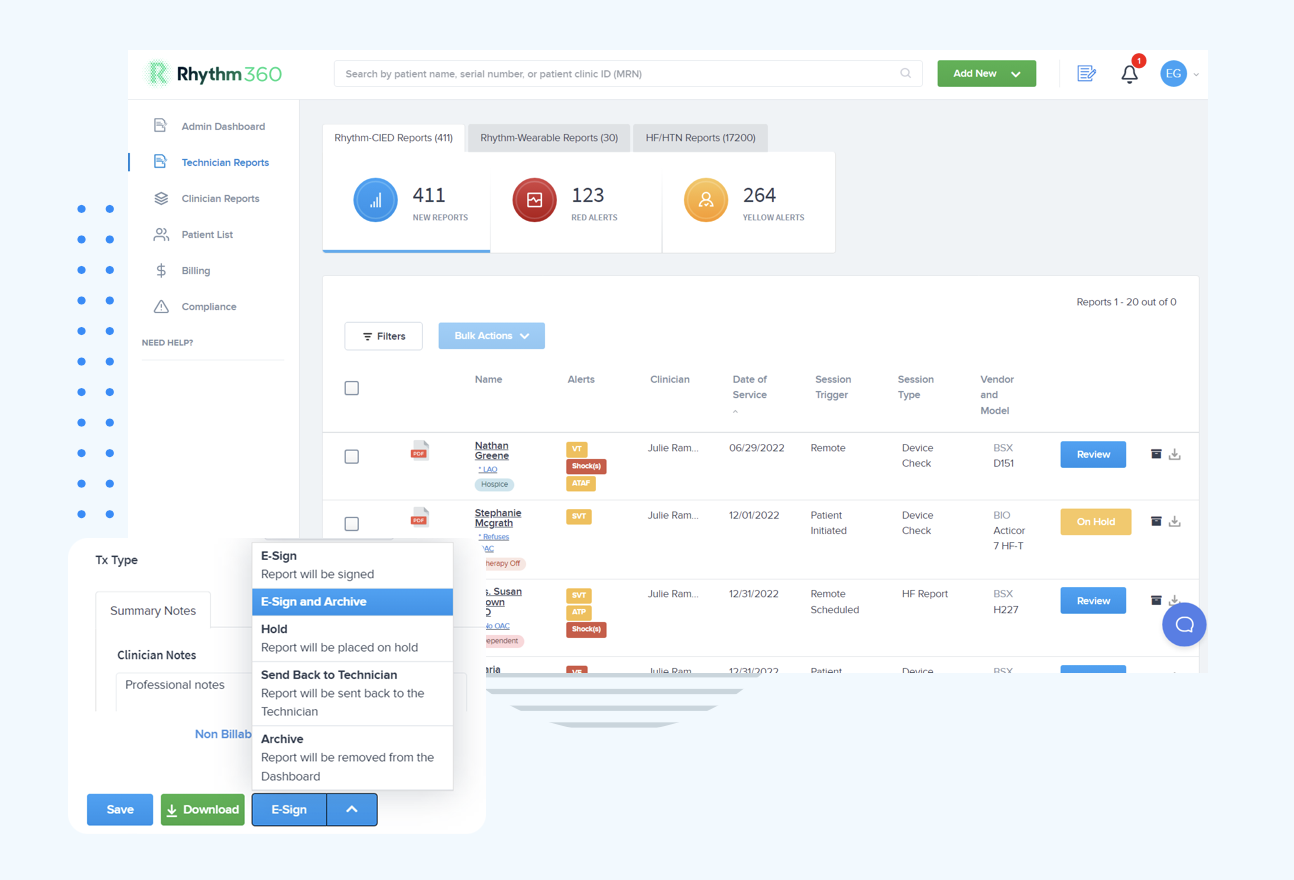
Rhythm360 is the vendor-neutral, AI-powered platform built to support every step of this playbook, from ingesting data across all major device manufacturers and EHR systems to automating alert triage, documentation, and billing compliance. Practices that have implemented Rhythm360 have seen the response-time and revenue gains outlined above translate into measurable program-wide impact.
Schedule a demo of Rhythm360 today and see how a unified platform transforms your heart failure remote monitoring program.