

Last updated: July 14, 2026
The table below lists each step's owner, timeline, and success metric. Use it as a quick reference before reading the detailed guidance for each step.
| Step | Recommended Owner | Timeline | Key Outcome Metric |
|---|---|---|---|
| 1. Define patient selection criteria | Cardiologist / EP | Week 1 | Eligible patient census established |
| 2. Standardize alert thresholds | Clinical Lead / NP | Week 1–2 | Threshold protocol document signed |
| 3. Map EHR integration requirements | IT / Practice Administrator | Week 1–2 | Bi-directional HL7 fields mapped |
| 4. Build multidisciplinary response team | Director of Cardiology Services | Week 2 | Roles and escalation matrix documented |
| 5. Onboard and educate patients | RN / Device Technician (CCT) | Week 2–3 | Consent rate ≥95%; device activation rate ≥90% |
| 6. Configure vendor-neutral data ingestion | Platform Administrator / IT | Week 2–3 | Transmissibility ≥99% |
| 7. Implement AI-powered alert triage | Clinical Lead / CCT | Week 3 | Critical alert response under 4 hours |
| 8. Automate CPT documentation | Practice Administrator / Billing | Week 3–4 | Claim denial rate under 5% |
| 9. Conduct 30-day compliance audit | Practice Administrator | Day 30 | Device compliance above 85% |
| 10. Scale and optimize | Director of Cardiology Services | Month 2+ | RPM/CIED revenue increase measurable |
Structured multiparametric heart failure remote management programs use selection criteria that include chronic HF with at least one hospitalization in the previous year, or NYHA functional class II or higher with BNP above 100 pg/mL or NT-proBNP above 1,000 pg/mL. These criteria are broader for CardioMEMS. The FDA expanded approval in February 2022 to include NYHA Class II patients, alongside the original Class III indication requiring a prior HF hospitalization within 12 months. This expansion lines up with more recent evidence. The 2026 HFSA/AAHFN scientific statement found that patients with recent hospitalizations or advanced NYHA class see the greatest monitoring benefit, which is why hospitalization history should anchor enrollment decisions.
Evidence-based HF remote monitoring protocols trigger a nurse callback within 4 hours for weight gain exceeding 2 lbs in 24 hours, require a same-day telehealth visit for weekly weight gain exceeding 5 lbs in 7 days, mandate immediate nurse contact for SpO2 below 90%, and require a nurse callback within 2 hours for systolic BP below 90 mmHg. These numbers work as starting points, not universal rules. NICE guidance warns that heart failure algorithms must not be used alone to make treatment decisions, since events other than decompensation, such as viral respiratory illness, can trigger alerts. Every alert needs review alongside other clinical information and a conversation with the patient. Thresholds should be individualized to each patient's baseline values and stratified by urgency level: Emergent, Urgent, and Routine.
Pro Tip: Document threshold rationale in the patient record at enrollment. This supports medical necessity for CPT 99457 and creates an audit trail if thresholds are later adjusted.
Common Pitfall: Applying uniform population-level thresholds without patient-specific calibration generates excessive false positives. The HeartInsight algorithm at its nominal threshold demonstrated a positive predictive value of only 7.7%, indicating a high probability of false positives.
The 2026 HFSA/AAHFN statement identifies interoperability as the foundation of integrated heart failure care, requiring seamless data flow between devices, EHRs, and clinicians. Organizations should build discrete fields in Epic for HF metrics so device data lands in the clinical workflow the same way laboratory results do. RPM EHR integration must support automatic transmission of device readings to patient charts, bidirectional demographic sync, clinical alert routing, and documentation templates that enable reliable capture of CPT codes 99453–99458.
Rhythm360 provides bi-directional EHR integration with Epic, Cerner, Athenahealth, eClinicalWorks, and Greenway Health via HL7, with onboarding typically completed in days to weeks. Its vendor-neutral ingestion engine normalizes data from Medtronic, Boston Scientific, Abbott, Biotronik, and other OEMs into a single source of truth, eliminating redundant portal logins.
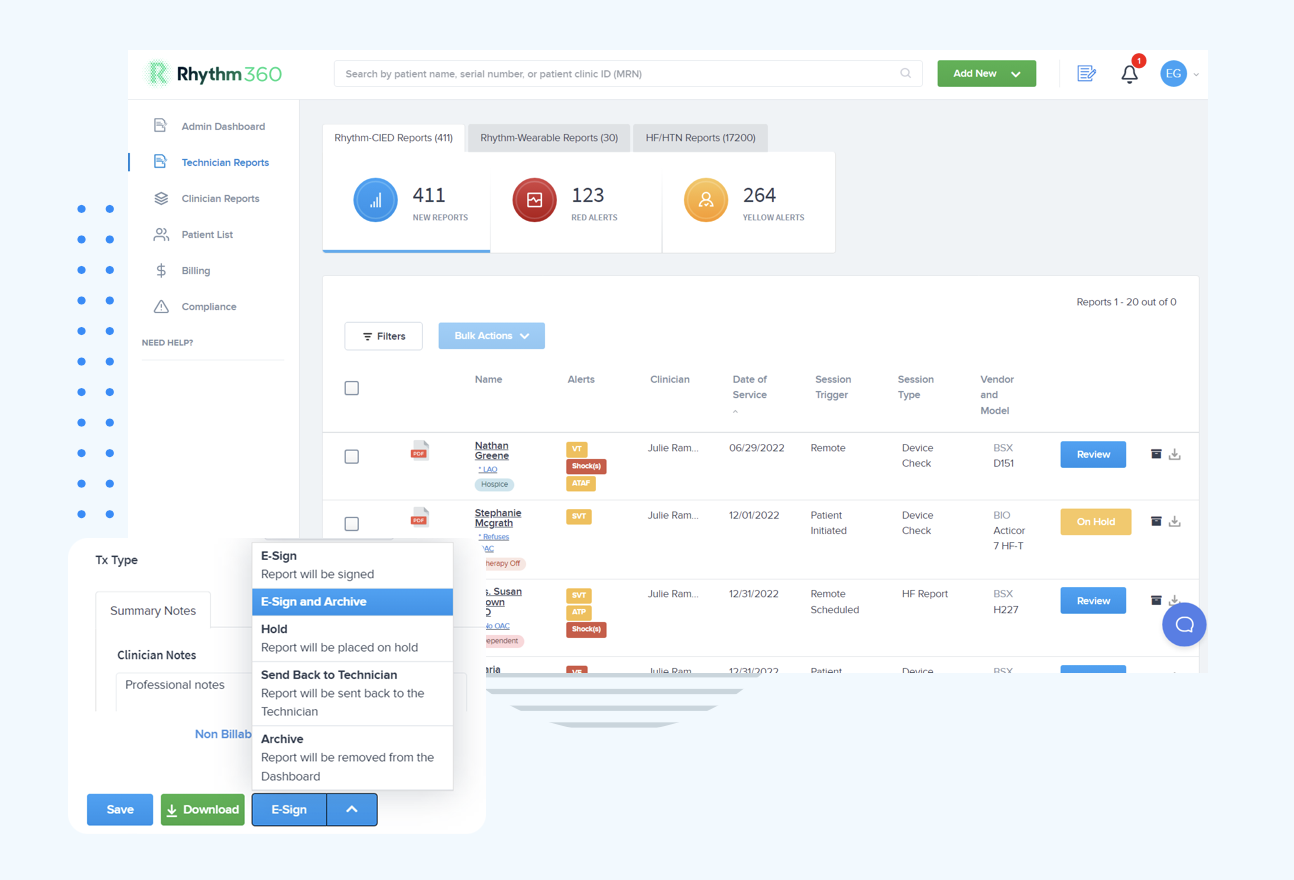
Common Pitfall: A Quebec heart failure telemonitoring pilot found that lack of integration with existing clinical information systems increased cognitive load and workflow fragmentation for home care nurses. Platforms without native EHR integration force manual copy-paste workflows that reduce billing accuracy and clinician trust.
Once EHR data flows correctly, the next challenge is deciding who acts on it. Atrium Health assembled a multidisciplinary remote monitoring team of pharmacists, nurses, navigators, and advanced practice providers who protocolize care or provide warm handoffs to primary care. Prisma Health operates device monitoring as one centralized systemwide clinic instead of separate local clinics, using real-time vendor metrics to redistribute workload. Assign clear ownership for each alert tier: CCTs handle routine transmissions, NPs manage urgent escalations, and electrophysiologists or HF cardiologists respond to critical events.
Adherence at or above 70% is linked to lower hospitalizations and mortality, as shown in the OSICAT trial. This makes patient feedback, tech support, and easy-to-use tools essential from the start. Obtain and document written consent before the first claim is submitted. Patient consent must include agreement to participate, single-provider billing acknowledgment, cost-sharing obligations, and the right to revoke. Written consent provides stronger audit protection than verbal consent. Rhythm360's integrated Twilio-powered communication hub logs all patient interactions with a full audit trail, supporting both compliance and care coordination.
Practices managing devices from multiple OEMs face unsustainable administrative burdens when staff log into separate, non-interoperable portals. University of Chicago Medicine reviewed more than 73,000 reports annually through Rhythm360 in 2025, averaging more than 18,000 reports per quarter, showing that centralized ingestion scales even in high-volume environments. Rhythm360 achieves greater than 99.9% transmissibility through redundant data feeds, computer vision, and AI-powered extrapolation, functioning as a fail-safe when an OEM server goes down.
Pro Tip: Validate data ingestion from implantable device platforms before importing to the EHR and reconcile device data before filing to the chart.
The Trento Cardiology Unit's remote monitoring program moved from manual case-by-case alert prioritization to standardized triage protocols, reducing nonrelevant alerts and improving efficiency. Standardized triage protocols reduce provider escalation rates from 60–70% to 30–50% by screening red-flag symptoms and enforcing clear disposition rules. Rhythm360's AI triage layer applies these principles automatically, surfacing only clinically significant events and routing them to the right team member. Andrew Beaser, MD, at UCM noted: "Decision support, including AI-assisted decision support, will become increasingly important as data volumes grow."
Compliant billing for heart failure remote monitoring requires precise documentation across multiple code families. For RPM, the 2026 code set includes:
For CIED monitoring, CPT 93294 covers remote interrogation of a single- or dual-chamber pacemaker, CPT 93295 covers ICD or CRT-D interrogation, and CPT 93297 covers physician interpretation of transmissions from an implantable loop recorder or insertable cardiac monitor. Best-practice targets include an 80% or higher 16-day transmission achievement rate, 95% or higher time documentation completeness, 100% consent coverage, and denial rates under 5%. Rhythm360 automates CPT code capture and documentation, helping practices recover previously lost revenue and improve profitability by as much as 300%. Gaurav A. Upadhyay, MD, at UCM observed: "We have improved billing and accountability for our patients after the integration."
Common Pitfall: Incomplete consent records, vague enrollment notes, copy-paste documentation, and failure to tie monitoring activity to clinical decision-making are the most common causes of RPM/RTM denials under 2026 CMS rules.
Internal compliance audits for RPM programs should happen at least quarterly, reviewing a random 10–20% sample of patient records across consent, orders, devices, 16-day transmission logs, and time documentation. At the 30-day mark, verify device activation rates, transmission day counts, alert response times, and documentation completeness before submitting the first billing cycle. Rhythm360's administrative dashboard provides a real-time overview of patient compliance, critical alerts, and captured versus potential revenue based on CPT code requirements.
Audit results from Step 9 point to exactly what needs fixing before scaling up. Under 2026 CMS code updates, billing eligibility expands for patients transmitting remote monitoring data between two and 15 days per month, provided organizations maintain proactive engagement and upstream infrastructure. Use the 30-day audit findings to refine thresholds, staffing ratios, and EHR field mappings before expanding the enrolled population.
The 10 steps above cover core implementation. Two extensions build on this foundation once the program stabilizes.
Three metrics define a mature heart failure remote monitoring program.
Once the core HF program hits stable compliance and billing metrics, two expansion paths add clinical and financial value. Adding hypertension RPM for patients with comorbid HTN uses the same CPT code infrastructure and device workflows already in place. This creates a new recurring revenue stream with minimal incremental overhead. Rhythm360's HF/HTN service lines share a centralized workspace, so the same dashboard that manages rhythm disorders and heart failure also supports hypertension monitoring without separate portals or staff training.
Optional 24/7/365 oversight by certified cardiac technicians supervised by physicians closes the coverage gap during nights, weekends, and holidays. This matters because critical arrhythmias and decompensation events are most likely to go undetected during those hours. Andrew Beaser, MD, at UCM explained: "We are able to address these issues earlier; rather than waiting for a 3-month visit, we can call patients in for evaluation." Adding CCT oversight operationalizes that capability around the clock.
Alert thresholds in heart failure remote monitoring programs are set at two levels: population-level defaults and patient-specific calibrations. Population-level defaults drawn from clinical evidence include weight gain exceeding 2–3 lbs in a single day or 5 lbs in one week, systolic blood pressure below 90 mmHg or above 180/120 mmHg, resting heart rate above 120 bpm, and SpO2 below 90%. These defaults get adjusted to each patient's baseline values at enrollment, because a patient with chronic hypotension will trigger false positives under a standard threshold. Thresholds should be stratified into three urgency tiers, Emergent, Urgent, and Routine, with defined response times and escalation pathways for each. NICE guidance emphasizes that no algorithm should be used in isolation. All alerts must be reviewed alongside other clinical information and discussed with the patient. Rhythm360's AI-powered triage layer applies individualized thresholds automatically and filters non-actionable alerts before they reach clinical staff, reducing alert fatigue while ensuring genuinely critical events get immediate attention.
CardioMEMS is an implantable pulmonary artery pressure sensor classified as a cardiac implantable electronic device for billing purposes. Remote monitoring of CardioMEMS transmissions is billed using CPT 93297 (physician interpretation of transmissions from an implantable cardiovascular physiologic monitor system) and CPT 93298-TC (technical component for the remote monitoring infrastructure). CPT 93297 does not require a 30-day minimum monitoring period and can be billed per clinically indicated transmission period when a substantive clinical interpretation is documented. Practices may also layer RPM codes, 99453, 99454 or 99445, 99457, and 99458, for physiologic data components such as weight and blood pressure that accompany CardioMEMS management, provided documentation requirements are met separately for each code family. As of January 13, 2025, CMS covers FDA-approved implantable pulmonary artery pressure sensors for heart failure management under National Coverage Determination 20.36. Rhythm360 automates documentation for both CIED interrogation codes and RPM codes, reducing the risk of incomplete billing packets and claim denials.
Alert fatigue in heart failure remote monitoring stems from three root causes: population-level thresholds that are not calibrated to individual patients, manual review workflows that cannot scale with transmission volume, and fragmented OEM portals that force staff to context-switch between systems. Reducing alert fatigue requires addressing all three at once. Patient-specific threshold calibration at enrollment eliminates a large share of false positives before they reach clinical staff. Structured triage protocols with defined urgency tiers convert unstructured alert streams into prioritized work queues. AI-powered filtering identifies patterns associated with genuine decompensation and suppresses alerts triggered by non-cardiac events such as viral illness or device artifact. Consolidating all device data into a single platform eliminates the cognitive overhead of navigating multiple portals. Rhythm360's AI triage system applies all of these principles in a vendor-neutral environment, and its optional 24/7 CCT oversight layer ensures alerts get reviewed by trained cardiac technicians even when in-house staff are unavailable.
The most effective staffing model for heart failure remote monitoring is a tiered, multidisciplinary structure with clearly defined roles at each escalation level. At the first tier, certified cardiac technicians or trained RNs review incoming transmissions daily and manage Routine alerts using protocol-driven workflows. At the second tier, nurse practitioners or physician assistants handle Urgent escalations, initiate medication adjustments within standing orders, and conduct telehealth visits for patients meeting decompensation criteria. At the third tier, electrophysiologists manage CIED-specific critical alerts and HF cardiologists manage hemodynamic alerts from devices such as CardioMEMS. Practice administrators and billing staff form a parallel operational tier responsible for CPT documentation, compliance audits, and revenue tracking. Large health systems such as Atrium Health and Prisma Health have shown that centralizing device monitoring into a single systemwide clinic, rather than maintaining separate local device clinics, improves workload distribution and reduces dependence on individual super-users. For practices that cannot staff 24/7 coverage internally, Rhythm360 offers optional CCT oversight supervised by physicians, extending clinical reach without additional full-time hires.
A structured 10-step implementation roadmap transforms heart failure remote monitoring from a fragmented, manual process into a scalable, revenue-generating clinical program. Patient selection aligned to NYHA class and hospitalization history, individualized alert thresholds with tiered escalation, bi-directional HL7 EHR integration, a multidisciplinary response team, and automated CPT documentation form the operational foundation. Programs that execute these steps consistently achieve critical-alert response times under 4 hours, device compliance above 85%, and measurable increases in RPM and CIED revenue.
Rhythm360 by RhythmScience is a vendor-neutral, HIPAA-compliant platform built to accelerate every step of this roadmap. Its AI-powered alert triage, redundant data ingestion achieving greater than 99.9% transmissibility, automated CPT documentation, and bi-directional EHR integration with Epic, Cerner, Athenahealth, and others eliminate the fragmentation and manual overhead that drive alert fatigue, missed events, and revenue leakage. As noted earlier, UCM's 73,000-report annual volume through Rhythm360 shows this scalability translates directly into earlier clinical interventions and stable dismissal rates.





