

Last updated: September 22, 2026
An effective automated HF pathway maps each step to a trigger, a task owner, an escalation threshold, and a documentation requirement. The following eight-step sequence reflects the structure recommended by the 2022 AHA/ACC/HFSA Guideline for the Management of Heart Failure and the 2019 ACC Expert Consensus Decision Pathway on patients hospitalized with heart failure.
Step seven, escalation, depends on triage that separates real clinical events from background noise. The next section explains how that triage works.
See How The Automated HF Pathway Works In Rhythm360
Alert fatigue arises when clinicians receive a high volume of undifferentiated notifications. A 2026 review in Cardiology Journal by Kubica et al. warns that alerting must minimize harm through limits on alert volume, explicit prioritization, and audited response times. Poorly designed automation creates an illusion of safety instead of genuine clinical protection.
Rhythm360's AI-powered triage filters the following non-actionable notification types before they reach clinical staff:
The following clinical events always surface for immediate review, consistent with the alert classification framework described by Calvanese et al. in a 2026 Frontiers in Cardiovascular Medicine narrative review:
Escalation routing follows a defined logic. Weight, blood pressure, and heart rate changes that cross configured thresholds generate a nurse task for initial clinical assessment. Events meeting higher-acuity criteria such as sustained arrhythmia, device safety alerts, or composite HF index threshold crossings route directly to physician review. The TRUST study found that remote monitoring reduced median time from arrhythmia detection to medical intervention from more than 30 days to 1 day. This finding illustrates the clinical consequence of faster, structured escalation.
Rhythm360 pairs AI-powered triage with optional 24/7/365 oversight by certified cardiac technicians (CCTs) supervised by physicians. This human safety net supports events that require immediate clinical judgment and produces the response-time improvement described earlier.
As Andrew Beaser, MD, Associate Professor of Medicine at the University of Chicago Medicine, observed after implementing Rhythm360: "Decision support, including AI-assisted decision support, will become increasingly important as data volumes grow."
Real-world GDMT uptake falls far short of guideline targets. A University of Pittsburgh observational cohort study of 6,111 heart failure hospitalizations found that only 15% of patients received triple or quadruple GDMT therapy at discharge, and only 54% of new GDMT prescriptions were filled within 7 days. A 2023 JACC focus seminar reported that only 7–10% of patients have HF medications initiated or up-titrated at follow-up visits. The authors describe this pattern as clinical inertia.
Automation addresses this gap through a structured workflow that begins at enrollment, when the discharge regimen is captured. From there, titration checkpoints are scheduled at protocol-defined intervals. If a drug class is absent, a dose falls below 50% of the target specified in the 2022 AHA/ACC/HFSA guideline, or a checkpoint is missed, the platform flags the gap to the responsible clinician with a task and a documentation prompt. All actions taken or deferred are recorded with timestamps for audit and quality review.
This approach mirrors the design of the TELEFASTER-HF intervention, which replaced routine in-person titration visits with protocol-driven dose escalation supported by home-based monitoring, achieving 93% optimal medical therapy by day 90 versus 8% in the standard-of-care cohort. Standardized protocols reduce clinician-level variability and prevent the decline in titration activity that typically occurs beyond the first one to two months of care.
Rhythm360's HF/HTN Remote Physiological Monitoring (RPM) service line ingests daily weight, blood pressure, and heart rate data from connected external devices such as blood pressure cuffs and weight scales, including FDA-cleared remote patient monitoring devices. Patient onboarding checklists guide device setup, and automated billing support covers CPT codes 99453, 99454, and 99457 throughout the monitoring period.
Escalation thresholds are configured per patient and per protocol. When a reading crosses a threshold, the platform routes the appropriate task, such as nurse outreach for initial assessment or physician review for higher-acuity changes, and logs the event with a timestamp. A 2025 comprehensive meta-analysis found that remote patient monitoring programs were associated with reductions in mortality and HF readmissions when monitoring was at least daily and included blood pressure. This evidence supports the clinical rationale for continuous, threshold-based RPM.
Rhythm360 also ingests and normalizes data from all major CIED manufacturers, including Medtronic, Boston Scientific, Abbott, and Biotronik, and from specialized sensors such as CardioMEMS pulmonary artery monitors. Greater than 99.9% transmissibility is achieved via redundant data feeds, computer vision, and AI-powered extrapolation, ensuring that a manufacturer server outage or connectivity gap does not create a blind spot in patient monitoring.
Reliable data capture is only half the operational picture. The other half is making sure the monitoring activity is billed correctly, which depends on matching each patient to the right code and cycle.
Automation prevents missed billing windows and device-type mismatch denials by tracking each patient's device type, monitoring cycle, and documentation status. The following codes apply to automated HF remote patient management workflows.
Pacemakers And ICDs (90-Day Cycle):
Physiologic Monitors And Loop Recorders (30-Day Cycle):
HF RPM (Rolling 30-Day Cycles):
Rhythm360 tracks device-specific CPT pairings, monitors billing cycle windows, and assembles compliant documentation automatically. Practices that implement this automated billing support see the revenue-capture improvement noted earlier. As Gaurav A. Upadhyay, MD, at the University of Chicago Medicine, noted after implementing Rhythm360: "We have improved billing and accountability for our patients after the integration."
Review HF Billing Support In Rhythm360
Rhythm360 integrates bi-directionally with Epic, Cerner, Athenahealth, eClinicalWorks, Greenway Health, and other EHR systems via HL7. HL7 v2 remains the workhorse of US healthcare data exchange, carrying ADT feeds, lab results, and device data. FHIR APIs support modern, real-time data access where EHR systems expose them.
Data flows in both directions. Device and RPM data such as transmissions, alert events, clinical findings, and CPT-compliant documentation flow from Rhythm360 into the EHR, appearing in the patient record without manual transcription. Patient demographics, orders, and enrollment status flow from the EHR back to Rhythm360, keeping the platform synchronized with the source of truth for patient identity and care plan data.
Epic holds clinical data on more than 305 million patients and supports interoperability for nearly 57% of U.S. hospital beds. Bi-directional Epic integration therefore represents a core requirement for most cardiology practices. Rhythm360's onboarding process, including integration setup, typically takes a few days to a few weeks, which minimizes disruption to existing clinical workflows.
Integration is necessary but not sufficient. Even a well-connected platform fails if the clinical response pathway behind it is undefined, which is the subject of the next section.
Automation without a defined clinical response pathway produces faster noise and weaker outcomes. A platform that routes alerts to an inbox without an assigned owner, escalation threshold, or documented response protocol shifts the bottleneck from data retrieval to alert management rather than reducing readmissions.
Kubica et al. specify four design requirements for a clinically credible remote monitoring program: a predefined set of actionable events, an escalation pathway with time targets and clear ownership, documentation of actions taken and outcomes, and a feedback loop that learns from false alarms and missed events. All four require human decisions before automation can execute them.
A May 2026 ACC Cardiology Magazine review supports automation as a force multiplier for structured care teams rather than a substitute for clinical staffing. The review frames APP-led, protocol-driven titration as the operational backbone of effective HF care delivery. Practices that implement Rhythm360 after defining role assignments, escalation thresholds, and response time targets achieve the strongest clinical and financial outcomes.
Protocol governance is also a prerequisite for billing compliance. CPT codes 99457 and 99458 require documented interactive communication and timestamped clinical time logs. Automation can capture and assemble that documentation, but a clinician must perform and authorize the underlying clinical activity.
The operational difference between manual and automated HF follow-up appears most clearly at the task level. In a manual workflow, a device technician logs into separate Medtronic, Boston Scientific, Abbott, and Biotronik portals to retrieve transmissions. The technician then transcribes findings into the EHR and adds the patient to a spreadsheet for follow-up tracking. Phone outreach happens without a structured escalation path. Billing documentation is assembled separately, often after the billing window has narrowed or closed.
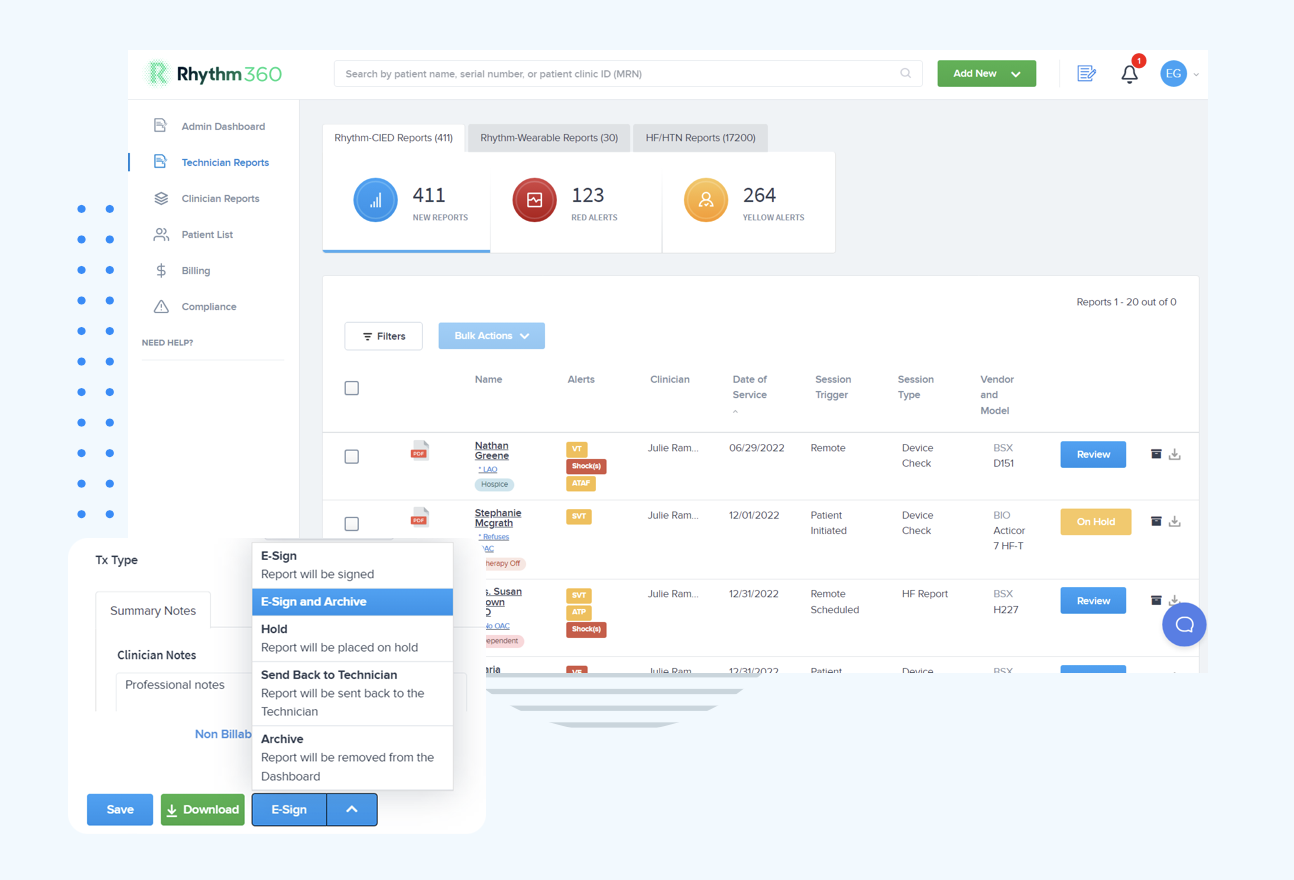
In an automated workflow on Rhythm360, a single dashboard surfaces all transmissions across manufacturers. AI triage filters non-actionable events and routes prioritized alerts to the assigned role. EHR documentation generates automatically from the clinical event record. Billing cycle windows are tracked per device type and per patient, and CPT-compliant documentation is assembled without additional staff effort. The table below breaks down how each workflow element differs between the two approaches.
| Workflow Element | Manual Process | Rhythm360 Automated Process |
|---|---|---|
| Device data retrieval | Separate login per manufacturer portal | Single dashboard, all manufacturers unified |
| Alert triage | Manual review of all transmissions | AI-powered triage, non-actionable events filtered |
| EHR documentation | Manual transcription | Bi-directional HL7 sync, auto-generated records |
| Billing cycle tracking | Spreadsheet or manual calendar | Automated per device type and CPT code |
Other platforms in the cardiac monitoring space exist. This article focuses on what Rhythm360 delivers as an integrated, vendor-neutral platform.
The University of Chicago Medicine reviewed more than 73,000 reports annually through Rhythm360 in calendar year 2025, averaging more than 18,000 reports per quarter. This volume demonstrates the scalability of the automated workflow in a high-volume academic cardiology setting. As Andrew Beaser, MD, noted: "We are able to address these issues earlier; rather than waiting for a 3-month visit, we can call patients in for evaluation."
Rhythm360 is a cloud-based platform that is vendor-neutral and HIPAA-compliant. It serves as a single source of truth for all implantable and wearable cardiac device data. It unifies CIED data from Medtronic, Boston Scientific, Abbott, and Biotronik alongside RPM data from connected physiologic monitors. Every data stream is normalized at greater than 99.9% transmissibility.
The platform's core capabilities for HF workflow automation include:
Practices implementing Rhythm360 achieve the response-time and revenue-capture improvements described earlier.
Explore Rhythm360 For HF Workflow Automation
Heart failure remote patient management spans two code families. For implantable devices, pacemakers and ICDs use a 90-day billing cycle: 93294 covers the pacemaker professional component, 93295 covers the ICD professional component, and 93296 covers the pacemaker and ICD technical component. Implantable cardiovascular physiologic monitors such as CardioMEMS are billed with 93297, and subcutaneous cardiac rhythm monitors or implantable loop recorders are billed with 93298. Both run on a 30-day cycle and may each be billed global, with modifier -26 for the professional component, or with modifier -TC for the technical component. For RPM-based HF monitoring using connected home devices, 99453 covers one-time device setup and patient education, 99454 covers monthly device supply and data transmission when 16 or more days of data are transmitted in a 30-day period, and 99457 covers the first 20 minutes of interactive clinical management time per calendar month. Add-on code 99458 covers each additional 20-minute increment of management time and can only be billed after 99457 has been satisfied.
Rhythm360 integrates bi-directionally with the major EHR systems listed earlier via HL7. Device transmissions, AI-triaged alert events, clinical findings, and CPT-compliant documentation flow from Rhythm360 into the EHR automatically, which eliminates manual transcription. Patient demographics, orders, and enrollment status flow from the EHR back to Rhythm360, keeping the platform synchronized with the patient record. Onboarding follows the timeline described in the integration section. HL7 v2 handles continuous event-driven data flows such as ADT discharge messages that trigger patient enrollment, while FHIR APIs support real-time data access where EHR systems expose them.
Implementation disruption is minimal. Rhythm360's onboarding process is designed to run in parallel with existing workflows, and the platform's single-dashboard design reduces the number of systems staff must access rather than adding to them. The more important staffing consideration is protocol governance. Automation acts as a force multiplier for a structured care team rather than a replacement for one. Practices that define role assignments, escalation thresholds, and response time targets before go-live see the strongest operational and clinical results. Practices that deploy the platform without those protocols in place route alerts faster but do not achieve the response-time reductions or revenue capture improvements the platform supports. Clinical staffing and protocol governance function as prerequisites, not optional enhancements.
Rhythm360 achieves greater than 99.9% transmissibility across all major CIED manufacturers, including Medtronic, Boston Scientific, Abbott, and Biotronik, as well as specialized sensors such as CardioMEMS pulmonary artery monitors. This reliability comes from redundant data feeds that act as a fail-safe when a manufacturer's server is unavailable, computer vision and optical character recognition that extract data from unstructured PDF transmissions, and AI-powered extrapolation that fills gaps when connectivity is intermittent. Clinicians therefore make decisions from the most complete and accurate view of each patient's device data available, without relying on a single data pathway that can fail silently.
Manual, fragmented heart failure follow-up costs cardiology practices clinical response time, GDMT optimization opportunities, and billable revenue. Multi-portal logins, manual transcription, phone-tag follow-up, and spreadsheet tracking create patient safety risks and revenue leakage at the same time.
Rhythm360 replaces that fragmented system with a triggered, role-assigned, documented HF pathway that unifies device and RPM data, triages alerts by clinical context, tracks GDMT gaps and titration progress, captures CPT-compliant documentation automatically, and integrates bi-directionally with your EHR. The result aligns with the response-time and revenue improvements described earlier, achieved without adding headcount.
Talk With Rhythm360 About Your HF Workflow





