Last updated: July 13, 2026
Six concrete criteria separate adequate heart rhythm data tools from truly comprehensive platforms, and Rhythm360 meets each one.
Any practice implanting devices from more than one manufacturer, such as Medtronic, Boston Scientific, Abbott, or Biotronik, inherits a fragmented data environment. Staff must authenticate separately into each OEM portal, reconcile incompatible data formats, and manually transcribe findings into the EHR. This process introduces transcription errors, delays critical event identification, and consumes staff hours that never return.
Rhythm360 replaces this fragmented workflow with a single-dashboard ingestion layer. Data arrives via API, HL7, XML, and computer-vision PDF parsing, which covers both structured and unstructured OEM outputs. A redundant data feed architecture ensures that if any OEM server experiences downtime, Rhythm360’s fail-safe layer maintains continuity and delivers high transmissibility across the entire device population. No other login is required, no manual reconciliation is necessary, and the entire device population becomes visible in one place.
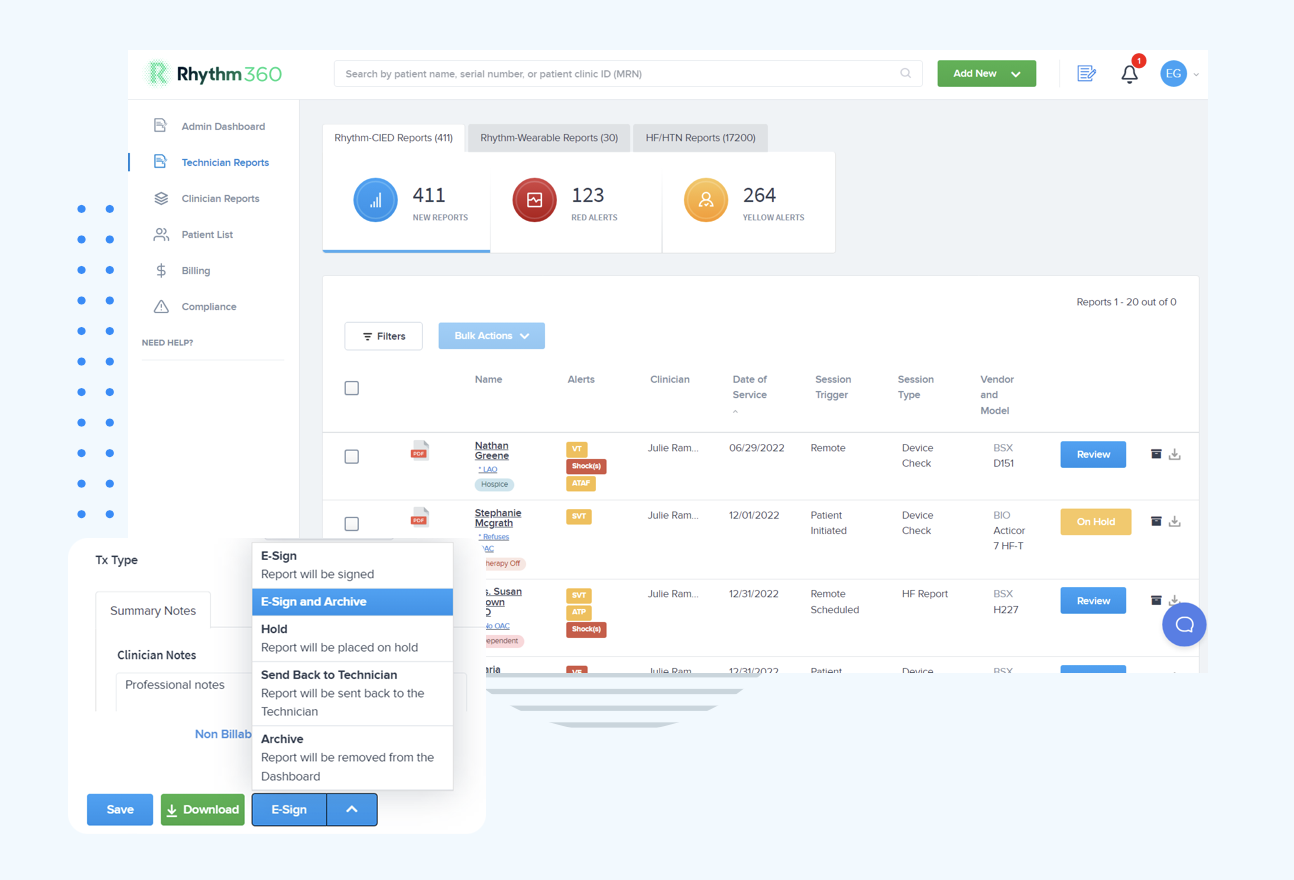
This comprehensive approach distinguishes Rhythm360 from other platforms that typically address only portions of the remote monitoring workflow. The evaluation question for any practice becomes whether a given solution covers every layer at once: aggregation, normalization, triage, EHR integration, and billing documentation.
Once data from multiple OEMs sits in one place, the next challenge is making that data usable through consistent normalization. In March 2026, HL7 International launched the Caliper FHIR Accelerator, a new implementation community dedicated to medical device interoperability for real-time data exchange. Caliper’s goals include creating standardized FHIR profiles for real-time device data, aligning HL7 FHIR with IEEE 11073 device communication standards, and enabling consistent data flow from implantable defibrillators to EHRs. Separately, the CardX mCARD initiative has finalized a list of 145 foundational cardiovascular concepts.
These standards matter because different RPM and CIED devices transmit the same measurement using inconsistent formats. Glucose values may appear as integers or decimals, timestamps may arrive in UTC or local time, and terminology such as “ventricular tachycardia” may be coded differently across OEM systems. In LOINC/SNOMED terms, ventricular tachycardia maps to SNOMED CT concept 25569003, while atrial fibrillation maps to SNOMED CT 49436004. Without a normalization layer, these concepts arrive as free text or proprietary codes that EHRs cannot consume directly.
Rhythm360 resolves unit mismatches, timestamp discrepancies, and terminology conflicts automatically. Its computer-vision OCR layer parses unstructured PDF reports from OEMs that do not yet expose structured APIs and maps extracted values to standardized LOINC and SNOMED identifiers before writing to the EHR. This approach aligns with both the Caliper FHIR Accelerator framework and the CardX mCARD vocabulary and positions Rhythm360 for forward compatibility as these standards mature.
Unfiltered alert volume represents one of the most documented sources of clinician burnout in cardiac monitoring. Research has shown that traditional threshold alarms can generate high alarm volumes, while score-based and machine learning alarms can reduce that burden and improve positive predictive value for clinically important events. The 2023 HRS/EHRA/APHRS/LAHRS Expert Consensus Statement on Practical Management of the Remote Device Clinic provides evidence-based recommendations on alert management and appropriate clinic workflows for CIED remote monitoring.
Best-practice AI triage governance calls for confidence-gated suppression rules and tiered notification systems. Tier 1 supports automated self-care messages, Tier 2 supports low-priority nursing review within 24 hours, and Tier 3 supports urgent escalation that requires immediate action. Rhythm360 implements this architecture directly. Its AI triage engine filters non-actionable transmissions and surfaces ventricular tachycardia, new-onset AFib, lead malfunctions, and ERI/RRT indicators with confidence scoring before any notification reaches a clinician.
This structure reduces critical event response times in real clinics. A clinician receiving a Tier 3 alert for new-onset AFib on a Saturday morning can initiate anticoagulation protocols by Saturday afternoon. In a fragmented portal environment, that same intervention might not occur until the following Monday. Andrew Beaser, MD, Associate Professor of Medicine at the University of Chicago Medicine, noted that “Decision support, including AI-assisted decision support, will become increasingly important as data volumes grow.”
A 2026 Frontiers in Digital Health review recommends that post-market monitoring for AI triage tools in cardiovascular applications must track alert rates, PPV/NPV at operational thresholds, and observed-to-expected ratios stratified by device vendor and model. Rhythm360’s platform architecture supports this governance standard.
Manual billing documentation for remote cardiac monitoring CPT codes, including 93298 for complex CIED remote interrogation and 99454 for RPM device supply and daily recordings, is error-prone and time-intensive. Missed documentation windows, incomplete records, and claim rejections translate directly into lost revenue that practices rarely recover.
Rhythm360 automates the capture and documentation of billable events as they occur. Transmission reviews, alert responses, and patient communications are logged with full audit trails and generate compliant documentation for CPT submission without manual staff intervention. Practices implementing Rhythm360 have achieved a 135% average increase in actual payments.
The University of Chicago Medicine reviewed more than 73,000 reports annually through Rhythm360 in calendar year 2025, averaging more than 18,000 reports per quarter. Gaurav A. Upadhyay, MD, at UCM, observed, “We have improved billing and accountability for our patients after the integration.” That volume, managed with stable dismissal rates, shows that automated billing documentation scales without proportional increases in administrative headcount.
| Capability | Rhythm360 Feature | Quantified Outcome |
|---|---|---|
| Multi-OEM Data Normalization | API, HL7, XML, and computer-vision PDF ingestion with LOINC/SNOMED semantic mapping, plus redundant data feeds | High transmissibility across the device population |
| AI-Powered Alert Triage | Confidence-gated, tiered triage surfacing ventricular tachycardia, new-onset AFib, lead faults, and ERI/RRT, with optional 24/7/365 CCT oversight | Reduction in critical event response times |
| Automated CPT Billing Documentation | Automated capture and audit-trail documentation for CPT codes including 93298 and 99454, with bi-directional EHR write-back | See payment increase and volume metrics in the billing section above |
Rhythm360’s onboarding process is structured to reach go-live in days to weeks, not months, through a clear 30-day checklist.
Rhythm360 centralizes data and automates reporting, so implementation does not depend on a single internal “super-user.” Business continuity remains stable even during staff transitions.
A cardiology practice administrator managing a multi-physician EP clinic with devices from three OEMs faced a familiar set of problems. Device technicians spent hours each week logging into separate portals, billing staff manually reconstructed transmission histories for CPT documentation, and no unified view existed for patients overdue for review. After implementing Rhythm360, the practice consolidated all OEM data into a single administrative dashboard showing real-time compliance status, pending billable events, and critical alert queues. Staff hours previously spent on portal navigation shifted toward patient-facing tasks. Andrew Beaser, MD, at UCM described the operational shift: “We are able to address these issues earlier; rather than waiting for a 3-month visit, we can call patients in for evaluation.”
An electrophysiologist covering weekend call at a busy academic center previously relied on manual portal checks to identify urgent transmissions. A new-onset AFib event arriving on a Saturday afternoon could sit unreviewed until Monday. With Rhythm360’s AI triage and HIPAA-compliant mobile app, the same clinician receives a Tier 3 push notification within minutes of the transmission, reviews the full report on a smartphone, and initiates anticoagulation protocols the same day. This shift from reactive to proactive management, enabled by mobile access and confidence-gated triage, directly reduces the risk of stroke and other adverse outcomes associated with delayed intervention.
The decision to consolidate CIED and RPM workflows onto a single platform spans clinical, operational, and financial dimensions. A solution that addresses normalization but not billing leaves revenue unrealized. A solution that addresses billing but not triage leaves patients at higher risk. A solution that addresses triage but not EHR integration leaves clinicians managing two systems instead of one.
Rhythm360 is architected to address all three dimensions in a single deployment. Its vendor-neutral design means no OEM relationship is required to add a new device type. Its SaaS pricing scales with clinic size and usage and avoids the high setup fees and rigid licensing structures common in legacy on-premise systems. Its implementation timeline, measured in days to weeks, avoids the 18-to-33-week migration timelines associated with full EHR migrations in cardiology settings.
Rhythm360’s EHR integration process typically takes from a few days to a few weeks, depending on the complexity of the existing EHR environment and the number of OEM device types in the practice’s population. Rhythm360 supports bi-directional integration with Epic, Cerner, Athenahealth, eClinicalWorks, Greenway Health, and other HL7-compatible platforms. The implementation does not require a prolonged parallel-run period or a dedicated internal super-user, which distinguishes it from traditional EHR migration projects that can span months. Discovery, HL7/FHIR mapping, testing, and go-live follow sequential milestones with defined completion criteria at each stage.
Rhythm360 achieves high transmissibility across its connected device population through a redundant data feed architecture. If any OEM server experiences downtime or connectivity issues, Rhythm360’s fail-safe layer maintains data continuity by switching to an alternate feed path. The platform’s AI-powered extrapolation layer identifies connectivity gaps and flags them for resolution rather than silently dropping data. Computer-vision OCR parsing covers OEM sources that do not yet expose structured APIs and ensures that even PDF-format reports are captured and normalized. This multi-layer approach means clinical decisions rely on the most complete and accurate data available at any moment.
Rhythm360’s automated billing documentation captures billable events, including remote interrogation reviews, alert responses, and patient communications, as they occur and generates audit-trail records that align with CMS documentation requirements for CPT codes such as 93298 and 99454. Every logged action includes timestamps, clinician identifiers, and transmission references, which creates the complete documentation chain required for claim submission and audit defense. The platform does not manage revenue cycle operations directly. Instead, it ensures that the documentation practices need for accurate, compliant claims is generated automatically and completely, which reduces the manual burden on billing staff and lowers the rate of claim rejections due to incomplete records.
AI triage in Rhythm360 augments human oversight rather than replacing it. The platform’s confidence-gated triage engine filters non-actionable transmissions and prioritizes clinically significant events, including ventricular tachycardia, new-onset AFib, lead faults, and ERI/RRT indicators, for human review. Rhythm360 also offers optional 24/7/365 oversight by certified cardiac technicians (CCTs) supervised by physicians, which provides an additional human review layer for high-risk events. For the highest-acuity arrhythmias, the system escalates immediately to the responsible clinician via the mobile app. This tiered architecture aligns with 2026 clinical guidance that recommends AI triage tools in cardiovascular applications maintain clear escalation thresholds and immutable audit trails for every suppression or escalation decision, preserving human accountability throughout the workflow.
Fragmented OEM portals, manual data reconciliation, unfiltered alert volumes, and incomplete billing documentation create systemic risks to patient safety, staff retention, and practice revenue. The 2026 landscape, shaped by the Caliper FHIR Accelerator, the CardX mCARD vocabulary, and evolving CMS billing requirements, calls for a platform that can normalize heterogeneous data, triage alerts intelligently, integrate bidirectionally with the EHR, and document billable events automatically. Rhythm360 delivers these capabilities in a single vendor-neutral deployment, with an implementation timeline measured in weeks and outcomes measured in lives protected and revenue recovered.
Take the first step toward unified heart rhythm monitoring by connecting with the Rhythm360 team.