

Last updated: July 14, 2026
These capabilities form the operational foundation of a high-performing cardiac remote monitoring program. Each one ties to a measurable outcome.
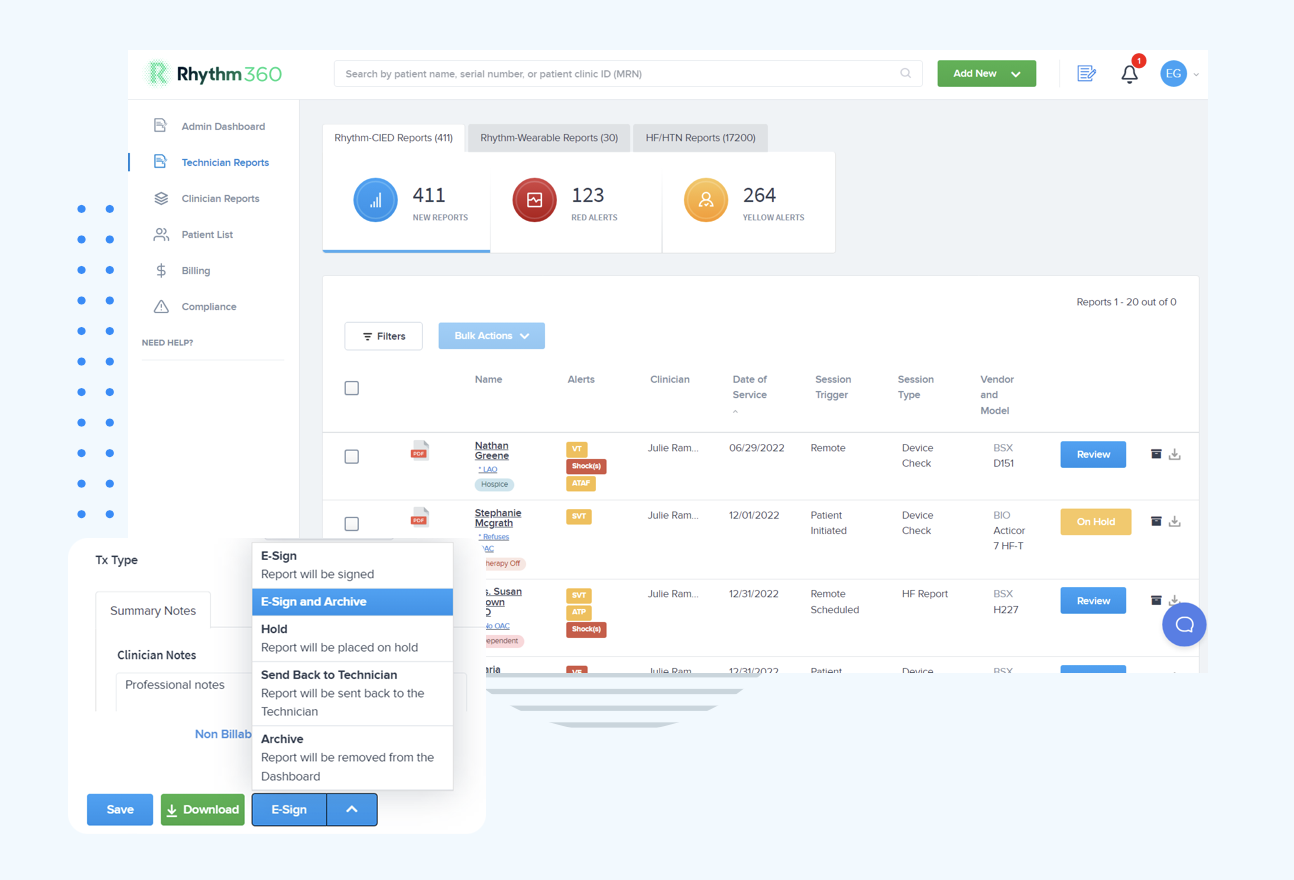
Schedule a demo to see all seven capabilities in a live Rhythm360 environment.
The AI triage capability described above solves a specific problem: alert overload. Device clinics managing patients across multiple OEM platforms receive a continuous stream of transmissions, and most require no immediate clinical action. Studies show 80-99% of ECG monitor alarms are false or clinically insignificant, which drives alarm fatigue among hospital staff. When alerts aren't filtered intelligently, clinicians start overriding notifications reflexively instead of evaluating them. Override rates for drug interaction alerts are often high for the same reason: too many low-value alerts teach clinicians to tune them out.
Rhythm360's intelligent alerting engine filters non-actionable transmissions at the point of data ingestion. It surfaces only clinically significant events, such as new-onset AFib, ventricular tachycardia, lead malfunction, and ERI/RRT indicators, as prioritized notifications. Clinicians review these through a secure, HIPAA-compliant mobile app, so they can act from anywhere without being tied to a workstation. Optional 24/7 oversight by certified cardiac technicians adds a human review layer for after-hours and weekend coverage. This directly addresses a staffing challenge University of Chicago Medicine identified: "Staffing was always an issue for our center, because our device clinic, like many other medical centers, had struggled with technician turnover and timely weekend coverage."
A large-scale AI triage study published in JACC: Advances covering 690,673 transmissions from 74,217 devices at 78 U.S. clinics found AI reduced transmissions forwarded for physician review by about 40%. The LINK-HF2 trial of an AI-enabled remote monitoring system found that 95% of AI-generated alerts were reviewed by clinicians within 24 hours, and 26.7% led to a clinical action such as therapy adjustment.
Pro Tip: Incomplete OEM data feeds are a leading cause of missed alerts. Before evaluating any monitoring platform, confirm it uses redundant ingestion pathways, including API, HL7, XML, and PDF parsing via computer vision, so a single vendor's server outage doesn't create a blind spot in your patient population.
Closing the Gap Between Documentation Errors and Denied Claims
Manual CPT documentation for remote monitoring programs is error-prone and time-intensive, and the consequences show up directly in denial rates. Missing or inaccurate data is a major contributor to claim denials, which reached an 11.8% initial rate in 2024. That risk grows when CIED codes like 93298 and 93299, or RPM codes like 99453, 99454, and 99457, carry documentation requirements that are specific and time-sensitive. Staff without a centralized tracking system routinely miss billable thresholds as a result.
Rhythm360 automates data ingestion, report generation, and CPT-compliant documentation in near-real time. The administrative dashboard tracks billable activities against CPT code requirements and flags gaps before the billing window closes. University of Chicago Medicine reported: "We have improved billing and accountability for our patients after the integration."
AI-powered medical coding automation reduces coding time while improving accuracy rates past 95%. For chronic care programs, moving from manual to AI-automated billing can capture substantial additional annual revenue while lowering compliance risk. Practices implementing Rhythm360 have realized up to a 300% revenue increase through optimized CPT capture and new HF/HTN RPM service lines, with outcomes measurable within the first billing cycle.
Pro Tip: The most commonly missed CPT documentation failure isn't the code itself. It's the time-threshold attestation. Automated platforms that log clinician interaction time and generate audit-ready reports close this gap without added staff effort.
Why Bidirectional Sync Matters More Than a One-Way EHR Push
Unidirectional data pushes, where device data flows into the EHR but clinical updates don't flow back to the monitoring platform, create reconciliation burdens and documentation gaps. This matters for billing too: integrated order-entry workflows that auto-populate charges from procedures and documentation can significantly cut missed charges, something a one-way push can't deliver. Without bidirectional sync, device technicians must manually update records in two systems, which compounds error rates and eats staff hours.
Rhythm360 offers deep, bidirectional integration with Epic, Cerner, Athenahealth, eClinicalWorks, Greenway Health, and others via HL7. Data ingested from OEM portals is normalized and written back to the EHR, while clinical updates in the EHR are reflected in the Rhythm360 dashboard. AI-powered natural language processing converts unstructured clinical notes into structured EHR fields with accuracy exceeding 95%, reducing the manual transcription burden that drives technician burnout.
Pro Tip: Integration timelines are frequently cited as a barrier to adoption. Rhythm360's implementation process, including full EHR integration setup, typically takes days to a few weeks, not months, making mid-year adoption feasible without disrupting active patient panels.
Schedule a demo to review Rhythm360's EHR integration specifications for your system.
What the Numbers Show Across Rhythm360 Deployments
The capabilities above translate into measurable operational gains. The table below summarizes the key metrics clinics can expect to track after implementation.
Metric Rhythm360 Outcome Operational Impact Source Critical-alert response time Up to 80% reduction Earlier intervention; reduced adverse events RhythmScience platform data; UCM white paper Revenue generation lift Up to 300% increase Recovered CPT billing; new RPM service lines RhythmScience platform data Annual reports managed (UCM) 73,000+ per year (18,000+ per quarter) Demonstrated scalability in high-volume environments UCM white paper, 2025 data Data transmissibility Greater than 99.9% No transmission gaps from OEM server outages RhythmScience platform specification Growing Beyond Rhythm Monitoring Into Chronic Disease Management
Once a clinic has stabilized its CIED monitoring workflow, expanding into adjacent chronic disease programs becomes the natural next move. Rhythm360's integrated HF/HTN RPM service line provides turnkey patient onboarding checklists, automated billing support for RPM CPT codes, and a centralized workspace managing rhythm disorders, heart failure, and hypertension on one platform. The LINK-HF2 trial results referenced earlier, where 95% of AI-generated alerts were reviewed within 24 hours, show that structured remote monitoring with AI triage holds up operationally at scale.
For on-call coverage, Rhythm360's secure mobile app lets electrophysiologists, NPs, and PAs review transmissions, sign reports, and coordinate care from their smartphones. UCM clinicians noted: "We are able to address these issues earlier; rather than waiting for a 3-month visit, we can call patients in for evaluation." That shift from reactive to proactive care is what a fully scaled monitoring program delivers.
Frequently Asked Questions
How long does Rhythm360 implementation take, including EHR integration?
Rhythm360's onboarding, including EHR integration with systems such as Epic, Cerner, Athenahealth, and eClinicalWorks, typically takes days to a few weeks. The streamlined process avoids disrupting active patient panels, making mid-year adoption realistic for busy cardiology and EP clinics. It covers data ingestion configuration for all connected OEM portals, bidirectional EHR sync, staff training, and dashboard customization.
How does Rhythm360 handle data security and HIPAA compliance?
Rhythm360 is a HIPAA-compliant, cloud-based platform. All patient data, whether ingested via API, HL7, XML, or PDF parsing through computer vision, is handled within a secure infrastructure with full audit trail documentation. The mobile app clinicians use for on-call review is also HIPAA-compliant. Patient communications managed through the integrated Twilio framework are logged with a complete audit trail in the patient record, supporting compliance reviews and billing documentation.
What quantified outcomes can a clinic expect after implementing Rhythm360?
The response-time and revenue gains outlined earlier hold up in practice. University of Chicago Medicine maintained stable dismissal rates and improved billing accountability while scaling to more than 73,000 reports annually. Individual results depend on clinic size, existing workflows, and the number of OEM portals being consolidated.
How does Rhythm360 pricing work for clinics of different sizes?
Rhythm360 uses a SaaS-based pricing model that scales with clinic size and platform usage. There are no prohibitive setup fees or rigid per-seat structures that penalize growth. A solo EP practice and a large integrated health system managing thousands of CIED patients can both access the platform at a cost proportional to their monitoring volume and service line configuration.
Making the Switch to a Unified Monitoring Platform
Multi-portal logins, alert fatigue, and CPT billing leakage aren't inevitable features of cardiac remote monitoring. They're workflow design problems with a measurable fix. Rhythm360 consolidates CIED and RPM data into one vendor-neutral, AI-powered platform with over 99.9% transmissibility, bidirectional EHR integration deployable in days to weeks, automated CPT documentation, and optional 24/7 CCT oversight. The result: faster alert response, stronger revenue capture, and outcomes already proven at scale at University of Chicago Medicine and in practices nationwide.
Read Next





