

Cardiology practices manage growing volumes of data from Apple Watch ECGs, implantable loop recorders, pacemakers, and other devices. These devices enable early detection but create new challenges in data extraction and alert management, often increasing alert fatigue for patients and staff.
Multiple OEM portals, manual EHR entry, and inconsistent workflows introduce delays and errors. Gaps in this process can slow recognition of new-onset atrial fibrillation, ventricular tachycardia, or heart failure decompensation, and they contribute to missed revenue from underbilled remote monitoring services.
Effective unification begins with a clear picture of current operations. Practices need to know how many portals staff use, how long data retrieval takes, how often critical alerts are missed or delayed, and how consistently CPT codes are captured. Clear expectations about how a unified platform will change workflows, staffing, and documentation help drive adoption and measurable gains.
Disparate systems increase administrative workload and burnout. Difficulty integrating device data into EHRs forces staff to navigate multiple portals to assemble a complete patient record. Each extra step raises the likelihood of human error and delayed clinical action, while non-actionable alerts crowd out urgent events.
Start with an inventory of all monitored cardiac devices in your practice, including pacemakers, ICDs, implantable loop recorders, CardioMEMS, and wearables. Document every OEM portal staff use, such as Medtronic CareLink or portals from Boston Scientific, Abbott, and Biotronik. Track time spent logging in, retrieving data, generating reports, and entering information into the EHR.
Map the path from device transmission to clinical decision. Note where staff re-enter data, transfer files between systems, or rely on manual flags for follow-up. Highlight points where alerts are delayed or missed and where documentation for billing is incomplete. These gaps indicate where a unified platform can provide the greatest clinical and financial impact.
A practical unified platform needs vendor-neutral data ingestion, AI-supported alert triage, automated reporting, bi-directional EHR integration, and robust HIPAA-compliant audit trails. Rhythm360 offers vendor-neutral integration for CIEDs and specialized cardiac sensors with more than 99.9 percent data transmissibility through APIs, HL7, XML, and computer vision-based PDF parsing, which supports a unified clinical view.
Data security and regulatory compliance must be core requirements. Portable ECG and monitoring devices face strict accuracy and privacy standards under FDA and global regulations, which demand strong cybersecurity controls to protect PHI and meet HIPAA and GDPR expectations. Select a platform that meets these standards, supports role-based access, and provides detailed logs for audits.
A unified dashboard reduces the friction of multi-portal workflows. Rhythm360 aggregates cardiac device data into a single interface, eliminating repeated logins to OEM portals. API integrations, HL7 messaging, XML parsing, and computer vision allow consistent data normalization across manufacturers, so clinicians see a complete, coherent cardiac profile for each patient.
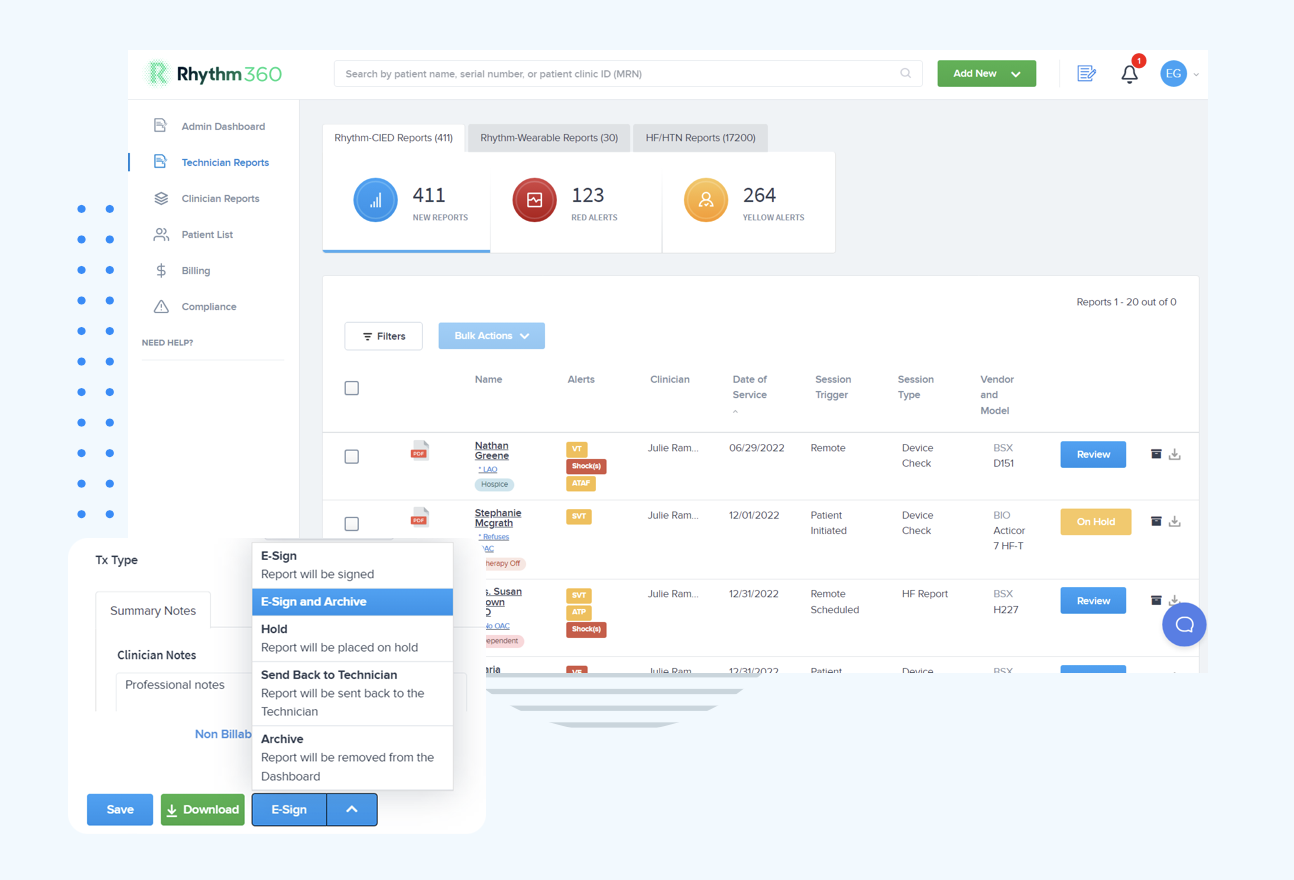
Shallow integrations that only pass basic summaries into the EHR often leave underlying silos in place. Rhythm360 focuses on deep normalization so that data from different OEMs is comparable, searchable, and ready for clinical workflows. This approach reduces manual reconciliation and supports more reliable decision-making.
Schedule a demo of Rhythm360 to see unified cardiac data workflows in action.
Structured alert management helps teams focus on the events that matter. Rhythm360 uses AI-supported triage to elevate clinically significant alerts and filter non-actionable noise. Optional 24/7 certified cardiac technician oversight further supports timely review. Practices can reduce response times for critical events by up to 80 percent, while lowering the volume of low-priority alerts that reach clinicians.
Coordinated communication reduces duplication. Rhythm360 includes tools for patient messaging and call logging within the same environment as device data, which simplifies follow-up and documentation. Teams spend less time chasing information across systems and more time on direct patient care, which can lower burnout risk.
Reliable reimbursement depends on accurate, timely documentation. Rhythm360 captures time and activity data for remote cardiac monitoring and multi-modality chronic disease management, including heart failure and hypertension. The platform supports key CPT codes such as 93298, 93299, 99453, 99454, and 99457, and produces audit-ready documentation to support compliance.
Automated billing workflows reduce missed charges and rejected claims. Practices using Rhythm360 can increase captured billable events, recover previously lost revenue, and reduce staff effort devoted to manual revenue cycle tasks. Some practices report profitability improvements of up to 300 percent when they fully align workflows, documentation, and billing around the platform.
Clinicians benefit from secure access to cardiac data when away from the office. Rhythm360 offers a HIPAA-compliant mobile application for reviewing alerts, reports, and transmissions, and for signing off on events. Modern wearables now monitor heart rate, sleep apnea, and blood pressure with FDA-cleared features, which increases the volume of sensitive data that must be secured during episodic care transitions. Mobile tools must match those security expectations.
Rhythm360 delivers normalized, current data through its mobile app, so on-call clinicians can make informed decisions without waiting to reach a workstation. Strong encryption and access controls help protect patient information while maintaining the responsiveness patients expect from continuous monitoring programs.
Feature | Traditional Manual Multi-Portal Management | Rhythm360 |
Data Integration | Fragmented data, multiple logins, manual reconciliation | Unified, vendor-neutral data from all supported OEMs and RPM devices |
Alert Triage | High alert volume, manual sorting, frequent fatigue | AI-supported prioritization with up to 80 percent faster response to critical events |
Revenue Capture | Manual billing, frequent missed CPT codes, revenue leakage | Automated CPT capture and documentation, with potential profitability gains up to 300 percent |
Staff Efficiency | High administrative burden and repetitive data entry | Automated workflows, reduced manual work, and more time for clinical tasks |
A unified cardiac monitoring platform can serve as the foundation for broader RPM services. Rhythm360 supports programs for heart failure and hypertension, allowing practices to manage multiple conditions through a single environment while aligning documentation with the appropriate CPT codes.
Regular reviews with physicians, nurses, and billing staff help identify friction points and training needs. Monitoring metrics such as alert response times, revenue per monitored patient, and staff satisfaction allows leaders to adjust protocols and staffing models for ongoing improvement.
Rhythm360 applies AI-supported triage rules to classify alerts by clinical urgency and filter low-value notifications. Clinicians receive fewer, more relevant alerts, which supports faster action on critical events and reduces cognitive load from noise.
Rhythm360 is designed as a vendor-neutral platform. It ingests and normalizes data from major CIED manufacturers such as Medtronic, Boston Scientific, Abbott, and Biotronik, as well as specialized sensors, by using APIs, HL7 interfaces, XML parsing, and computer vision for PDFs. This creates a single source of truth for cardiac monitoring data.
Rhythm360 operates as a secure, cloud-based platform with encryption for data in transit and at rest, role-based access controls, and detailed audit logs. These measures support HIPAA compliance and address security concerns associated with remote monitoring devices and connected wearables.
Rhythm360 offers bi-directional integrations with leading EHR systems such as Epic, Oracle Health Cerner, Athenahealth, eClinicalWorks, and Greenway Health through HL7 and related standards. Many practices complete implementation and integration within a time frame of a few days to a few weeks, depending on local configuration needs.
Practices typically see gains from more complete CPT code capture, fewer denied claims, and expanded RPM service lines. Rhythm360 supports these improvements by automating documentation and billing workflows, and some practices report profitability increases of up to 300 percent after optimizing their programs.
Unified cardiac remote monitoring in 2026 requires more than device connectivity. Practices need integrated data, clear workflows, strong security, and reliable reimbursement processes to translate continuous monitoring into better outcomes and sustainable operations. Rhythm360 provides a vendor-neutral platform that connects these elements into a single environment.
By consolidating cardiac device data, prioritizing alerts, automating documentation, and enabling secure mobile access, Rhythm360 helps practices shift from reactive review of fragmented reports to proactive, coordinated patient management.
Schedule a Rhythm360 consultation to evaluate how unified cardiac monitoring can fit your practice.





