Last updated: July 13, 2026
The table below maps each relevant code to its 2026 national average Medicare non-facility payment, the minimum threshold required to bill it, and its billing frequency. All payment figures reflect the CMS 2026 Physician Fee Schedule Final Rule.
| CPT Code | 2026 Medicare Non-Facility Rate | Minimum Threshold | Billing Frequency |
|---|---|---|---|
| 99453 | $21.71 | Device setup + patient education completed | Once per episode of care |
| 99445 (new 2026) | approximately $52 | 2–15 days of device data transmission in 30-day period | Once per 30-day period (mutually exclusive with 99454) |
| 99454 | $52.11 | 16+ days of device data transmission in 30-day period | Once per 30-day period (mutually exclusive with 99445) |
| 99470 (new 2026) | approximately $26 | 10–19 minutes of clinical staff time + 1 interactive contact | Once per calendar month (exclusive with 99457) |
| 99457 | $51.77 | ≥20 minutes of clinical staff time + 1 interactive contact | Once per calendar month |
| 99458 | $41.42 | Each additional 20 minutes beyond 99457 | Unlimited units per calendar month, requires 99457 |
| 93296 | $32 with RVU increased from 0.60 to 0.95 effective Jan 1, 2026 | Remote pacemaker/ICD interrogation technical component | Once per 90-day period |
| 93297 | approximately $61–$63 | Remote ICD/CRT-D interrogation technical component | Once per 90-day period |
A single complex cardiac patient who generates 60+ minutes of documented clinical staff time in a month can yield $51.77 (99457) plus two units of 99458 at $41.42 each, approximately $134 in monthly RPM management billing alone, before device-supply and interrogation codes are added.
CPT 93295 (remote interrogation of implantable cardioverter-defibrillator with physician analysis) is billable once per 90-day period per patient. Surviving a payer audit requires documentation that goes beyond a simple transmission receipt. The following elements must be present in the patient record for each 90-day billing cycle:
Automated tracking of the 90-day billing window for CPT 93296 alone can recover approximately $25,600 per year for a 200-patient CIED program, revenue that is lost when practices rely on manual calendar reminders or OEM portal notifications that do not aggregate across manufacturers.
Understanding how the professional and technical components interact helps teams bill 93295 and 93296 correctly.
CPT 93295 is the professional component (physician analysis and report) and CPT 93296 is the technical component (data acquisition and transmission) of remote ICD interrogation. When a practice employs its own device technicians and the supervising physician bills globally, both components may be billed in the same claim. When a hospital or independent technical service performs the data acquisition, the physician bills 93295 only and the technical entity bills 93296 separately.
Payer-specific rules add further complexity. Medicare fee-for-service follows the component-billing framework above. Many Medicare Advantage plans and commercial payers apply global bundling edits that deny 93295 when 93296 appears on the same claim from the same billing entity. The practical workaround is to verify each payer's modifier requirements, typically modifier 26 for the professional component and TC for the technical component, before submitting. Practices with mixed payer panels should build payer-specific billing rules into their workflow rather than applying a single submission template across all claims.
The CY 2026 Medicare Physician Fee Schedule Final Rule introduced two new RPM codes and clarified documentation standards across the entire 9945x family. The key requirements by code group are outlined below.
CPT 99453. Billed once per episode of care. Documentation must include the device type and model, date of setup and education, description of education delivered, verification of successful data transmission, and the clinical order authorizing RPM monitoring. The device must be FDA-cleared and capable of automated physiologic data transmission; consumer wellness devices do not qualify.
CPT 99445 and 99454. These device-supply codes are mutually exclusive per 30-day period. 99445 applies when 2–15 days of readings are collected; 99454 applies when 16 or more days of readings are collected. A transmission day counts only when the device records at least one reading and transmits it, and multiple readings on the same day count as one day.
CPT 99470. New for 2026. Covers 10–19 minutes of clinical staff time per calendar month. It requires at least one live interactive contact and is mutually exclusive with 99457 in the same calendar month. Once cumulative time reaches 20 minutes, 99457 applies instead.
CPT 99457 and 99458. Time documentation must include timestamps, staff identity, activity performed, and patient interaction, and vague entries are increasingly flagged in audits. Each code requires at least one live interactive contact; asynchronous messages alone do not qualify. RPM treatment management services can be performed by auxiliary staff under general supervision, and the supervising physician does not need to be physically present.
CMS clarified in 2026 that RPM services can be furnished to patients with a single chronic condition, which significantly expands the eligible patient population for cardiology practices beyond those with multiple comorbidities.
Manual time logs in cardiology RPM workflows routinely lose 15–30% of billable 99457/99458 minutes. The problem is structural. Clinicians reviewing transmissions, responding to alerts, and coordinating care across multiple OEM portals accumulate time in disconnected systems that never feed a single billable-time ledger.
Automated time capture solves this by logging start and stop times for every RPM-related activity, including transmission reviews, alert responses, phone calls, and documentation, and aggregating them against each patient's monthly threshold in real time. The operational impact is measurable. Automated workflows increase 99457 capture from 60–70% to over 90%, adding roughly $72,000 annually on a 500-patient panel. On the same panel, automation routinely captures two units of 99458 on complex patients, adding 3,000+ units annually, approximately $117,000 at 2026 rates.
The key workflow requirement is clear. The platform must surface a real-time time counter per patient, alert staff when a patient is approaching the 20-minute threshold for 99457 or the next 99458 increment, and lock the documented time to the patient record with a compliant audit trail before the calendar month closes.
G0511, the bundled code previously used by FQHCs and RHCs for remote patient monitoring and chronic care management, expired September 30, 2025. FQHCs and RHCs now bill the same individual RPM and CCM CPT codes used by private practices.
FQHCs and RHCs must now bill individual CPT codes for RPM services. RPM codes are paid at the national non-facility Physician Fee Schedule rate and are not folded into the RHC All-Inclusive Rate. This payment structure means RPM revenue now sits on top of the existing PPS payment rather than being absorbed into a bundled rate, so RPM becomes a distinct, additive revenue stream for FQHCs.
Documentation requirements are stricter under unbundled billing. FQHCs face heightened scrutiny on transmission-day counts for device-supply codes. The day-counting rule described earlier still applies, but auditors now expect explicit documentation of the exact number of days rather than general compliance statements. For CPT 99470, time documentation must specifically show 10–19 minutes rather than simply noting less than 20 minutes.
FQHCs must obtain and document separate patient consent for RPM services even when the patient is already enrolled in APCM or another care management program, prior to initiating RPM. Texas Medicaid adds a further requirement. Effective for dates of service on or after January 1, 2026, FQHC and RHC home telemonitoring providers submitting claims to TMHP must use procedure code S9110 with modifier U3.
A monthly audit run before the billing window closes is the single most effective intervention for preventing revenue leakage. The following KPIs should be reviewed for every patient in the monitoring program:
Pro Tip: Run the transmission compliance check on day 21 of the monitoring period, not day 28. Patients flagged on day 21 still have time to reconnect devices or complete a manual transmission before the 30-day window closes.
Troubleshooting: The most common denial triggers for the 9945x family are missing interactive-contact documentation, time entries that lack staff identity or activity description, and device-supply codes submitted without a corresponding transmission log. Complete, accurate records, including vitals, communication logs, clinical decisions, and automatically generated audit trails, build a more stable and predictable revenue stream.
Rhythm360 is a vendor-neutral, HIPAA-compliant platform built for cardiology practices and electrophysiology clinics managing patients with Cardiac Implantable Electronic Devices (CIEDs) and chronic conditions including heart failure and hypertension. Staff no longer need to log into separate OEM portals for Medtronic, Boston Scientific, Abbott, Biotronik, and others. Rhythm360 ingests data from all manufacturers through API, HL7, XML, and PDF parsing via computer vision, then normalizes it into a single source of truth with greater than 99.9% transmissibility achieved through redundant data feeds and AI-powered extrapolation.
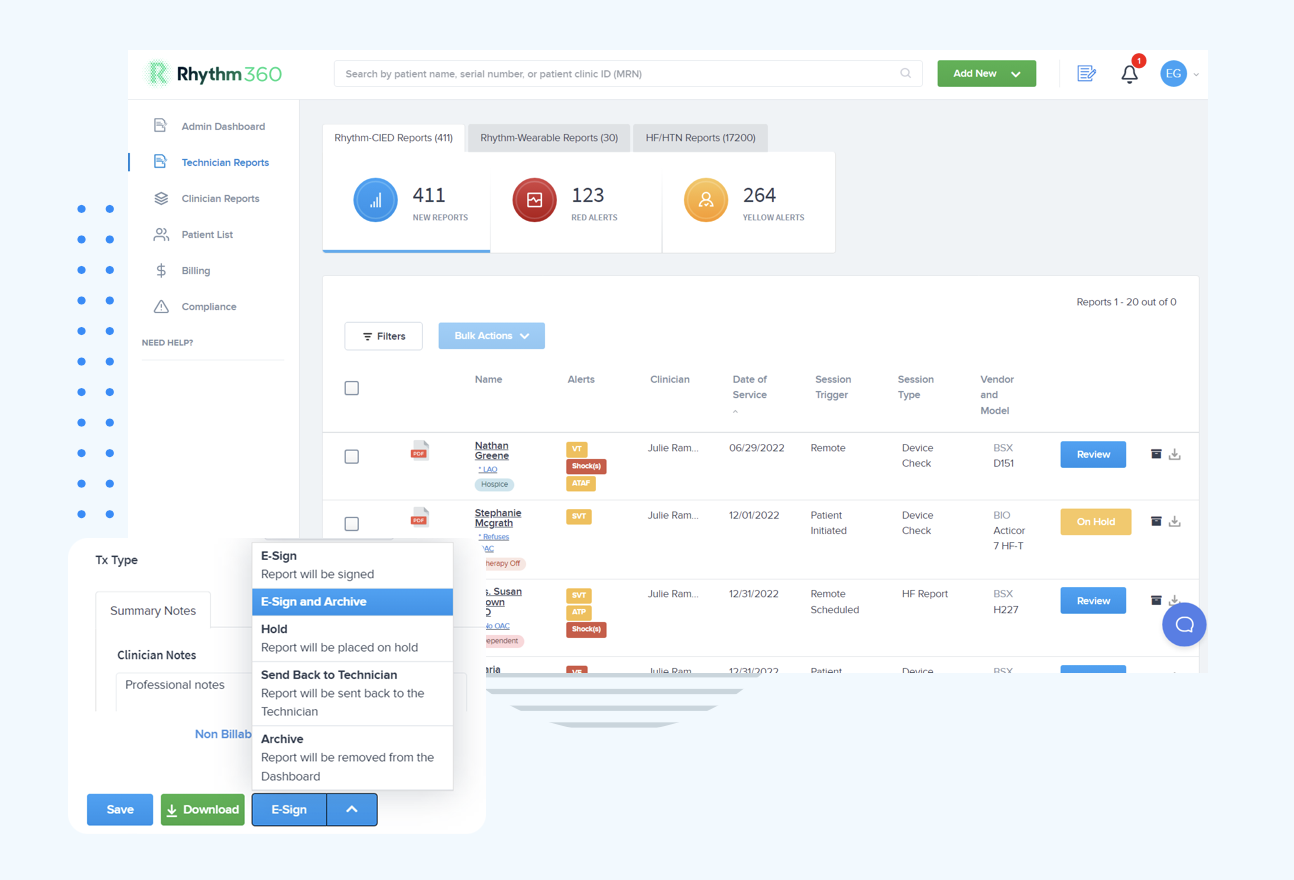
The platform's automated time-tracking module logs every RPM-related clinical activity, including transmission reviews, alert responses, phone calls, and documentation, against each patient's monthly time ledger. Staff see a real-time counter per patient, receive threshold alerts when a patient approaches the 20-minute mark for 99457 or the next 99458 increment, and generate audit-ready documentation with timestamps, staff identity, and activity descriptions already populated. Bi-directional EHR integration with Epic, Cerner, Athenahealth, eClinicalWorks, Greenway Health, and others via HL7 means that documentation flows directly into the patient record without manual transcription.
Rhythm360's AI alert triage system filters non-actionable transmissions and prioritizes clinically significant events, including new-onset atrial fibrillation, ventricular tachycardia, lead malfunction, and ERI/RRT indicators, which reduces critical response times by up to 80%. Faster response times directly support the interactive-contact documentation requirement for 99457, 99470, and 99458. The platform's secure, HIPAA-compliant mobile application allows clinicians to review transmissions, sign reports, and coordinate care from anywhere, so weekend and after-hours events are acknowledged within compliant timeframes.
Practices implementing Rhythm360 have documented up to a 300% increase in revenue generation through more complete CPT code capture, improved staff efficiency, and the addition of RPM service lines for heart failure and hypertension management.
The 2026 addition of CPT 99445 and 99470 creates a billing pathway for patients who previously generated no RPM revenue because they could not meet the 16-day transmission or 20-minute time thresholds. CMS added these short-period codes specifically to allow billing for complex cardiac patients who do not meet traditional 16-day or 20-minute thresholds.
The layering logic for a given patient in a given month follows a simple decision tree. If the patient transmits on 2–15 days, bill 99445 (approximately $52) rather than forfeiting the device-supply code entirely. If clinical staff time reaches 10–19 minutes with one interactive contact, bill 99470 (approximately $26) rather than billing nothing. If time reaches 20 minutes, shift to 99457 and add 99458 units for each additional 20-minute increment. Three services may be stacked into a monthly RPM claim: one-time setup (99453), a single device-supply code (99445 or 99454), and one treatment-management code (99470 or 99457 plus 99458 add-on).
For practices with heart failure and hypertension patient populations, Rhythm360's integrated HF/HTN service line enables the same automated documentation and billing support applied to CIED patients. RPM services may be billed concurrently with chronic care management, transitional care management, behavioral health integration, principal care management, or chronic pain management services, provided time and effort are not double-counted. The 99457 capture improvements discussed earlier combine with these short-duration codes to create multiple revenue pathways for previously unbillable patients. A correctly stacked CCM and RPM workflow can capture $1,300 or more per complex cardiac patient per year; when including full device interrogation codes, the total can reach approximately $3,000 per year per patient.
One payer-mix consideration affects program design. UnitedHealthcare announced that its Commercial, Individual Exchange, and Medicare Advantage policies would cover RPM only for heart failure or hypertensive disorders of pregnancy effective January 1, 2026, but the policy implementation was delayed until further notice. Medicare fee-for-service continues broader coverage. Practices should verify coverage by payer before enrolling patients in RPM programs to avoid claim denials on the front end.
Rhythm360's implementation process, including EHR integration setup, typically takes from a few days to a few weeks depending on the size of the practice and the complexity of the EHR environment. The platform supports bi-directional integration with Epic, Cerner, Athenahealth, eClinicalWorks, Greenway Health, and others via HL7. Because Rhythm360 is cloud-based and vendor-neutral, practices do not need to replace existing OEM relationships or device infrastructure, and the platform ingests data from all major manufacturers from day one.
Rhythm360 uses a SaaS-based pricing model that scales based on clinic size and platform usage. This structure creates a flexible, value-adjusted investment rather than a fixed high setup fee, so it remains accessible for solo practitioners and electrophysiology clinics as well as large integrated health systems managing thousands of CIED patients. Specific pricing is discussed during the demo and scoping process, where the team can align the platform configuration to the practice's patient volume and service lines.
Payer verification for 2026 RPM codes involves several distinct steps. First, confirm whether the payer follows Medicare fee-for-service guidelines or applies its own coverage policy, because Medicare Advantage and commercial plans frequently differ from traditional Medicare on covered diagnoses, required prior authorization, and documentation standards. Second, check the payer's current RPM policy for covered indications; for example, UnitedHealthcare's 2026 commercial policy limits RPM coverage to heart failure and hypertensive disorders of pregnancy. Third, verify modifier requirements for component billing of 9329x codes, as some payers require modifier 26 or TC to distinguish professional and technical components. Fourth, confirm consent documentation requirements, since some payers require written consent while Medicare fee-for-service accepts verbal consent documented in the record. Finally, establish a process for tracking payer-specific denial patterns monthly so that billing rules can be updated as payer policies change mid-year.
Practices implementing Rhythm360 have documented two headline outcomes: an 80% reduction in response times for critical patient alerts and up to a 300% increase in revenue generation through more complete CPT code capture and improved staff efficiency. The revenue gains stem from capturing previously missed 99457 and 99458 units, recovering transmission shortfalls before billing windows close, and eliminating manual documentation gaps, improvements detailed in the sections above.
The 2026 CPT code landscape for remote heart rhythm monitoring is more complete than it has ever been. New short-duration codes 99445 and 99470 fill gaps that previously left revenue on the table, the G0511 retirement opens individual RPM billing for FQHCs and RHCs, and the 93296 RVU increase rewards practices that track 90-day interrogation windows accurately. The practices that capture this revenue are those with automated transmission logging, real-time time tracking, and a monthly audit process that closes gaps before the billing window closes, not those with the largest staff or the most OEM portal logins.
Rhythm360 provides the infrastructure to make that automation operational. The platform delivers vendor-neutral data ingestion across all major device manufacturers, AI-powered alert triage, automated CPT code documentation, and bi-directional EHR integration in a single HIPAA-compliant environment.