Last updated: July 13, 2026
Each new implanted device from a different manufacturer adds another siloed web portal for staff. Medtronic's CareLink, Boston Scientific's LATITUDE, Abbott's Merlin.net, and Biotronik's Home Monitoring all require separate logins, separate data exports, and separate reconciliation steps. Proliferation of third-party vendors causes each new input to demand its own login and workflow, which worsens system fragmentation across cardiovascular service lines.
The downstream effects are measurable. An estimated $8.3 billion is lost annually in the U.S. healthcare sector due to poor data integration and interoperability failures. At the clinic level, device technicians spend hours each day toggling between portals instead of reviewing clinically actionable data. Andrew Beaser, MD, Associate Professor of Medicine at the University of Chicago Medicine, described pre-implementation workflows as "a major challenge and incredibly difficult." Gaurav A. Upadhyay, MD, FACC, FHRS, Director of the Pacing & Defibrillation Device Clinic at UCM, added that "staffing was always an issue for our center, because our device clinic, like many other medical centers, had struggled with technician turnover and timely weekend coverage."
Unfilled electrophysiology positions can create significant revenue loss for departments. Technician retention becomes a financial imperative, not just an operational concern.
A vendor-neutral cardiac data management platform resolves fragmentation by ingesting data from all major OEMs through a combination of direct APIs, HL7 messaging, XML feeds, and computer-vision PDF parsing. Rhythm360 applies this multi-channel ingestion architecture to normalize disparate data streams into a single source of truth, achieving >99.9% data transmissibility through redundant feeds and AI-powered gap extrapolation.
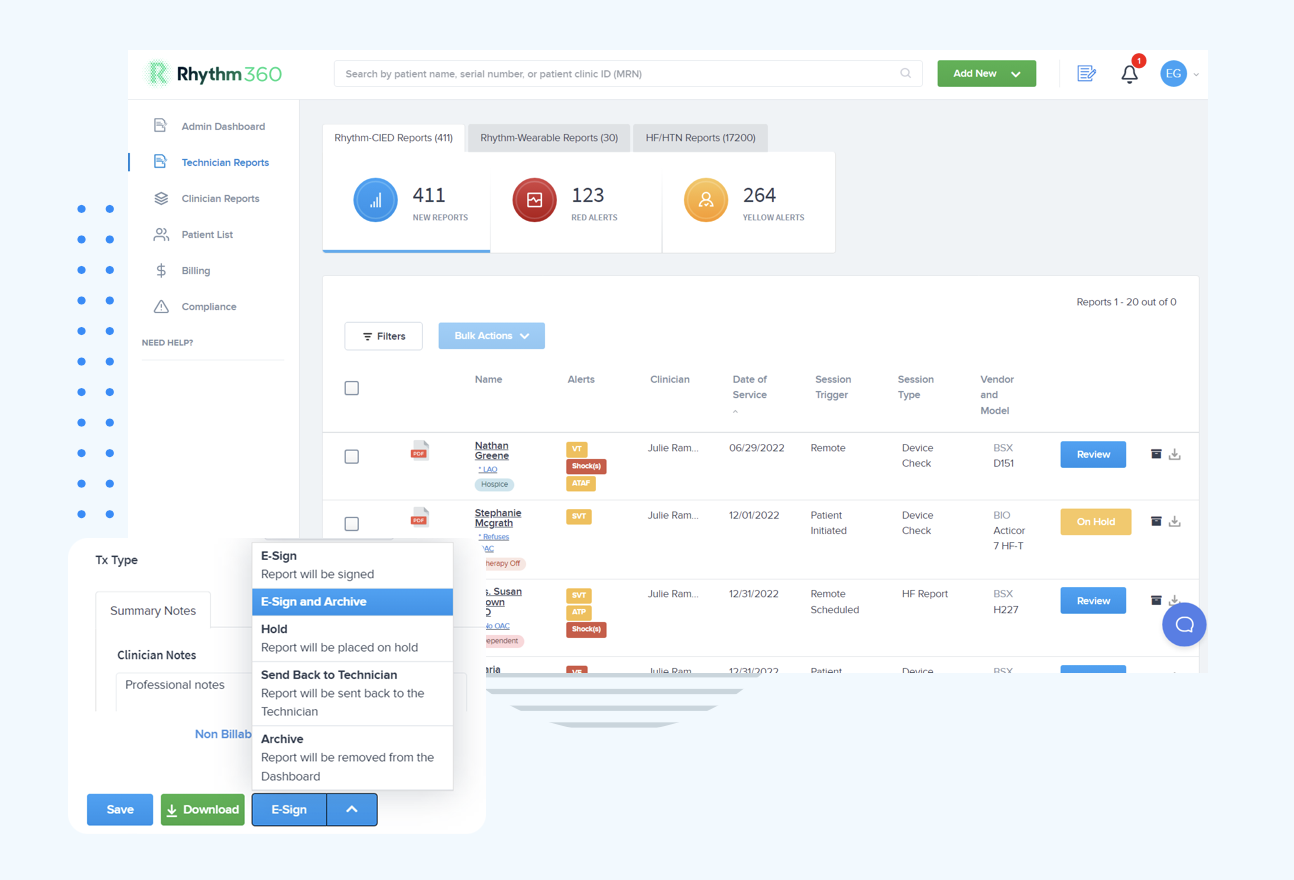
Dr. Upadhyay at UCM summarized the clinical value directly: "That was a big piece for us, to have an integrated review of data from trained personnel." The result at UCM was a monitoring program that reviewed more than 73,000 reports annually through Rhythm360 in calendar year 2025, averaging more than 18,000 reports per quarter. That volume would be operationally impossible across disconnected OEM portals.
The 2026 HFSA/AAHFN scientific statement on integrated health technologies in heart failure reinforces this architecture. Interoperability is key because seamless data flow between devices, EHRs, and clinicians forms the foundation of integrated care. Once data from multiple manufacturers flows into a unified workspace, the next challenge emerges: determining which alerts require immediate clinical attention.
Alert fatigue creates a documented patient-safety risk in remote cardiac monitoring. A cross-manufacturer analysis of 2,659 rhythm episodes from 1,710 patients found that even in AI-equipped devices, 32.9% of episodes were non-actionable and 30.6% were indeterminate. As Niraj Varma, MD, PhD, Consultant Electrophysiologist at the Cleveland Clinic, stated, "False-positive alerts remain one of the biggest operational challenges in remote cardiac monitoring. Every episode flagged by an implantable cardiac monitor must be reviewed by a clinician, yet even devices equipped with manufacturer AI algorithms still generate a substantial number of non-actionable alerts."
Rhythm360's AI-powered alert triage layer filters non-actionable noise and surfaces clinically significant events, including new-onset AFib, ventricular tachycardia, ERI/RRT indicators, and significant HF weight gain, for immediate review. The practical impact is an 80% reduction in critical alert response times.
Consider a Saturday-morning scenario. At 7:14 AM, a patient's ILR transmits a new-onset AFib episode. Rhythm360's AI triage engine classifies it as high-priority within minutes and routes a mobile notification to the on-call EP. By 9:30 AM, the clinician has reviewed the transmission, confirmed the arrhythmia, and initiated anticoagulation. Without automated triage, that transmission would have sat in an OEM portal queue until Monday morning, which creates a 48-hour window of stroke risk. Dr. Beaser at UCM confirmed this shift: "We are able to address these issues earlier; rather than waiting for a 3-month visit, we can call patients in for evaluation."
Dr. Beaser also noted that "decision support, including AI-assisted decision support, will become increasingly important as data volumes grow."
Manual billing workflows for remote cardiac monitoring reliably create revenue leakage. A 500-patient cardiology RPM program leaves more than $400,000 per year on the table when the 20-minute rule, 16-day transmission rule, and 90-day device interrogation cycles are tracked manually. Specific code-level gaps are well documented:
Rhythm360 automates CPT capture for codes including 93298, 99454, and 99457 by surfacing billable thresholds before month-end, generating compliant documentation, and integrating directly with billing workflows. Practices implementing Rhythm360 have achieved a 300% increase in revenue generation through improved CPT code capture and the addition of new RPM service lines. Dr. Upadhyay, whose team faced the staffing challenges described earlier, confirmed: "We have improved billing and accountability for our patients after the integration."
Bi-directional EHR integration transforms remote monitoring data from a siloed report into a living clinical record. Traditional remote cardiac monitoring platforms rely on batch syncing with the EHR, which pulls data on a schedule and does not refresh when a clinician opens a report. Rhythm360 uses real-time API and HL7 connections with major EHR systems to push device data into discrete EHR fields and pull current patient context, such as medications, hospitalizations, and anticoagulation status, back into the monitoring workflow.
The 2026 HFSA/AAHFN scientific statement recommends integrating patient-generated data into EHR dashboards to provide clinicians with visibility into remote monitoring information. Meeting this recommendation requires a structured integration process. Rhythm360's implementation, including full EHR integration, completes in a few days to a few weeks by following a defined sequence of milestones. The following checklist covers those core steps:
On-call clinicians need full access to monitoring workflows without staying tethered to a workstation. Rhythm360's HIPAA-compliant mobile application allows EPs and cardiologists to review transmissions, sign reports, and coordinate care from their smartphones, which closes coverage gaps on evenings, weekends, and holidays.
Dr. Beaser at UCM described the practical shift in his own workflow: "I am more likely to sign off on these while in meetings because I can easily access them on my phone." That accessibility directly supports the faster response times discussed earlier. When the Saturday-morning AFib alert fires, the on-call clinician receives a prioritized mobile notification, reviews the full transmission context, including current anticoagulation status pulled from the EHR, and initiates a care protocol before the patient's next meal. The alternative, a transmission sitting unreviewed in an OEM portal until Monday, represents an avoidable clinical risk.
Remote access solutions for cardiology must implement end-to-end encryption together with phishing-resistant MFA, RBAC mapped to clinical roles, and tamper-evident audit trails before connecting to EHR or RPM platforms. Rhythm360's mobile architecture meets these requirements natively.
The following table consolidates key technical specifications and clinical outcomes from the sections above, so you can quickly compare Rhythm360 to your practice requirements.
| Feature | Rhythm360 Metric |
|---|---|
| Vendor-neutral OEM unification (Medtronic, Boston Scientific, Abbott, Biotronik, and others) | Single dashboard via API, HL7, XML, and computer-vision PDF parsing |
| Data transmissibility | >99.9% (see section 2 for methodology) |
| AI-powered alert triage | Significant reduction in critical alert response times |
| Automated CPT capture (93298, 99454, 99457, and related codes) | Up to 3x revenue improvement (see section 4) |
| Bi-directional EHR integration | Real-time data flow with patient context pulled at report open (see section 5) |
| HIPAA-compliant mobile access | Full transmission review, report signing, and care coordination from any device |
| Implementation timeline | Efficient go-live including EHR integration |
Schedule a demo to walk through each capability with a Rhythm360 specialist.
Understanding Rhythm360's capabilities is one step; determining whether they align with your practice's specific needs is another. Selecting an automated heart rhythm monitoring workflow tool requires evaluating both clinical and operational fit. The following checklist maps directly to the pain points that drive practices to seek a unified solution, including automated CPT billing for remote monitoring programs:
Rhythm360 provides a structured implementation roadmap that proceeds in three phases: onboarding, configuration, and activation. The initial phase establishes the legal and technical foundation, including credentialing, BAA execution, OEM portal connections, and EHR integration setup. Once those connections are in place, the middle phase validates data accuracy through patient matching, alert configuration, and staff training. The final phase then activates full monitoring, automated CPT billing for remote monitoring workflows, and confirms alert routing accuracy, which ensures the system is production-ready.
Troy Leo, MD, MHCM, FACC, Service Line Leader for Heart and Vascular at Atrium Health, observed, "At the end of the day, infrastructure wins. You may not be able to realize the gains right away, but the ones that invest in infrastructure now are going to be the winners."
What makes a cardiac monitoring platform truly vendor-neutral?
A genuinely vendor-neutral platform ingests and normalizes data from all major device manufacturers, such as Medtronic, Boston Scientific, Abbott, Biotronik, and others, without requiring staff to log into separate OEM portals. Rhythm360 achieves this through a combination of direct APIs, HL7 messaging, XML feeds, and computer-vision PDF parsing, which delivers a unified patient view regardless of which manufacturer's device is implanted.
How does automated CPT billing improve revenue without creating compliance risk?
Automated CPT capture tracks billable thresholds, including transmission counts, clinician review time, and 90-day interrogation windows, in real time and surfaces documentation gaps before they become missed claims or denials. Rhythm360 generates compliant documentation tied to each billable event, creating an auditable record that supports CPT codes including 93298, 99454, and 99457 while reducing the manual time-logging errors that trigger OIG audit flags.
How long does it take to integrate Rhythm360 with an existing EHR system?
Rhythm360's implementation process, including bi-directional EHR integration with systems such as Epic, Cerner, and Athenahealth, typically completes within a few days to a few weeks. The onboarding team handles interface configuration, patient matching validation, and alert routing testing before go-live, so clinical staff transition to the new workflow without a disruption period.
Can on-call clinicians access and act on alerts outside the office?
Rhythm360's HIPAA-compliant mobile application gives on-call EPs and cardiologists full access to transmission reviews, AI-triaged alert queues, and report signing from any smartphone. This mobile capability is the mechanism behind the faster critical response times, because clinicians can act on a Saturday-morning AFib alert within minutes rather than waiting until the next business day.
Fragmented OEM portals, alert fatigue, missed CPT revenue, and on-call coverage gaps are operational problems with a documented solution. Rhythm360 delivers vendor-neutral data unification, AI-powered triage, automated CPT documentation, bi-directional EHR integration, and HIPAA-compliant mobile access in a single platform, with a 30-day go-live timeline and outcomes including faster critical response and up to 300% revenue improvement.
Schedule a demo and see how Rhythm360 can remove your clinic's cardiac monitoring headaches.