Last updated: June 20, 2026
A covered entity must execute a BAA with any cloud storage provider that creates, receives, maintains, or transmits ePHI before any PHI is transferred to that service. The following seven-step checklist reflects current regulatory expectations and the proposed Security Rule modernization targeting a final rule around May 2026.
With these seven requirements established, the following sections evaluate how widely used cloud storage platforms measure against this baseline, starting with the three consumer-grade services most commonly misused for PHI storage.
Google Drive can be configured for HIPAA compliance under specific Google Workspace business plans with a signed BAA executed through Google's Admin Console. The most common BAA-related mistake is signing with the right vendor on the wrong plan tier, and the free consumer version of Google Drive carries no BAA eligibility. Even on an eligible plan, the covered entity must restrict ePHI to HIPAA-covered Google services, configure sharing permissions to prevent unauthorized external access, and enforce MFA across all accounts. Google Drive provides no cardiology-specific integrations, CPT billing automation, or CIED data normalization.
Dropbox offers BAA coverage on multiple business-tier plans including Standard, Advanced, Business, Business Plus, Enterprise, and Education. Without a signed BAA before PHI transfer to a cloud storage vendor, the covered entity has a Privacy Rule problem under 45 CFR 164.502(e). Dropbox's standard feature set does not include role-based access controls granular enough for multi-clinician cardiology workflows, and it does not offer EHR interoperability, alert triage, or automated documentation for remote monitoring CPT codes such as 93298, 93299, or 99454.
Apple does not offer a BAA for iCloud in any consumer or standard business configuration as of June 2026. Free tiers of iCloud are ineligible for HIPAA-compliant PHI storage. Apple Business Essentials provides some managed device controls but does not extend to a signed BAA covering iCloud storage of ePHI. Cardiology practices must not use iCloud to store, transmit, or receive CIED transmissions, RPM readings, or any other PHI without explicit BAA coverage, which Apple does not currently provide for iCloud storage services.
The following table highlights the difference between general-purpose HIPAA-compliant storage and cardiology-focused platforms. All listed vendors can support technical safeguards, but only Rhythm360 adds CIED workflows, billing automation, and mobile tools tailored to cardiac care teams.
| Provider | BAA Availability | Cardiology Integrations & CPT Billing | Mobile Access & Pricing Model |
|---|---|---|---|
| Box | Business Plus or Enterprise plan required | None native, no CIED ingestion or CPT automation | Mobile app available, per-user SaaS pricing |
| Microsoft 365 | Business Premium or higher, ePHI must be restricted to HIPAA-eligible services | None native, no cardiology workflow automation | Mobile apps available, per-user SaaS pricing |
| Google Cloud | BAA available, organization must restrict ePHI to covered services and configure safeguards | None native, requires custom development for any clinical workflow | Mobile access via Workspace apps, per-user or consumption pricing |
| Sync / Proton | BAA available on paid business tiers, end-to-end encryption emphasized | None, general-purpose file storage only | Mobile apps available, per-user SaaS pricing |
| Rhythm360 | BAA included, purpose-built HIPAA-compliant architecture for cardiac ePHI | Vendor-neutral CIED ingestion (Medtronic, Boston Scientific, Abbott, Biotronik), automated CPT documentation for 93298, 93299, 99453, 99454, 99457 | HIPAA-compliant mobile app for on-call clinicians, flexible SaaS pricing scaled to clinic size |
Generic cloud storage platforms are a common source of HIPAA violations in document workflows because they lack healthcare-specific compliance design, including granular RBAC and audit logging. These technical gaps create compliance exposure, but for cardiology practices the operational consequences extend well beyond regulatory risk.
The same platforms that fail to provide adequate access controls also lack the clinical workflow infrastructure cardiology requires. When a practice implants devices from more than one OEM such as Medtronic, Boston Scientific, Abbott, or Biotronik, staff must log into multiple non-interoperable portals to retrieve patient data. A critical event such as new-onset atrial fibrillation, ventricular tachycardia, or device malfunction can be missed due to manual processes, unreliable data transmission, or alert fatigue from an overwhelming volume of non-actionable notifications.
The absence of a centralized system for tracking billable events leads to missed revenue and rejected claims, particularly for complex remote monitoring CPT codes. A May 2026 Trend Micro analysis identified 3,627 exposed DICOM servers, demonstrating that even major cloud platforms with HIPAA-compliant offerings do not prevent exposure when organizations misconfigure security settings. Generic storage tools place the entire configuration burden on the practice and provide no cardiology-specific guardrails.
Rhythm360 ingests and normalizes data from all major CIED manufacturers using API, HL7, XML, and PDF parsing via computer vision. This architecture achieves greater than 99.9% transmissibility through redundant data feeds and AI-powered extrapolation. Bi-directional EHR integrations with Epic, Cerner, Athenahealth, eClinicalWorks, and Greenway Health remove manual transcription and ensure that device data flows directly into the patient record.
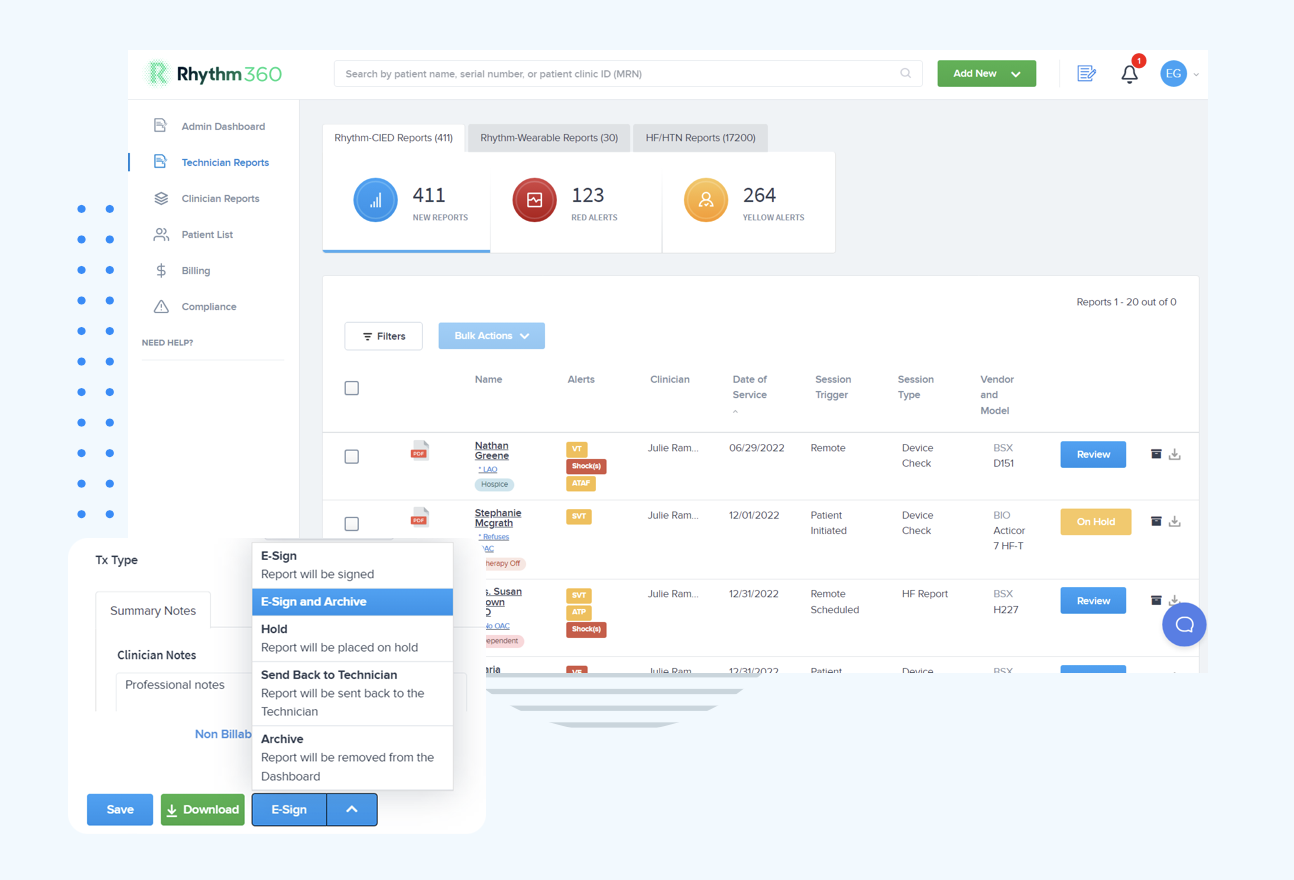
The platform's AI-powered alert triage filters non-actionable notifications and prioritizes clinically significant events such as ventricular fibrillation, lead malfunction, ERI or RRT indicators, and significant weight gain in heart failure patients. These capabilities reduce critical alert response times by up to 80%. Optional 24/7/365 oversight by certified cardiac technicians (CCTs) supervised by physicians provides an additional safety layer for practices that require continuous monitoring.
Small and solo cardiology practices face the same HIPAA obligations as large health systems but with fewer administrative resources to meet them. Rhythm360's SaaS-based pricing addresses this constraint by scaling costs to clinic size and platform usage, which removes large capital barriers that keep smaller practices on manual workflows. The onboarding process, including EHR integration, typically completes within days to a few weeks so practices see compliance and revenue benefits quickly.
A centralized dashboard eliminates reliance on a single super-user and supports business continuity when staff turnover occurs. Automated CPT code capture and documentation reduces the hours staff spend chasing billing documentation and improves margins without adding headcount.
Large integrated health systems managing thousands of CIED patients require infrastructure that scales without compromising compliance or clinical oversight. Rhythm360 supports high-volume patient populations through population-health dashboards that provide real-time visibility into device compliance metrics, critical alert queues, and captured versus potential revenue by CPT code.
Bi-directional EHR integration at the enterprise level ensures that data flows consistently across facilities. Optional 24/7 CCT oversight provides continuous monitoring coverage regardless of time zone or on-call staffing gaps.
Beyond the technical safeguards in the checklist above, three contractual questions determine whether the vendor relationship will remain compliant and operationally viable over the contract term. Key contractual questions: Does the BAA cover API logs and integration platforms that contain ePHI, a gap that often appears only after implementation when practices discover their integration layer is not covered? What are the documented RTO and RPO objectives, and do they align with your practice's tolerance for downtime during a system failure? How does the vendor handle PHI return or destruction at contract termination, and does the process meet your state's data retention and destruction requirements?
Civil penalties for HIPAA non-compliance currently range from $145 to $2,190,294 per violation (depending on culpability tier), with annual caps of approximately $2.13 million per violation category after 2026 inflation adjustments. These penalty risks make compliance the floor, not the ceiling, of vendor evaluation. For cardiology practices, the financial exposure from a single misconfigured storage bucket or unsigned BAA can exceed the cost of a purpose-built compliant platform.
Beyond avoiding penalties, practices that consolidate CIED and RPM data into a unified, automated platform recover previously lost CPT billing revenue. Rhythm360 clients have documented up to a 300% increase in revenue generation through optimized CPT code capture and improved staff efficiency. This revenue recovery directly supports the third strategic dimension, which is staff retention.
Staff retention is an underappreciated dimension of this decision. Device technicians and clinical staff experiencing burnout from administrative overload and alert fatigue are difficult to replace. A platform that removes redundant portal logins, automates reporting, and prioritizes only actionable alerts reduces the conditions that drive turnover.
Schedule a demo to review how Rhythm360's compliance architecture and cardiology-specific workflows map to your practice's current infrastructure.
A HIPAA-eligible service is one that a vendor has designated as capable of supporting HIPAA compliance and for which the vendor will sign a Business Associate Agreement. HIPAA-compliant means the covered entity has executed that BAA, restricted ePHI to the eligible services, and configured the required safeguards such as encryption, access controls, audit logging, and MFA. Eligibility is a vendor designation, while compliance remains the responsibility of the healthcare organization using the service.
A cardiology practice can use Google Drive or Dropbox for CIED transmission data only on paid business plan tiers with a signed BAA in place. The practice must also configure sharing permissions, MFA, and access controls to meet HIPAA's technical safeguard requirements. Neither platform provides CIED data ingestion, OEM portal consolidation, CPT billing automation, or EHR interoperability, so the practice must build and maintain all clinical workflow infrastructure separately, which creates significant administrative burden and compliance risk.
Rhythm360 provides a dedicated HIPAA-compliant mobile application that enforces the same authentication, encryption, and access control standards as the desktop platform. Clinicians can review CIED transmissions, sign reports, and coordinate care from their smartphones without accessing unsecured consumer applications. All mobile access events are captured in the platform's audit log, which maintains a complete chain of custody for every PHI interaction regardless of the device used.
Rhythm360 automates documentation and billing support for the primary remote cardiac monitoring CPT codes, including 93298 and 93299 for implantable cardiovascular physiologic monitor analysis, and 99453, 99454, and 99457 for remote physiological monitoring of chronic conditions such as heart failure and hypertension. The platform tracks billable events in real time, generates compliant documentation, and surfaces captured versus potential revenue in the administrative dashboard, which reduces the manual effort required to close billing gaps.
Implementation timelines are detailed in the Small Cardiology Practices section above, with most practices going live within days to weeks depending on their size, EHR environment, and number of OEM device connections. The platform is designed to minimize disruption to existing clinical workflows, and the SaaS pricing model removes large upfront infrastructure costs so practices begin seeing value shortly after go-live.
Generic HIPAA-compliant cloud storage satisfies baseline regulatory requirements for file storage but leaves cardiology practices with fragmented OEM data, unmanaged alert queues, and incomplete CPT documentation. The compliance checklist, provider comparison, and implementation guidance in this article establish a consistent set of objective criteria, including a signed BAA on the correct plan tier, AES-256 and TLS 1.2+ encryption, MFA and RBAC enforcement, tamper-evident audit logs, and a documented shared-responsibility matrix.
Against those criteria, Rhythm360 is the only platform in this comparison that combines full HIPAA compliance architecture with vendor-neutral CIED data ingestion, AI-powered alert triage, bi-directional EHR integration, automated CPT billing documentation, and a HIPAA-compliant mobile application. These capabilities deliver the alert triage and billing automation improvements documented earlier in this guide for cardiology practices of every size.
Schedule a demo to see how Rhythm360 replaces fragmented storage and OEM portals with a single, compliant, cardiology-purpose-built platform.