
HIPAA Compliant Video Conferencing for Cardiology Telehealth
Compare HIPAA compliant video conferencing for cardiology telehealth. Rhythm360 unifies compliant video with vendor-neutral CIED data. Learn more.

Last updated: June 19, 2026
Key Takeaways for Cardiology Telehealth Leaders
- HIPAA compliant video conferencing requires encryption, MFA, role-based access controls, audit logging, and a signed BAA covering all vendors handling ePHI.
- Cardiology practices face elevated compliance risk and revenue leakage when video tools, CIED data, and EHR systems operate in disconnected silos.
- Before selecting a platform, verify baseline requirements including signed BAAs, encryption standards, EHR connectivity, and vendor-neutral CIED data access.
- Top platforms such as Zoom for Healthcare, Microsoft Teams Healthcare, and Doxy.me meet HIPAA standards on qualifying plans but vary in EHR integration depth and configuration needs.
- See how Rhythm360 unifies compliant video workflows with vendor-neutral CIED data, AI alert triage, and automated CPT billing in a live demo.
Why HIPAA Compliant Video Conferencing Matters for Cardiology Practices
A retrospective cohort study of 23,334 cardiologists found that electrophysiologists used telemedicine at a rate 57% higher than general cardiologists (aIRR 1.57, 95% CI 1.47–1.67) during 2022–2023 Medicare fee-for-service encounters, with unadjusted telemedicine visit rates of 4.5% for electrophysiologists versus 3.4% for general cardiologists. That volume of virtual encounters creates a proportionally large compliance surface.
Cardiology practices face a compounding problem. Fragmented OEM portals for CIED data, disconnected video tools, and manual CPT documentation workflows operate in silos. Each gap is a potential HIPAA violation and a source of revenue leakage. Temporary HIPAA enforcement discretion for telehealth ended in August 2023, meaning every virtual cardiology visit is now subject to full HIPAA Privacy and Security Rule enforcement. Practices that have not audited their video tools since the pandemic era face material compliance risk.
Fragmented workflows also suppress CPT capture. Remote monitoring codes such as 93298, 93299, 99454, and 99457 require documented, time-stamped clinical interactions. When video visit records and CIED transmission data live in separate systems, billing staff cannot efficiently reconcile billable events. Revenue is lost.
Prerequisites: BAAs, EHR Links, and CIED Data Foundations
Before evaluating specific platforms, confirm the following baseline requirements are met. The first five items are legal and technical prerequisites for any HIPAA-compliant video platform. The final two are cardiology-specific integration requirements that determine whether the platform can function within your clinical workflow.
- Signed BAA with every video conferencing vendor, storage provider, and any AI transcription service used during visits
- Encryption for all data in transit and at rest, including recordings
- MFA enforced for all clinical staff accounts
- Role-based access controls limiting ePHI visibility to authorized personnel
- Audit logging: HIPAA requires certain documentation to be retained for six years, but does not prescribe a specific retention period for audit logs, and organizations often apply the six-year rule to logs as a best practice
- Vendor-neutral CIED data access so that device transmissions from Medtronic, Boston Scientific, Abbott, Biotronik, and others feed a single normalized record
- Bi-directional EHR integration (HL7 or FHIR) to eliminate manual transcription between video visit notes and the patient chart
Step 1: Verify Current BAA and Encryption Standards
HHS guidance classifies software vendors and service providers as business associates due to "persistent access" to PHI on their servers, even when the covered entity holds the decryption key. Marketing language such as "HIPAA-ready" carries no legal weight. A signed BAA is legally required before any PHI is shared, and it must extend to every infrastructure component, including cloud hosting environments, media relay servers, content delivery networks, and storage services.
For Microsoft Teams, organizations must verify and accept the BAA through the Microsoft 365 Compliance Center or Service Trust Portal, because older BAA references may be outdated or unsigned. Teams does not operate as HIPAA-compliant by default. It requires Microsoft 365 E3/E5 or Business Premium plans and explicit configuration of MFA, DLP policies, and audit logging via Microsoft Purview.
The HIPAA Security Rule (45 C.F.R. § 164.312(b)) requires covered entities to implement mechanisms that record and examine activity in information systems containing ePHI, without specifying particular data elements such as user IDs or timestamps. Confirm that your video platform generates and retains these logs independently of your EHR.
In complex setups where a video platform connects directly with an EHR or uses an AI-assisted transcriber, separate BAAs must be maintained with each vendor, including the communications platform, the EHR, and the transcription service.
Step 2: Compare Top HIPAA Compliant Video Conferencing Platforms
The table below evaluates five platforms against cardiology-relevant criteria. All platforms listed offer a signed BAA on qualifying plans. Pricing and feature availability reflect publicly documented configurations as of mid-2026. Verify current terms directly with each vendor before procurement.
Platform BAA Availability Encryption Standard EHR / API Integration Zoom for Healthcare Yes, paid healthcare plan required Encryption at rest and in transit REST API, HL7 handoff via middleware Microsoft Teams Healthcare Yes, M365 E3/E5 or Business Premium, must be explicitly acceptedEncryption at rest and in transit, MFA and DLP required via Purview Microsoft Graph API, Epic integration available Doxy.me Yes, included on paid plans Encryption at rest and in transit Limited native EHR integration, browser-based, no download required Google Meet (Healthcare) Available via Google Workspace for Healthcare, standard Meet lacks BAA Encryption in transit and at rest on Workspace plans Google Workspace APIs, limited native HL7 support
Pexip, an enterprise-grade video interoperability platform, supports BAA execution and offers on-premises or private cloud deployment, which can satisfy strict data-residency requirements for large health systems. Its HL7 and API capabilities make it a viable option for practices that require deep EHR integration, although it typically requires dedicated IT resources to configure and maintain.
General-purpose tools such as standard Zoom, Google Meet, and Microsoft Teams lack native EHR integration, automated consent capture, and clinical documentation tied to sessions, which creates compliance gaps when practices use them alongside separate EHR systems. Cardiology practices should treat EHR connectivity as a non-negotiable selection criterion, not an optional enhancement. Once you identify platforms that meet baseline compliance and EHR requirements, the next step is mapping how those platforms connect to your existing clinical systems.
Step 3: Map Integration Paths with EHR and Vendor-Neutral RPM Systems
A compliant video platform forms only one layer of a cardiology telehealth stack. The integration path must connect the video encounter to the patient EHR record and to the CIED transmission data that informs the clinical conversation.
Rhythm360 integrates bi-directionally with Epic, Cerner, Athenahealth, eClinicalWorks, Greenway Health, and others via HL7, and ingests CIED data from all major OEMs, including Medtronic, Boston Scientific, Abbott, and Biotronik, through APIs, HL7, XML, and AI-powered PDF parsing via computer vision. A clinician conducting a telehealth visit can review a normalized, complete CIED transmission record within the same workflow, without toggling between OEM portals.
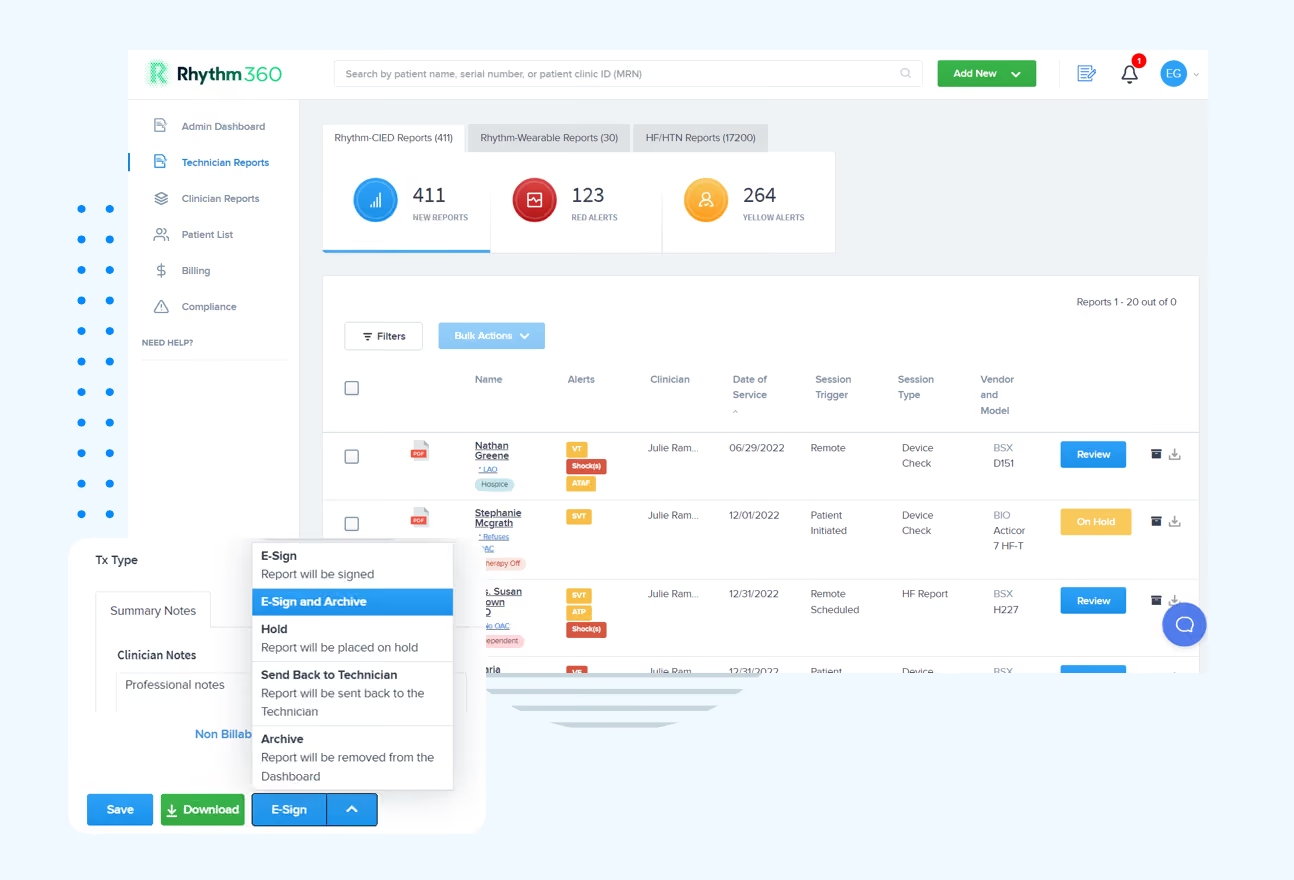
The integration path for a mid-sized electrophysiology practice typically follows this sequence: video platform to EHR (via HL7 or FHIR) to Rhythm360 (vendor-neutral CIED and RPM data layer) to automated CPT documentation. Each handoff point requires a signed BAA with the respective vendor.
Step 4: Common Violations and Configuration Pitfalls
Configuration and process errors cause most compliance failures in cardiology telehealth, not encryption gaps.
- Unsigned or outdated BAAs: Vendors qualify as business associates due to persistent server access to PHI, so BAAs must be current and cover all subprocessors.
- Uncontrolled meeting recordings: Recordings containing PHI must be encrypted, access-restricted, governed by retention policies, and subject to documented deletion procedures.
- Session metadata exposure: Participant identities, timestamps, IP addresses, and other metadata qualify as PHI if identifiable and health-related, even when call content is encrypted.
- Consumer apps in clinical workflows: FaceTime and free Zoom lack BAAs and end-to-end encryption and are unsuitable for any clinical interaction involving PHI.
- Failure to verify patient identity: Patient identity verification must occur at each telehealth visit using visual confirmation, date of birth, or security questions.
- Shared or generic login credentials: HIPAA requires unique user IDs, and shared accounts prevent meaningful audit logging.
Step 5: Cardiology-Specific Configuration Checklist
- Enable waiting rooms on all video sessions to prevent unauthorized entry before the clinician joins.
- Disable meeting recordings unless a compliant, BAA-covered storage solution is in place.
- Enforce MFA for all clinical staff accounts on the video platform.
- Configure session links as unique, single-use or time-limited URLs.
- Confirm audit logging is enabled to support review of user activity and access events.
- Verify that the video platform BAA explicitly covers media relay servers and cloud storage subprocessors.
- Establish a written patient identity verification protocol for the first visit and document it in the EHR.
- Confirm that CIED transmission data is accessible within the visit workflow via a vendor-neutral RPM platform, not a separate OEM portal login.
With compliance and configuration requirements defined, the final decision variable is cost and how each platform scales with practice size.
Step 6: Cost and Scalability Considerations
Solo practices and small EP clinics typically find browser-based platforms like Doxy.me cost-effective, because they require no software installation and offer straightforward BAA execution on paid plans. Mid-sized practices with existing Microsoft 365 infrastructure may find Teams Healthcare the most economical path, provided the required E3/E5 licensing and configuration steps are completed. Large health systems with Epic or Cerner deployments often benefit from Zoom for Healthcare or Pexip due to their mature API ecosystems and enterprise support tiers.
Rhythm360 SaaS pricing scales with clinic size and platform usage, which makes it accessible from solo practitioners through large integrated health systems. Implementation, including EHR integration, typically takes from a few days to a few weeks. That timeline is significantly faster than legacy on-premise alternatives.
Pairing Compliant Video with Vendor-Neutral Cardiac RPM
A HIPAA-compliant video platform addresses the communication layer of a telehealth encounter, but that covers only part of the decision framework. The platform you select must also integrate with the clinical data layer that informs each visit. Without that integration, even a compliant video tool leaves data fragmentation unresolved and makes cardiology telehealth operationally unsustainable at scale.
Practices implanting devices from more than one OEM must log into multiple non-interoperable portals to retrieve patient data before a video visit. That workflow creates alert fatigue, documentation gaps, and missed CPT codes.
Rhythm360 resolves this by ingesting and normalizing CIED data from all major manufacturers into a single vendor-neutral dashboard, achieving greater than 99.9% transmissibility through redundant data feeds, computer vision, and AI-powered extrapolation. The AI alert triage system filters non-actionable notifications and surfaces clinically significant events, including new-onset AFib, ventricular tachycardia, lead malfunction, and ERI or RRT indicators, so clinicians enter a telehealth visit already oriented to the patient current status.
Automated CPT documentation within Rhythm360 captures billable events tied to remote monitoring codes (93298, 93299, 99454, 99457) and links them to the corresponding clinical interactions. This closes the revenue leakage gap that manual workflows create. Practices using Rhythm360 have achieved up to a 300% increase in revenue generation through optimized CPT code capture and an 80% improvement in critical alert response times.
Validation: Measurable Outcomes in Cardiology Practices
Once you select a compliant video platform and integrate it with a vendor-neutral RPM layer, the decision framework success becomes measurable. Practices that have implemented Rhythm360 alongside a properly configured HIPAA-compliant video platform report improvements across three dimensions that validate the integration investment.
The AI triage system described earlier has enabled practices to respond to urgent events, such as a Saturday morning arrhythmia flag, with same-day anticoagulation or device reprogramming. These scenarios demonstrate the clinical impact of the 80% response-time improvement. Revenue generation has increased by as much as 300% through automated CPT capture that recovers previously lost billing opportunities. Some clinics report that this increase paid for the platform implementation within the first quarter.
Staff satisfaction also improves as the administrative burden of multi-portal logins and manual data transcription is eliminated. Burnout decreases among device technicians and clinical staff.
Variations by Practice Size and Device Mix
Solo EP practices with a single-OEM device population can often manage with Doxy.me for video and a lightweight EHR integration, but they still benefit from Rhythm360 for automated CPT documentation and data reliability. Multi-OEM practices, which represent the majority of mid-sized and large cardiology groups, require a vendor-neutral RPM layer as a non-negotiable operational foundation. Without it, the administrative overhead of OEM portal management negates the efficiency gains from any video platform.
Large health systems managing thousands of CIED patients benefit most from the Rhythm360 enterprise dashboard, which provides population-level compliance metrics, real-time alert queues, and revenue tracking across all device types and service lines.
Advanced Optimization Tactics for Mature Programs
Once the baseline compliance and integration stack is in place, practices can implement automated triage rules within Rhythm360 to route alerts by severity, device type, or patient risk stratification. A ventricular fibrillation alert reaches an on-call EP immediately, while a routine battery status check enters the standard workflow queue.
Cross-team reporting dashboards allow administrators to track billable event capture rates, staff response times, and patient compliance metrics in real time. These insights support data-driven staffing and workflow decisions. The Rhythm360 secure HIPAA-compliant mobile application extends these capabilities to clinicians on call, allowing transmission review, report signing, and care coordination from any location.
Frequently Asked Questions
What makes a video conferencing platform HIPAA compliant for cardiology telehealth?
A platform is HIPAA compliant for cardiology telehealth when it provides encryption for data in transit and at rest, enforces multi-factor authentication and role-based access controls, generates tamper-evident audit logs, and executes a signed Business Associate Agreement that covers all subprocessors including media relay servers and cloud storage. HIPAA requires certain documentation to be retained for six years, but does not prescribe a specific retention period for audit logs, and organizations often apply the six-year rule to logs as a best practice. For cardiology specifically, the platform must also support integration with EHR systems and vendor-neutral RPM platforms so that CIED transmission data is accessible within the telehealth workflow. No federal agency certifies platforms as HIPAA compliant. Legal protection derives from the signed BAA, vendor security documentation, and the practice internal policies and risk assessments.
Can standard Zoom or Google Meet be used for cardiology patient visits?
Standard consumer Zoom and standard Google Meet cannot be used for any clinical interaction involving protected health information. Neither platform provides a Business Associate Agreement on free or standard consumer plans, and operating without a BAA constitutes a HIPAA violation regardless of the technical security measures in place. Zoom for Healthcare on a paid healthcare plan and Google Workspace for Healthcare both offer BAA execution and are appropriate for clinical use when properly configured. The distinction between the consumer and healthcare versions of these products is a licensing and contractual matter, not merely a feature difference.
How does Rhythm360 complement a HIPAA-compliant video conferencing platform?
Rhythm360 functions as the vendor-neutral RPM layer that sits beneath the video conferencing encounter. A compliant video platform handles the encrypted communication between clinician and patient. Rhythm360 aggregates and normalizes CIED data from all major OEMs, including Medtronic, Boston Scientific, Abbott, Biotronik, and others, into a single dashboard that clinicians access before, during, and after the telehealth visit.
Its AI-powered alert triage system filters non-actionable notifications and prioritizes clinically significant events, reducing critical response times by up to 80%. Automated CPT documentation within Rhythm360 captures billable remote monitoring events and links them to clinical interactions, which recovers revenue that manual workflows routinely miss. The platform integrates bi-directionally with major EHR systems via HL7, so telehealth visit notes and CIED data flow into a single patient record without manual transcription.
What are the most common HIPAA violations in cardiology telehealth workflows?
The most common violations are configuration and process gaps rather than encryption failures. These include using consumer-grade video apps that lack a BAA, failing to update or explicitly accept BAAs with video vendors after plan changes, storing meeting recordings in non-compliant or uncontrolled environments, using shared login credentials that prevent meaningful audit logging, and neglecting to verify patient identity at the start of each visit. In cardiology specifically, a frequent operational gap is the absence of a vendor-neutral CIED data layer, which forces clinicians to access multiple OEM portals during or before a telehealth visit. That pattern creates documentation inconsistencies and missed billing opportunities that compound compliance and revenue risks over time.
Conclusion: Turning Compliance Choices into Measurable Gains
Selecting a HIPAA-compliant video conferencing platform for cardiology telehealth in 2026 requires more than checking an encryption box. It demands verified BAA execution across every vendor and subprocessor, proper configuration of MFA, audit logging, and access controls, and a clear integration path to the EHR and CIED data systems that inform every clinical encounter. The platforms that meet these requirements, including Zoom for Healthcare, Microsoft Teams Healthcare on qualifying plans, Doxy.me, and others, provide the compliant communication layer.
Rhythm360 provides the vendor-neutral RPM layer that makes that communication clinically actionable. It delivers unified CIED data from all OEMs, AI-powered alert triage, and automated CPT documentation in a single HIPAA-compliant platform. See how Rhythm360 and a properly configured video platform work together to eliminate compliance gaps, reduce alert fatigue, and recover lost revenue in a live demonstration tailored to your practice.
.avif)