

Critical alerts in cardiac remote patient monitoring include life-threatening arrhythmias, device malfunctions, and rapid physiological changes that demand immediate action. These events include new-onset atrial fibrillation, ventricular tachycardia episodes, elective replacement indicator (ERI) warnings, lead impedance changes, and CardioMEMS pressure threshold breaches. Each alert type carries specific HIPAA exposure based on how quickly data must move and how sensitive the information is.
Alert Type | Description | Clinical Impact | HIPAA Risk |
AFib Onset | New atrial fibrillation detection | Stroke risk within hours | High, requires immediate secure transmission |
VTach/VFib | Ventricular arrhythmia events | Sudden cardiac death risk | Critical, emergency protocols needed |
Device ERI | Battery replacement indicator | Device failure within months | Medium, scheduled secure communication |
Lead Issues | Impedance or sensing problems | Therapy delivery compromise | High, diagnostic data transmission |
Set precise clinical thresholds for each alert category, document response steps, and train staff on what counts as urgent versus routine. This structure supports over 99% accurate alert prioritization and sharply reduces false positives that drive clinician fatigue.
The 2026 HIPAA Security Rule requires multifactor authentication for all systems that access ePHI and mandates TLS 1.2+ for data in transit and AES-256 for data at rest. Critical alert workflows must use end-to-end encryption from device transmission through clinical notification, with keys stored in hardened vaults that support rotation and detailed audit trails.
Use role-based access controls with least privilege so each clinician only sees the patient data needed for their role. Add automatic session timeouts, short-lived authentication tokens, and full audit logging for every alert access attempt. Execute Business Associate Agreements with all vendors that touch alert data, including device manufacturers and communication tools.
Configure alert systems to escalate automatically through secure channels when primary recipients do not acknowledge alerts within defined timeframes. Avoid standard SMS or email for critical alerts because these channels violate HIPAA transmission rules and create clear breach risk.
Fragmented OEM portals from Medtronic, Boston Scientific, Abbott, and Biotronik create silos that slow responses and increase administrative work. Vendor-neutral platforms such as Rhythm360 pull these data streams into one view through API integration, HL7 messaging, and computer vision PDF parsing to reach over 99.9% data transmissibility across device types.
Schedule a Rhythm360 demo to unify your critical alerts and remove dangerous data silos
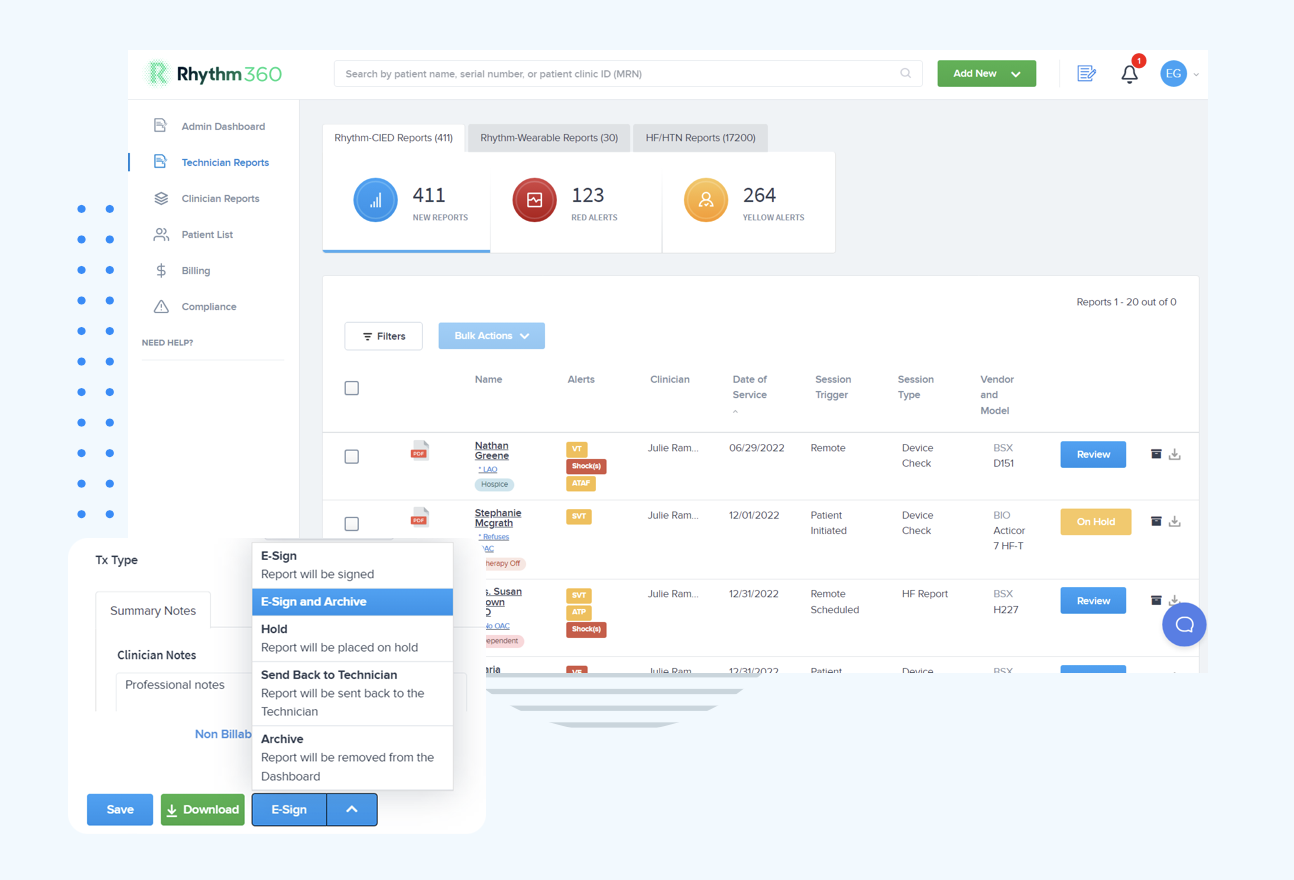
Feature | Rhythm360 | OEM Portals | Benefit |
Multi-vendor support | All major OEMs unified | Single vendor only | Removes portal switching |
Data reliability | >99.9% transmissibility | Variable, often <95% | Prevents missed critical events |
Alert prioritization | AI-powered triage | Basic threshold alerts | Cuts alert fatigue 80% |
Mobile access | HIPAA-compliant app | Vendor-specific apps | Unified 24/7 response |
Use redundant data feeds and automated backups so monitoring continues during OEM server outages. This unified model often reduces critical alert response times by up to 80% while keeping complete audit trails for HIPAA compliance.
Alert fatigue threatens patient safety, and clinical alarm management tools are growing at 32.2% CAGR as organizations adopt AI to reduce non-actionable alarms. Rhythm360’s AI reviews patient baselines, device history, and clinical context to filter noise and highlight truly critical events.
Set tiered alert levels with clear color coding, role-based routing, and concise context that supports fast decisions. New-onset AFib in a patient with prior stroke history receives immediate escalation. The same arrhythmia in a low-risk young athlete can follow a standard pathway. AI models learn from clinician actions and steadily improve prioritization accuracy.
Build escalation paths that route unacknowledged critical alerts to backup clinicians and supervisors. Group related alerts to avoid notification storms during device interrogations and apply intelligent suppression during planned maintenance windows. These steps usually cut alert fatigue by 80% while still capturing every clinically significant event.
Role-based access control keeps each user limited to the minimum ePHI needed for their work. Automated audit logs record every alert view, acknowledgment, and action with timestamps, user identity, and any data changes. The 2026 HIPAA updates require annual audits and detailed documentation of all security controls.
Rhythm360 creates complete audit trails that meet HIPAA expectations and adds real-time anomaly detection for unusual access patterns. Configure automated reports for compliance leaders that show alert response times, access violations, and system performance. Use behavioral analytics to flag after-hours access, bulk downloads, or other suspicious activity.
Apply least privilege by defining separate roles for device technicians, nurses, physicians, and administrators with granular permissions. Run regular access reviews so departing staff lose access immediately and role changes update permissions without delay.
HIPAA breach rules require 72-hour data restoration and documented incident response when ePHI is compromised. Remote monitoring programs face risks such as device communication failures, unauthorized access attempts, and transmission errors that may qualify as reportable breaches.
Create incident response playbooks tailored to remote monitoring, including failed device transmissions, unauthorized alert access, and communication platform compromises. Rhythm360 supports automated incident detection and guided workflows that isolate affected systems, preserve forensic data, and trigger notification steps. Document each incident with a clear timeline, affected patients, and remediation actions.
Remember that Business Associate Agreements do not remove breach liability for covered entities. Practices must confirm that associates maintain proper safeguards through assessments and periodic audits.
HIPAA-compliant mobile access lets clinicians handle critical alerts from anywhere while preserving encryption and audit trails. Rhythm360’s mobile app supports secure push notifications, encrypted traffic, and integration with Epic, Cerner, and other major EHRs through HL7 interfaces.
Configure mobile alerts with clear urgency tiers so ventricular arrhythmias trigger immediate notifications while routine transmissions follow standard queues. Use geofencing and time-based routing to shift on-call duties based on location and availability. Rhythm360’s 24/7 certified cardiac technician oversight adds another safety layer for nights and weekends.
In one case, a weekend AFib detection in a high-risk patient triggered an immediate mobile alert to the on-call electrophysiologist. The physician started anticoagulation within 90 minutes. Without unified mobile access, the event might have waited until Monday, with far higher stroke risk.
Many practices rely only on OEM portals, which creates roughly 20% higher miss rates for critical events because of fragmented data and slower notifications. Standard SMS or email for critical alerts also creates HIPAA violations. Encryption alone does not close the gap, since access controls, audit logs, and incident response plans carry equal weight.
Helpful tactics include using Rhythm360’s redundant data feeds for continuity during OEM outages, configuring intelligent alert grouping to avoid notification floods, and defining clear escalation paths with backup coverage. Ongoing staff training on alert protocols and platform updates keeps response performance and compliance strong.
Track success with metrics such as critical alert response time, aiming for under two hours, HIPAA audit outcomes with zero violations, revenue capture through accurate CPT coding with a target of 300% growth, and clinician satisfaction with alert workflows. Rhythm360’s dashboards surface these metrics in real time with automated reporting.
Cardiology practices can extend the same HIPAA-compliant infrastructure from CIED monitoring to heart failure and hypertension remote physiological monitoring. Confirm that Business Associate Agreements cover all device categories, keep encryption standards consistent, and maintain unified audit trails across every monitoring program.
New AI capabilities include predictive analytics for early intervention, automated decision support, and links to social determinants of health data. Rhythm360’s architecture supports these advanced features while preserving HIPAA compliance and fitting into existing clinical workflows.
The 2026 HIPAA Security Rule requires multifactor authentication for all ePHI systems, end-to-end encryption using TLS 1.2+ for data in motion and AES-256 for stored data, full audit logging, and role-based access controls. RPM platforms must support automated backups with 72-hour restoration, maintain detailed asset inventories, and hold Business Associate Agreements with every vendor that handles patient data. Rhythm360 meets these requirements with comprehensive audit trails, redundant data feeds for over 99.9% uptime, and optional 24/7 certified cardiac technician oversight.
AI-based triage reviews patient baselines, device history, and clinical context to filter non-actionable alerts and highlight critical events. Tiered alerts with color-coded severity, intelligent grouping during interrogations, and concise context support faster decisions. Escalation paths for unacknowledged alerts and role-based routing ensure the right clinician receives each notification. Rhythm360’s AI typically cuts alert fatigue by 80% while still capturing every clinically significant event through continuous learning.
Rhythm360 is a HIPAA-compliant platform with end-to-end encryption, role-based access controls, and automated audit logging. The system reaches over 99.9% data transmissibility through redundant data feeds and automated backups. All communication uses encrypted channels, and Business Associate Agreements cover vendor relationships. Optional 24/7 certified cardiac technician oversight and real-time compliance dashboards further support regulatory readiness.
The 2026 HIPAA Security Rule requires TLS 1.2 or higher for data in transit and AES-256 for data at rest. Authentication must use multifactor methods with short-lived tokens and automatic timeouts. Key management must rely on hardened vaults with regular rotation and complete audit trails. Mobile apps must support device-level encryption, secure push notifications, and remote wipe for lost or stolen devices. Rhythm360 delivers these protections as part of its cloud-based platform.
Vendor-neutral platforms remove data silos by combining feeds from multiple manufacturers into one dashboard, which can cut critical alert response times by up to 80%. Clinicians gain a complete view across device types, apply consistent care protocols, and maintain continuous histories even when devices change. Unified monitoring also prevents missed events during OEM outages, lowers administrative workload, and keeps HIPAA controls consistent across programs. These gains support faster interventions, better patient safety, and higher practice efficiency.
Effective management of critical alerts in HIPAA-compliant remote monitoring depends on unified data, AI-driven triage, and strong compliance controls. The seven steps in this guide, from defining critical alerts through mobile EHR integration, help practices move from reactive alert handling to proactive patient care.
Rhythm360’s vendor-neutral platform delivers clear results, including up to 80% faster responses, zero HIPAA violations, 300% growth in RPM revenue capture, and over 99.9% data transmissibility across manufacturers. By consolidating OEM portals, applying intelligent prioritization, and adding 24/7 certified cardiac technician oversight, cardiology teams can spend more time on patient care and less on manual administration.
Ready to cut alert response times by 80% and grow RPM revenue by 300%? Schedule your Rhythm360 demo today and turn critical alert management into a competitive edge.





