Last updated: July 14, 2026
When a practice implants devices from more than one manufacturer, such as Medtronic, Boston Scientific, Abbott, and Biotronik, staff must log into separate, non-interoperable portals to retrieve patient data. Transmissions sit in one system, implant records in another, and symptoms in a third, forcing clinicians to manually assemble the real clinical picture.
The consequences show up in the numbers. A 2025 international survey of 471 device clinic staff across 44 countries found staffing levels often fall short of remote monitoring workloads, and 45% of clinics do not measure remote monitoring performance in any structured way. The same survey named managing disconnected patients, initial transmission review, and patient phone calls as the three most burdensome tasks.
Documentation gaps add to the strain. CRT devices generate both heart failure and arrhythmia diagnostics that must reach separate teams, but manual parsing of combined data streams risks clinically relevant HF data going unreviewed for weeks. Without a centralized system for tracking billable events, practices lose revenue on complex remote monitoring CPT codes, and that loss scales with patient volume.
Andrew Beaser, MD, Associate Professor of Medicine at the University of Chicago Medicine, described pre-implementation workflows as "a major challenge and incredibly difficult." Gaurav A. Upadhyay, MD, FACC, FHRS, Director of the Pacing & Defibrillation Device Clinic at UCM, added: "Staffing was always an issue for our center, because our device clinic, like many other medical centers, had struggled with technician turnover and timely weekend coverage."
Each major manufacturer runs its own proprietary remote monitoring ecosystem. Medtronic's CareLink, Abbott's Merlin.net, Boston Scientific's LATITUDE, and Biotronik's Home Monitoring each transmit device diagnostics wirelessly to secure cloud servers for real-time cardiologist access. Transmission methods vary. Boston Scientific's LATITUDE NXT Communicator supports cellular and internet connectivity for automatic daily monitoring of ICDs, CRT-Ds, CRT-Ps, and pacemakers, while Abbott's Confirm Rx ICM connects patient, device, and cloud directly via Bluetooth and a smartphone app, with no bedside console required.
The interoperability problem runs deeper than app design. Each manufacturer uses its own nomenclature, technical standards, and communication protocols to describe similar or identical features. Common data formats like IDCO exist, but adoption remains uneven, leaving clinics with non-standardized data across vendors. Traditional EHRs aren't built for CIED data, and standalone products designed for this purpose have had mixed success unlocking proprietary formats.
Remote CIED monitoring generates reimbursement across two code families: device-specific interrogation codes (93294 to 93299) and remote physiological monitoring codes (99453 to 99458). Clean claims depend on precise documentation and adherence to minimum monitoring periods.
The interrogation codes work together to cover different device types and components:
The RPM code family, updated in the CMS CY 2026 PFS Final Rule (CMS-1832-F), adds a separate revenue stream on top of interrogation billing:
At maximum engagement, monthly Medicare revenue per patient in 2026 can reach substantial levels under the highest-tier RPM codes alone, before adding interrogation code reimbursement. Capturing that revenue consistently requires automated transmission logs, confirmed monitoring dates, ICD-10 codes, and a signed clinician note. Fragmented OEM portals rarely generate this documentation in a billing-ready format.
Patients keep their home transmitter powered, connected, and within range of the implanted device. Managing disconnected patients is one of the three tasks device clinic staff find most burdensome and most want to outsource. When a transmitter goes offline, the clinic must identify the gap, contact the patient, and document the outreach, all manually in a fragmented environment.
Clinics carry the heavier load: reviewing transmissions on time, triaging alerts, generating interpretation reports, routing findings to the right care team, communicating results to patients, and producing billing-compliant documentation. The 2023 HRS/EHRA/APHRS/LAHRS expert consensus statement treats staffing, alert management, patient communication, and third-party resources as areas needing structured clinic-level governance. The 2026 HRS/AHA/APHRS/EHRA/IDSA/LAHRS/PACES/STS consensus update calls for mandatory remote monitoring of pacemakers and defibrillators, which means clinic infrastructure must scale to sustain that mandate. Meeting it requires a system that can unify multi-vendor data. That's the gap Rhythm360 was built to close.
Rhythm360 by RhythmScience is a cloud-based, HIPAA-compliant platform that ingests and normalizes data from all major CIED manufacturers into a single dashboard. Rather than replacing OEM transmitters, Rhythm360 sits above them. It pulls data via APIs, HL7, XML, and computer vision PDF parsing, then standardizes it into one clinical record.
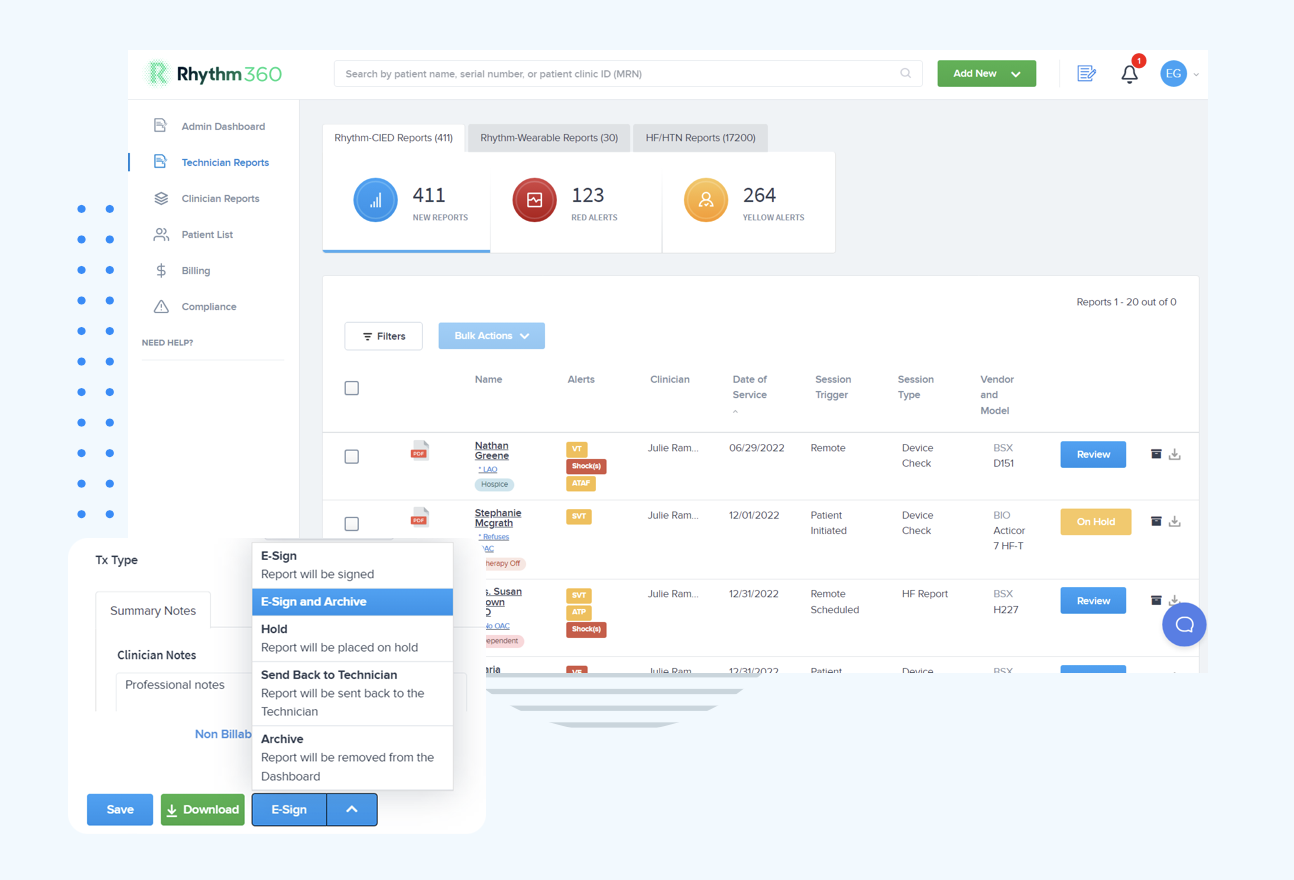
The table below maps each capability directly to the pain points described above: portal fragmentation, alert delays, and billing documentation gaps.
| Capability | How It Works | Clinical/Operational Outcome |
|---|---|---|
| Multi-vendor data ingestion | API, HL7, XML, and computer vision PDF parsing across all major OEMs | Greater than 99.9% transmissibility via redundant data feeds |
| AI-powered alert triage | Machine learning filters non-actionable alerts and prioritizes critical events | Up to 80% reduction in critical alert response times |
| Bi-directional EHR integration | Native connections to Epic, Cerner, Athenahealth, eClinicalWorks, and others via HL7 | Eliminates manual transcription; onboarding in days to weeks |
| Automated CPT documentation | Tracks monitoring periods and transmission logs, generates billing-ready reports | Supports clean claims for 93294 to 99458 code families |
| HIPAA-compliant mobile access | Secure app for transmission review, report signing, and care coordination | Clinicians manage critical alerts from any location, any time |
Rhythm360 combines vendor-neutral aggregation, AI-driven triage, automated billing documentation, and EHR integration in one platform built around these operational realities.
AI cannot compensate for weak data foundations. If underlying data is incomplete, inconsistent, or disconnected from clinical workflow, any intelligence layer built on top has limited impact. Rhythm360 addresses this by ensuring data completeness first, using redundant feeds and computer vision to reach greater than 99.9% transmissibility before applying AI triage logic.
The alert engine filters non-actionable transmissions and surfaces clinically significant events: new-onset atrial fibrillation, ventricular tachycardia, lead malfunction, battery depletion nearing elective replacement, and significant weight gain in heart failure patients. Optional 24/7/365 oversight by certified cardiac technicians, supervised by physicians, adds a human layer for after-hours events. This reduction in response time translates directly into earlier interventions and fewer adverse outcomes.
Dr. Beaser at UCM described the shift after implementation: "We are able to address these issues earlier. Rather than waiting for a 3-month visit, we can call patients in for evaluation." He also noted: "Decision support, including AI-assisted decision support, will become increasingly important as data volumes grow." UCM processed more than 73,000 reports through Rhythm360 in 2025, averaging over 18,000 per quarter, a volume that would strain any manual triage process.
Revenue leakage in CIED monitoring programs is mostly a documentation problem, not a clinical one. Practices do the monitoring work but fail to capture billing evidence, transmission logs with dates, confirmed monitoring periods, and signed interpretation notes, in a format that supports clean claims.
Rhythm360 automates that layer. It tracks each patient's monitoring window, logs every transmission with timestamps, and generates interpretation reports pre-populated with device type, manufacturer, programmed parameters, and alert findings, then routes them for clinician signature. This workflow supports documentation for CPT codes 93294 through 93298 and 99453 through 99458. Dr. Upadhyay at UCM confirmed the downstream effect: "We have improved billing and accountability for our patients after the integration." This revenue gain, driven by optimized CPT capture, compounds with faster alert response to strengthen the case for consolidation.
A device technician arrives Monday morning and opens a single Rhythm360 dashboard. Overnight transmissions from Medtronic, Boston Scientific, and Abbott patients have already been ingested, normalized, and sorted by priority. A new-onset AFib episode flagged at 2:14 a.m. in a Boston Scientific ICD patient sits at the top of the queue.
The technician reviews the AI-generated summary, confirms the finding, and routes it to the on-call electrophysiologist. The physician gets a push notification on the mobile app, reviews the full transmission, and starts an anticoagulation protocol before the clinic even opens.
Routine transmissions get batched for scheduled review, each with a draft interpretation report already populated with device data and monitoring dates. The technician reviews, annotates, and routes them for physician signature, all in the same interface. Billing documentation captures automatically once each report is signed. No portal switching. No manual transcription. No missed monitoring periods.
Dr. Upadhyay summed up the value: "That was a big piece for us, to have an integrated review of data from trained personnel." This kind of workflow, running on a single screen instead of four browser tabs, is what turns the case studies above into daily practice.
Rhythm360's redundant data feed architecture acts as a fail-safe when an OEM server is unavailable. The platform also uses computer vision and AI-powered extrapolation to fill data gaps and flag connectivity issues, reaching greater than 99.9% transmissibility across the patient population. A temporary outage on one manufacturer's network doesn't create a blind spot in your monitoring program.
Implementation, including EHR integration with systems like Epic, Cerner, Athenahealth, and eClinicalWorks, typically takes a few days to a few weeks depending on practice size and existing infrastructure. Rhythm360's SaaS pricing scales with clinic size and usage, so practices aren't locked into rigid contracts.
Yes. All patient data, including transmissions, interpretation reports, communication logs, and billing documentation, is stored and transmitted with full audit trail capability. The mobile app used for remote access is also HIPAA-compliant, with secure authentication and encrypted data handling. Phone call logs generated through the integrated Twilio framework are tracked within the patient record to support compliance documentation.
Yes. Rhythm360 offers integrated service lines for CIED monitoring (pacemakers, ICDs, CRT devices, implantable loop recorders, and CardioMEMS pulmonary artery monitors) and chronic disease management for heart failure and hypertension through remote physiological monitoring. It supports the full RPM code family, including 99453, 99454, 99445, 99457, and 99458, for practices extending monitoring to patients with comorbid cardiometabolic conditions.
Rhythm360 offers optional 24/7/365 oversight by certified cardiac technicians supervised by physicians. When a critical event, such as ventricular fibrillation, new-onset AFib, or a lead malfunction, arrives on a weekend or overnight, the technician team triages it and escalates to the responsible clinician through the secure mobile app. This closes the coverage gaps fragmented OEM portals create during off-hours, so urgent interventions like anticoagulation or device reprogramming don't wait until the next business day.
Fragmented OEM portals create a compounding set of problems for cardiology practices: administrative overload, alert fatigue, documentation gaps, and revenue leakage across the CPT code families remote monitoring generates. Most device clinics already run hybrid in-person and remote programs, and the 2026 HRS-led consensus statement calling for mandatory remote monitoring means the operational stakes of fragmented infrastructure will only grow.
Rhythm360 addresses these problems at the source by unifying multi-vendor CIED data into a single AI-powered platform with automated CPT documentation, bi-directional EHR integration, and mobile access for clinicians. These gains in speed and revenue, outlined above, define the operational upside of unification. Contact the Rhythm360 team to schedule a demo and discuss your clinic's specific monitoring environment.